
Bespoke eLearning development creates custom, compliant training that fits your organisation's procedures and regulations, and the work can be turned around in hours to a week when the production process is governed properly. In Ireland, that matters because 52.1% of people aged 25 to 69 took part in formal or non-formal education or training in 2022, and lifelong-learning participation reached 14% in Q4 2023, so your learners are already used to training that feels current and relevant rather than generic CSO staff training and education data.
That is usually the point where training teams realise their old process won't hold. A slide deck gets approved, then a procedure changes, then someone asks whether the wording matches site practice in another jurisdiction, and suddenly the “simple” course needs governance, version control, and audit evidence as much as it needs visuals.
Table of Contents
- What Bespoke eLearning Development Means
- The Modern Production Workflow From Script to LMS
- Governance and Compliance Requirements for Regulated Training
- Handoff Packages Versus Fully Finished Delivery
- Cost Drivers and Timeline Expectations
- Making the Decision for Your Organisation
What Bespoke eLearning Development Means
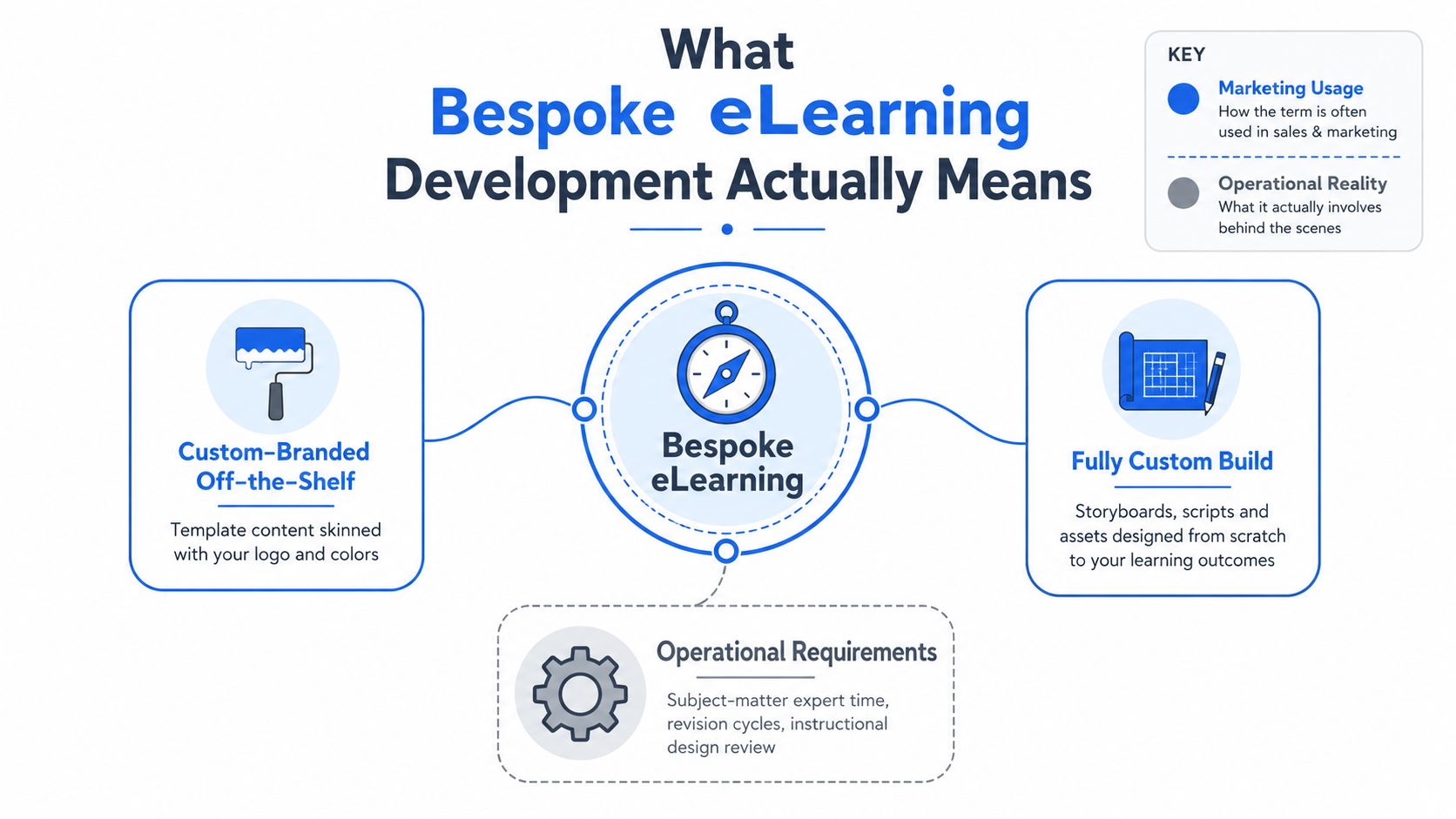
A lot of teams call something bespoke when it is really just branded. The logo changes, the colour palette changes, maybe the stock characters get swapped out, but the underlying script stays generic and the course still talks about “the company” in language no frontline worker would use.
Bespoke is not just custom styling
Real bespoke eLearning development starts earlier, with the brief. The instructional designer is not adapting a template, they are translating your procedures, risk controls, and audience needs into original learning content that reflects how work happens. That distinction matters most in regulated environments, where the course has to match site practice, not a vendor's default scenario.
Practical rule: if a course can be reused unchanged across three unrelated organisations, it is not bespoke.
The practical test is simple. Ask whether the course was written from your actual policy, your actual process steps, and your actual escalation path. If the answer is yes, you are dealing with original scripting, role-specific scenarios, and learning outcomes that can stand up to scrutiny.
What makes it operationally different
True bespoke work also needs controlled production, not just creative work. Subject-matter experts have to review scripts, legal or compliance owners need sign-off, and every change needs a traceable reason. That is why audit-ready documentation matters more than a glossy completion certificate.
A strong production model usually includes these elements:
- Original script development, not lightly edited template text.
- Role-specific scenarios, so learners see the decisions their job requires.
- Plain-language narration and captions, so the course works for mixed audiences.
- Structured assessments, so competence is evidenced, not assumed.
- Versioned approvals, so you can show what changed and who accepted it.
The best bespoke courses do not try to look universal. They look specific, because specificity is what makes them usable in day-to-day operations and defensible during an audit.
The Modern Production Workflow From Script to LMS
Traditional training production used to be slow because it was built like a film shoot. You booked people, waited on availability, captured footage, edited, reviewed, and then discovered that one policy line no longer matched the current procedure. That model still exists, but it's a poor fit for compliance content that needs quick revision cycles.
The workflow starts with the script, not the camera
The fastest teams treat the script as the master asset. They lock the learning objectives, map the scenarios, write the compliance points into plain language, and only then generate visuals, narration, and interaction. That order cuts a lot of rework because the expensive media layer sits on top of a approved learning structure.
A solid workflow usually moves through five stages:
- Brief and analysis, where the audience, risks, and delivery format are defined.
- Script and storyboard, where compliance points become scenes and decisions.
- Asset generation, where visuals, voice, and animation are produced.
- Review and QA, where subject-matter experts check accuracy and branching logic.
- LMS packaging, where the final course is prepared for deployment.
The difference between a rushed course and a governed one is rarely visual polish. It is whether the learning flow is structured enough that reviewers can confirm accuracy quickly and revisions can be made without rebuilding the entire module.
Why modern pipelines compress turnaround
AI-assisted production helps most when it is constrained by an approved script and a clear approval chain. It can generate drafts, scene variants, narration options, and assessment shells far faster than a fully manual studio process, but it still needs human review before anything reaches learners. That is the trade-off worth protecting.
The useful question isn't whether production is “automated”. It's whether the team can move from approved script to LMS-ready package without losing traceability. That's where structured asset naming, labelled scenes, and editable timelines make a practical difference, especially when a course needs a quick update after a policy or procedure change.
For teams building this kind of pipeline, the production logic behind script-to-video workflow training is the closest thing to a repeatable operating model.
Here's the part that gets overlooked most often. A course can be visually polished and still be hard to maintain if nobody knows which scene maps to which policy clause. The production workflow has to serve version control, not just presentation.
A good workflow makes change cheap. A bad one makes every revision feel like a new project.
Governance and Compliance Requirements for Regulated Training
Compliance courses fail when they are treated like marketing assets. A slick finish does not prove that the training matches the site, the law, or the current procedure. In regulated work, the product itself is the evidence trail.
What governance actually means
Governance starts with mapping. Every legal or procedural requirement should link to a learning objective, a scenario or assessment item, and an approval record. That traceability matrix gives reviewers a way to confirm that nothing important has been lost between source material and final course.
For Irish occupational safety training, the legal basis requires training to be customized to workplace risks, delivered in a form, manner, and language employees understand, and provided during paid working hours, under Sections 8, 9 and 10 of the Safety, Health and Welfare at Work Act 2005 HSE training guidance. That creates a very specific production requirement. Generic stock content isn't enough when the course has to reflect site hazards, equipment, controls, and escalation routes.
Audit evidence is part of the course
A compliant course should produce records that show who learned what, when, and against which version. That means learner identity, attempt history, pass status, completion timestamp, and version number need to be exportable from the LMS. If a procedure changes, the course version should change with it, and the approval record should show who signed off the update.
That is also why plain language and synchronised narration matter. If the learner can't clearly understand the content, the organisation can't claim the training met the requirement to be delivered in a form employees understand. Visual style comes after that. Governance comes first.
A few controls should be firm requirements:
- Traceability matrix, linking requirements to objectives and assessments.
- Approval workflow, so HSEQ or compliance sign-off is recorded.
- Version control, so updated procedures trigger refreshed training.
- Exportable completion evidence, for audit and incident review.
- Plain-language scripting, so roles and risks are easy to follow.
For AI-enabled course production, the governance burden gets even tighter. Training content can't drift away from policy or invent advice, which is why teams also need a review process for AI-generated drafts and a clear approval path for any scenario content. The practical risk is not speed, it's inconsistency.
If your organisation is still formalising how AI can be used in course production, the issues around AI hallucinations in training content are worth treating as a governance problem, not a creative one.
Handoff Packages Versus Fully Finished Delivery
This is one of the first decisions that changes how the project runs. Some organisations want the raw, structured material so their own team can finish and upload it. Others want a course that can go straight into the LMS with very little internal effort.
Handoff packages suit teams with in-house finishing capacity
A handoff package usually includes the approved script, storyboard, narration, media assets, and a structured learning flow. It gives internal teams more control over branding, localisation, and final assembly. It also asks more of your own people, because someone has to manage editing, packaging, and deployment.
Fully finished delivery suits teams that need speed
A fully finished package arrives closer to launch-ready. Branding is applied, the course is assembled, and the packaging is aligned for LMS delivery. That reduces internal workload and makes turnaround easier to predict, especially when the organisation is already stretched.
| Factor | Handoff Package | Fully Finished Delivery |
|---|---|---|
| Editorial control | Higher internal control over final edits | Lower, because the vendor finishes the course |
| Internal workload | More work for your team | Less work for your team |
| Revision flexibility | Easier if you update courses often | Easier if you want one accountable producer |
| Speed to deploy | Depends on in-house capacity | Usually faster to launch |
| Compliance evidence | Must be managed internally | Typically supplied as part of the finished pack |
| Best fit | Teams with editors and LMS admins | Teams without spare production capacity |
The right choice depends less on preference and more on capacity. If your team already manages course publishing, branding, and version control, a handoff package can be efficient. If not, fully finished delivery is usually the safer route because it reduces the number of places where a compliance issue can be introduced.
Gap between pilots and production is a useful lens here, because many teams can make a pilot look good but still lack the operational structure to launch, maintain, and update the course reliably.
Cost Drivers and Timeline Expectations
The fastest way to misread a quote is to treat every bespoke project as if it were the same size. In practice, the quote is shaped by how much original thinking, media production, and compliance checking the course needs. Two projects can be the same length and still sit in completely different cost bands.
What actually moves the budget
The biggest variables are usually course complexity, media ambition, interactivity, compliance depth, and revision load. A simple process refresher with a knowledge check is not the same job as a branching scenario with role-play, manager escalation, and a documented approval cycle. Jurisdictional adaptation also adds work, because different rules can mean different examples, wording, and sign-off paths.
A realistic budget conversation should cover:
- Scope length, because more content means more writing, review, and packaging.
- Media type, because cinematic footage takes more effort than stock-based modules.
- Interactivity, because branching logic and decision practice need extra design.
- Compliance depth, because audit evidence adds structure and review time.
- Update frequency, because a course that changes often needs a maintainable production model.
Why speed doesn't have to kill quality
Modern AI-assisted pipelines can compress production dramatically when the governance is tight. The point isn't to remove review, it's to remove avoidable manual handling between approved text and final course. That's why organisations can move from a long studio-style process to a much shorter script-to-LMS cycle without giving up control.
The sensible benchmark is whether the production method keeps the course auditable and editable. If it does, faster turnaround can be an advantage rather than a compromise. If it doesn't, speed just moves the risk earlier in the process.
Treat fast turnaround as a workflow question, not a content question. If the review and approval chain is weak, faster delivery just produces faster mistakes.
A useful budgeting habit is to ask vendors what they need from you before they quote. If the brief is vague, the content is scattered, or the review group is too large, the project slows down no matter how good the production tools are. Clean input produces cleaner output.
Making the Decision for Your Organisation
The decision comes down to fit, not fashion. If your training needs are generic and the main goal is simple awareness, modified off-the-shelf content may be enough. If the course has to reflect your own procedures, your own risk controls, or your own regulatory environment, bespoke development is usually the safer choice.
Use these questions before you commission anything
Start with the nature of the content. If the material involves safety, compliance, onboarding, or procedure-based decisions, generic training often misses the details that matter in practice. Then check how often the process changes, because frequent updates make version control and structured handoff more valuable.
A practical decision set looks like this:
- Does the course need audit evidence? If yes, governance matters from day one.
- Do procedures vary by site or jurisdiction? If yes, the script has to be adaptable.
- Do you have internal production capacity? If not, fully finished delivery may be safer.
- Do you need rapid updates? If yes, editable assets and traceable versioning matter.
- Do learners need practice, not just information? If yes, scenarios and assessments are essential.
What to ask a vendor
Ask how they handle approvals, who signs off accuracy, and how they document changes. Ask what evidence the LMS can export, how versioning is managed, and whether the production pack can be updated without rebuilding the whole course. Those questions reveal whether you're buying a visual asset or a defensible training system.
The strongest bespoke training projects are not the flashiest ones. They are the ones that survive policy change, jurisdictional variation, and audit scrutiny without collapsing into rework.
If you need bespoke training that's built for compliance, governance, and fast turnaround, Loresson can help with scripted, cinematic workplace courses that are ready for audit and LMS deployment. Visit Loresson to see how its governed production approach fits bespoke eLearning development, especially when your content has to be accurate, editable, and defensible from the first version onward.
Made with the Outrank app