
61% of Irish internet users engaged in online learning in Q1 2024, the highest rate in the EU. Ireland also recorded 36% course completion and 52% use of online learning materials, so elearning course development now has to serve both full courses and modular resources CSO online learning release.
That changes the job. A course team can't rely on studio bookings, fixed shoot days, or a once-and-done script approval if the material has to stay current in a regulated environment. In practice, elearning course development now needs a traceable production chain, fast update points, and a format that can survive legal, compliance, and operational change without being rebuilt from zero.
Table of Contents
- Why Elearning Course Development Has Changed
- Building a Competency-First Development Workflow
- Choosing Between Simple Recall and Complex Performance Training
- Designing for Uneven Digital Readiness
- Creating Auditable AI-Assisted Courses
- Packaging Courses for Different LMS Platforms
- Your Elearning Development Decision Checklist
Why Elearning Course Development Has Changed
A locked studio schedule looks efficient until a regulated course changes after approvals are already in motion. A pharma SOP update can invalidate a presenter script two days before filming, forcing rebooking, re-approval, and fresh version control before anyone can record a clean final take.
That is why the old production model breaks so easily. Ireland's learner behaviour shows that online learning is now a normal part of how people consume training and reference material, not just a one-off course format CSO online learning release. Once learning is used that way, a course built around a single filming event falls behind the way organisations update content.
The bottleneck has shifted from filming to governance. Teams need more than polished delivery. They need content that can be reviewed, versioned, localised, and refreshed without losing the record of what was approved, who approved it, and why.
A practical rule holds up across regulated work. If a course cannot be changed in small pieces, it is too fragile to maintain.
That is why elearning course development now depends on modular authoring, reusable assets, and clear approval paths. The projects that fail usually fail at the handoff between pilot and production, where the script, visuals, and assessment logic were never mapped tightly enough to survive a real change request. That gap is worth studying closely, because it is where promising builds turn into unmaintainable ones. See the gap between pilots and production for a practical look at that failure point.
Building a Competency-First Development Workflow
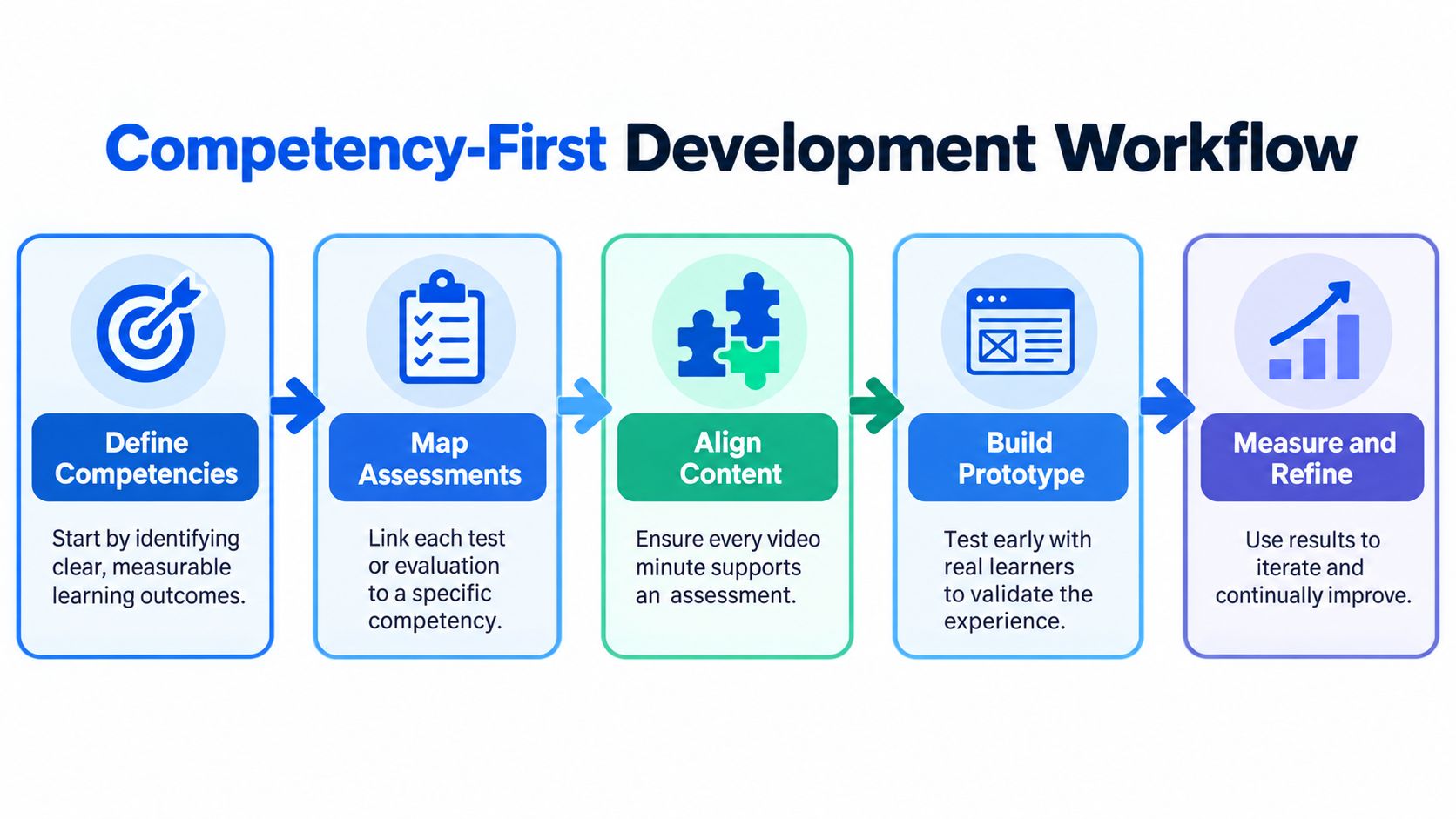
Competency-first development starts before anyone writes narration or chooses visuals. The first job is to define what a learner must do, in observable terms, with input from the business owner and subject-matter experts. If the competency can't be stated clearly, the course is already drifting into content delivery instead of performance training.
Start with traceability, not scripting
Every scripted scene should map to a competency, a behavioural objective, an assessment item, and any jurisdiction-specific requirement that applies. That traceability matrix is the control point, because it stops the course from turning into a collection of nice-looking clips with no measurable purpose. In regulated work, this is also the simplest way to show what was approved and why.
The practical sequence is straightforward:
- Define competencies first. Write them as actions people can demonstrate, not broad topics they can “understand”.
- Split large tasks into microcurricula. Keep each unit small enough to pilot without delaying the whole programme.
- Map every objective to content, practice, and assessment. If one of those is missing, the chain is broken.
- Apply Universal Design for Learning. Give learners more than one way to access information and show competence.
- Choose technology by teaching need. Tool novelty is a weak reason to adopt anything.
- Pilot and iterate. Use learner response and performance evidence before scaling.
The strongest support for this kind of workflow is the kind that happens in real delivery settings, not theory decks. A Dublin City University implementation over three years, serving more than 5,000 students across 15+ programmes and five faculties, identified competency definition, microcurriculum design, UDL, constructive alignment, technology selection, and evidence-based iteration as the core process DCU implementation study.
The hard rule is simple, don't produce video before the map is approved. Cinematic work can make a course feel more real, but it can't rescue weak assessment design or vague outcomes. A pilot should contain one representative scenario, one knowledge check, and one applied decision task, then be reviewed for completion, item quality, learner feedback, and supervisor-observed transfer before anything else scales.
A course that cannot survive traceability review is not ready for regulated deployment, no matter how polished the footage looks.
Choosing Between Simple Recall and Complex Performance Training
Not every workplace course needs the same architecture. Policy acknowledgment, procedure reminders, and basic compliance checks can work well with a standard module format, concise explanation, illustrative examples, knowledge checks, and a final assessment. That's efficient, and trying to over-engineer it usually wastes production time.
Complex workplace performance is different. When a learner needs to handle an incident, complete a task sequence, or make a judgement under pressure, the 4C/ID model is a better fit because it starts with whole authentic tasks and then moves from simple to complex with scaffolding that fades over time. It also gives just-in-time procedural information and part-task practice, which is much closer to how people build competence on the job.
The Ireland-indexed meta-analysis is useful here because it doesn't just look at one subject or one study type. Across academic areas, study designs, and outcomes including knowledge and complex skills, programmes developed with 4C/ID showed a large overall performance effect of d = 0.79 standard deviations 4C/ID meta-analysis. That is evidence for the model, not a guarantee that every course will benefit, but it does support the idea that the assessment should look like the job.
For HSEQ, manufacturing, or customer-service training, that means the learner shouldn't just recognise a correct answer. They should see a realistic incident or conversation, decide what to do, see the consequence, and get feedback tied to the governing procedure. The common failure modes are predictable, disconnected topic slides, multiple-choice questions that only test recognition, and scaffolding that stays in place long after the learner should be performing independently.
Useful test: if the job requires judgement, your course needs a scenario, not a summary.
Time allocation should follow task importance, not an equal split across topics. A 30-minute course can still be effective if most of the time goes into the decisions that matter and the feedback that explains them. Completion rate on its own doesn't tell you much, so pair it with attempt quality, pass rates by objective, retry patterns, and post-course workplace checks.
Designing for Uneven Digital Readiness
A course can be well built and still fail in the field. Heavy media, dense menus, and unfamiliar interactions create friction for learners who already have limited digital confidence, especially in operational roles where training time is tight and devices may be shared or low-spec. If the group is not comfortable online, polished design can become a barrier rather than a help.
Ireland's 2025 Digital Decade reporting points to persistent digital-skills gaps and warns that declining employer-led training could weaken long-term readiness. It also notes that 12,655 workers participated in supported digital-skills programmes in 2025, while almost 80% of businesses expect employees to need digital upskilling in coming years Ireland 2025 Digital Decade country report. Demand is broad, but capability is uneven.
Design for low-friction access
The best courses in this environment make the easiest path the default path. Browser-based delivery is usually the safest starting point, with simple navigation, readable text, downloadable support materials, and alternatives for learners who cannot or will not sit through large media files. Video still has a place, but it should not be the only route to the key point.
A practical specification helps teams avoid vague decisions later:
- Use video when context matters. Demonstrations, conversations, and visual procedures benefit from it.
- Add transcripts when precision matters. Learners need a fast way to review wording and terminology.
- Offer audio-only where bandwidth or access is a concern. Some teams need the content without the visual load.
- Keep assessments simple when the goal is recall. Interface complexity can hide the learning objective.
- Build facilitator support into rollout plans. Some groups need a human backstop, not more interface polish.
For regulated teams, I also test on throttled Chrome over 3G, cap video at 720p, turn captions on by default, and confirm keyboard-only navigation. That catches the failures that look minor in QA and become blockers in the field.
Testing should include urban, rural, and lower-confidence user groups before launch. In SMEs and operational workforces, the problem is often access and confidence, not motivation. If the navigation is awkward, the course becomes another thing to avoid.

Creating Auditable AI-Assisted Courses
Speed is only useful when the course can survive scrutiny. AI can accelerate scripting, quiz drafting, and restructuring, but it also raises the risk of outdated procedures, unsupported claims, hidden synthetic media, and unclear ownership of the final approval. In compliance and HSEQ work, that isn't a minor issue, it's the whole issue.
Ireland's AI Advisory Council says educational AI use should be secure, inclusive, and accessible, that generated data should not be used to train models or expose documents, and that guidance must stay updateable as the technology changes AI and education paper. The same paper also notes that many educational institutions had not made enough progress on AI-literacy requirements despite EU AI Act obligations. That gap is where most governance failures begin, because teams move quickly on drafting and slowly on control.
Build the approval chain before production
The control chain should be simple enough to audit and strict enough to matter. Start with a source register so every claim has a documented origin, then route the draft through human subject-matter review before anything is released. After that, tag versions and jurisdictions, run evidence checks, complete accessibility review, and record approval ownership.
A defensible workflow also includes learner-facing AI disclosure where relevant, plus scheduled refresh triggers so content doesn't sit unchanged after a rule or procedure update. The important question is not whether AI made the draft quickly, it's whether the organisation can show who verified each safety-critical statement and when that review happened.
For a deeper look at the risks of generated content going wrong, see how hallucinations show up in training content. The practical lesson is that faster production does not excuse weaker governance. In regulated sectors, it usually demands stronger governance.
Non-negotiable: if a course touches safety, privacy, or compliance, every AI-assisted line needs a named human owner before release.
Packaging Courses for Different LMS Platforms
A good course can still fail at handoff. If the package doesn't match the LMS, the metadata is incomplete, or the tracking behaves oddly, the learning team ends up debugging deployment instead of improving the course. That's why packaging deserves as much discipline as scripting.
SCORM 1.2 is still the baseline in many legacy environments, while SCORM 2004 and xAPI give richer tracking when the training needs more detail. The right choice depends on the platform, the reporting need, and how much interaction the client wants to preserve. A complex assessment hidden inside a package that the LMS can't read cleanly is just an integration problem waiting to happen.
Handoff needs to be structured
The cleanest course handoff includes a manifest, labelled folders for all assets, the script, the storyboard, narration files, and learning objectives in a form the reviewer can inspect. For AI-assisted production pipelines, that folder structure matters because it shortens review time and makes localisation and updates far easier later on. A structured media library also prevents teams from losing track of the final approved version.
For teams commissioning bespoke work, Loresson's bespoke elearning development shows how a handoff pack can be prepared for client branding and deployment without forcing the client to reconstruct the course from scattered files. The operational logic is the same regardless of vendor, the cleaner the asset library, the easier the final cut and the next revision.
Before release, check that all assets load correctly, assessments record results accurately, and the metadata matches the LMS schema. That sounds basic, but it's where a lot of production time disappears.
Your Elearning Development Decision Checklist
Start by defining competencies with stakeholder input, then map each objective to content, practice, and assessment. If that map is missing, the rest of the production process is guesswork.
Choose the right model for the job. Standard modules are fine for simple recall, while complex performance training needs 4C/ID-style task design, realistic decisions, and feedback that mirrors the workplace. Test the course with a pilot that includes one scenario, one knowledge check, and one applied decision task.
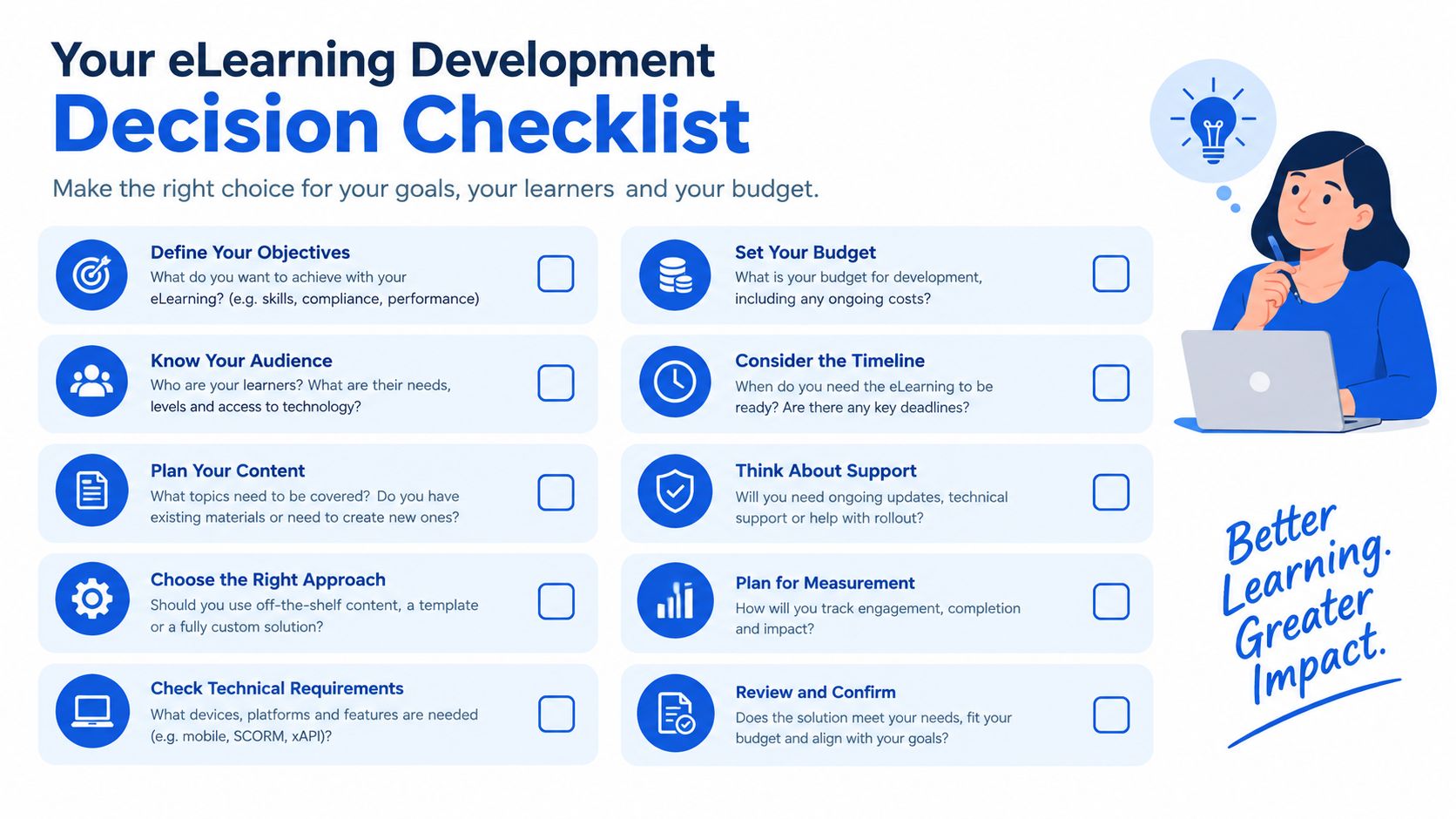
Verify accessibility across urban, rural, and lower-confidence learner groups, then build a traceability matrix that links scripted scenes to competencies and jurisdictional requirements. Document the AI governance workflow too, including source registers, human review, version tagging, and approval records. Finally, package the assets for the target LMS with complete metadata and labelled media folders.
If you need elearning course development that's built for regulated work, faster updates, and auditable handoff, Loresson can help you turn a brief, procedure, or jurisdictional requirement into production-ready training. Visit Loresson to see how its AI-assisted production approach supports compliant workplace courses without losing traceability or deployment discipline.