
There is no single right eLearning development company. The right partner is the one that can prove governance evidence, realistic delivery timelines, accessibility compliance and a pricing model that remains credible before anyone writes a script.
That answer may sound less exciting than choosing the vendor with the strongest showreel, but Irish learning behaviour makes the decision more operationally important. In 2024, 61% of Irish internet users engaged in online learning, the highest proportion recorded among EU countries, while 36% completed a complete online course, compared with an EU average of 18%, according to Eurostat's Irish online-learning data. Digital training in Ireland has moved well beyond experimentation. The question is no longer whether people will use online learning. It's whether the course can withstand review, deployment, updating and scrutiny.
Table of Contents
- Why Most Vendor Evaluations Miss the Point
- Scope, Output Formats and Governance Reviews
- Compliance Credentials and Accessibility Requirements
- Portfolio Evidence That Actually Proves Capability
- Pricing Models, SLAs and Realistic Turnarounds
- Practical Checklist for Shortlisting Vendors
Why Most Vendor Evaluations Miss the Point
Vendor selection often goes off course before anyone reviews a script sample or QA record. Procurement teams are shown motion graphics, presenter reels, authoring badges and compressed timelines, then asked to treat those as proof that a supplier can manage controlled learning production. They are not. A course can look polished and still fail where regulated organisations carry risk: version control, policy sign-off, accessibility, assessment defensibility and update handling.
That gap matters in Ireland because online learning is already part of normal working and study behaviour. In 2024, 61% of Irish internet users engaged in online learning, the highest share in the EU, and 52% used online learning materials such as video tutorials, webinars and learning software, according to Eurostat. The practical issue is no longer adoption. It is whether the training product can stand up to review, rollout, amendment and audit after launch.
I have seen this mistake repeatedly. A vendor promises fast delivery, records attractive narration and builds interactions that look modern, but cannot show who approved the source wording, which policy version was used, what changed between drafts or how the scored assessment maps to the required job behaviour. In a marketing module, that may be inconvenient. In onboarding, HSEQ, conduct, customer handling or regulated process training, it becomes an operational problem.
The five filters that matter first
A serious shortlist should test five connected capabilities:
- Instructional scope. Can the company turn a policy, process or job task into observable learning objectives and assessments?
- Governance. Does it maintain version-controlled scripts, source references, approval records and revision history?
- Accessibility. Are captions, transcripts, keyboard operation, colour contrast and alternative text designed into production?
- Deployment. Are the files, metadata, interactions and reporting structures compatible with the client's LMS?
- Commercial control. Does the quote explain review rounds, change requests, updates, ownership and maintenance?
These filters give a better read on delivery risk than a tool list. Articulate Storyline, Rise, video workflows and generative AI can all be used well or badly. The difference is the production discipline around them.
Procurement rule: Ask what evidence the vendor will hand back to your organisation, not only what learners will see on screen.
The workplace angle is clear in Ireland. The Central Statistics Office found that 64% of people who undertook online learning cited professional or work-related purposes in 2024, while 34% of internet users completed an online course, according to the CSO online-learning release. When training supports workplace decisions, the supplier is not just making content. The supplier is producing a recordable, reviewable training asset your organisation may need to defend later.
Scope, Output Formats and Governance Reviews
A proposal from an eLearning development company should describe the production system in enough detail for another team to operate it. A portfolio link shows the finished surface. It doesn't tell you whether the supplier can reproduce the result after a policy changes, a regulator asks for evidence or the LMS rejects a package.
Start by requesting a deliverables schedule. It should identify what the vendor will provide at each stage, who reviews it and what constitutes approval.
Ask for the complete production chain
A clear scope usually separates:
- Brief and source analysis: The supplier identifies the governing policy, procedure, audience, jurisdiction and required learner behaviour.
- Learning design: Objectives, scenarios, interactions and assessments connect to workplace decisions rather than general awareness.
- Script and storyboard: Spoken narration, on-screen text, visual direction and interaction logic remain visible for review.
- Media production: Narration, graphics, video and supporting assets follow an agreed brand and accessibility specification.
- Authoring and packaging: The course is prepared for the target LMS, with the required SCORM or xAPI configuration.
- Quality assurance: Functional, editorial, technical, accessibility and stakeholder checks are recorded.
- Handoff: The client receives the final package plus editable or source assets, documentation and update instructions.
This matters particularly for jurisdiction-specific policy training and procedure-based safety content. A vendor that supplies only a finished video may leave your team unable to change a single instruction without commissioning another production cycle. A vendor that supplies the script, learning structure and labelled media gives the organisation a more durable asset.
The distinction between a creative review and a governance review should also appear in the proposal. A creative review checks tone, pacing and visual consistency. A compliance or HSEQ review checks whether the course accurately represents the approved source material and whether named stakeholders have signed off the relevant content.
Test the handoff before signing
Ask for a redacted example of a handoff folder, review log or change register. You're looking for clear filenames, version history, ownership and a straightforward route from approved script to deployed course.
A useful supplier should also explain how it handles an LMS test. That may include launch behaviour, completion status, assessment results, bookmarking, audio controls and reporting fields. The bespoke eLearning development service is one example of a production model that separates the complete handoff pack from the finished deployment option.
The key question is simple: if your policy owner changes one paragraph next quarter, can the vendor show exactly what will be updated, what requires reapproval and which output files will be republished?
A credible proposal makes those dependencies visible. A vague promise of a “fully managed course” often hides them.
Compliance Credentials and Accessibility Requirements
Compliance credentials matter only if they change the production process. A badge on a supplier website does not show whether the team checks the governing source, records who approved each change or keeps enough evidence to defend the course later during an audit.
For Irish public-sector work, accessibility sits inside delivery, sign-off and maintenance. Ireland's 2020 accessibility regulations require public-sector websites and mobile applications to meet WCAG 2.1 Level AA, and the relevant digital environment can include virtual learning environments, intranets, embedded video, e-books and other learning assets, as described in the HSE guidance on accessible content.
Request evidence, not assurances
Ask for proof you can inspect before appointment, not broad statements that accessibility is “covered”.
- An accessibility statement or conformance record.
- A mapping between learning components and relevant WCAG success criteria.
- Evidence of automated testing with tools such as axe or WAVE.
- A manual keyboard test and screen-reader check.
- Caption and transcript workflows for audio and video.
- A process for accessible document exports and alternative text.
- Versioned records showing who reviewed and approved the course.
Timing matters here. If a storyboard depends on colour alone, if a video puts a safety instruction only in narration or if an interaction fails by keyboard, the problem started upstream. By the time the package reaches the LMS, fixing it can mean reworking script, design, media and technical build together, which is slower, harder to approve and more expensive to evidence.
Captions and transcripts also do more than support access. They preserve spoken instructions in a form reviewers can check, compare against policy wording and revisit after release. Where a procedure depends on a visual cue, the supplier should be able to explain the text alternative or audio description approach before production starts, not after someone raises a defect.
Design for a mixed workforce
Irish learners do not arrive with the same confidence, device setup or working conditions. The European Commission's Ireland digital-skills snapshot reports that 82.82% of people aged 16 to 74 had at least basic digital skills in 2025, compared with an EU average of 60.40%. That is encouraging, but basic capability still leaves plenty of room for missed instructions, poor navigation and avoidable friction.
That matters in course design.
A supervisor dealing with an incident may benefit from a branching scenario that tests judgement under pressure. A frontline worker completing recurring compliance training may need shorter modules, plain-language narration, predictable controls, downloadable reference material and an assessment tied to the correct job decision. Audit-ready production respects that difference instead of forcing every audience through the same high-motion template.
Visual polish can help attention. It can also increase cognitive load, bury instructions and make future updates harder to control. Ask the supplier why each interaction, animation and sound cue exists. If the answer comes back as “engagement” with no link to the policy, learner task or accessibility requirement, the course may look polished while failing the standard that matters in regulated training.
Portfolio Evidence That Actually Proves Capability
A showreel demonstrates taste. It doesn't demonstrate control.
The most persuasive portfolio evidence connects the finished course to a real training problem. Look for examples involving a defined policy, a named audience, a jurisdiction, a practical procedure or a regulated subject. A polished fictional demo can show that a team knows how to edit video. It can't show whether the team can manage stakeholder disagreement over an approved instruction.
Compare surface signals with production proof
| Shallow signal | Substantive evidence |
|---|---|
| A fast-paced showreel | A complete course with objectives, assessments and review records |
| Attractive stock footage | Role-specific scenarios tied to actual workplace decisions |
| A list of software tools | Clear ownership of scripts, source files and LMS packaging |
| A single finished video | Consistent treatment across modules and update cycles |
| A claim of accessibility | Conformance evidence, test results and accessible alternatives |
| A generic client logo | Branded deployment with documented approval and handoff |
Ask to inspect the learner-facing layer and the producer-facing layer separately. Learners should see a coherent experience. Your internal team should be able to find the approved script, narration text, assessment mapping, source references and change history without reverse-engineering a video file.
Probe for repeatability
A useful vendor can explain how it handles a policy revision. Ask these questions:
- Which file becomes the source of truth?
- Who confirms that the revised wording is correct?
- How are affected scenes and assessments identified?
- How is the new version distinguished from the old one?
- What evidence proves that the updated package passed review?
- Can the course be localised without rebuilding unrelated media?
The answers reveal more than a showreel. They show whether the supplier understands training as an operating asset.
A portfolio should also include different levels of interaction. Not every course needs branching role-play, and forcing game mechanics into a policy module can distract from the required behaviour. Conversely, a vendor with only passive video may struggle to test judgement in safety, customer service or supervisory situations.
Review Loresson's eLearning showcase as you would any supplier portfolio, but apply the same test to every provider. Look for documented thinking behind the media, not only attractive frames.
Pricing Models, SLAs and Realistic Turnarounds
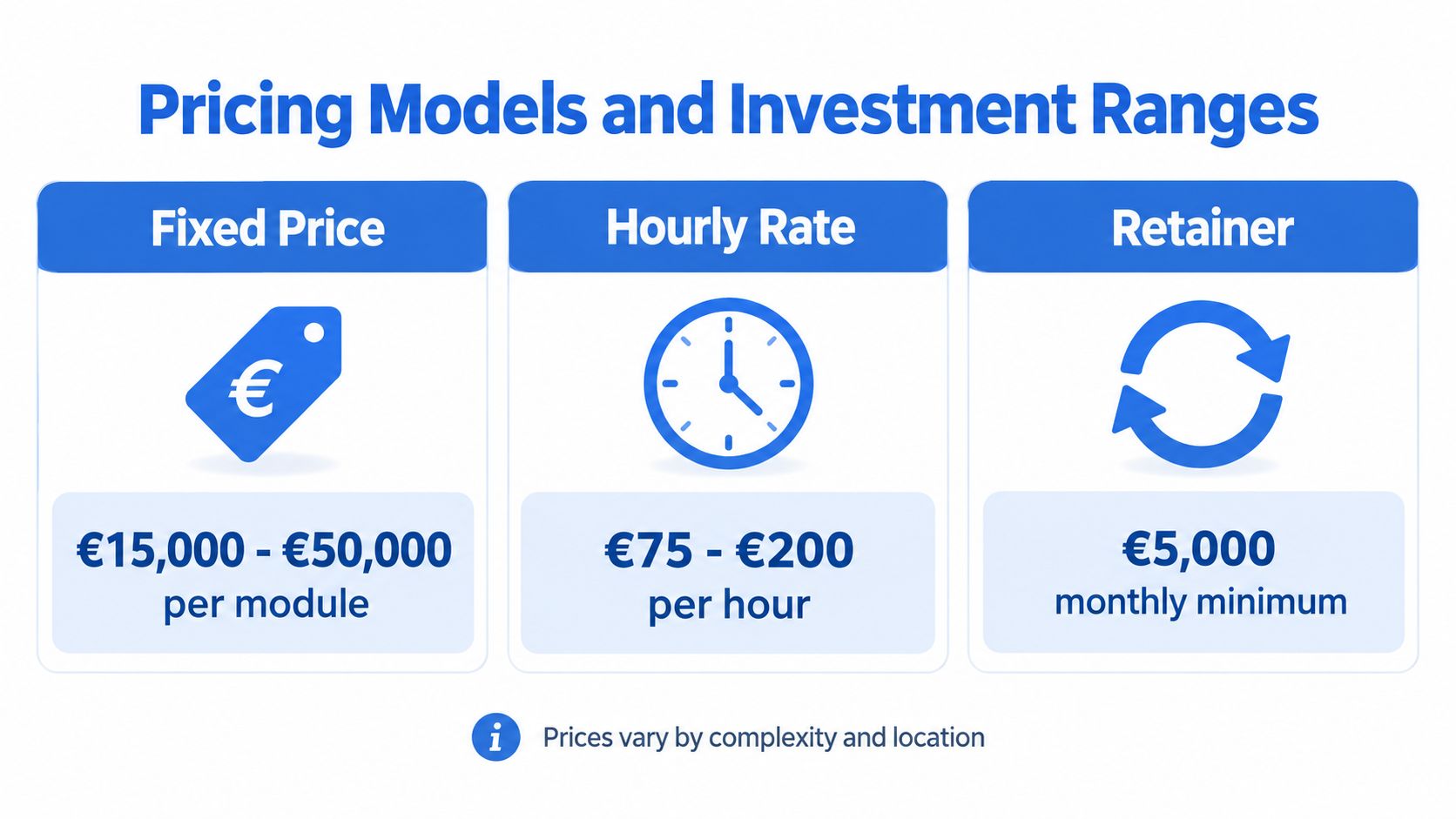
Commercial structure exposes how an eLearning development company thinks about production. A fixed price can give procurement certainty, but it becomes dangerous when the definition of “a module” is vague. An hourly model offers flexibility, but it can transfer cost uncertainty to the buyer. A retainer can suit a training function with regular updates, yet it may create waste if the organisation has no reliable content pipeline.
The right comparison starts with scope rather than the headline figure.
Match the model to the work
| Model | Best fit | Main risk to test |
|---|---|---|
| Fixed project price | A defined course with stable source material | Change requests and review rounds may sit outside the quote |
| Hourly or day rate | Discovery, complex revisions or uncertain requirements | Total cost can drift without stage gates |
| Retainer | Ongoing maintenance and a planned course pipeline | Unused capacity or unclear ownership of priority work |
The infographic in the earlier section illustrates common commercial categories, but a price range is meaningful only when the included production work is explicit. Ask whether the fee includes instructional design, scriptwriting, narration, media creation, assessments, accessibility testing, LMS packaging, source files and post-launch corrections.
Treat turnaround as a governed sequence
A rapid delivery claim isn't automatically unrealistic. It becomes unrealistic when the timeline ignores client decisions. The schedule should show time for source review, learning design, script approval, compliance or HSEQ sign-off, media production, accessibility verification, LMS testing and final acceptance.
A short production window is credible only when the review path is short, the decision owners are named and the source material is stable.
Many fixed quotes fail at this point. The vendor prices the visible production but not the internal delay caused by unresolved policy questions. The buyer then receives a "finished" course that still needs editorial assembly, accessibility remediation or stakeholder correction.
Ask for service-level definitions, not just delivery dates. What starts the clock? What pauses it? How many consolidated review rounds are included? What happens when a subject-matter expert introduces a substantive policy change? Who owns the cost of repackaging the LMS file?
Structured, labelled handoffs can reduce internal editorial work because editors aren't sorting disconnected narration, graphics and video fragments. An editable timeline connected to the approved authoring plan can make future changes more controlled, provided the vendor documents the relationship between source content and final media.
The transition from pilot to repeatable production is often the commercial test. The gap between pilots and production is where teams discover whether a supplier has repeatable controls or merely produced one impressive demonstration.
Practical Checklist for Shortlisting Vendors
Shortlisting works best when you treat it as a control test, not a beauty parade. A polished demo can hide weak version control, vague approval points and a handoff that collapses the first time your policy team requests a change. Ask each supplier to respond to the same material, the same scenario and the same commercial questions, so you can compare operating discipline rather than presentation style.
Start with the source
Send a real, redacted policy, SOP or procedure and ask the vendor to explain how it would turn that source into training. A credible response names the audience, the behaviour that must change, the business or safety risk, the approval owner and the assessment method. If the answer jumps straight to animation, filming or visual treatment, the supplier is selling production before it has shown it can interpret controlled content.
Inspect the governance pack
Request redacted samples of the documents you will rely on once the project is live: script, storyboard, review log, change register, accessibility record and LMS handoff. You are not looking for design flair here. You are checking whether the vendor runs a documented workflow that can survive audit, legal review and future updates.
This is usually where the difference shows. Some suppliers manage review through email threads and scattered attachments. Others can show exactly what changed, who approved it and which file became the final training asset.
Test update handling
Policy training rarely stays still. Ask what happens when one approved point changes after sign-off and affects a scene, an assessment item and the transcript. The answer should cover dependency tracking, version naming, reapproval points and republishing steps. If the vendor treats the course as one sealed output, your update cost and approval risk are likely to rise later.
Verify accessibility in practice
Ask for the actual checking process, not a generic assurance. Which automated checks are run, which manual checks are carried out, when they happen and who fixes failures? For public-sector training, confirm that WCAG 2.1 Level AA expectations are built into scripting, storyboarding and QA from the start, as noted earlier, rather than left for remediation after packaging.
Pressure-test the commercial terms
Check whether the quote clearly identifies:
- Included work: Design, scripting, media, narration, assessments, packaging and testing.
- Review boundaries: Named rounds, approvers and response windows.
- Change treatment: Editorial correction versus new scope.
- Ownership: Source files, licences, editable assets and update rights.
- Maintenance: Cost and workflow for future policy revisions.
- Deployment: LMS compatibility, testing responsibility and acceptance criteria.
Then compare the promised turnaround with your own governance reality. No vendor can approve a compliance script for your organisation. The best eLearning development company is the one whose workflow matches your approval structure, accessibility duties and update cycle, not the one with the most confident delivery promise.
Loresson provides bespoke workplace training with scripts, narration, cinematic media, assessments and LMS-ready handoff options, with governed production and optional compliance or HSEQ review. Visit Loresson to discuss a course workflow built around your approval requirements, accessibility obligations and ongoing update needs.
Built with the Outrank tool