
Effective employee onboarding training reduces time to independence and improves retention. Structured programmes outperform ad hoc orientation regardless of company size, because they teach people how to perform the work rather than proving that paperwork was completed.
That distinction matters in Ireland, where training is widespread but not consistently planned or measured. The Central Statistics Office found that 69% of Irish enterprises provided training in 2020, yet only 30% had a written training plan, 32% maintained an annual training budget, and 34% assessed training outcomes (Central Statistics Office training data). A new starter can therefore enter a well-intentioned organisation and still receive an uneven induction, shaped by the availability of a manager, the habits of a local team, or the quality of an inherited checklist.
Good employee onboarding training treats induction as a phased learning journey. It connects the employee to the organisation, builds role competence, tests understanding and gives managers evidence that the person is ready to work safely and independently.
Table of Contents
- Why Structured Onboarding Training Matters More Than Checklist Completion
- The Irish Training Baseline and What It Reveals About Onboarding Gaps
- Designing Phased Learning Journeys From Day One
- Multimedia Delivery and LMS Deployment Strategies
- Measuring Onboarding Effectiveness Beyond Completion Rates
- Real-World Examples of Phased Onboarding in Action
- Building Onboarding Programmes That Last Beyond the First Week
Why Structured Onboarding Training Matters More Than Checklist Completion
A new employee arrives at a manufacturing site on Monday morning. In the first few hours, a supervisor collects identity documents, issues an access card, points out the toilets and asks the employee to sign several policies. The employee receives a password, watches a generic safety presentation and is introduced to a colleague who is already busy with a shift. By lunchtime, the checklist looks healthy. The learner still doesn't know which hazards require escalation, what good performance looks like or who approves work outside the normal procedure.
A structured programme produces a different first day. The employee receives essential information before arrival, completes a short foundation module, meets the manager and buddy, observes the relevant workflow, and practises a task under supervision. The organisation records not just attendance, but what the employee can explain and demonstrate. The first day remains busy, but it has a learning purpose.
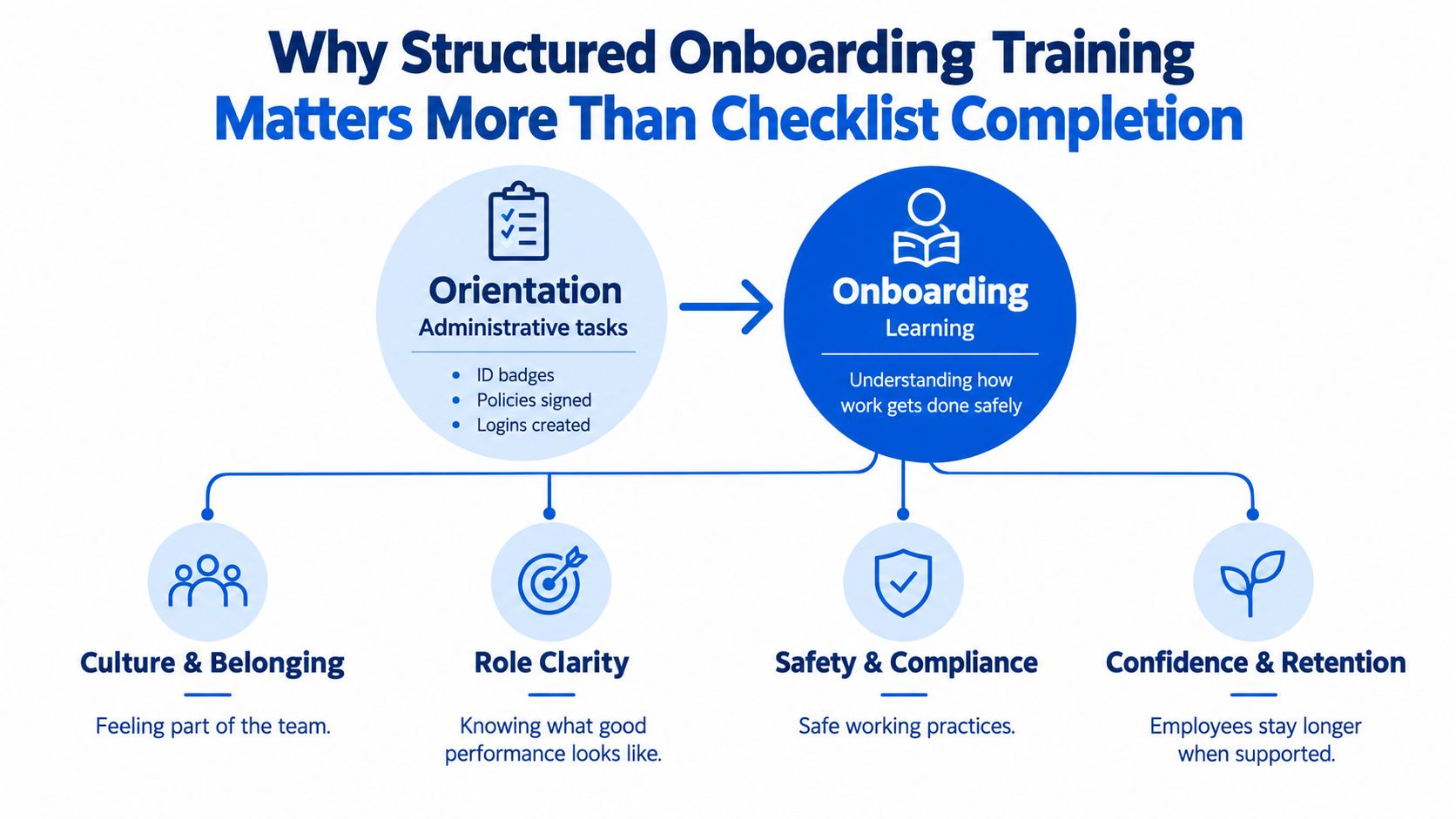
Orientation handles access, onboarding builds capability
Orientation is mainly administrative. It covers identity badges, payroll information, policy acknowledgements, equipment and system access. Those tasks matter, but completion doesn't show that the employee understands how decisions are made or how risks are controlled.
Onboarding is the learning system around those tasks. It should answer practical questions:
- Role clarity: What does the employee need to do, and what does acceptable performance look like?
- Safe practice: Which hazards, controls and escalation routes apply to this role?
- Operational confidence: Can the employee use the required systems and follow the correct workflow?
- Belonging and support: Who can the employee approach when a situation falls outside the procedure?
Practical rule: Treat every induction item as either access, knowledge, practice or evidence. If an item fits none of those categories, it may be administrative noise.
The distinction becomes especially important in regulated, safety-critical and multi-site environments. A manager's informal explanation may be accurate, but it can vary by shift, location and individual confidence. A structured programme creates a common baseline while leaving room for role-specific coaching.
A phased journey corrects a common organisational weakness
Enterprise-level training provision can create a false sense of consistency. An organisation may report that training is available while failing to confirm that each new starter received the same version, passed an assessment or practised the relevant task. Structured onboarding closes that gap by assigning ownership, setting milestones and retaining learner-level records.
The aim isn't to keep employees in training indefinitely. It's to move them from supported participation to demonstrated independence. Administrative completion can happen on day one. Operational readiness often requires explanation, observation, practice, feedback and reassessment over a longer period.
The Irish Training Baseline and What It Reveals About Onboarding Gaps
Irish employers do train. The gap is that many still do not run onboarding with the same discipline they apply to compliance, operations or customer delivery.
The headline figure is strong. The Central Statistics Office found that 69% of Irish enterprises provided training to staff in 2020, and the same survey also reported that 37% of employees attended a training course, with average course time of 11.9 hours across the year. Participation also differed sharply by enterprise size, from 52% of employees in large enterprises to 31% in medium-sized enterprises and 24% in small enterprises (CSO Continuing Vocational Training Survey). That is useful context, but it should not be mistaken for proof that every new starter receives the same induction, at the right point, with any check that the learning stuck.
That distinction matters in practice. I often see organisations describe onboarding as complete because documents were issued, systems access was granted and a manager talked a new hire through the job. Those steps have value. They do not give much control over consistency, especially across sites, shifts, business units or busy line managers.
Provision isn't the same as control
The same CSO survey points to the deeper weakness. Only 30% of enterprises had a written training plan, 32% maintained an annual training budget, and 34% assessed training outcomes. Those numbers help explain why onboarding so often looks organised from the employer side and uneven from the employee side. If planning, budget and outcome checks are missing at enterprise level, induction usually relies on local effort rather than a managed learning journey.
That is where onboarding programmes break down. The paperwork gets done first because it is visible and easy to track. Role-readiness gets treated as informal coaching, which means one new starter shadows a capable colleague while another gets a rushed handover and no structured practice.
Sector differences make the case even clearer. Course participation ranged from 70% of employees in financial and insurance activities to 21% in accommodation and food services in the same CSO release. The right response is not to force one standard package onto every function. It is to design a shared baseline, then build role-specific learning around the actual risks, decisions and customer interactions employees will face early on.
Ireland's broader learning culture supports that approach. Lifelong learning participation reached 52.1% among people aged 25 to 69 in 2022, above the EU average of 43.5%, according to CSO lifelong learning data. Onboarding should be treated as the first stage of workplace learning, with clear milestones toward independent performance, not as a short administrative event.
Designing Phased Learning Journeys From Day One
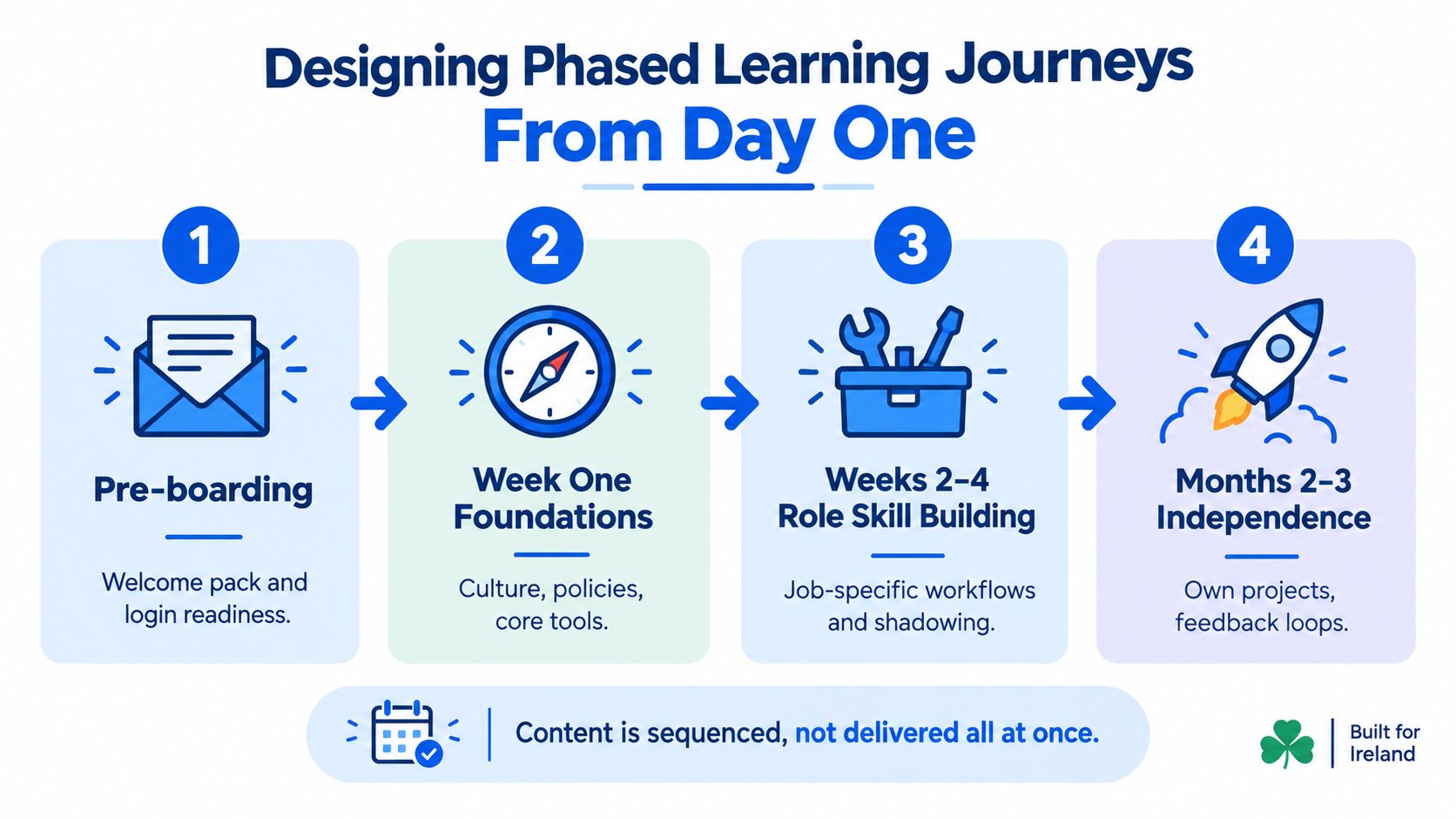
The strongest onboarding programmes don't deliver everything at once. They sequence learning according to what the employee needs to know, practise and prove at each stage. A useful design has four practical stages, grouped around three learning purposes: orientation, role competence and integration.
Start before the first shift
Pre-boarding should remove avoidable friction. Send the welcome information, confirm where the employee must report, prepare equipment and provide only the essential context needed before arrival. Keep sensitive or complex role training for a setting where the learner can ask questions and practise.
During week one, establish the shared foundation. Cover the organisation's purpose, key policies, core systems, communication norms, safety responsibilities and escalation routes. Pair digital learning with a manager conversation or live walkthrough. A policy acknowledgement alone isn't evidence that the employee knows how to apply the policy.
Build role competence through practice
The next phase focuses on the work itself. Map each module to a specific capability or job risk, then choose the learning method that matches it.
- Explain: Use concise video, diagrams or guided reading for concepts and procedures.
- Show: Demonstrate the workflow through a screen recording, live example or supervised walkthrough.
- Practise: Give the learner a realistic task with boundaries and support.
- Verify: Use questions, observation, a scenario decision or an assessor sign-off.
A new customer service adviser might practise handling an upset customer before receiving independent contacts. A warehouse operative might identify a hazard and follow the correct reporting route under supervision. The assessment should resemble the decision the employee will make at work.
Let readiness, not the calendar, control progression
The final stage is integration. The employee begins to handle normal work, joins team routines and receives feedback on judgement, quality and communication. The programme can still contain formal modules, but the emphasis shifts towards supported autonomy.
Use completion evidence that survives an audit:
- learner identity and role
- jurisdiction and work location
- version-controlled content
- completion timestamp
- assessment result
- remediation status
- assessor or approver
The calendar provides useful prompts, but it shouldn't authorise independent work by itself. A learner who completes a module without demonstrating the task remains a learner who has completed content, not necessarily a competent operator.
The following video provides another way to visualise how structured learning can support workplace induction and role development.
Multimedia Delivery and LMS Deployment Strategies
A polished video won't rescue a weak learning design. Nor will an LMS create a coherent onboarding experience just because it records completions. The delivery model has to match the task, the learner's environment and the evidence the organisation needs.

Choose media for the learning job
Cinematic video works well for human context, culture, demonstrations and emotionally recognisable scenarios. It can show how a conversation feels, how a safe environment should look and how a manager handles an escalation. It becomes inefficient when learners need to search a precise procedure or make repeated decisions.
Interactive scenarios suit judgement. Present the situation, ask the learner to choose a response, then explain the consequence and the governing principle. Screen recordings help with software workflows, while concise diagrams support process memory. A live session remains valuable for discussion, questions and local context, particularly when a role includes ambiguity that a standard module can't cover.
Use a mixed approach rather than forcing every topic into one format:
- Video: context, demonstrations and human interactions.
- Interactive scenarios: judgement, escalation and policy application.
- Reference resources: detailed procedures and job aids.
- Live support: questions, coaching and relationship-building.
- Observed practice: evidence of physical or operational competence.
Build the LMS around routing and control
The LMS should route the right content to the right person. Create a common foundation, then branch by role, site, jurisdiction, equipment or risk profile. A finance employee and a site operative may share values and reporting principles, but their competence paths shouldn't be identical.
Use version labels, review dates, named owners and approval records. Store the source script and assessment logic alongside the published course so reviewers can understand what changed. This approach makes localisation and policy updates more manageable than editing an unstructured collection of videos and PDF attachments.
Mobile access matters for employees who don't work at a desk, but mobile delivery must respect the setting. Break long modules into manageable units, provide transcripts and captions, and make essential reference material available when connectivity is unreliable. Don't place a critical assessment in a format that can't be completed safely on the shop floor.
For organisations commissioning media, bespoke e-learning development can support a defined workflow from script and storyboard through narration, graphics, assessment design and LMS-ready delivery. The important decision isn't whether to use an external production service. It's whether the production process preserves reviewability, version control and a clear connection between each scene and the capability it teaches.
Measuring Onboarding Effectiveness Beyond Completion Rates
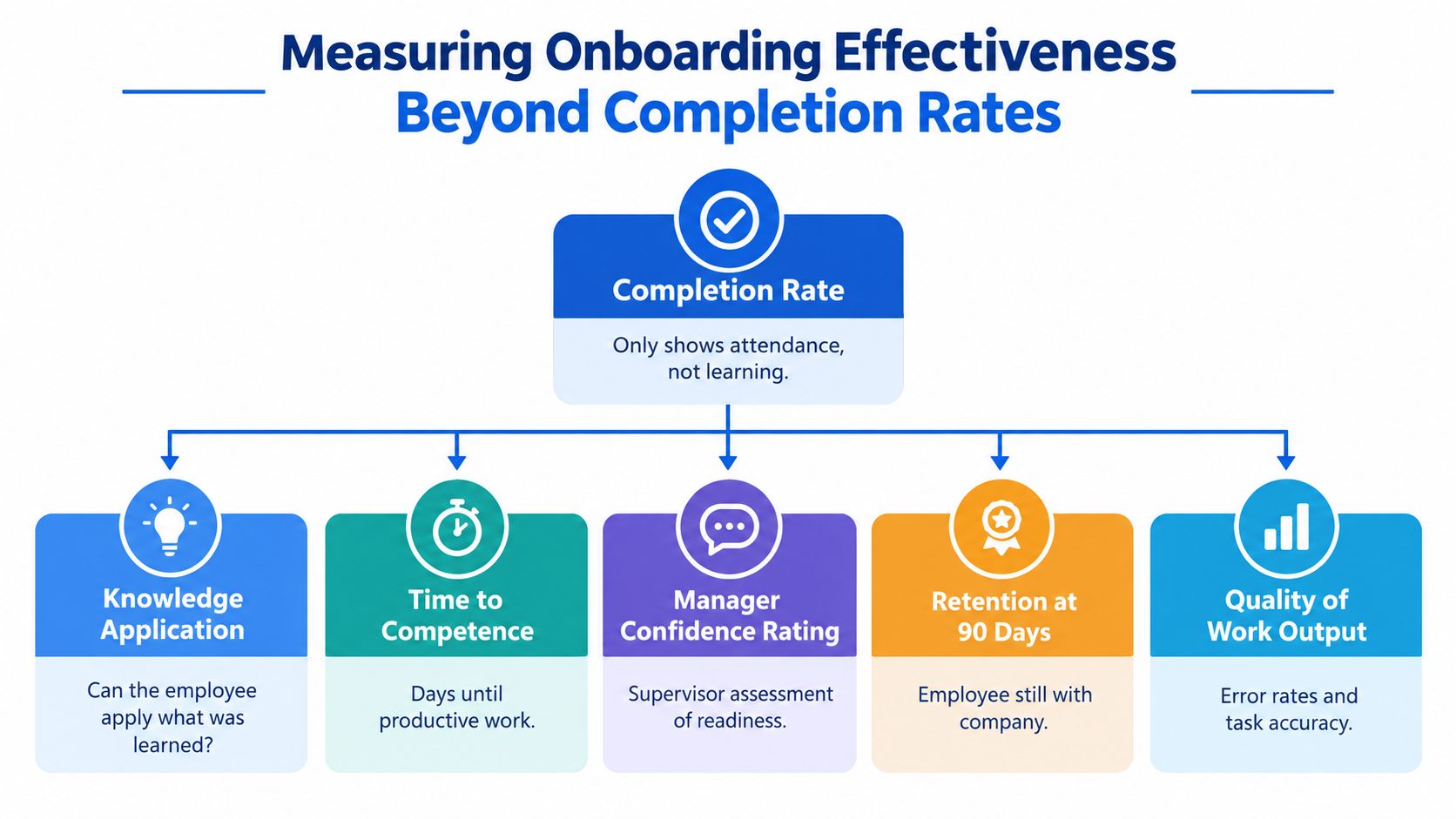
Completion is an administrative signal. It tells you that a learner reached the end of a module, not that the learner understood the content, can apply it or is ready to work without supervision.
Compare the metric with the decision it supports
A useful dashboard begins with the operational decision. If the question is whether a new starter can work independently, a completion percentage is too shallow. Track evidence that sits closer to the work:
| Measure | What it tells you | What it doesn't prove |
|---|---|---|
| Module completion | Whether assigned content was accessed and finished | Understanding or task competence |
| Knowledge assessment | Whether the learner answered defined questions correctly | Whether they can apply the knowledge under pressure |
| Observed practice | Whether the learner performed a task against a standard | Whether competence transfers to every situation |
| Manager readiness review | Whether the supervisor considers the learner ready | Whether the assessment standard is consistent |
| Remediation record | Where the learner needed support or reassessment | Why the original learning failed without further analysis |
Record evidence at learner level
Enterprise-wide provision can conceal uneven coverage. The CSO's finding that training was common among Irish enterprises doesn't demonstrate that every employee received the same onboarding content or achieved the same result (CSO background notes on training provision). Your system should therefore record the learner, role, location, content version, score, assessor and outstanding actions.
Time to independence is a practical outcome measure, but define it carefully. Agree what the employee must be able to do without direct supervision, then record the point at which the manager signs off that standard. For a customer service role, that might mean handling a defined range of cases accurately. For a regulated role, it may require correct escalation and documentation as well as task execution.
A dashboard becomes useful when every metric changes a decision. If nobody knows what to do when a score falls, the metric is decoration.
Review the data by role, manager, location and module. Repeated reassessment in one site may indicate a local coaching issue. Consistent errors on one scenario may indicate unclear content or a procedure that needs better explanation. Measurement should improve the programme, not punish learners for gaps the organisation created.
Real-World Examples of Phased Onboarding in Action
A manufacturing induction usually needs a sharper boundary between learning and authorisation. Before the first shift, the employee can complete a short introduction to site rules, reporting routes and essential terminology. During the first week, a supervisor demonstrates the relevant equipment and emergency process. The learner then performs a controlled task while an assessor checks the steps. Independent work begins only after the evidence meets the site's standard.
The trade-off is time. A rushed programme puts production ahead of verification, while a carefully staged programme temporarily uses supervisor capacity. The latter is easier to defend because the organisation can show what the employee was taught, what was observed and who approved progression.
A customer service team needs different practice. A new adviser might learn the product range and systems through short digital modules, then work through scenarios involving a complaint, a vulnerable customer or a request outside normal authority. A manager reviews the reasoning, not merely the selected answer. The programme should expose uncertainty and escalation, because polished scripts don't prepare people for conversations that depart from the script.
Hybrid work requires designed connection
Remote and hybrid employees need access to information that office-based starters often gain informally. Irish coverage estimates that remote and hybrid work is embedded in roughly 35% of Irish employment, while employers identify onboarding, communication, collaboration, team cohesion and engagement as recurring challenges (Grow Remote report based on CSO labour force data).
A remote onboarding path should combine asynchronous explanations with deliberate human contact. Assign a buddy, schedule manager check-ins, document escalation routes and ask the employee to complete a real but bounded first task. Useful readiness signals include the ability to find support, explain communication norms and make a safe decision without waiting for someone to notice a problem.
For scenario-led video and conversational practice, a defined script-to-video workflow for training can help teams turn procedures into repeatable situations rather than passive presentations. The medium still needs careful review, especially where local policy or jurisdiction changes the correct response.
AI-enabled work introduces another onboarding requirement. An Ireland-focused Working in Ireland survey reported that only around half of Republic of Ireland employees worked for organisations with an official AI policy, while 42.8% had received employer training in generative AI, and almost 60% of those trained received less than one day of instruction (UCD Working in Ireland survey report). New starters need role-specific scenarios covering confidentiality, verification, bias, copyright, prohibited inputs and human approval, not just a policy link.
Building Onboarding Programmes That Last Beyond the First Week
A durable onboarding programme has four characteristics. It is role-specific, so employees learn the procedures and decisions attached to their work. It is phased, so the organisation introduces complexity as the learner gains context. It is assessed, so completion doesn't masquerade as competence. And it is maintained, with owners responsible for content review, policy changes and local variations.
The strongest programmes also connect digital learning to people. A video can demonstrate a conversation, an interactive module can test judgement and an LMS can retain evidence. None replaces the manager who observes practice, the buddy who explains informal norms or the assessor who decides whether independent work is safe.
Ireland's training evidence makes the business case for governance without pretending to prove outcomes it doesn't measure. Training is widespread, but planning and assessment remain incomplete. The practical response is to make onboarding measurable at learner level, shaped to sector risks and linked to operational readiness.
That work also benefits from a clear production model. Teams comparing internal authoring with external support can use resources such as the gap between training pilots and production to examine where promising content often loses structure, review control or deployment readiness.
A first-week checklist still has a place. It shouldn't be mistaken for the programme. The standard is whether a new employee can perform the right work, ask for help at the right time and demonstrate safe judgement when the situation changes.
Loresson helps organisations turn procedures, policies and role requirements into bespoke onboarding courses with scripts, storyboards, narration, graphics, assessments and optional interactive role-play, prepared for LMS deployment. If your induction relies on inconsistent manager explanations or completion-only reporting, visit Loresson to discuss a structured, reviewable learning pathway.
Powered by Outrank