The worst advice about elearning localization services is that translation comes first and everything else can be “fixed later”. In real training operations, that approach creates broken quizzes, unusable captions, clumsy compliance references, and courseware that looks finished but fails the people who need it most.
In Ireland, that risk is easier to see because the learner base is mixed, digitally active, and multilingual. A course that swaps words without rethinking the interface, the terminology, or the governance trail is not localised in any meaningful sense. It's just been re-labelled.
Table of Contents
- Why Elearning Localisation Is More Than Translation
- Prioritising Languages Based on Workforce Risk
- The End-to-End Localisation Production Workflow
- Engineering Accessibility and Cognitive Load
- AI Governance and Auditability in Localisation
- Understanding Pricing Models and Provider Structures
- Selecting the Right Localisation Partner
Why Elearning Localisation Is More Than Translation
A translated course can still be wrong for the learner. It can use the right words and still miss the workplace reality, the escalation path, or the local legal reference that gives those words force. That's the mistake behind a lot of shallow elearning localization services, they treat language as the whole job when the actual work starts after the first draft is translated.
In Ireland, that distinction matters because the environment is both multilingual and legally sensitive. The country's literacy, numeracy and digital literacy strategy says more than 200 home languages are spoken, Irish Sign Language is recognised as a native and independent language, and Irish-medium education remains a policy priority. At EU level, Irish has had full official and working-language status since 1 January 2022, which means EU legislation must be translated into all 24 official languages. Those are not cosmetic details, they shape how training content needs to be built and reviewed.
Translation preserves words, localisation preserves intent
A safety module word-for-word translated can still fail if it uses the wrong escalation wording, the wrong measurement format, or a cultural reference that doesn't land. The same applies to onboarding, HR policy, and procedure training, where a learner needs to understand not just what to do, but what happens next if they don't.
Practical rule: if a local manager has to rewrite the translated course in the room after launch, the localisation didn't finish the job.
The institutional scale also shows why this work is operational, not decorative. The European Commission translates about 2.2 million pages annually, and translation and interpretation across EU institutions cost about €1.1 billion per year, less than 1% of the EU budget, or roughly €2 per citizen annually. That's a reminder that governed language work is already part of how large systems function, not an optional extra.
For e-learning, the output isn't just translated text. It's a course that behaves correctly for the local audience, including captions, examples, assessments, terminology, and legal framing. That's the standard buyers should expect from elearning localization services, because anything less leaves compliance and comprehension to chance.
Prioritising Languages Based on Workforce Risk
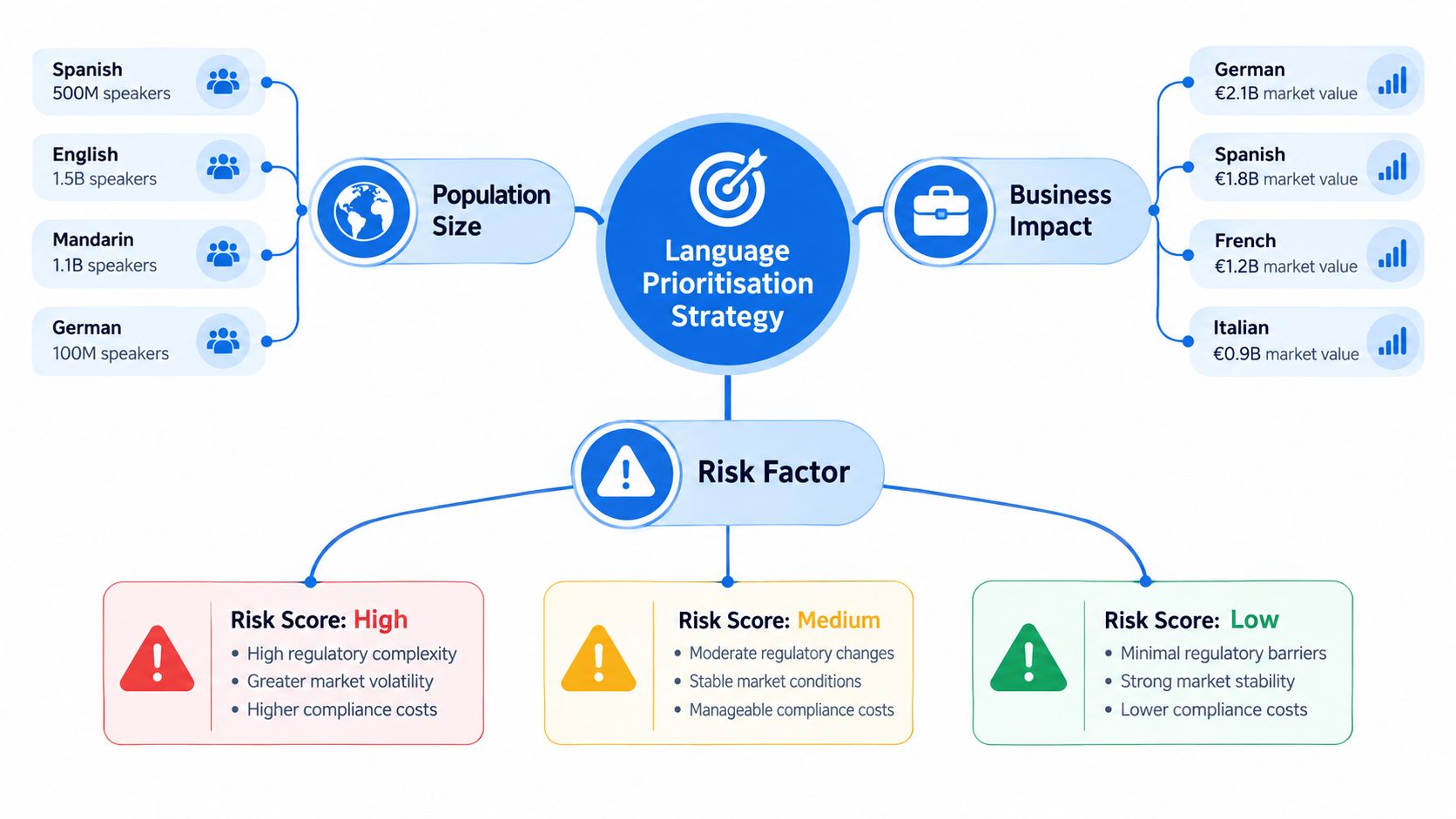
The wrong way to choose target languages is to start with population size alone. That might work for a marketing brochure. It doesn't work for safety, onboarding, or procedure training, where a smaller group in a higher-risk role can create far more exposure than a larger group in low-risk office work.
Ireland makes that trade-off obvious. The 2022 Census recorded more than 1 million residents born abroad, with 20% of residents born outside Ireland. Residents reported speaking 212 languages, and 751,507 people spoke a language other than English or Irish at home, a 23% increase since 2016. Those numbers don't tell you which language to localise first, but they do show why a one-size-fits-all decision rule is weak.
Choose by exposure, not by headline demand
A useful prioritisation model weighs three things together, the language group's size, the business impact of the role, and the risk attached to the task. A language with a smaller audience can still deserve priority if it sits inside a high-consequence operation such as warehousing, manufacturing, logistics, or regulated customer support.
That's where many generic translation programmes go wrong. They localise the most visible audience first, then discover the actual business risk sits elsewhere. A purely demographic approach can leave a high-risk site under-supported while a lower-risk audience gets the polished version.
Test comprehension with actual workers
Linguistic quality isn't enough on its own. Subject-matter review and comprehension testing with real employees matter because the course has to survive use, not just approval. A technically correct translation can still fail if it assumes vocabulary, background knowledge, or task sequencing that the workforce doesn't share.
A defensible prioritisation process usually looks like this:
- Map roles first: Identify which jobs involve safety, compliance, customer impact, or operational interruption.
- Score language need by task: A translated induction may be unnecessary in one unit but essential in another where instructions are time-sensitive.
- Use bilingual support selectively: Some teams only need subtitles, glossaries, or facilitated sessions rather than a full course rewrite.
- Check real completion paths: Ask workers to move through the course, not just read it.
The best language choice is the one that reduces operational risk, not the one that looks cleanest on a spreadsheet.
That mindset makes elearning localization services more strategic. It replaces broad assumptions with a practical decision framework that matches the business to the learner group.
The End-to-End Localisation Production Workflow
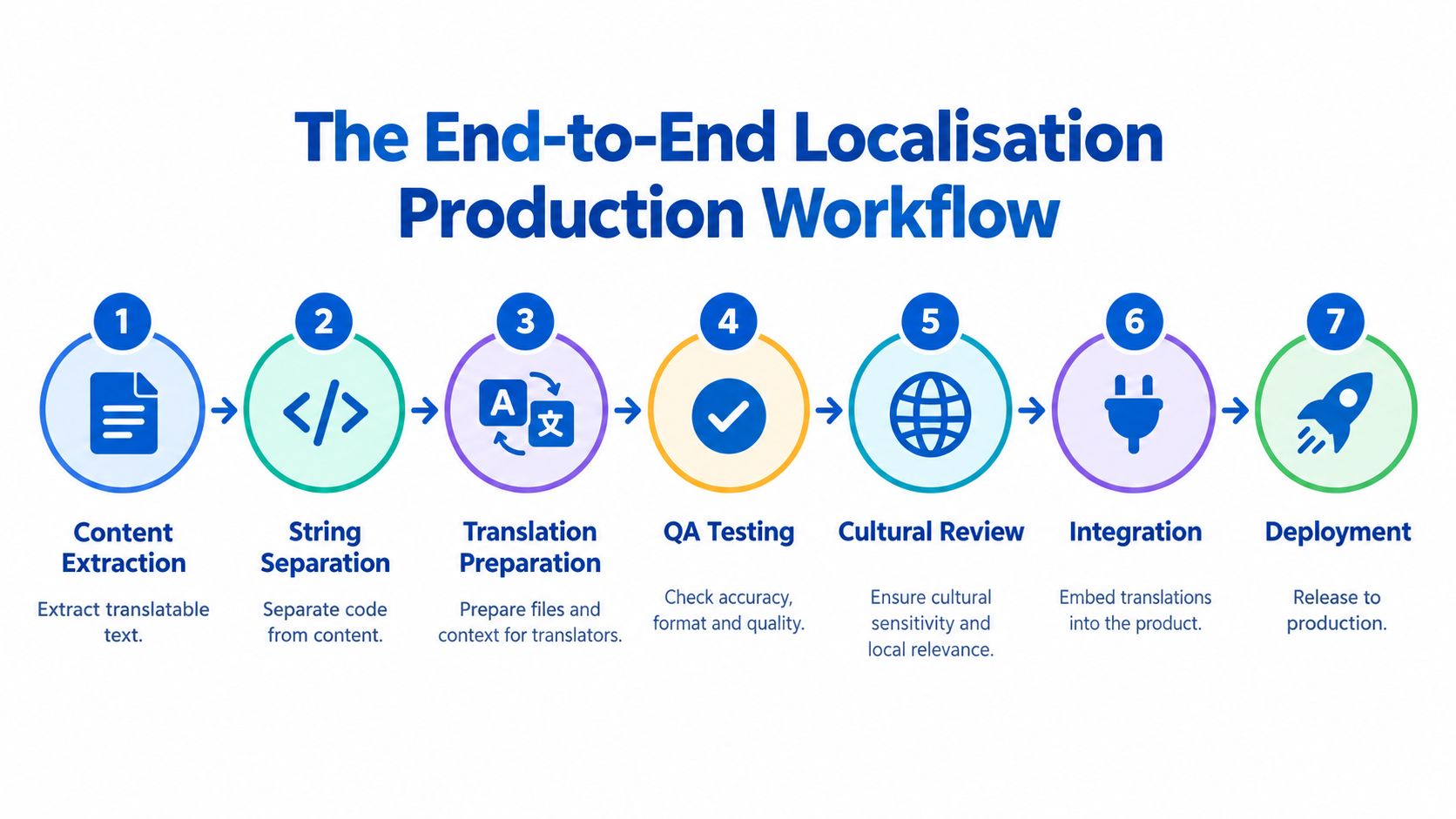
Strong localisation starts before translation begins. If the source package is built as one oversized block of content, every later change becomes expensive, and every language variant inherits the same structural problems. The safer approach is to separate content from logic, then keep the assets traceable from draft to deployment.
Build the source so it can survive versioning
The first job is content extraction. Narration, captions, on-screen text, quiz items, and downloadable documents should be separable from the course logic before anyone starts adapting language. Stable IDs make this much easier, because a revised safety instruction or assessment item can then be updated across every language without guessing where the text lives.
A practical source package should include:
- Time-coded scripts so narration changes can be tracked cleanly.
- Editable subtitle files so timing can be adjusted without manual re-authoring.
- Terminology glossaries so key terms stay consistent across modules.
- Jurisdiction-specific references that remain intact unless a local reviewer changes them.
That structure matters because course updates don't stay local. If a procedure changes in one module and the same content appears in captions, narration, and a quiz answer key, those versions have to move together.
Keep metadata with the content
Dates, numbers, measurements, and legal phrasing need locale metadata, not ad hoc judgement. That sounds administrative, but it prevents the kind of mismatch that causes support tickets and audit headaches later. A changed policy date or a revised internal reference shouldn't be trapped in one format while the rest of the course moves on.
The workflow also needs quality gates before deployment. Rebuild the interactions in the authoring tool, test the rendered layout, then verify the package in the LMS. If the text expands, the buttons shift, or the subtitles drift, the issue has to be caught before learners see it.
For teams managing the authoring and delivery side, a linked development handoff matters too, and this bespoke elearning development reference is relevant when source structure and language adaptation need to be planned together.
If the course can't be updated one asset at a time, it'll cost more every time the policy changes.
That is the genuine production advantage of proper elearning localization services: they reduce synchronization defects and make future updates survivable.
Engineering Accessibility and Cognitive Load
Language substitution alone doesn't make a course usable. A learner can understand the words and still fail the module because the interface, pacing, or assessment design asks too much of them at once. In Ireland, that isn't an edge case, because the digital-skills gap is wide enough to affect how different groups experience the same course.
Ireland's 2023 digital-skills data shows a 58.48 percentage point gap between people with tertiary education and those with low or no formal education, with 88.23% versus 14.43% possessing at least basic digital skills. The adult-literacy evidence is just as clear, 18% of adults aged 16 to 65 struggle with everyday written text, and 42% struggle with basic digital tasks. Those figures point to one conclusion, accessibility has to be engineered into the course, not patched onto the end.
Reduce load before you chase polish
A localised course should preserve the source learning model while adapting the parts that create friction. That means shorter on-screen text, cleaner navigation, simpler assessment language, audio alternatives, and feedback that tells the learner what to do next without burying them in jargon.
Rendered QA matters more than string-level QA. A translated line can be correct and still break the interface if it clips, overflows, or pushes the buttons into a confusing hierarchy. Captions can also drift if the timing wasn't tested against the final media, which creates a poor experience even when the language is right.
Set acceptance criteria that reflect real learners
Practical acceptance standards should include plain-language review, task completion testing with representative Irish users, caption and transcript verification, accessible contrast and focus states, and a low-bandwidth fallback. Those are not nice-to-have extras. They're the controls that decide whether the course is actually usable across mixed-skill workforces.
A few field-tested adjustments tend to deliver the most value:
- Shorten screen text: Dense blocks raise cognitive load faster than expected.
- Use audio support deliberately: Some learners need the spoken version more than the written one.
- Check keyboard and mobile interaction: Many users don't experience the course on a desktop first.
- Review feedback language: Assessment explanations should guide, not shame.
When teams ignore accessibility, they often blame the learner. That's backwards. A course that depends on high confidence, high literacy, and high digital fluency is fragile by design.
Elearning localization services work best when they lower that fragility. The point isn't just to make the words local. It's to make the path through the training manageable.
AI Governance and Auditability in Localisation
AI can speed up localisation, but it also creates a heavier governance burden. Every language variant becomes a controlled asset, and every controlled asset needs versioning, review, and evidence. That's especially true in regulated workplace training, where the question isn't just whether the course is fast to produce, but whether the organisation can prove what was approved and why.
Ireland's government says providers and deployers must ensure staff have sufficient AI literacy under the EU AI Act, and its guidance identifies workplace emotion recognition and social scoring among prohibited practices. That matters for localised training because AI-assisted scripts, narration, visuals, and assessments still need human accountability. The goal is not to remove people from the process, it's to make their decisions visible and auditable.
Build records that stand up to scrutiny
A localisation dossier should show who approved the source, which version was localised, what AI contributed, how terminology was validated, and whether the assessment still measures the original learning objective. If the content later changes, the audit trail needs to show when the change happened, who reviewed it, and what followed.
That record is more than bureaucracy. It's the difference between a course that can be defended and a course that can only be described. In compliance-heavy environments, that distinction matters.
The right governance pack usually includes:
- Source-to-target scripts so reviewers can compare meaning, not guess it.
- Glossary decisions so terminology stays consistent across languages.
- Reviewer sign-off so responsibility is assigned, not implied.
- Change logs so updates can be traced across revisions and locales.
Keep AI visible, not invisible
AI-generated output shouldn't disappear into the final deliverable as if nothing happened. If an organisation can't identify what was machine-assisted and what was human-reviewed, then it has less control over the asset than it thinks. That problem grows when the same course is rolled out across several jurisdictions and has to be updated repeatedly.
This is why a good AI transparency statement belongs near the centre of any governed localisation programme. It sets expectations for disclosure, review, and accountability before production gets messy.
Governance rule: faster production is useful only if review, version control, and ownership keep pace.
Elearning localization services that ignore this layer may look efficient at first. They usually become harder to defend later, especially when someone asks what changed, who approved it, and whether the local version still teaches the same thing.
Understanding Pricing Models and Provider Structures
Pricing in localisation rarely tracks a simple per-word model. That approach misses the moving parts that drive the invoice, such as media handling, engineering, subtitle timing, assessment rebuilds, and LMS checks. Buyers who compare vendors only on translation rate usually discover the true cost after the project has already started.
The better way to compare providers is by service component.
| Service Component | Pricing Model | Key Cost Drivers |
|---|---|---|
| Source preparation | Project-based | File cleanup, string separation, script extraction |
| Translation | Per word or per hour | Language pair, terminology complexity, repetition |
| Voiceover | Per minute or per session | Speaker selection, recording direction, retakes |
| Subtitles and captions | Per minute or per file | Timing adjustments, format changes, QA |
| Cultural adaptation | Project-based | Local references, examples, compliance wording |
| Engineering and rebuild | Hourly or fixed scope | LMS packaging, interaction repairs, layout changes |
| Testing and QA | Project-based | Rendered layout checks, device testing, sign-off |
| Updates and maintenance | Retainer or change order | Version control, regulatory changes, revised assets |
Generalist translation and specialist elearning teams aren't the same buy
A general translation firm may handle text well but struggle once the course has quizzes, media timing, or LMS dependencies. A specialist elearning localisation provider is usually better equipped to manage the file structure and the rebuild cycle. AI-assisted production services can move faster again, but only if they're governed properly and reviewed with the same care as the rest of the course.
The hidden cost is usually the handoff. Desktop publishing, subtitle timing, and integration testing are where projects often expand without warning. If those tasks are not scoped early, they show up later as change orders or internal rework.
Ask what is included, not just what is translated
A clean quote should show what happens to narration, captions, graphics, quizzes, and LMS delivery, not just the written source text. It should also be clear whether the provider handles update cycles after launch. If the vendor can't explain how revised content moves across every language version, the initial price may be low for the wrong reason.
The source content matters too. A well-structured package with repetition and stable terminology costs less to maintain than a fragmented course rebuilt by hand each time. That's why authoring choices influence localisation cost long before the first invoice lands.
Elearning localization services work best when the buyer knows which component is being purchased. Translation is only one line item.
Selecting the Right Localisation Partner
A good partner should be judged on technical maturity, governance discipline, and subject-matter comfort, not just language coverage. If they can't show how they handle source control, glossary decisions, and layout QA, they probably aren't equipped for training content that has compliance weight. The same goes for providers who can translate but can't show how they update courses cleanly when policy changes.
The quickest way to vet a provider is to ask for evidence, not promises.
Use the RFP to test operational depth
Start with the basics, then push into the messy parts. Ask how they separate translatable assets from course logic, how they manage localisation dossiers, and how they validate assessments against the original learning objective. If they work with governed AI, ask how human review is documented and how revisions are tracked across versions.
It's also worth asking whether they can show their process in practical terms. This how it works overview is a useful reference point for teams that want to compare handoff, production, and delivery structures before they commit.
Look for proof, not branding
A strong provider should be able to show a sample dossier, not just a polished case page. That dossier should make it easy to trace the source revision, the localised revision, reviewer sign-off, and effective date. If the provider can't demonstrate that chain, they'll struggle when your policy content changes mid-rollout.
Use this checklist during vendor selection:
- Ask for layout QA evidence: Translated strings alone don't prove the course renders correctly.
- Request glossary governance: You need to know who approves key terminology and how often it's reviewed.
- Check update handling: The provider should explain how revised content propagates across all language versions.
- Verify compliance awareness: Regulated training demands more than fluent copy.
- Confirm AI disclosure and human review: If AI is used, the review trail should be explicit.
A provider that can't explain how it handles revisions is a risk multiplier, not a delivery partner.
The best elearning localization services reduce rework, support auditability, and stay usable when the source course changes. That's the standard to hold every partner against.
If you need elearning localization services that treat language, governance, accessibility, and auditability as one production problem, visit Loresson. It's built for teams that need training content adapted carefully across regions, not just translated quickly. If your courses have compliance weight, multilingual audiences, or AI review requirements, start the conversation there.