

The usual advice on regulatory compliance courses is to make them shorter, more engaging and easier to complete. That's useful production advice, but it's a poor starting point for safety-critical training. A polished course can still teach the wrong procedure, assess the wrong behaviour or leave an employer unable to show which version a worker completed.
Start instead with the action the worker must perform and the evidence the employer must retain. For HSEQ and L&D buyers, the strongest course isn't necessarily the fastest to produce or the most cinematic. It's the one that connects an applicable duty to a safe decision, tests that decision properly and leaves a versioned file that someone can retrieve without reconstructing the project.
Table of Contents
- Course Types and the Evidence They Must Leave
- Labelling Jurisdiction and Calendar Across Countries
- Legal Duty and the Assessment Audit File
- Designing and Proving Task-Specific Competence
- Retraining Triggers When Rules Change
- Commission a Course That Survives an Audit
Course Types and the Evidence They Must Leave
A completion certificate is weak evidence when it says only that someone reached the end of a module. It becomes more useful when the underlying record identifies the learner, the authorised content, the assessment and any practical verification. It still shouldn't claim to prove skills that nobody observed.
The first commissioning decision is therefore which kind of training the work requires, not which catalogue title sounds closest. The HSA's explanation of Irish workplace law identifies the Safety, Health and Welfare at Work Act 2005 and the General Application Regulations 2007–2023 as broadly applicable, with employer duties covering information, training, instruction and supervision and corresponding employee obligations to attend required training and complete assessments.
Course types and the evidence that counts
Use this comparison to specify the intended evidence before anyone writes the script. Specialist credentials, practical performance and general awareness shouldn't be treated as interchangeable outputs.
| Setting | Typical course | Anchor | Evidence that counts |
|---|---|---|---|
| General Irish workplace | Information, instruction and supervision | Irish workplace safety legislation | Named duty, safe practice, assessment and completion record |
| Construction | Safe Pass and CSCS where the work requires them | SOLAS schemes | Valid card or scheme certification, not a generic induction |
| Asbestos work | Task- and profession-specific training plus refresher | Applicable amended asbestos rules | Certificate meeting the applicable requirements plus supervised on-the-job training |
| Industrial trucks | Operator training to the current code | Current HSA operator-training code of practice | Training against the live code, not the retired one |
| Manual handling | Control sequence for the actual task | Workplace risk assessment and applicable handling requirements | Scenario choices covering aids, team handling and stop points |
| More than one country | Jurisdiction-labelled modules | Separate national health, safety and reporting calendars | Role, country and version on the completion record |
Match the deliverable to the claim
A general induction can introduce reporting routes, site rules and worker responsibilities. A procedure course should go further, explaining how a named role carries out a defined task using the organisation's equipment and controls. A specialist training package may also need an authorised training route, prescribed records or practical assessment.
Don't commission the same evidence for all of them. A worker acknowledging a site emergency procedure needs a different assessment from an operator demonstrating control of equipment. The distinction should appear in the commissioning brief, the learner instructions and the wording on the final record.
Practical rule: Write the claim you want the completion record to support before choosing the course format.
For example, a maintenance awareness module might support the claim that a technician can recognise a suspected hazardous material and stop work. It shouldn't imply that the technician is qualified to disturb or remove that material. A clear boundary is more useful than a certificate with an impressive but ambiguous title.
Before production begins, record the sector, role, legal or scheme anchor, safe behaviour and acceptable evidence. Add the workplace procedure where one exists, together with the person authorised to approve it. This keeps the project focused on what the organisation needs to demonstrate, rather than what a standard learning template happens to collect.
Labelling Jurisdiction and Calendar Across Countries
Say a manufacturer wants a plant-maintenance course for teams in Ireland and the UK. The equipment looks similar, and the learning designer can reuse much of the visual treatment. That doesn't make a single undifferentiated compliance module a sound choice.
Separate the shared learning design from the country-specific authority. Hazard recognition, control selection and escalation can follow a common teaching pattern, while the legal references, applicable guidance and local approval follow their own review paths.
Give every module a country identity
Create a course-control entry before scripting begins. Keep these fields visible to the author, reviewer and learning-system administrator:
- Country: Identify where the module is intended to apply, rather than using a broad label such as international compliance.
- Governing regulator: Record the authority whose current publications the reviewer must check.
- Legal anchor: Name the applicable legislation, code, scheme or approved procedure.
- Version date: Identify the released content version that will appear against the learner's record.
For the maintenance example, the Irish reviewer checks Irish duties and applicable guidance. The UK reviewer checks the relevant UK primary sources independently. Neither reviewer should approve the other country's content merely because the narration describes similar machinery.
Choose the right boundary for reuse
Build separate jurisdictional courses when the legal anchor changes the instructions, assessment or evidence required. Use a shared core with country-specific appendices when the common teaching remains accurate and local differences can be isolated without confusing the learner.
Reuse the explanation of the hazard. Don't reuse an unverified legal conclusion.
Before release, verify who published the rule, when it takes effect, which roles it reaches and whether it sets a refresher interval. Where a local scheme prescribes a certificate format, use that format rather than substituting a branded certificate.
The detailed legal examples here concern Ireland. UK, US and Australian dates, training requirements and reporting obligations need current primary-source checks before publication, not recollection or a copied calendar.
Finally, make the learning record readable outside the LMS interface. It should identify the learner, role, country, course version and completion date. A manager exporting records for a visiting contractor should be able to distinguish the applicable module without opening every course.
Legal Duty and the Assessment Audit File
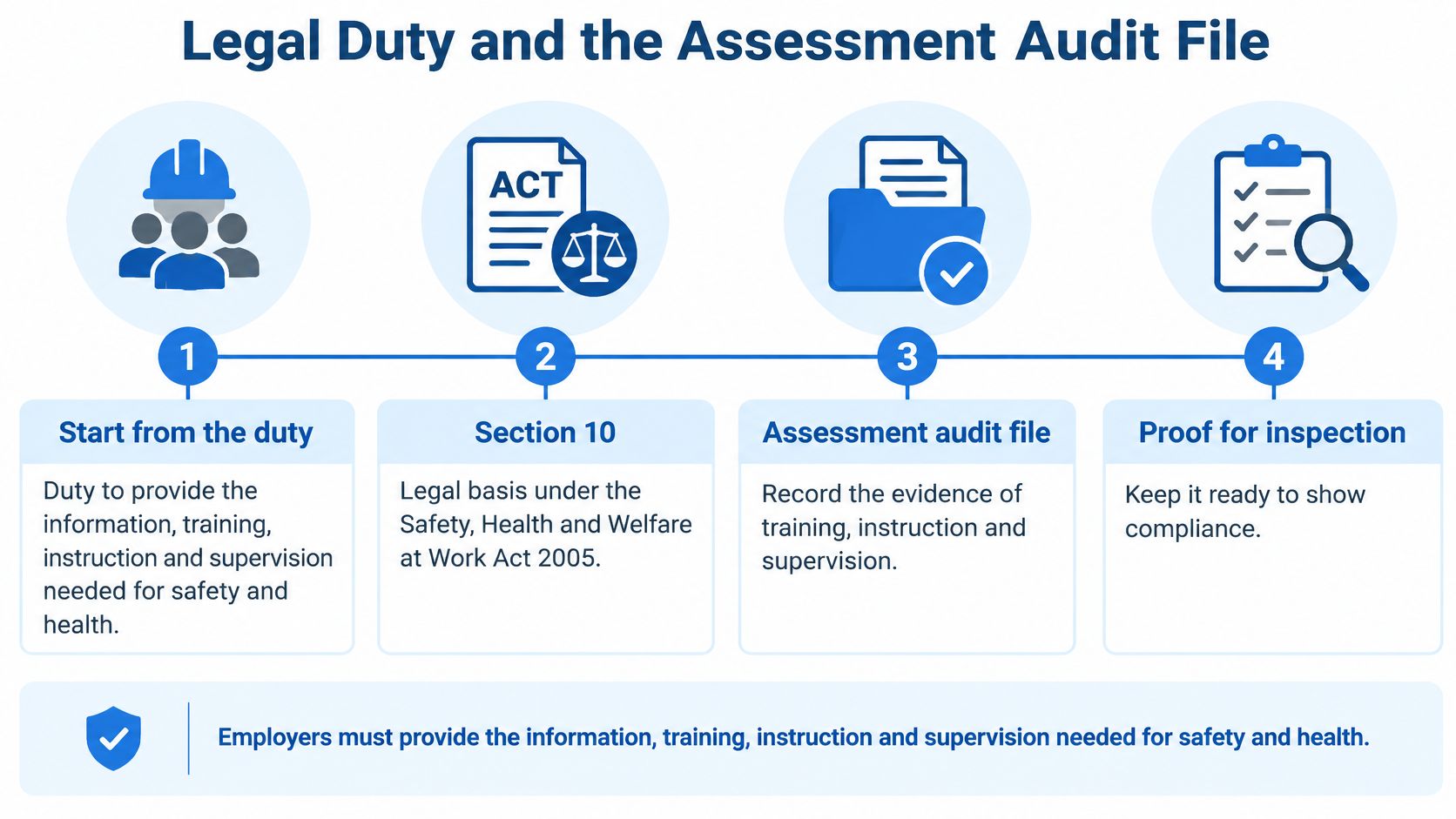
An inspector's useful question isn't whether training happened. It's whether the employer can show that the training addressed the work, communicated the relevant controls and was understood by the people expected to apply it. Build the file to answer that question.
The HSA explains the employer's instruction and training duty under Section 10 of the Safety, Health and Welfare at Work Act 2005, while stressing that training cannot substitute for proper risk control, in its annual review of workplace injuries, illnesses and fatalities. That review records 10,441 reported non-fatal workplace incidents in 2024, 3% more than in 2023, and 36 fatal work-related incidents in 2024.
Those figures don't measure the effectiveness of a particular course. They underline why a completion dashboard, on its own, can't establish that workplace risks are controlled. A course should state the hazard it addresses and make clear which physical, organisational or protective measures remain necessary.
The evidence path starts with the duty and ends with records that can be retrieved.
Build the file in approval order
Start with a source register. Identify the governing legislation, applicable code and internal procedure, then record which passages support the learning objectives. Distinguish a binding requirement from guidance and from an employer's chosen operating rule.
Next, retain the approved script and revision date. A video file alone is awkward to review, and its filename doesn't establish who authorised the instructions. The script should connect each safety-critical statement to its source and show which local details the client approved.
Then preserve the assessment version, pass criteria and answer rationales. A question's rationale should explain why an answer is safe or unsafe, not merely identify the correct option. This makes technical review possible before learners encounter the test.
Tie learner identity to completion evidence, and add manager or specialist sign-off where the content or task warrants it. Finish with a change log that explains the revision, the affected audience and the retired version.
Records that make a course defensible
This is a recommended governance structure, not a claim that every record below is universally prescribed in this exact form.
| Record | What it proves | Revise when |
|---|---|---|
| Source register | Which Act, code or procedure was taught | Legislation, approved code or procedure changes |
| Approved script and revision date | The exact safe practice that was authorised | Wording, hazard or method changes |
| Assessment version, pass mark and rationales | The test matched the objective | Questions or pass criteria change |
| Learner identity and completion evidence | Who finished which version | Role, site or reassignment changes require a new linked record |
| Manager or specialist sign-off | A qualified person accepted the content | Safety-critical content or a local rule enters scope |
| Change log | What changed, for whom, and what was retired | New equipment, technology, procedure or law changes the course |
| Practical observation record | Competence where a click is not enough | The task needs supervised performance or renewed verification |
Preserve historical completion records when assigning updated training. Don't overwrite the old version identifier with the new one, because that would obscure what the learner received. An updated assignment and its result should remain distinguishable from the earlier training.
Verify credentials separately from induction
The construction findings illustrate a different evidence problem. The HSA's legislative updates and associated construction findings report that its review of construction fatalities from 2022–2024 recorded six workers without a valid SOLAS Safe Pass card and two workers performing specialist work without required Construction Skills Certification Scheme training.
A site induction record doesn't resolve a missing scheme credential. Keep credential verification separate from local instruction, with enough information to identify what was checked and whether it covered the assigned work. Neither record should be used to imply the other exists.
Our health and safety training approach keeps clients' internal approval central, particularly where a course explains safety-critical actions or local requirements. The client's authorised reviewer must confirm that the depicted isolation point, reporting route or operating restriction matches the workplace.
Make retrieval part of acceptance testing. Give a reviewer a learner's name and ask them to locate the applicable script, assessment, approval and practical record. If they need the original producer to explain the folder, improve the filing before release.
Designing and Proving Task-Specific Competence
A completion tick proves attendance or a course result. It does not, on its own, prove that someone can perform a task safely. Start with the work the learner must do, then choose evidence that shows whether the relevant behaviour changed.
For each behaviour, define an objective and connect it to a hazard, a control and a check. A scenario can test a decision. Physical performance requires observation of the action itself.
The design sequence should remain visible from the first draft to the final assessment.
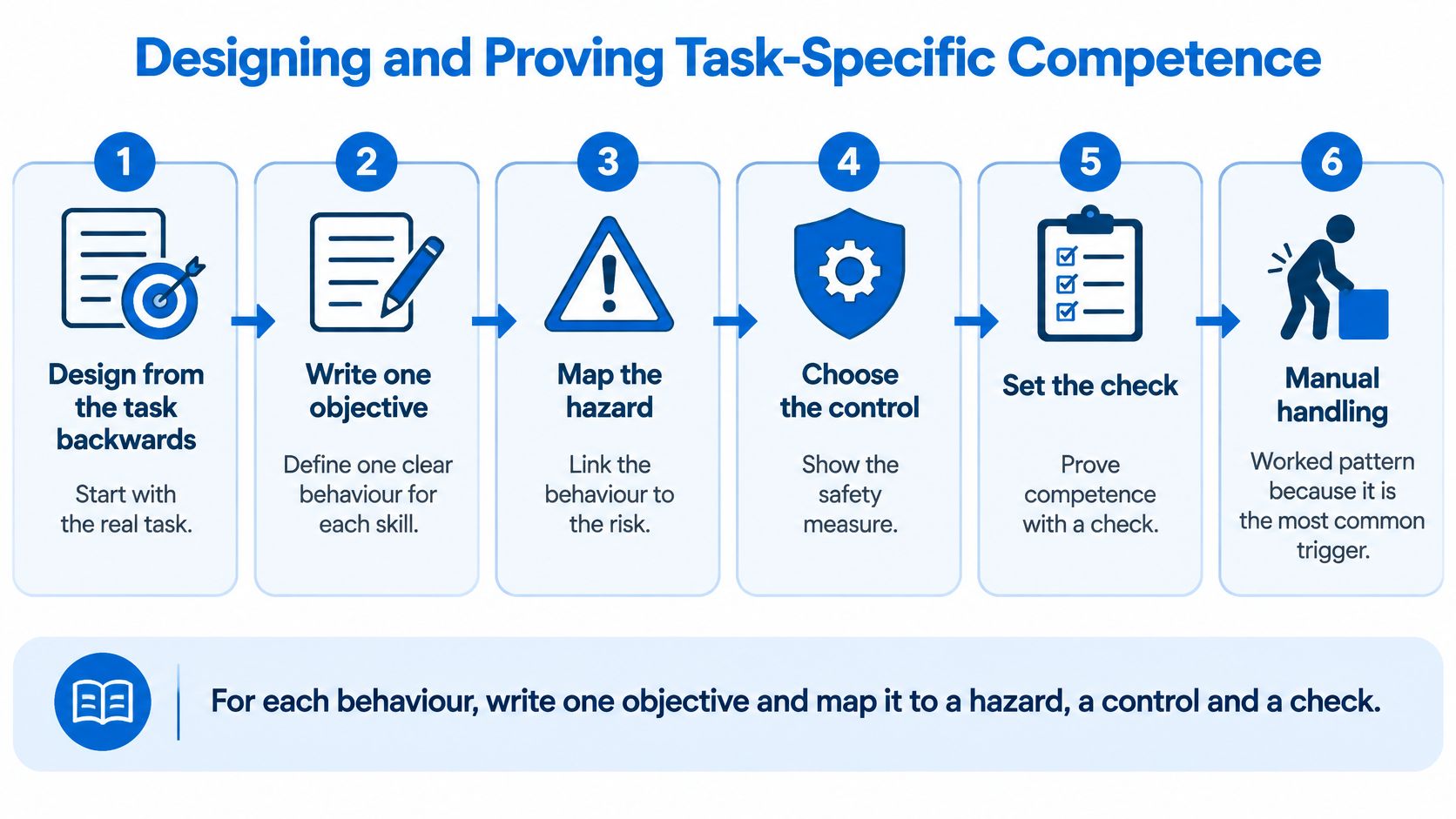
Work backwards from a handling decision
A warehouse picker is moving an awkward carton from a low shelf to a dispatch area. The first question is not how to lift it. It is whether the task should proceed in that form.
Show the learner the information needed to choose a control: the carton's stability, the available trolley, a restricted turning space and an obstruction on the route. Keep the details that affect the decision visible.
Build the scenario around a sequence of decisions:
- Assess the load: Check its stability, shape, grip and any information needed before attempting movement.
- Plan the route: Identify obstructions, changes in level, restricted space and the destination.
- Select the control: Consider changing the task or using a suitable mechanical aid before presenting a manual movement.
- Coordinate assistance: If the assessed method calls for team handling, establish who directs the movement and how workers communicate.
- Apply stop criteria: Require the learner to stop and escalate when the planned method or equipment isn't safe.
Team handling is not automatically the right answer whenever a load looks difficult. The task assessment and local procedure determine the acceptable method. Teach the reasoning behind that method, rather than relying on a slogan.
Set the assessment before polishing the media
Decide what the learner must demonstrate before writing distractors or commissioning animation. Identify safety-critical errors, acceptable alternatives and the feedback attached to each choice. If an unsafe decision conflicts with the objective, unrelated easy questions should not conceal the failure.
A useful answer rationale explains the control. Choosing a trolley may still be wrong if it is unsuitable or the route remains blocked. The learner needs to understand why an answer that sounds sensible does not resolve the actual risk.
The HSA's annual reporting records more than 11,600 workplace inspections and investigations and nearly 74,000 online training courses delivered through its learning platform in 2024. At scale, consistent review criteria matter alongside consistent visual design.
Ask an operations reviewer to test the scenario without seeing the answer key. If they identify another safe approach, recognise it in the assessment or clarify what conditions rule it out. A defensible assessment should not penalise sound judgement because the author pictured only one acceptable response.
Separate awareness, knowledge and practical performance
Use separate evidence for separate learning outcomes. Awareness establishes hazard recognition and the boundaries of a role. A knowledge check tests decisions. Practical sign-off records observed performance against defined criteria.
The HSA's safety and health management guidance supports linking training to the work and training needs. A generic awareness certificate should not be treated as proof of practical competence.
For example, an awareness scenario for a maintenance technician preparing to drill in an older plant room can test whether the technician checks relevant information, recognises uncertainty and stops for specialist advice. It cannot establish competence to carry out specialist asbestos work.
| Role and situation | What the digital course can check | What workplace verification should establish |
|---|---|---|
| Maintenance technician preparing intrusive work | Recognition, information checks and stop-or-escalate decisions | Application of the authorised method within the worker's competence |
| Facilities worker using an abrasive wheel | Selection of the applicable procedure and recognition of unsafe conditions | Performance against the specialist task criteria |
| Warehouse picker moving a load | Choice of route, aid and escalation action | Safe use of the actual equipment under local conditions |
Make observation usable for supervisors
A practical checklist needs observable actions, not vague judgements such as “worked safely.” State what the assessor must see, the conditions for the assessment and what happens after an unsuccessful attempt. Record the task, equipment or method clearly enough to avoid implying unrestricted competence.
The assessor should be able to record a missed control, give corrective instruction and require further practice before authorising the activity. Keep that result separate from the online knowledge result.
A learner can know the correct answer and still need supervised practice. Record both outcomes honestly.
Check that the learning format does not obstruct understanding. Use readable diagrams, captions, clear narration and instructions that do not rely on colour alone. If a learner misunderstands the interface, the course cannot provide useful evidence of their decisions about the task.
Retraining Triggers When Rules Change
An annual refresher is a schedule, not a reliable way to detect every training need. A rule, machine or operating method can change before the next scheduled course assignment. The course owner must identify what changed and decide whether it affects the work.
Treat regulatory review as a controlled task, not a last-minute edit.
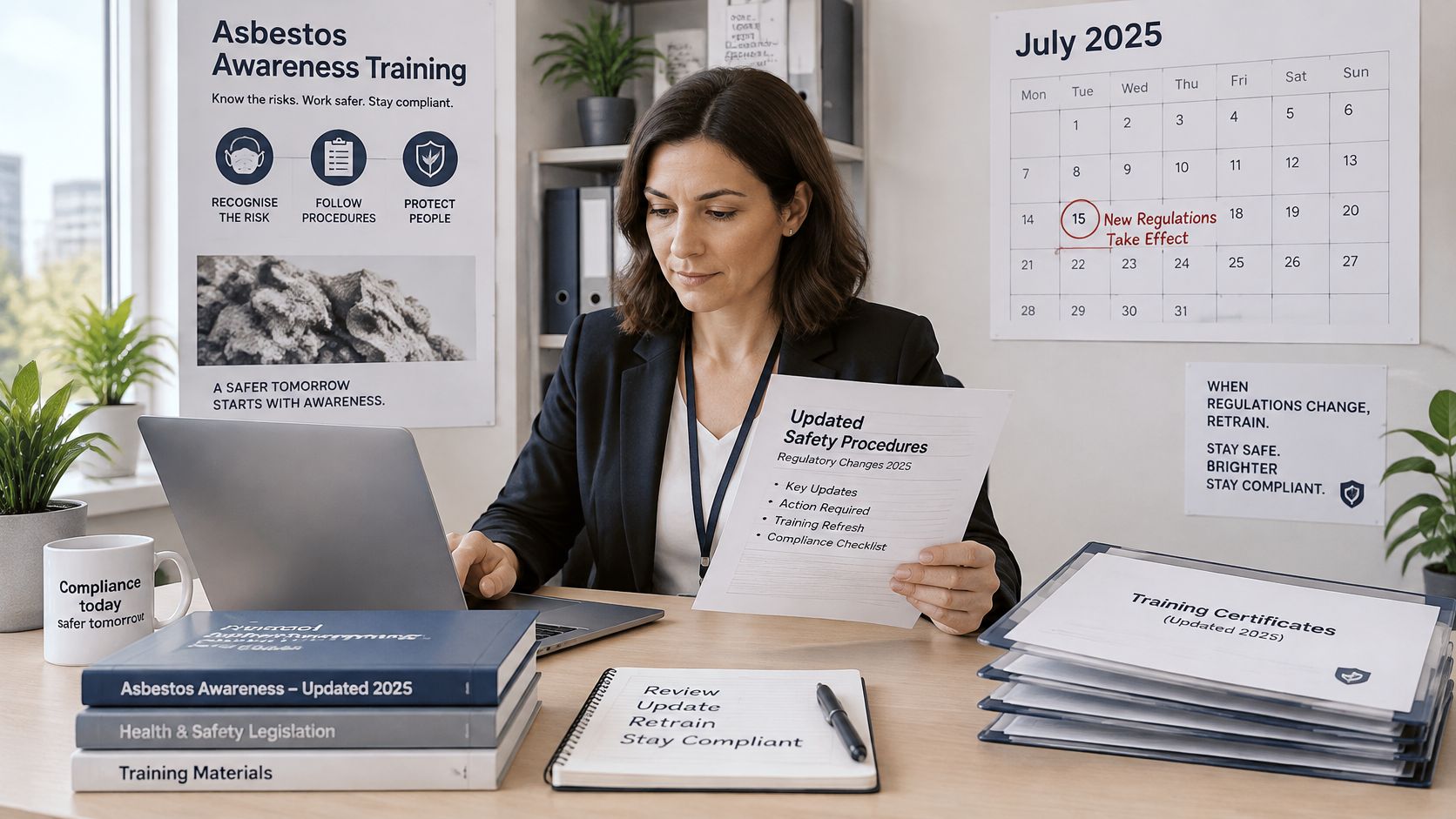
Distinguish a deadline from a training need
Ireland's amended asbestos regulations introduced enhanced training requirements from 21 December 2025, including revised content and certificates and a refresher interval not exceeding two years.
A refresher interval sets an outer boundary for the training it covers. A material change may require action sooner. New equipment, technology, procedures or legislation should prompt an assessment of what workers need to know and do.
Use risk-based triage for regulatory change to distinguish an editorial amendment from a change to a control decision. Correcting a reference label does not have the same training impact as changing when an operator must stop work.
Make the release traceable
Before publishing a changed course, resolve three questions:
- Which roles are affected? Identify the people whose tasks, permissions or evidence requirements change.
- Which version is live? Confirm what new starters, current workers and reassigned staff can launch.
- Can the change be traced? Connect the requirement to the revised script, assessment, approval and completion record.
Show learners what changed rather than replacing the media. An update notice should state the new action or restriction and when the organisation expects workers to follow it. Managers need enough detail to brief affected teams and arrange any practical verification.
The accompanying video can support the discussion, but it is not authority for the applicable rule.

Retire superseded assessments from active assignment while preserving their historical results. If learners have started the old version, decide whether they may finish it or must move to the replacement. Record the decision instead of relying on the LMS default.
Apply the same controls to generated drafts. AI-generated material needs review against the client's actual procedures and applicable requirements, and generation does not guarantee regulatory compliance. A fluent summary can omit a role restriction or introduce an instruction that belongs to another jurisdiction.
Assign a named owner to monitor updates and a named reviewer to approve their training consequences. A course that is easy to edit still needs these responsibilities to remain current.
Commission a Course That Survives an Audit
A fixed studio date can make a minor regulatory update feel like a major production project. A governed production path lets the team revise the authorised learning design, generate the affected media and review the changed outputs without rebuilding unrelated content. The benefit is useful only if the approvals remain attached to the release.
Loresson uses a governed AI production system shaped and vetted with auditors and compliance experts. A qualified HSQE specialist reviews every claim in a Loresson course and signs it off before it leaves us. That is an internal review and approval, not a legal certificate or an accreditation decision.
Approve the instruction before the spectacle
Cinematic production should make a control decision easier to understand. A realistic hazard scene can show what the worker notices, which option they reject and how they escalate. A dramatic accident sequence without a clear learning purpose adds little to the assessment.
Review visual instructions as carefully as spoken claims. Check the equipment configuration, protective measures, labels, working position and sequence of actions. A correct voiceover doesn't make an incorrect demonstration acceptable.
Commissioning test: Could the reviewer explain why each safety-critical action is shown, and identify the procedure that authorises it?
AI generation does not by itself establish that a course meets a law, standard, accreditation requirement or an employer's training obligations. Keep that boundary explicit in approval paperwork. Neither the production method nor the reviewer's signature removes the employer's responsibility to confirm suitability for the work.
Send a brief that supports a decision
For bespoke training course development, begin with the information that determines the learning outcome:
- Jurisdiction: State where the course will apply and identify any cross-border audience.
- Role: Name the workers and distinguish their responsibilities from those of supervisors or specialists.
- Required behaviour: Describe the decision or action that must change, including when the worker must stop.
- Existing procedure: Supply the authorised method if one exists, with its owner and current revision.
A procedure is optional as an initial input, but its absence shouldn't be disguised. Where local instructions haven't been agreed, identify the unresolved decision and obtain approval before presenting a method as authorised.
Accept the governance file with the course
Choose an editor-ready pack when an internal team will finish the cut, or a finished course prepared for the learning system when it won't. Agree the LMS format and interactive requirements as part of scope, rather than assuming a video export covers every delivery need.
At acceptance, inspect the supporting records alongside the learner-facing output. Check that the approved script matches the final narration and visuals, that assessment rationales remain accurate, and that the sign-off identifies the released version. Confirm who holds the editable materials and who owns the next review.
The final buying decision is not cinematic versus conventional, or fast versus slow. It's whether the production method preserves the connection between the authorised instruction, the learner's demonstrated behaviour and the employer's evidence. Commission that connection explicitly.
Loresson offers bespoke workplace training production with coordinated scripts, media, assessments and qualified HSQE review. Visit Loresson with the jurisdiction, role, behaviour you need to change and any existing procedure to discuss a course whose learning evidence and approval records are planned from the start.