

You've got a policy change landing next month, new starters arriving at two sites, and a safety refresher that's already overdue. Booking everyone into a training room won't work, because shifts don't align and half the team works from home. So you start comparing corporate elearning solutions, and every provider quotes you a different thing. One sells a library, another sells a platform, a third sells video production. They're not interchangeable, and choosing on the first build price alone leaves you with a course nobody can update when the procedure changes again.
Table of Contents
- What Corporate eLearning Solutions Actually Cover
- Four Solution Categories and the Fit Test
- When Video-Led and Role-Play Courses Earn Their Place
- Branding, Compliance and Sign-Off Controls to Set Early
- Deploying Courses Through an LMS and Tracking Them
- Measuring ROI and Operational Gains
- Choose a Production Approach Before You Commit
What Corporate eLearning Solutions Actually Cover
A useful definition splits the purchase into three parts. There's the course content itself, meaning lessons, assessments and job aids. There's the platform that assigns, hosts and records learning, usually a learning management system, or LMS. And there's the production route that creates the content, whether that's a library licence, an in-house authoring tool or a commissioned build.
An easy way to picture it is a shop. The LMS is the shelf, the content is the stock, and the production route is the workshop out the back. If you only buy shelves, you've got nowhere to put stock and nothing to sell. If you only buy stock, you've got no way to track who took what. Confusing these three parts is where most buying mistakes start.
The Irish Context in Brief
Training isn't a side activity in Ireland. The Central Statistics Office Continuing Vocational Training Survey 2020 found that 68% of Irish enterprises provided employee training in 2020, 37% of staff participated in courses, and enterprises spent €296 million on training courses, equivalent to 1.9% of labour costs. The CSO counts planned self-directed learning and e-learning as recognised forms of continuing vocational training, so digital courses sit inside Ireland's official measure of enterprise training, not beside it.
Common Triggers That Start the Search
- New starters across sites: You need the same induction in Dublin and Cork without flying a trainer between them.
- Policy changes on short notice: A revised rule has to reach everyone, with proof they saw it.
- Safety refreshers: Annual or incident-driven training that must repeat and leave a record.
- Staff who can't attend fixed sessions: Shift workers, field teams and remote staff need learning that fits around work.
The decisions that follow are practical ones. First you'll sort courses into categories, then test which category fits each topic, set your controls, choose formats, deploy through the LMS, measure the return, and pick a production route. Get the order right and the later choices get easier.
Four Solution Categories and the Fit Test
Before you compare prices, sort what's on offer into four categories. The table below gives you the working version, with turnaround ranges that move with course length, languages, scenarios and review cycles.
| Category | Best for | Typical turnaround | Customisation | Main trade-off |
|---|---|---|---|---|
| Off-the-shelf library course | Generic soft skills, software basics, broad awareness topics | Days, ready to assign | Low, branding limited to the platform | Generic content may not match your policies, sites or jurisdiction |
| Bespoke instructional course (slide or screen based) | Specific procedures and role-based training on a modest budget | Several weeks | High, written around your own process | Relies on subject-matter expert time and review cycles |
| Video-led bespoke course | Onboarding, culture, equipment and process demonstrations | Weeks to months with a studio crew | High, presenters, locations and visuals chosen for your workplace | Needs locked scripts, expert review and a plan for updates |
| Interactive role-play course | Customer conversations, supervisor decisions, hazard recognition, policy judgement | Several weeks, longer with complex branching | Very high, scenarios and branches built around your workplace | Highest design effort, assessment design must be careful |
Reading Each Row Properly
An off-the-shelf library course is written by the provider for a general audience. You can assign it within days, which is really useful when an auditor wants evidence of awareness training this quarter. The limit is specificity. It won't name your reporting line, your form, or your site layout, because it was never built to.
A bespoke instructional course is written around your procedures, usually as screens, diagrams and knowledge checks. It takes several weeks because your subject-matter expert has to review drafts and correct details. When that expert is also your busiest operations manager, review delays, not authoring speed, set the timeline.
A video-led bespoke course adds filmed presenters, demonstrations and locations. It carries more credibility for onboarding and equipment work, because learners see the actual task. It also locks you in. Once a presenter has recorded a threshold or a sequence, changing it means re-recording, not editing a text box.
An interactive role-play course asks learners to make decisions inside branching scenarios. That design effort is the highest of the four, and it pays off only where judgement matters. For a topic where there's one correct sequence and no conversation involved, branching adds cost without adding learning.
Applying the Fit Test to a Real Scenario
Say a manufacturer employs 400 people across two plants, and lockout-tagout differs by production line. A generic module explains the principle of isolating energy sources well enough. It can't show each line's isolation points, valve positions or verification steps. So supervisors still walk every new operator through the line in person, and the certificate from the generic module doesn't reflect what the operator can actually do.
Four questions sort this out before you spend anything:
- Generic or procedural: Is the content the same in every company, or tied to how your organisation does the work?
- Named specifics: Does the course need to cite your policies, your sites or your jurisdiction?
- Change frequency: How often will this content change, and what will trigger the change?
- Learner volume: How many people need it, and over what period?
Stable, generic topics such as basic data protection awareness favour off-the-shelf. Specific, changing or jurisdiction-bound topics favour bespoke. Lockout-tagout at that manufacturer is specific and site-bound, so it lands firmly in bespoke territory, even though the underlying principle is universal.
When a Hybrid Works Better Than Either
Practical rule: Buy generic for the shared baseline and build specific for the risk.
A hybrid keeps a library module for shared awareness, then adds a short company-specific course with its own assessment. The generic module covers what lockout-tagout means. The bespoke piece covers your lines, your permits and your authorised persons list. Learners complete both, and only the bespoke piece needs rebuilding when a line changes.
Watch the edge case. A generic course bought to fill a specific gap issues completion certificates without changing behaviour. On paper your cost per learner looks low. In practice your cost per useful learner is high, because supervisors still have to teach the actual procedure separately. That's the number worth protecting.
When Video-Led and Role-Play Courses Earn Their Place
A video is a driving manual. It shows you how something works. Role-play is a driving lesson, where an instructor stops you at the junction and asks what you're about to do. Both have value, but they do different jobs.
Video suits demonstrations: equipment set-up, a process walk-through, a site induction tour, a policy explained by a consistent presenter with one tone throughout. Learners can watch, pause and rewatch. What watching doesn't do is test judgement. Someone can watch a flawless demonstration and still make the wrong call when the situation in front of them doesn't match the recording.
Where Role-Play Earns Its Cost
Role-play suits conversations and decisions. A customer escalating a complaint. A supervisor handling a disclosure. A worker deciding whether to stop a job. In each case the learner has to choose, see the consequence and try a better route. That's rehearsal, and rehearsal is what changes behaviour in the moment.
AI-use governance shows why this matters now. Reporting by RTÉ on Irish AI training gaps found that 80% of employees wanted to upskill in AI while only 16% had received training, and 62% of organisations expected to permit monitored AI use compared with 8% expecting to allow unmonitored use. Employees increasingly expect structured AI training from their employers, and they aren't asking for theory. They're asking what they're allowed to do.
A generic "AI awareness" module doesn't answer that. A useful scenario asks the learner to identify prohibited inputs, such as customer records pasted into a public tool, spot a confident but false output, document human review and escalate an incident through the right channel. Each choice maps to a line in your approved-use policy, which makes the assessment evidence meaningful at audit.
Realistic dialogue and believable settings help learners recognise the situation as their own workplace, which is the point of investing in corporate training video production rather than narrated slides.
A Pattern That Contains the Cost
Use a short demonstration to set context, then a branching scenario, then a retrieval assessment, then a downloadable job aid. The demonstration carries the explanation once. The scenario carries the practice. The job aid survives after the course closes.
Be honest about the cost driver, both at build and after. Each branch multiplies scripting, media and testing, and every decision mapped to your policy becomes a point to re-check when that policy, procedure or site changes. A scenario with ten branches isn't just ten times the build work. It's ten maintenance obligations you'll carry for as long as the course runs. Limit scenarios to the three to five decisions that carry the most risk and let the rest be taught directly. You get most of the behavioural benefit without building a scenario for every possible detour, and without an update list your team can't service.
Branding, Compliance and Sign-Off Controls to Set Early
Controls come before scripts, and the reason is cost. Correcting a wrong legal threshold at the scripting stage takes a sentence change and a reviewer's initials. Correcting it after filming means re-recording narration, re-editing graphics and reissuing the course to everyone who already completed the wrong version. The earlier you catch it, the cheaper it is.
| Control | What it protects | Evidence to keep |
|---|---|---|
| Brand assets and voice | Consistent look, logo use and approved terminology | Brand guide version and date of sign-off |
| Jurisdiction check | Correct legal thresholds, reporting duties and rules by country or region | Source citation, jurisdiction and date for every regulatory claim |
| Subject-matter expert review | Accuracy of procedures, equipment and examples | Named reviewer, review date and version reviewed |
| Compliance or HSEQ sign-off | Fitness for audit and internal policy | Signed approval record for each release |
| AI-output check | Confident but false statements in drafted scripts | Log of checked claims and corrections made |
| Version control and update triggers | Course accuracy after rules, procedures or incidents change | Change log, trigger that caused the change and next review date |
What Each Control Looks Like in Practice
Brand assets and voice means more than a logo file. It includes colour rules, typefaces, approved terminology and the words you never use for a process. If your organisation says "authorised person" and the course says "approved individual", learners notice, and so do auditors.
A jurisdiction check means every legal or regulatory claim carries a citation and a date. Thresholds, reporting duties and retention periods differ between Ireland, Northern Ireland and Great Britain, so a course written for one jurisdiction can be wrong in another without anyone noticing. This matters most in areas like health and safety training, where the duty-holder and the reporting route are defined in law.
Subject-matter expert review needs a named person, not a department. Record who reviewed, on what date, and which version they saw. Compliance or HSEQ sign-off then confirms fitness for release, with a signed approval per release rather than a verbal go-ahead you'll struggle to evidence later.
A drafted script can state an outdated threshold in exactly the same fluent, confident tone as a correct one. Confidence is not evidence.
The AI-output check exists for that reason. Any drafted content, however it's produced, needs each factual line traced to a source. Keep a log of what you checked and what you corrected. That log is dull to maintain and very useful when an auditor asks how you know the course is accurate.
Setting Update Triggers in Advance
Version control fails when nobody has agreed what forces a new version. Set the triggers now: a change in legislation, a revised procedure, a reportable incident, or an annual review date. When a trigger fires, the course owner knows to act without waiting for someone to spot the discrepancy during an audit.
Existing procedures, worked examples and brand guidance make a course specific to your organisation, though supplying them is optional rather than a precondition. Your first action is a one-page control sheet listing these six controls, their owners and the evidence you'll keep. Build it before any brief goes out, because providers scope their work around whatever you put in front of them.
Deploying Courses Through an LMS and Tracking Them
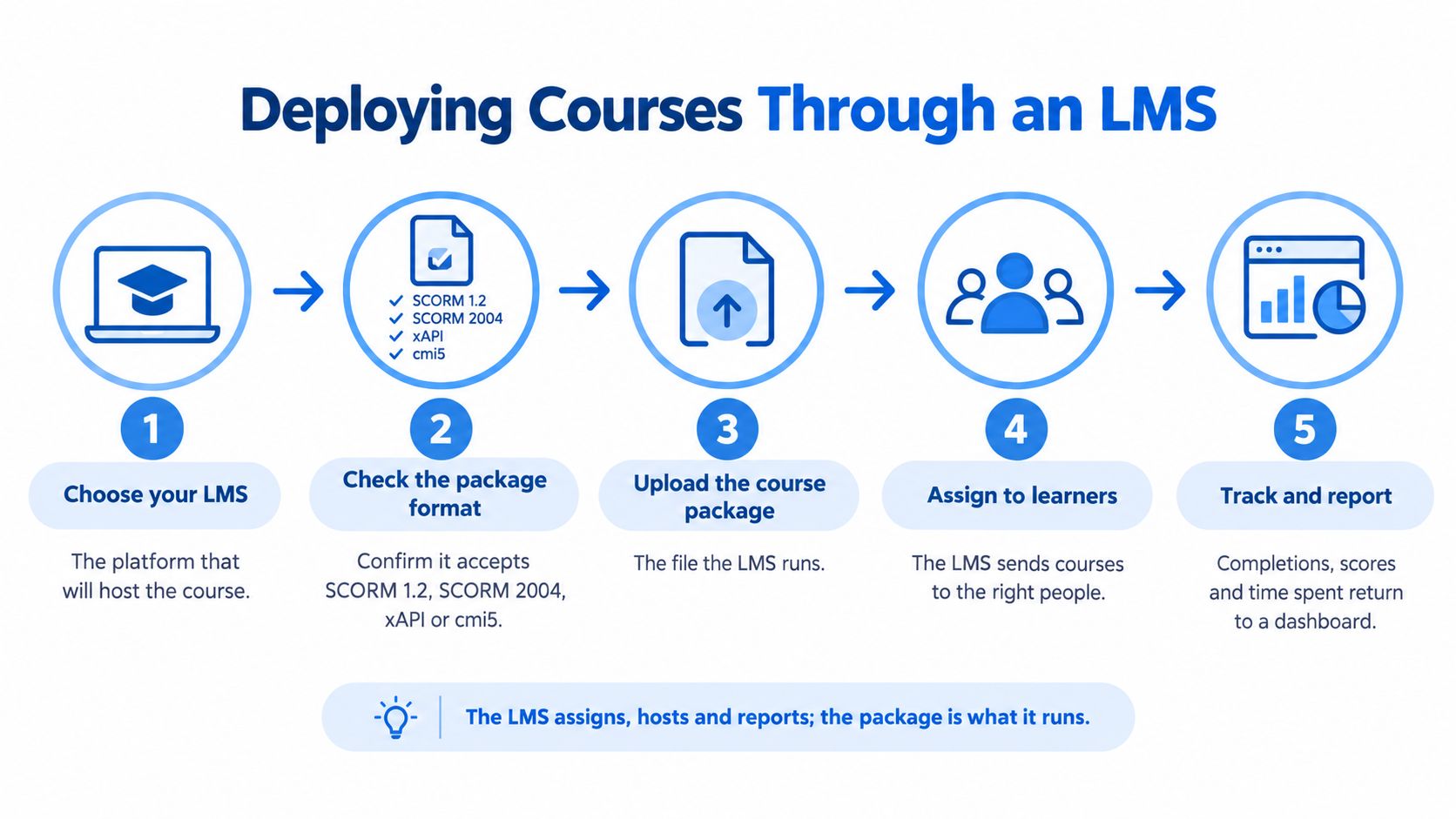
Ask this question first: which LMS will host the course, and which package format does it accept? Buyers often leave it until delivery day, then discover the finished course won't report scores in their system. The LMS assigns, hosts and reports. The course package is what it runs. Those are separate decisions with separate constraints.
| Standard | What it records | Best for |
|---|---|---|
| SCORM 2004 | Completion and score, with richer sequencing and navigation rules | Courses that must be followed in a fixed order |
| xAPI | Any learning activity, sent as statements to a learning record store | Role-play, mobile and on-the-job activity |
| cmi5 | xAPI tracking inside a standard LMS launch structure | Teams wanting detailed xAPI data within a conventional LMS |
SCORM 1.2 and SCORM 2004 record completion, score and pass status, which covers most compliance reporting. xAPI sends activity statements to a learning record store, so it can capture choices inside a role-play or activity outside the LMS entirely. cmi5 adds a standard launch structure inside xAPI, which suits teams who want detailed data without leaving a conventional LMS setup.
Six Deployment Steps
- Confirm the LMS and format: Named platform, named standard, agreed before production.
- Package the course: Export to that standard with assessment metadata intact.
- Upload to a test environment: Never test on the live catalogue your staff can see.
- Run a test learner to completion: Check that the report shows the score and status you expect.
- Set the rules: Pass mark, retake limits and what counts as complete.
- Release and record the version: Log which version went live and when.
We discuss your LMS platform and required format with you up front, and packaging for the finished course and interactive learning is agreed as part of the relevant Premium scope. That sequencing is the whole point. Format is a production input, not a delivery surprise.
The delivery gap behind this is measurable. Ireland's Digital Decade 2025 country report records that 21.58% of Irish firms with more than 10 employees provided ICT training in 2024, and that 14.43% of people with low or no formal education had at least basic digital skills in 2023 compared with 72.91% across the population. A bare LMS won't close that gap on its own.
So design for low-friction access. Captioned video, clear audio, mobile-responsive layouts and short assessment cycles aren't polish. They're what determines whether a frontline worker on a phone in a break room finishes the course or gives up on screen three.
Measuring ROI and Operational Gains
Start with a calculation instead of a claim. This worked example is illustrative. Say a 30-minute compliance course costs €18,000 to produce, and 300 staff complete it across three releases in a year. That's 900 completions, or €20 per completion. That single number is more useful than the production invoice, because it tells you what each trained person cost.
The wider point is about framing. Return on investment for corporate elearning solutions is cost per useful learner, not cost per video. A cheap course nobody finishes, or everybody finishes without learning, is expensive by the only measure that matters.

The Levers That Move the Number
Production cost is only one lever. Reuse across sites and languages spreads it. The cost of each update recurs, so a course that's cheap to build and expensive to amend loses its advantage quickly. Learner time counts too, because 300 people spending an unnecessary extra 20 minutes is a real operating cost. Then come time to competence and audit findings, which is where training either proves itself or doesn't.
The business case is usually about closing a gap. Reporting by RTÉ on Ibec's 2025 Skills Survey found that 82% of companies surveyed reported significant skills gaps affecting their organisations, in a survey of 281 CEOs and senior HR leaders in Ireland. Framed that way, you're not buying content. You're buying a reduction in a gap that's already costing you.
Update speed belongs in the same calculation. If an update cycle that once took eight weeks now takes two, the gain shows up as staff time released and a shorter window where your published course disagrees with your current procedure. That window is risk exposure, and it's often worth more than the production saving.
The short video below walks through how a finished course is assembled and reviewed, which helps when you're judging how much internal time a route will really consume.

Track first-attempt pass rate, time from rule change to live course, audit exceptions, supervisor-observed behaviour change and completion rate. Then respect the limit. Completion rate shows attendance, not competence, so pair it with assessment results and on-the-job checks.
Choose a Production Approach Before You Commit
Choose by fit, not by the cheapest quote. The cheapest quote usually prices the first build and says nothing about updates, sign-off effort or what files you receive. Three routes cover most of the market.
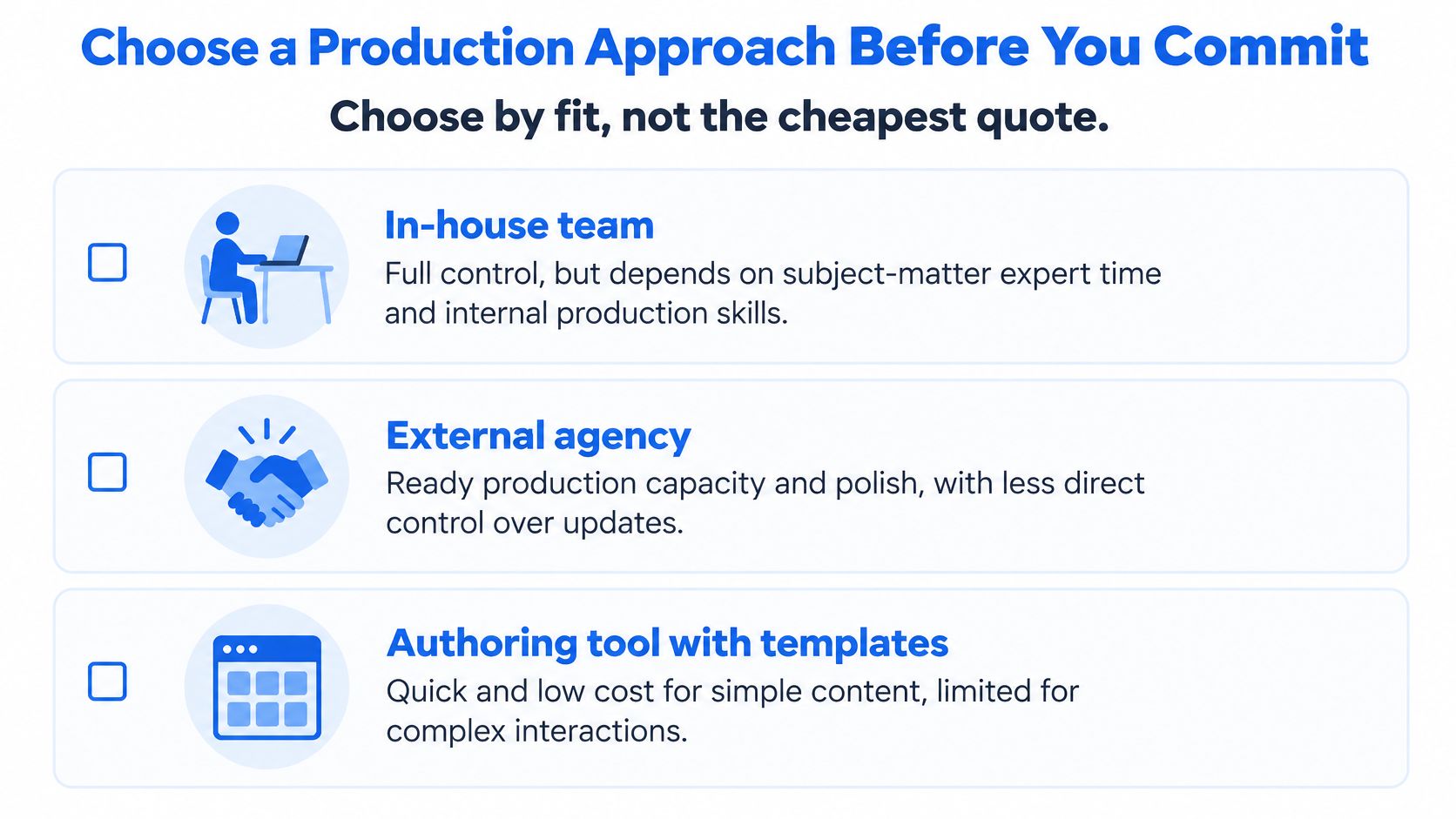
An in-house team gives you control. You set priorities and keep the source files. It depends entirely on subject-matter expert time and internal production skills, and it stalls when the one person who knows the authoring tool goes on leave. A traditional agency or studio brings strong craft and spare capacity, but updates move at agency pace and every change becomes a new commission.
A governed AI-assisted service is the third route. Turnaround is faster and you keep a consistent cast and visual world across a course, but expert review still applies. Faster drafting doesn't remove the need to check facts, thresholds and procedures. It makes the checking more important, not less.
Loresson is one example of that third route, an AI-assisted production service directed by experienced learning, compliance and HSEQ specialists. It produces bespoke cinematic courses with narration, graphics and assessments, with optional interactive role-play, prepared for LMS deployment under client branding. Its Premium scope includes preparation of the course for embedding in the client's LMS or learning platform, with format and interactive features confirmed in the quote. Behind it, Acorn Star has experience delivering training to organisations across Europe. You can read more about how that model works as an eLearning development company before you brief anyone.
Testing Any Provider Against Your Controls
Take your one-page control sheet and test each provider against it. Which controls are in scope, and which stay with you? What's the LMS and format? Who signs off, and at which stage? How are updates triggered and priced? Which files do you receive at handover, including scripts and source assets?
If a provider can't show you their review and version records, you'll be creating that evidence yourself after delivery.
Finish with a concrete step. Write a one-page brief covering the procedure, jurisdiction, audience, LMS and sign-off owner. Send it to two or three providers. Compare their control evidence side by side, not just their showreels and prices.
If you're weighing up corporate elearning solutions and want courses built around your own procedures, jurisdiction and brand, with documented review and LMS-ready delivery, that's what we produce. Send us your procedure, audience, LMS and sign-off owner, and we'll scope the course, the controls and the update route before anything is built. Start the conversation at Loresson.