
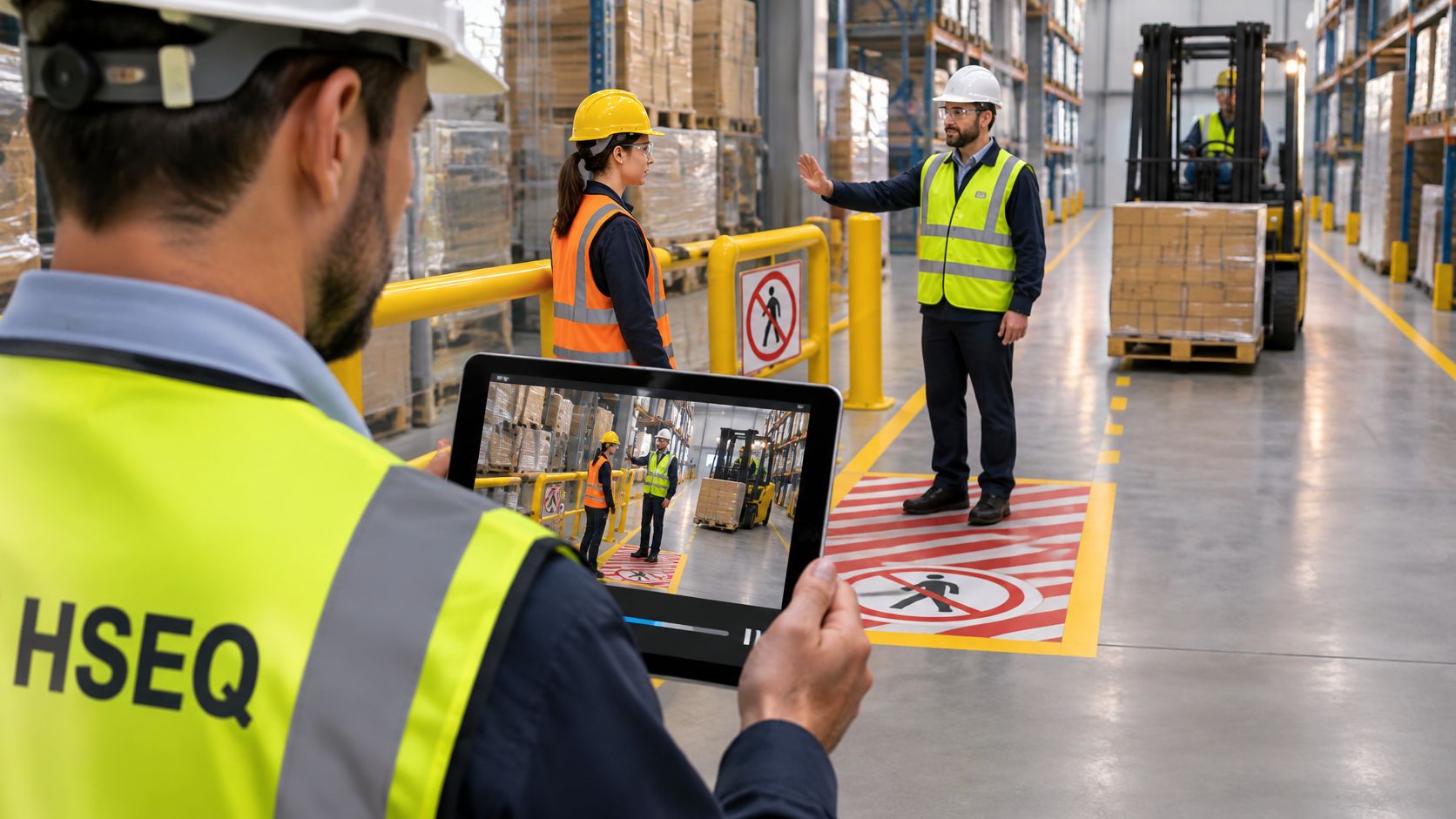
The Health and Safety Authority's 2025 annual report recorded 61 workplace fatalities in Ireland, up from 36 in 2024. Agriculture, forestry and fishing accounted for 27 deaths, or 44% of the total, and more than 59% of fatal-accident victims were aged 55 or older. Those figures challenge the idea that a standard PPE film and a quiz at the end are enough: useful safety training videos need to help people recognise a real hazard and choose the right control in their own work.
Table of Contents
- Why Generic Hazard Films Miss the Risk
- What a Safety Training Video Has to Do
- Fatal Tasks Irish Videos Should Show First
- How a Scenario Teaches the Control in Order
- Three Scenes That Change the Next Decision
- Records That Make a Video Auditable
- Choose a Governed Route Into the LMS
Why Generic Hazard Films Miss the Risk
A worker who knows how to wear a high-visibility vest still needs to know when to stop a vehicle movement, clear a reversing zone or ask a supervisor to reset a plan. A generic film can state a rule, but it often doesn't show how the rule applies when the weather changes, a delivery is late or someone is using unfamiliar equipment. The video should make that decision visible, then connect it to the procedure the worker is expected to follow.
The fatality profile gives Irish employers a reason to be selective about what they commission. In 2025, construction recorded 11 workplace fatalities and transportation and storage recorded five, while more than 59% of people killed in fatal accidents were aged 55 or older, according to the Health and Safety Authority's annual report. That older-worker share matters to how training is made: experienced workers shouldn't be treated as novices, but they still need clear demonstrations when a task, piece of equipment or site condition changes.
A strong scene respects that experience. It can show an experienced operator recognising that a familiar routine no longer fits, and a supervisor intervening without turning the moment into a lecture. Pacing should give the learner time to notice the changing hazard, see the failed barrier and consider the available action. A quiz can check recall, but it can't compensate for a scene that never presented a meaningful choice.
Practical rule: Build the film from the procedure and the hazard, not from a library category such as “PPE” or “slips and trips”.
The right format depends on the learning job. A physical check may call for a live demonstration; a decision under pressure may be clearer in a cinematic scene; and an invisible hazard may need animation. Once the format is chosen, prioritise the tasks that match the site's risk assessment, script the control sequence, and keep the approval and version records with the finished course.
What a Safety Training Video Has to Do
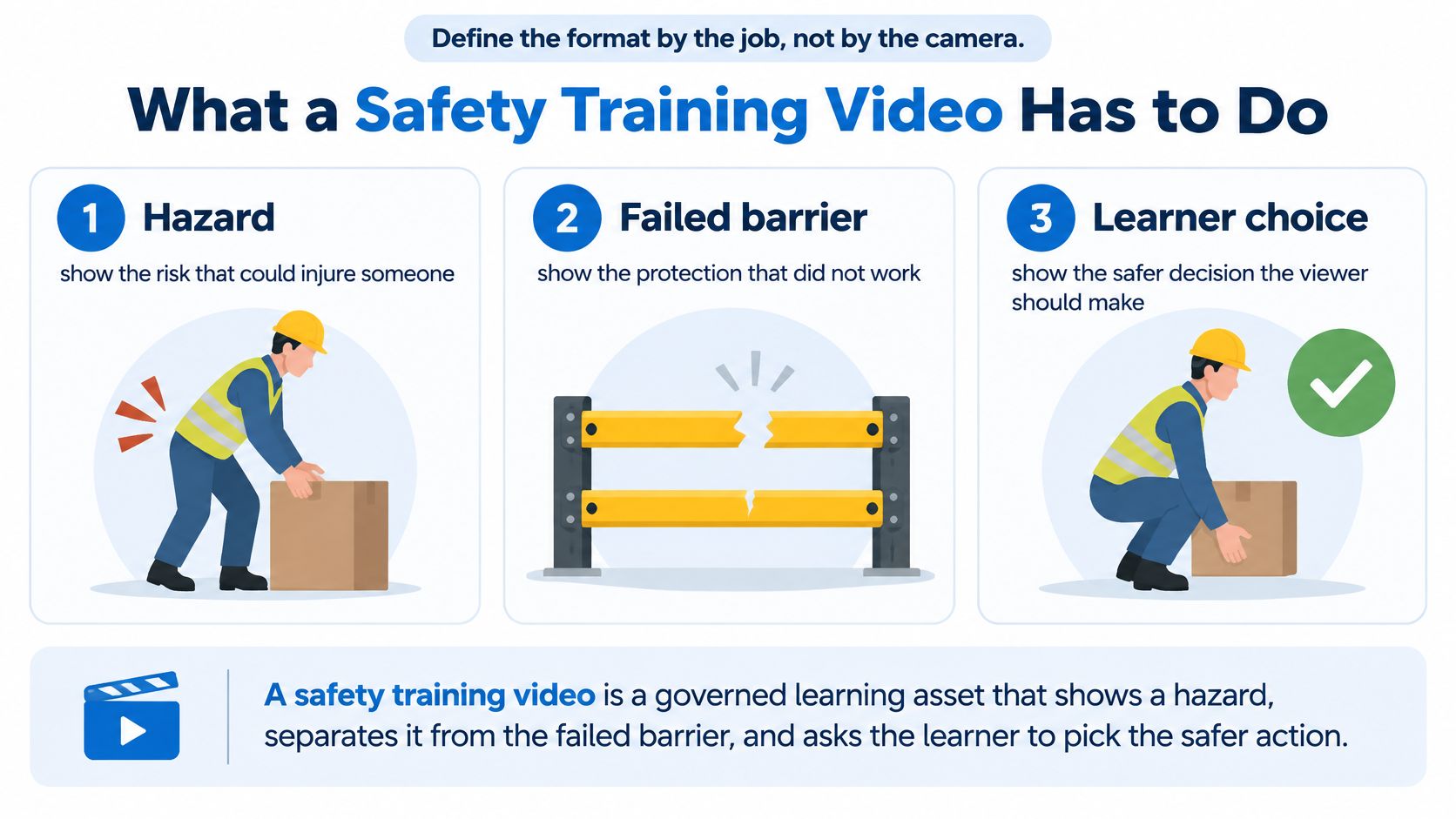
A safety training video is a governed learning asset that shows a hazard, separates it from the failed barrier, and asks the learner to pick the safer action. The camera style is secondary. What matters is whether the learner can recognise the risk and select the control the workplace requires.
| Format | Best job | What it proves | Where it fails |
|---|---|---|---|
| Live procedure demonstration | Copying a physical sequence | The learner sees the order of a check or isolation | Pressure, weather and bad decisions stay off screen |
| Cinematic decision scene | Choosing under time or production pressure | Hazard versus failed barrier is visible | Needs a real procedure or it becomes drama |
| Animation or graphic | Invisible energy, sightlines, exclusion zones | A control that a camera cannot show cleanly | Can feel abstract if it never returns to the site |
| Interactive role-play | Stop-work talk and escalation | The learner practises the words, not only the steps | Weak if the scenario is generic small talk |
| Slide and stock narration | A short policy statement | That a rule was stated | Does not show the barrier or the next decision |
A live demonstration works well for a sequence people must physically copy, such as checking equipment before use. Animation can clarify a blind spot or stored energy that a camera can't easily show, but it should return to the work setting so the learner can connect the graphic to the job. Role-play adds value when the skill is a conversation, such as challenging a colleague or asking a supervisor to stop the task.
Brief the duration around the learning outcome. A single control can often be shown in two to four minutes; a task with a knowledge check may need eight to twelve minutes. A course of about thirty minutes makes sense only when several related controls need to stay together. Longer isn't automatically more thorough, and extra interaction isn't useful if it tests a different skill from the one the film teaches.
For a single outcome, pick one primary format. Combining a studio film, a slide deck and a quiz can muddle the lesson if each presents a different version of the task. A well-scoped health and safety training course should keep the scene, the procedure and the assessment aligned.
Fatal Tasks Irish Videos Should Show First
Start with the hazards that have caused fatal incidents, then check that the same mechanisms exist in the workplace being trained. In 2023, the Health and Safety Authority recorded 43 work-related fatalities among approximately 2.7 million workers, a rate of 1.6 per 100,000 workers. Vehicle-related work caused 13 deaths, and falls, including 11 falls from height, caused 11; together, those mechanisms accounted for almost 60% of fatal incidents, according to the HSA's report on 2023 work-related fatalities.
| Priority | What happened in 2023 | Count | What the video should show |
|---|---|---|---|
| 1 | Vehicle-related work | 13 deaths | Pedestrian segregation, reversing controls, site traffic plan |
| 2 | Falls, including falls from height | 11 deaths | Preparation, equipment inspection, emergency response |
| 3 | Agriculture, forestry and fishing | 20 fatalities | Machinery, vehicles and farm tasks, not an office induction |
| 4 | Construction | 11 fatalities | Height, plant and site controls matched to the method statement |
| Context | Vehicles and falls together | Almost 60% of fatal incidents | Film those two mechanisms before generic topics |
| Context | All work-related fatalities | 43 among about 2.7 million workers | Rate 1.6 per 100,000, up from 38 deaths in 2022, down from 3.4 per 100,000 in 2003 and 2.8 in 2014 |
The same report records a rise from 38 work-related fatalities in 2022, alongside a longer-term decline in the fatality rate from 3.4 per 100,000 workers in 2003 and 2.8 in 2014. That contrast argues for sharper targeting, not a broad campaign that gives every topic equal screen time. It also makes the national figures a useful governance baseline: compare them with the site's risk assessment, then commission only the scenes that match credible serious risks there.
For vehicle work, show how people and moving plant are separated, what the reversing controls require and how the site traffic plan changes behaviour. For work at height, show preparation and equipment inspection as well as what happens if the task can't proceed safely. A helmet shot on its own tells the learner little about whether the work area, access method or emergency response is ready.
Sector-specific versions matter. A farm induction should show the machinery and vehicle movements workers face; a construction scene should reflect the method statement and the plant on site. A cinematic view of a real hazard is more useful than a slide that only says “work safely”, but only when the scene reflects a control the employer can verify.
How a Scenario Teaches the Control in Order
A well-written scenario shows the hazard before it becomes an injury, makes the failed barrier easy to spot and gives the learner a clear opportunity to choose the safer action. In 2024, the Health and Safety Authority recorded 36 work-related fatalities and 10,441 non-fatal incidents. Loss of control of transport or handling equipment caused 13 fatalities and falls caused six, together accounting for more than half of fatal incidents, according to the HSA's 2023–2024 workplace injuries and fatalities review.
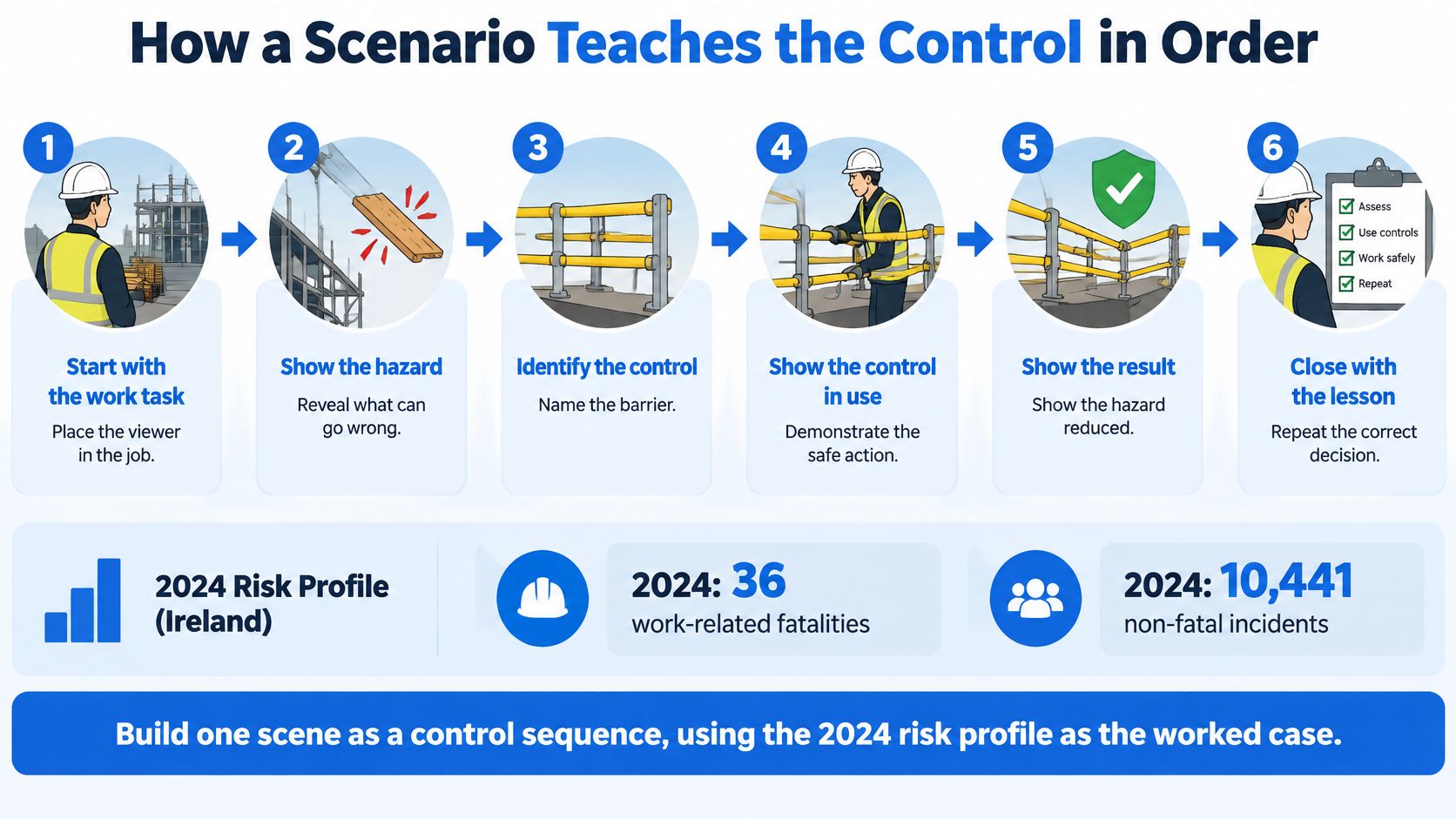
Use this six-beat scene plan:
- Show the initiating hazard. A poor line of sight puts a pedestrian near a moving vehicle; an unstable load begins to shift. Let the viewer recognise the conditions before anyone is hurt.
- Make the failed barrier distinct. Show that the agreed exclusion zone wasn't maintained, or that a load check was skipped. PPE may be present, but it isn't a substitute for the control that failed.
- Demonstrate the safe sequence. Include the relevant pre-use inspection, pedestrian and vehicle segregation, speed and visibility controls, load stability checks and exclusion zones.
- Pause on a real decision. Show the worker stopping the task, securing the area or calling a supervisor when control is lost.
- Test the choice straight away. Ask a scored question that requires the learner to select the control in the right order, rather than recall a slogan.
- Tie the scene to the workplace. Map it to the client's risk assessment and Safe System of Work. Produce a sector variant where the required behaviour changes.
A scene should explain cause and effect. Poor visibility can lead to a vehicle–pedestrian interaction; an unstable load can create a struck-by risk. If the learner only sees a close-up of PPE, the film hasn't made the failed barrier or the next decision clear. Realistic depictions of hazards, accidents, injuries, emergencies and difficult conversations are appropriate when they serve a learning purpose; the depiction can also be adjusted so it remains instructional for the intended audience.
The production team should check every action against the client's procedure before recording narration or building an assessment. Procedure-led training video production can make the scene and its question part of one learning flow, but the test remains practical: can the learner name the hazard, identify the failed barrier and state the next action without needing the narration repeated?
Three Scenes That Change the Next Decision
The most useful training scenes are specific enough to feel familiar and structured enough to teach one safe decision. A farmyard, construction deck or loading bay can each carry a different lesson without reducing the worker to a passive viewer.
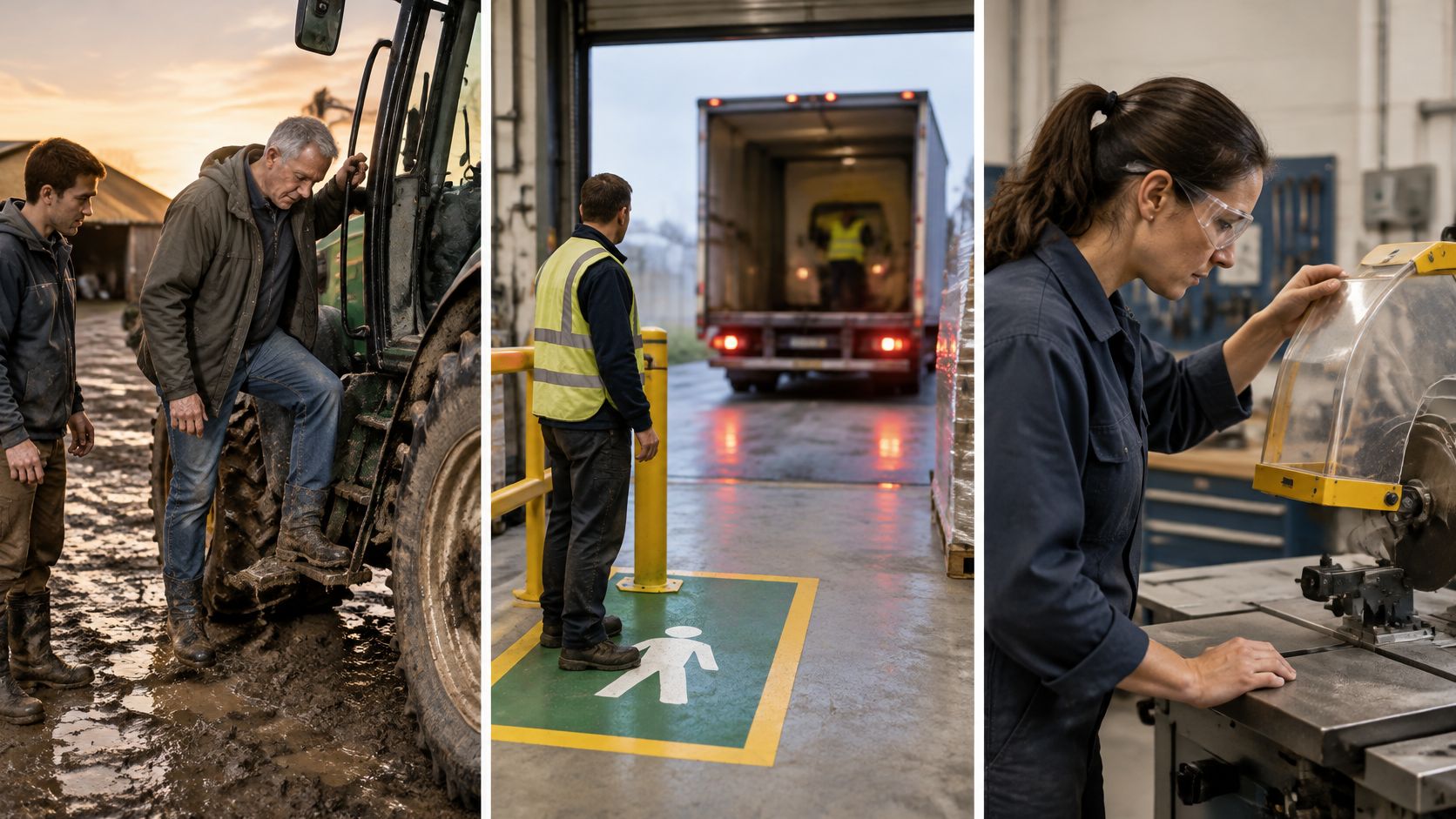
Farmyard at dusk. An experienced operator, over 55, is preparing to reverse a trailer while a younger helper stands on the blind side. The failed barrier is the habit of relying on shouted warnings instead of the agreed exclusion zone. The operator stops, resets the spotter and refuses to reverse until the zone is clear. On-screen text: “Stop. Reset the zone. Confirm it's clear.” Ask: “What must happen before the trailer moves?” The site-specific detail must come from the client's procedure: how the spotter is identified and where the exclusion zone begins. Give the experienced worker room to demonstrate judgement; don't narrate as if they're learning how to do their job for the first time.
Construction deck after a weather change. The crew arrives to find that conditions have changed, and the anchor point described in the task plan may no longer fit the work. The barrier fails if someone assumes the original arrangement still applies. The safe decision is to pause, keep the task on hold and get the supervisor to confirm the control before anyone ties on. On-screen text: “Conditions changed? Reconfirm the control.” Ask: “Who confirms whether work can resume?” The answer must match the client's method and escalation procedure.
Logistics bay under time pressure. A load begins to shift as the team rushes to clear a vehicle. The failed barrier is load stability, not a shortage of high-visibility clothing. The worker calls a stop, keeps people clear and follows the site's procedure for securing and checking the load. On-screen text: “A shifting load means stop work.” Ask: “What do you do before anyone approaches the load?” The handling and exclusion-zone details must come from the client's own safe system.
A short video can show an emergency or difficult conversation when that helps workers practise the response. The scene can be less graphic for a mixed audience without removing the decision or the control. The video below can be used as a reference point for the kind of visual storytelling a workplace scenario can support.
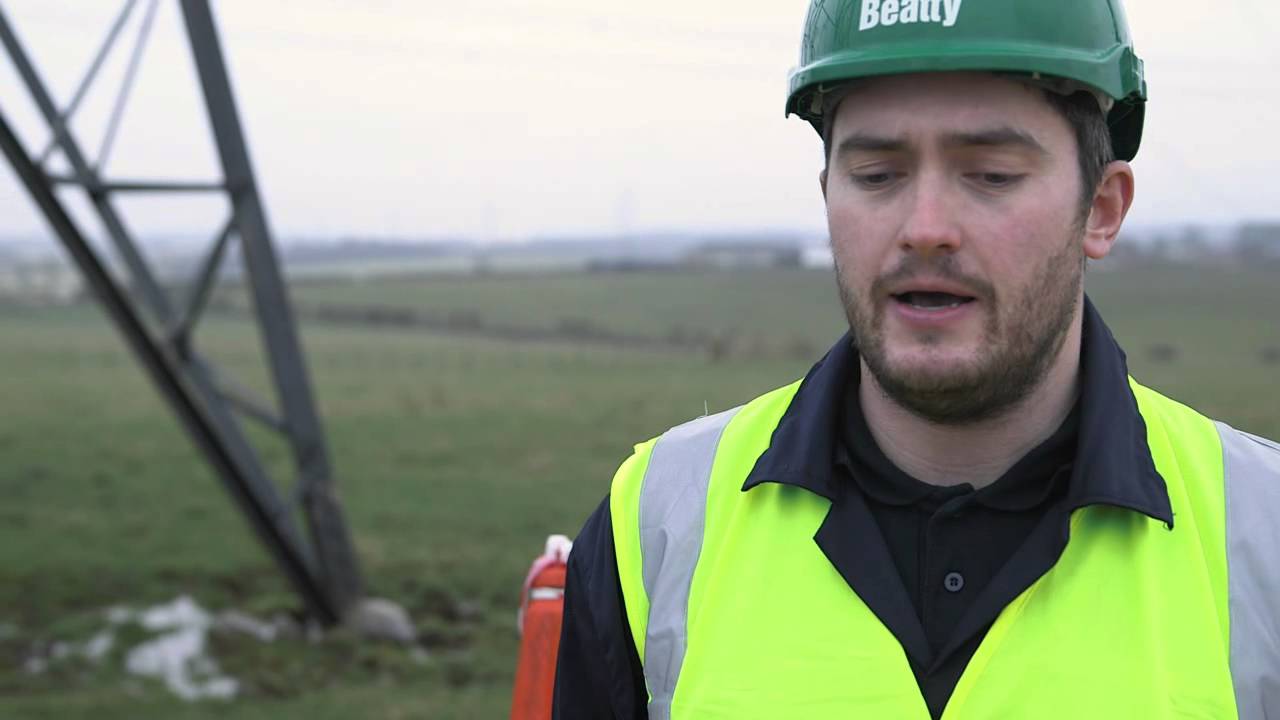
Take one of these situations and rewrite it around a task, procedure, and decision on your own site before commissioning a film. That exercise quickly reveals whether the story is site-specific or still just a stock accident with new branding.
Records That Make a Video Auditable
A film by itself isn't evidence that a learner received the right training or understood the control. The Health and Safety Authority reported carrying out more than 11,600 workplace inspections and investigations in 2024, while its learning platform delivered nearly 74,000 online training courses, according to the HSA's 2024 annual report announcement. For HSEQ teams, auditability starts with keeping the learning asset and its approval trail together.
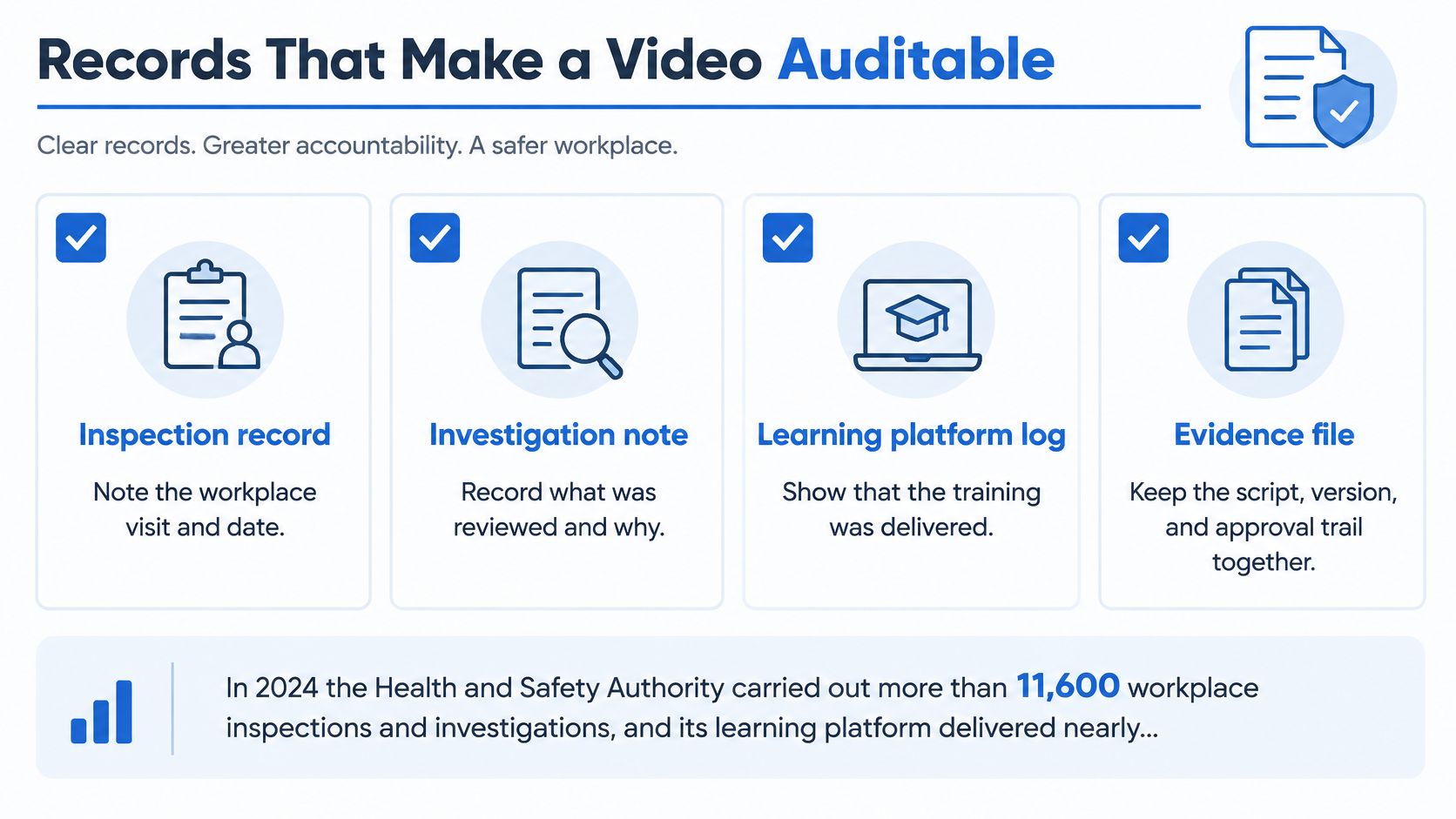
Keep the material that lets someone check what was taught, how it was assessed and which version a worker completed:
- Version-controlled script: retain the approved wording and identify which version went into production.
- Source procedure: keep the risk assessment, safe operating procedure or other workplace document that informed the scene.
- Approval records: record who reviewed the learning, compliance and safety content, and who approved it for use.
- Subtitle files: retain the files associated with each language version so the course can be adapted without losing control of the wording.
- Assessment mapping: show which question tests each critical control and what answer the procedure requires.
- LMS completion record: store the course version beside the learner's result.
Short, decision-focused segments are easier to revise than a long film that combines several unrelated tasks. Put a scored question after each critical control, then keep the question and media together as one course object in the LMS. That structure also makes it easier to replace one outdated procedure scene without rebuilding a whole course.
Set explicit review triggers. Revisit the material after an incident, a regulatory change, an equipment change or a procedure revision. This matters especially in sectors where workplace controls can differ between sites, including construction, agriculture, manufacturing and healthcare.
Use this localisation and LMS path:
- Keep one version-controlled script as the source.
- Produce subtitle files for each site language from that script, so crews don't need to be reshot.
- Load the decision segment and its scored question as one LMS object.
- Store the course version beside the learner result, so a later translation doesn't orphan the completion record.
Two sign-off rules matter. A suitably qualified person must verify safety, technical or compliance training materials before publication or use. The client's internal approval remains central when the course explains a safety-critical action or local requirement. A production team can organise the script, media and records, but it can't replace the client's sign-off.
At audit, the practical question is: which version did this person complete, and which procedure was it based on?
Choose a Governed Route Into the LMS
When a course needs to show a site-specific control, preserve a versioned script and reach the LMS quickly, production should support governance rather than become a separate project that delays it. The client still needs to verify the safety content with a suitably qualified person and approve local requirements before anyone trains on it.
Loresson is an AI-assisted production service directed by experienced learning, compliance and HSEQ specialists. It offers an editor-ready handoff for an in-house editor or agency to finish, and a Premium package that adds expert editing and final assembly, a finished course ready for review and deployment, interactive conversational practice shaped to the workplace, and preparation for the client's LMS. Loresson claims to save 90% of production time and budget compared with traditional bespoke training video production of similar scope, and has trained 120,000 people.
A useful brief includes the procedure, intended audience, jurisdiction, course length and brand rules. That gives the production team a basis for shaping the scene and assessment around the workplace rather than filling a generic hazard template. Choose an editor-ready pack if your team will handle the final cut; choose Premium if you need the course edited, assembled and prepared for review and deployment. For teams developing a complete learning experience alongside the media, eLearning course development can help match the course format to the way learners need to practise the control.
If you're commissioning a site induction, procedure course or safety role-play, Loresson can turn your approved workplace materials into a governed, LMS-ready training package. Visit Loresson with your procedure, audience and learning goal to choose the production route that fits.