

An employee asks their manager for everything the company holds about them. Across the office, someone sends a payroll attachment to the wrong recipient. Both colleagues completed the annual privacy slideshow, but neither knows who to contact next. That's the gap good GDPR training should close: knowing what personal data is helps, but knowing what to do with it matters more.
Table of Contents
- What GDPR Training Is and Why It Matters
- Who Needs GDPR Training and How Often
- Legal Duties Your Training Must Support
- Recommended Course Structure, Module by Module
- Scenario Modules That Change Behaviour
- Assessment Methods That Prove Learning
- Build Your GDPR Training Plan This Quarter
What GDPR Training Is and Why It Matters
A fire extinguisher is useful only if people know when and how to use it. Privacy rules work the same way: a policy sets expectations, while training helps people apply them in daily work.
GDPR training is structured learning that helps people handle personal data lawfully, securely and accountably. Personal data can identify someone directly, such as a name, or indirectly, through details that identify them when combined with other records. Handling it includes reading, collecting, sharing, storing and deleting it.
Training should connect those activities to actual tasks. A receptionist needs to know what they can tell a caller. A manager needs to handle a notebook with employee performance comments as carefully as a digital record.
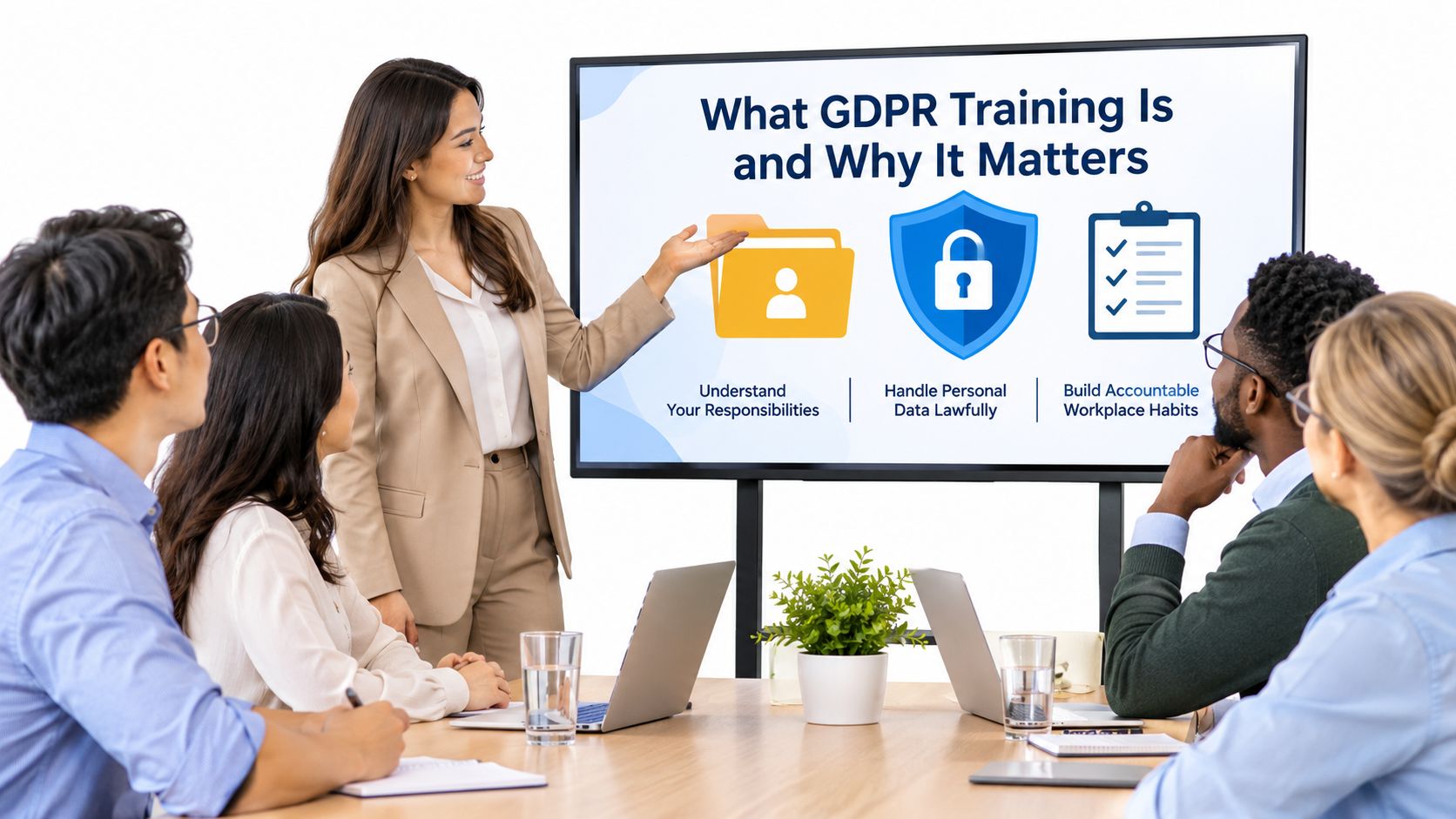
Why Irish organisations need practical capability
GDPR began applying across the EU on 25 May 2018. Ireland's Data Protection Act was enacted on 24 May 2018, and the Data Protection Commission was established, according to the DPC's annual-report material.
In the early months after GDPR applied, the Commission received thousands of complaints and breach notifications. Everyday decisions about recipients, records and requests can affect how an organisation handles these matters.
A useful programme should produce three outcomes:
- Understanding: Staff can explain data protection principles using examples from their work.
- Consistent action: Staff follow the approved procedure when something unexpected happens.
- Evidence: The organisation can show what people learned and how their understanding was checked.
A certificate alone does not show that someone can apply the rules. Training also cannot make an unclear procedure usable. Staff need clear instructions, approved tools and a named person to contact when they are unsure.
Who Needs GDPR Training and How Often
Employees who receive requests deserve particular attention. In its 2025 annual report, the DPC recorded 16,160 new cases, a 45% increase on the previous year; subject-access requests represented 42% of complaints, erasure 17%, and fair-processing complaints 16%.
Access and erasure together made up most complaints. That makes reception, customer service, HR and line management important training audiences, not peripheral ones.
Training should follow the personal data a role touches, not its seniority. Someone answering a shared inbox may need more request-recognition practice than a senior employee who rarely handles individual records.
Who needs GDPR training, by role
The refresh cycles below are suggested planning choices, not statutory intervals. Use them as a starting calendar, then adjust for incidents, changed procedures and demonstrated gaps.
| Role | Personal data handled | Training focus | Suggested refresh |
|---|---|---|---|
| All staff | Email, contact details, personal files | Principles, confidentiality, breach reporting | Annually and at induction |
| HR and people teams | Employee records, payroll, health data | Special category data, access requests, retention | Annually and on policy change |
| Customer service and reception | Caller details, ID checks, complaints | Verifying identity, informal access requests, safe disclosure | Every six months |
| IT and engineering | System logs, databases, backups | Security controls, secure transfer, privacy by design | Annually and on system change |
| Marketing | Contact lists, consent records, analytics | Lawful basis, consent, opt-outs | Annually |
| Line managers | Team records, performance notes | Subject access, retention, avoiding unnecessary extra records | Annually |
| DPO and privacy team | Processing records, impact assessments | Breach handling, regulatory duties, risk assessment | Continuous, with external CPD |
Prioritise exposure rather than headcount
Start with a staff-role list, including temporary workers and contractors who use your systems. Beside each role, record the information handled, the systems used and whether the person receives requests or authorises disclosures.
Health information needs particular care. HR staff may need it for a legitimate workplace process, but that doesn't mean everyone managing the employee should receive the underlying medical details. Teach the boundary between information needed to perform a task and information someone is merely curious about.
Practical rule: Train the people who receive requests and release information before relying on them to recognise a problem unaided.
Keep the baseline for everyone, but add targeted practice where mistakes have greater consequences. A changed customer-verification process should trigger a focused update for the people using it, rather than waiting for the next scheduled course.
Legal Duties Your Training Must Support
A learner doesn't need to recite legislation to handle a record correctly. They need to understand what they're allowed to do, when they must stop and which decisions belong to someone else.
The controller decides why and how personal data is processed. A processor handles it on the controller's behalf. Those distinctions matter when staff use suppliers, commission services or share material outside the organisation.
The principles provide a useful checklist for everyday handling.
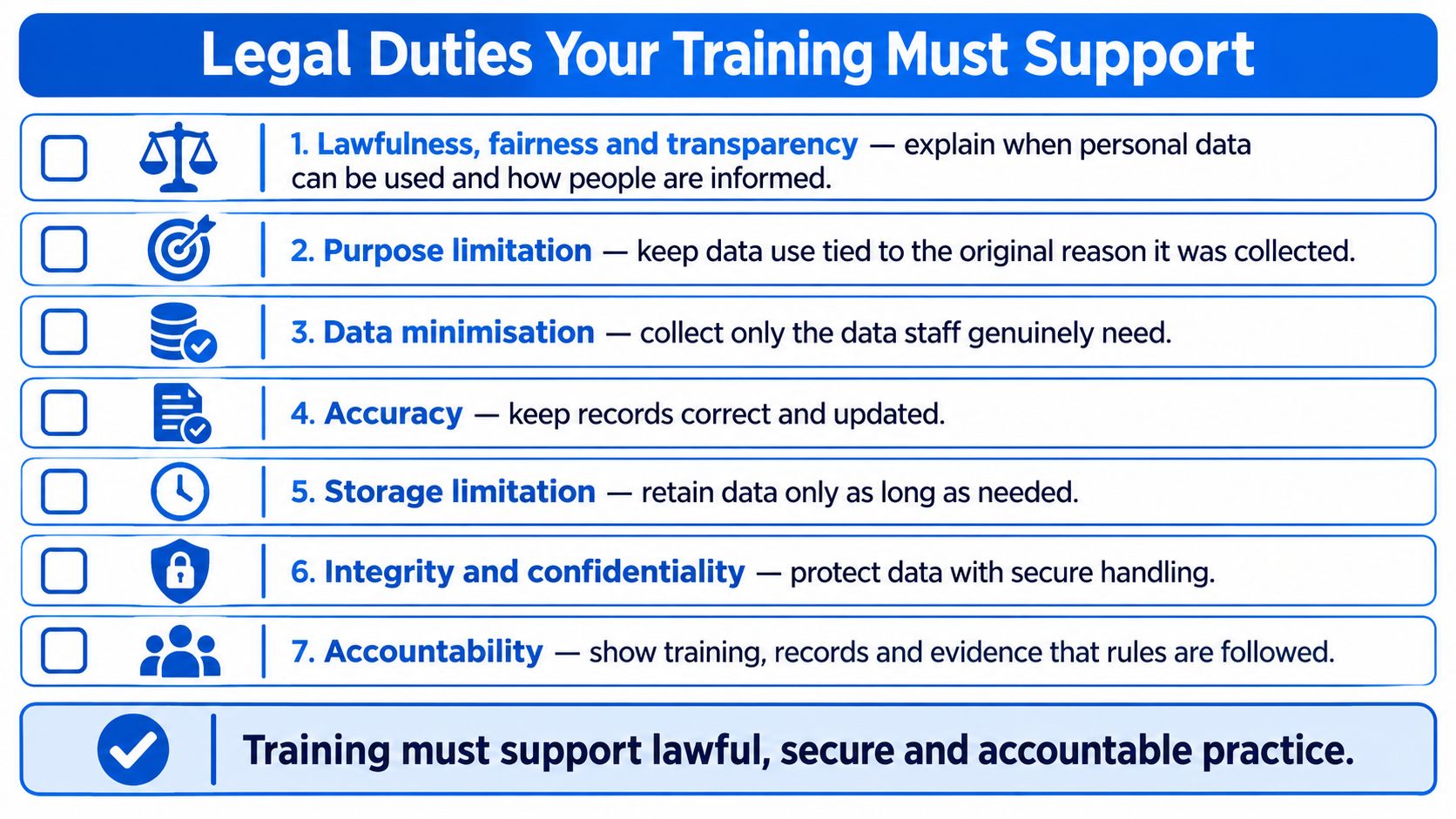
Legal duties and what training must evidence
| Duty | Requirement | What the training must evidence |
|---|---|---|
| Article 5 principles | Lawfulness, fairness and transparency; purpose limitation; data minimisation; accuracy; storage limitation; integrity and confidentiality; accountability | Each principle applied to a daily task |
| Articles 5(2) and 24 | Controller must demonstrate compliance | Training records held for each learner |
| Article 32(4) | Anyone acting under authority processes data only on instructions, unless otherwise required by law | Staff know their processing limits |
| Article 33 | Notify qualifying breaches to the supervisory authority without undue delay, subject to the applicable statutory deadline | Staff spot and report a suspected breach immediately |
| Article 12(3) | Respond to rights requests within the applicable statutory period, managing any permitted extension correctly | Staff recognise and promptly escalate a request |
| Article 39(1)(b) | DPO responsibilities include awareness-raising and staff training as part of monitoring compliance | Documented DPO input or review where appointed |
| Article 25 | Data protection by design and by default | Builders apply protective settings and controls in system work |
Internal escalation isn't regulatory notification. Employees should report suspected incidents through your procedure; the designated response team assesses risk and decides whether notification is required. Don't teach staff to wait until they've proved that a reportable breach occurred.
Likewise, a request shouldn't sit with an employee while they investigate whether an exemption applies. Teach recognition and routing separately from specialist decisions about disclosure.
Turn duties into observable work
For each duty, identify a task and a suitable record. Data minimisation could mean removing unnecessary fields from a collection form. Processing on instructions could mean refusing an unapproved export from the customer database.
Where training production involves personal data, the supplier relationship also needs attention. Our data processing agreement applies when we handle personal data in client briefs, scripts, procedures and other supplied materials.
Course approval is a governance control, not a substitute for these operational safeguards. Have the DPO or qualified reviewer check that the examples, instructions and escalation contacts match how the organisation works.
Recommended Course Structure, Module by Module
Build the course around actions, not a tour of legal terminology. Learners should finish able to recognise a request, choose an approved sharing method and report a suspected incident without guessing.
Start with the common language. Explain personal data and processing before asking someone to decide whether a proposed use is appropriate. Then introduce rights and incident response before testing those decisions in workplace scenarios.
Seven-module GDPR course blueprint
These durations are illustrative course-design allocations, not legal requirements or measured completion times.
| Module | Core learning outcome | Suggested length |
|---|---|---|
| 1. Data protection principles | Apply the principles to a daily task | 15 minutes |
| 2. Lawful basis and transparency | Identify the approved lawful basis for a use and what the individual must be told | 15 minutes |
| 3. Data subject rights | Recognise a request in any channel and escalate it the same day | 20 minutes |
| 4. Breach recognition and reporting | Spot a suspected personal data breach and report it immediately | 15 minutes |
| 5. Secure handling | Choose the correct method for sharing, storing and disposing of personal data | 15 minutes |
| 6. Role-specific scenarios | Make the right call under time pressure in your own job | 30 minutes |
| 7. Emerging technology and AI tools | Decide what personal data may enter an AI tool and what needs approval | 15 minutes |
Principles come first because they explain why a shortcut can be unsafe. Lawful basis follows so staff understand that having access to information doesn't automatically authorise a new use.
Rights training should cover access, correction, erasure and other requests employees may encounter. Teach staff not to promise deletion before the responsible team checks whether records must be retained.
Breach recognition then gives learners a response route when prevention fails. Secure handling supplies the practical alternatives: approved transfer tools, restricted folders, recipient checks and controlled disposal.
Scenarios belong after those foundations because learners need a procedure they can apply. The final technology module tests whether they can transfer that judgement to unfamiliar tools.
Give AI use its own decision process
In its AI Insights Report announcement, the DPC says it engaged with controllers on approximately 180 AI products and services between 2021 and 2025, identifying recurring concerns including lawful basis, transparency and data minimisation.
A useful AI module goes beyond a blanket warning. Give staff an approved-tool register and show what each approval covers. Enterprise access alone shouldn't be treated as permission to upload any document.
Teach learners to check:
- Content: Does a prompt, attachment or output identify someone, even after names are removed?
- Permission: Is this tool approved for this data category and purpose?
- Control: Who can access the material, and how should prompts and outputs be retained?
- Escalation: How should someone report an unapproved tool already in use?
Use synthetic examples rather than real employee complaints in demonstrations. A document labelled anonymous may still identify someone through their role, location and circumstances.
For refresher training, retain the decisions people struggle with and shorten familiar explanations. The training course development process should begin with the audience, procedure and learning outcome, not a fixed slide count.
Scenario Modules That Change Behaviour
A colleague stops a manager in a corridor and asks for everything the company holds about them, including notes about a recent promotion decision. The manager recognises a potentially sensitive conversation, but must also recognise a data-access request.
A training scene can pause at that moment and ask the learner what they would do next.
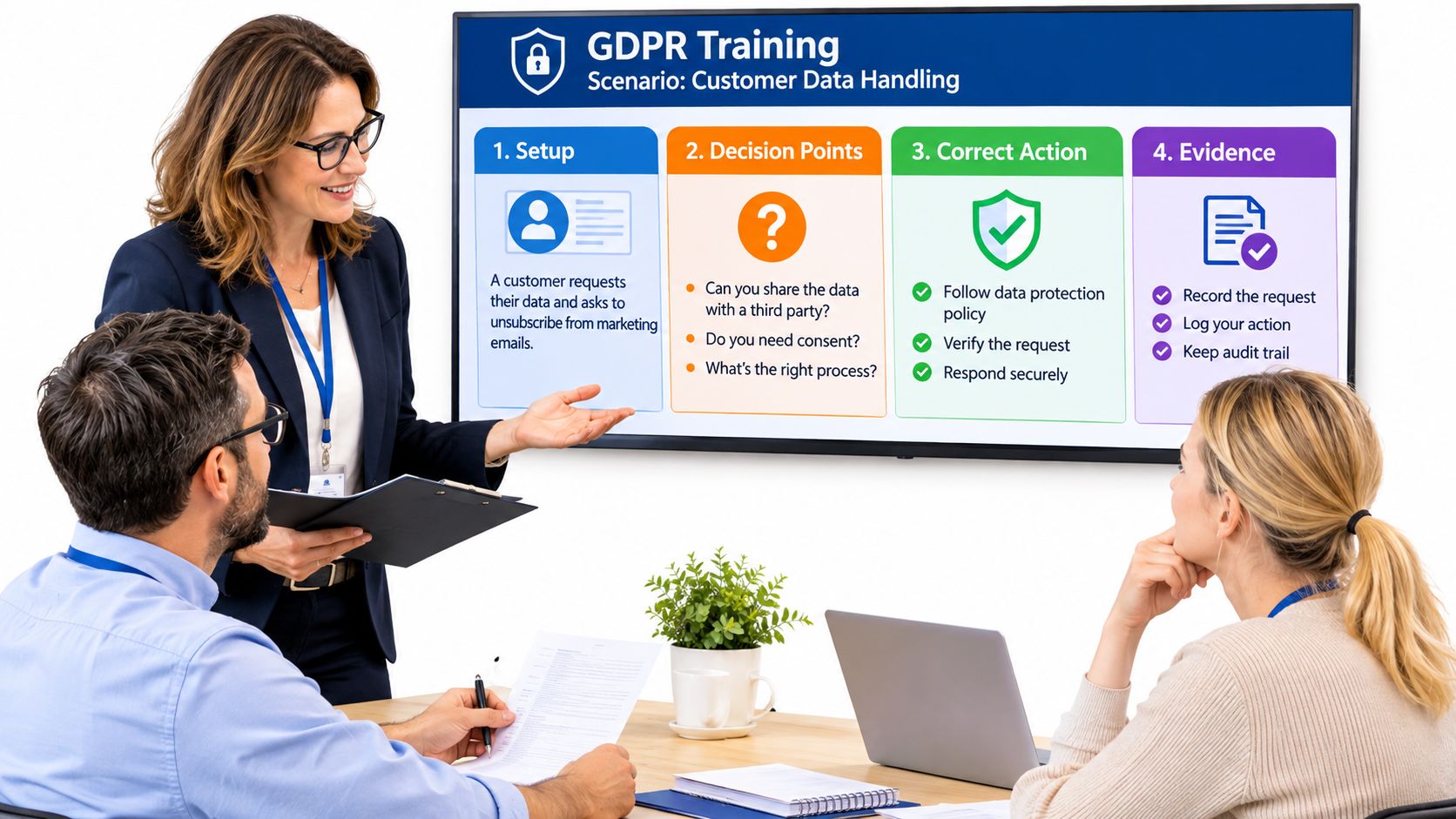
The DPC's data security guidance identifies staff awareness as an organisational security control and recommends scenario-based training to improve how people apply security procedures.
Work through the corridor request
The learner should recognise that the employee hasn't needed to use formal terminology. They should record what was requested and when it was received, then route it to the designated privacy contact.
Identity checks should be proportionate. Asking a well-known colleague for unnecessary identity documents can create another collection problem; sending records to an unverified personal address creates a disclosure problem.
The correct response isn't to start emailing notes. Preserve relevant records, avoid informal disclosure and let the authorised team manage the search, third-party information and response deadline.
Capture the learner's choice, explanation and time taken. A fast but unsafe disclosure is not a successful response.
Test different controls with different incidents
| Scenario | Decision to test | Correct operational direction | Control practised |
|---|---|---|---|
| Payroll attachment sent to the wrong recipient | Report now or quietly try to fix it? | Notify the incident contact, preserve details and follow containment instructions | Incident reporting and secure transfer |
| Caller requests another person's account records | Does knowing account details prove authority? | Withhold disclosure until identity and authority are checked through the approved route | Access restriction |
| Laptop cannot be found after travel | Wait for it to turn up or escalate? | Report promptly, give device and location details, and let IT assess protective actions | Device security and documented response |
For the mistaken email, don't award full credit merely for selecting recall. The learner must recognise that recall may not succeed and that reporting is still necessary.
For the laptop, ask what information IT needs: device identifier, last known location, whether it was locked and what data may have been accessible. Don't expect the employee to determine the technical risk alone.
Use video as a discussion prompt, then ask learners to explain their decision against your own procedure.

Build your own scenarios from incident and near-miss records. Remove identifying details, retain the decision that caused difficulty and define the expected action before writing dialogue. Include a plausible wrong answer, such as asking a colleague informally instead of using the reporting channel, so the assessment tests judgement rather than obvious wording.
Assessment Methods That Prove Learning
A quiz can show whether someone remembers a definition. It can't, by itself, show whether they'll withhold information from an unauthorised caller or report an embarrassing mistake.
Choose the assessment according to the action you need to verify. Use recall questions for vocabulary and practical tests for consequential decisions.
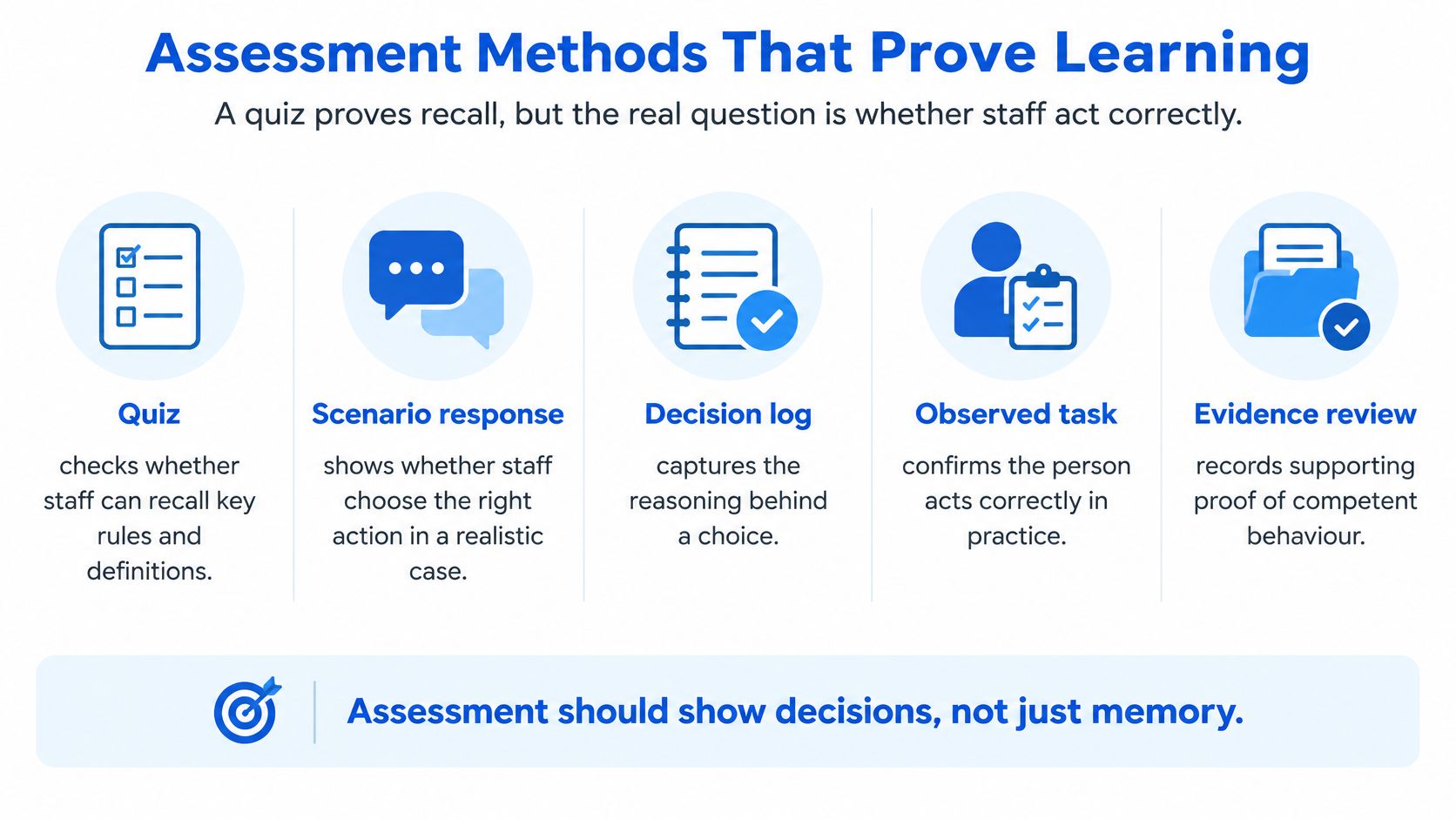
Assessment formats compared
| Format | Best for | Evidence produced | Main limitation |
|---|---|---|---|
| Multiple-choice quiz | Recall of principles and definitions | Score and timestamp | Doesn't demonstrate workplace action |
| Scenario decision test | Rights requests and breach calls | Chosen action and time taken | Longer to write and review |
| Live role-play | Front-line staff and complaint handling | Observer checklist | Resource-intensive at scale |
| Simulated breach drill | Incident response teams | Timed escalation log | Needs a facilitator |
| Manager sign-off on a workplace task | Ongoing behaviour | Signed record | Requires consistent manager judgement |
A decision log adds something a score cannot: the learner's reasoning. Someone might choose the right answer because they understand the procedure, or because the alternatives looked unlikely. Ask them to identify the risk and explain their next action.
Observed tasks reveal whether staff can find the reporting form or apply permissions in the actual system. Keep observations controlled, using dummy records rather than exposing live personal data.
Don't let correct answers about definitions cancel out an unsafe disclosure decision.
Keep an evidence record that explains the result
The DPC's 2024 annual-report material records eight enforcement notices, most concerning failures to respond to access requests. That makes practical request-handling evidence more useful than a certificate saying only that someone attended.
Retain the learner's name, role, module version, completion timestamp, assessment result, attempt history, remediation and content owner. Link the record to the procedure tested so a reviewer can establish which instructions applied at the time.
Set completion criteria around critical actions. A learner who selects unauthorised disclosure should receive a targeted explanation and a different practice case, not just another attempt at the same question.
Before publishing or using materials, arrange verification by a suitably qualified person, particularly for compliance content. Have the reviewer check the answer logic as well as the script; a polished scenario can still reward the wrong decision.
When planning corporate training solutions, agree how results will transfer into the learning platform and who can access them. Protect assessment records too, and review questions after an incident or procedure change exposes a weakness.
Build Your GDPR Training Plan This Quarter
Give the programme a named operational owner. Learning and development can coordinate delivery, while the privacy lead or qualified reviewer checks the legal and procedural content. Managers should make time for practice and follow up where staff need support.
Put the work on the calendar
- Map roles to data. Record the information each team uses and mark roles that receive requests or release records.
- Select relevant modules. Prioritise rights handling, incident response and secure handling where exposure is greatest.
- Agree refresh triggers. Add procedure changes, new systems and failed assessments to the training calendar.
- Arrange qualified review. Resolve unclear instructions before releasing the course.
- Define the evidence record. Decide where results, approvals and course versions will be stored.
- Book the first cohort. Choose a realistic launch date within the quarter and protect the time in staff calendars.
Choose production capacity without outsourcing responsibility
Building internally needs time for scripting, narration, assessment design, accessibility checks and expert review. Commissioning production can help when those skills or resources aren't available.
We produce role-specific scripts, narration, graphics and assessments as editor-ready or finished learning-platform packages. Production can take hours to a week, with bespoke work, human review and interactive elements governed by the scope and timetable agreed in the quotation.
Acorn Star has provided compliance training for organisations across Europe since 2018. That background doesn't remove the need to check each course against the client's actual procedures and local requirements.
AI generation alone doesn't establish compliance with a law, standard, accreditation requirement or employer's training obligations. Internal client approval remains central, especially where materials explain safety-critical actions or local requirements.
Start with one role and one decision that employees currently find difficult.
Choose that role and its first module this week. Give the reviewer an approved procedure and a realistic scenario, then agree what competent performance will look like before production begins.
Loresson offers bespoke workplace training built around your procedures, with scripts, cinematic media, narration and assessments prepared for editing or learning-platform deployment. Visit Loresson with your first audience, approved privacy procedure and request-handling scenario to scope a role-specific GDPR training course and agree the review it needs.