

You've got a new induction to launch next month, a safety procedure that changed last week, and a catalogue course that almost fits but uses the wrong equipment, the wrong terminology and the wrong sequence. Your team can't wait for a long production cycle, but you also can't defend a generic course in an audit. That's the commissioning problem most buyers face, and it's why choosing corporate training solutions well matters more than buying content quickly.
Table of Contents
- Why Corporate Training Solutions Are a Strategic Choice
- Understanding the Core Components
- Compare Off-the-Shelf and Bespoke Training
- Choose the Right Delivery Model
- See Corporate Training Solutions in Practice
- Procure Corporate Training Solutions with Control
- Measure ROI Through the Evidence Chain
- Build a Repeatable Selection Checklist
Why Corporate Training Solutions Are a Strategic Choice

Treat this decision as commissioning a learning system, not purchasing a video. A complete solution connects learning design, production, delivery, practice, evidence and maintenance. If you buy only the visible part, you'll inherit the invisible work later when procedures change, managers ask for proof, or learners can't apply what they watched.
The Irish context makes that distinction practical. The Central Statistics Office Continuing Vocational Training Survey 2020 found 68% of Irish enterprises provided some form of training and 48% provided formal courses, yet only 37% of employees attended training courses. Access also varied sharply, with 52% of employees in large enterprises attending courses compared with 24% in small enterprises, according to the same survey.
Where the Strategic Value Sits
That gap isn't mainly a motivation problem. It's a delivery and access problem, especially for smaller employers and operational teams who can't release people easily or gather everyone in one room. Scalable, deployment-ready training helps because it delivers consistent instruction across sites, shifts and roles without rebuilding the course for every cohort.
Your choice affects four outcomes at once:
- Onboarding consistency: Every new starter gets the same core message, in your language and branding.
- Compliance defensibility: You can show what was taught, which version learners saw and how understanding was checked.
- Operational consistency: Site teams follow one approved procedure instead of local interpretations.
- Update speed: You can revise a module when a policy changes instead of recommissioning the whole programme.
Buyers who frame corporate training solutions this way ask better questions from the start. They don't ask how polished a demo looks. They ask whether the solution fits their procedure, works for their hardest-to-reach learners, produces usable evidence and can be maintained without friction. Those questions drive every decision that follows.
Understanding the Core Components
Think of training like a professional kitchen. The recipe is your source material, a procedure, policy, risk assessment or service standard. Preparation is learning design, where someone decides what learners must do differently and sequences the content accordingly. Service is delivery, and the quality check is assessment. A well-plated dish still fails if nobody can eat it, and a polished course still fails if behaviour doesn't change back at work.
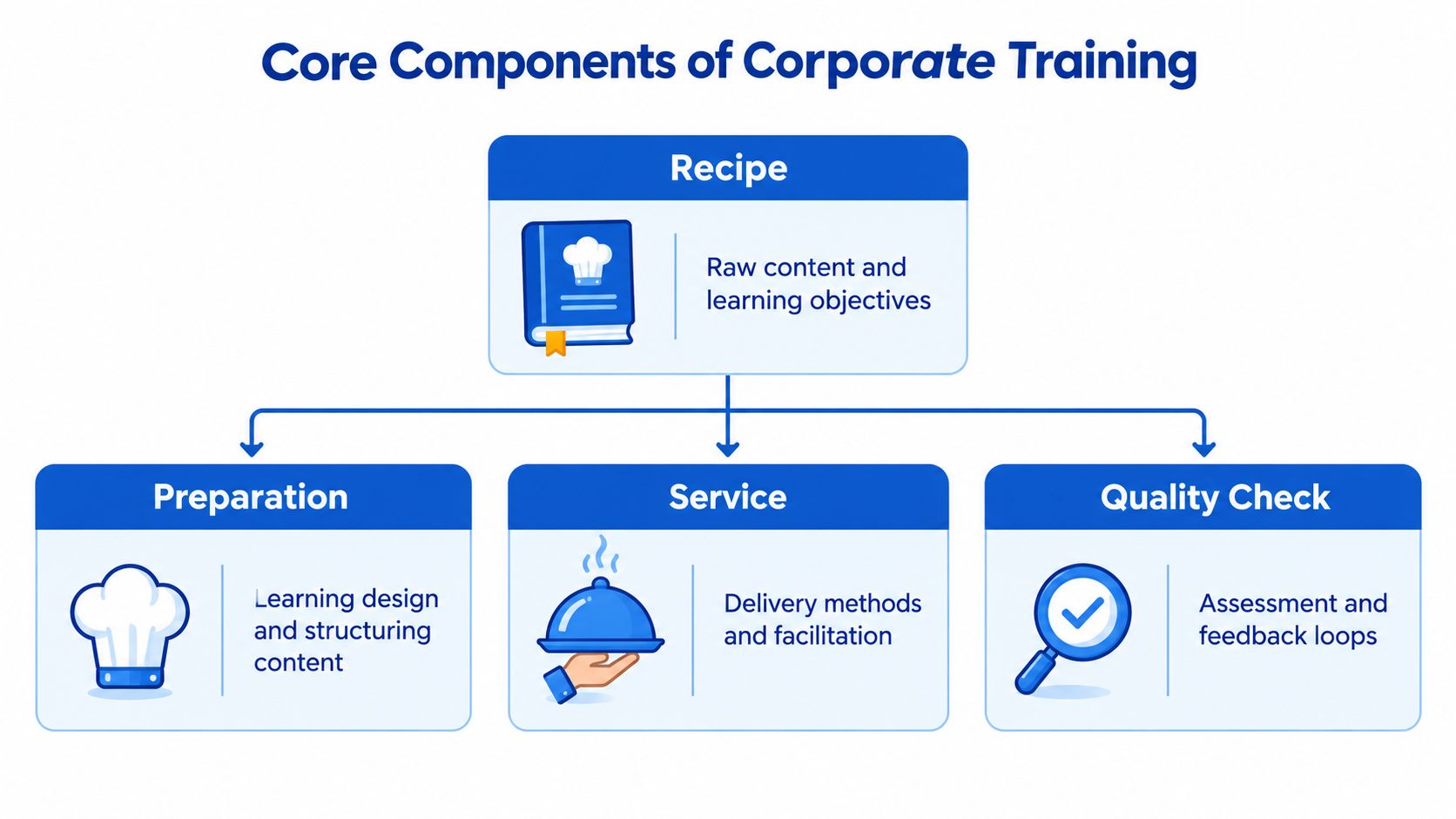
The Components You Need to Name
Use this vocabulary when you brief suppliers, because vague briefs produce vague courses.
- Objectives: The observable actions learners should perform after training, written in plain verbs.
- Content: The approved source material, not a presenter's opinion or outdated slides.
- Delivery channel: The LMS, classroom, mobile device or blended route learners use.
- Interaction: Decisions, questions and practice that force learners to think, not just watch.
- Assessment: Knowledge checks and scenarios aligned to each objective.
- Governance: Review roles, sign-off, version control and update ownership.
- Evaluation: Workplace evidence that shows whether performance changed.
Practical rule: If you can't trace a line from a source requirement to an objective, a practice activity and an assessment, you don't have a learning system yet. You have content.
These components depend on each other. Strong media can't rescue weak objectives. A complex LMS can't compensate for content that contradicts your current procedure. Assessment can't prove competence if it only tests recall of phrases learners saw two minutes earlier.
Ireland already has a strong learning culture to build on. The CSO Business in Ireland 2025 staff training release reports 52.1% participation in lifelong learning among people aged 25 to 69 in 2022, with 62.0% participation among employed adults. Your workforce isn't resistant to learning in principle. Your job is to give that willingness a structure that connects source material to workplace action, then checks the result.
Compare Off-the-Shelf and Bespoke Training
Off-the-shelf training is a standard-issue tool: fast, predictable and economical because the supplier spreads production costs across many buyers. Bespoke training is a tool machined to your tolerances, built around your procedures, roles, vocabulary, equipment and risk profile. The right choice is the one that keeps the evidence chain intact from module design to assessment, workplace observation and refresher decisions.
Off-the-Shelf and Bespoke Training Decision Guide
| Decision criterion | Off-the-shelf | Bespoke | Strongest fit |
|---|---|---|---|
| Initial cost and speed | Low upfront cost, immediate access | Higher design effort, longer lead time | Off-the-shelf for urgent generic topics |
| Content relevance | General examples, standard terminology | Your procedure, sites and roles | Bespoke where errors carry consequences |
| Update control | Supplier controls revisions and timing | You control changes and version history | Bespoke for frequently changing procedures |
| Ownership | Licence only, limited editing rights | Scripts and assets can be contractually yours | Bespoke for localisation and reuse |
| Review burden | Check for contradictions with your policy | Full subject matter review and sign-off | Off-the-shelf where alignment is already high |
| Maintenance | Supplier maintains, you accept their roadmap | You fund and schedule revisions | Depends on internal capacity |
Standard content works well for stable, universal topics where your organisation has no distinctive procedure, for example general data protection awareness or introductory management concepts. It still needs a local check: confirm examples, terminology and assessment thresholds do not contradict policy, then observe whether learners apply the generic rule correctly on real tasks. Configurable courses sit in the middle. You keep a proven structure but add your branding, policy links, examples and assessment thresholds. Choose that middle route when the core content is sound but learners need local context to trust it.
Full bespoke production earns its complexity when a wrong action creates safety, legal, financial or reputational harm, or when generic examples actively mislead learners. If your lockout sequence, escalation route or customer script differs from the catalogue version, don't ask learners to translate on the job. Commission content that matches the work, and specify editable scripts, assessment banks, source files, version history and named review sign-off so procurement can control updates later.
Newer production methods have changed the cost calculation. Loresson's bespoke e-learning development page states its AI-assisted bespoke production can achieve reductions of 90%+ in production cost and delivery time versus traditional bespoke video-led training of similar scope. Treat any such claim as a supplier statement to test against a like-for-like quote, not as a reason to skip review. AI-assisted production can compress scripting, narration and media assembly, but human reviewers must still verify accuracy, tone and compliance before content reaches learners.
Apply one rule consistently. Buy standard where alignment is already high and evidence can be gathered through existing checks. Commission bespoke where weak transfer or an incorrect action would carry material consequences, and where owned source files make refresher decisions cheaper to execute.
Choose the Right Delivery Model
Production decisions decide what learners encounter. Delivery decisions decide who does the work, the learner, a facilitator, the LMS or the workplace itself. Choose based on where practice and feedback need to happen, not on fashion.
The four main models differ sharply in engagement and supervision.
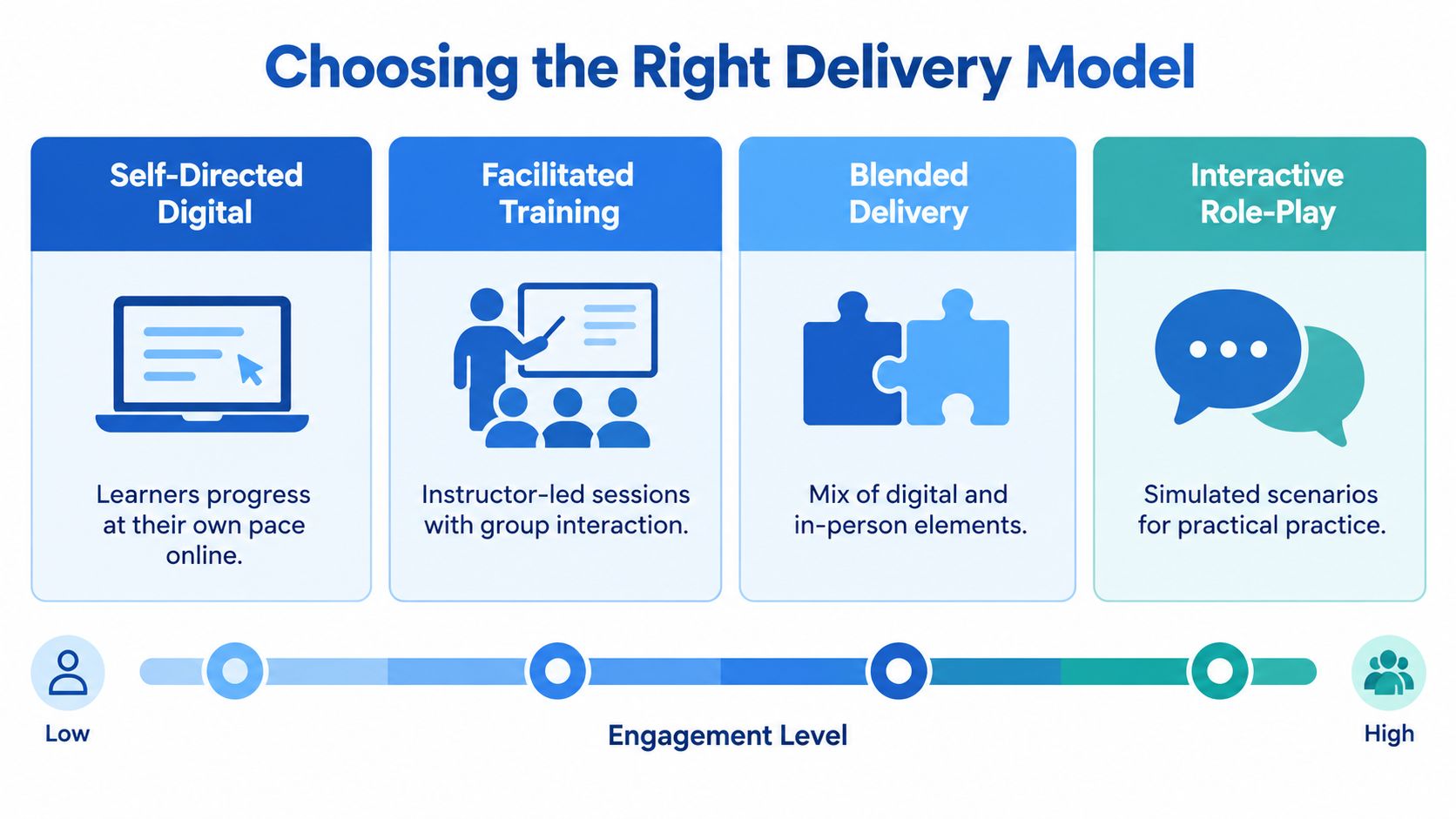
How Each Model Divides the Work
Self-directed digital learning puts pacing and completion with the learner, while the LMS handles access, tracking and reminders. It suits knowledge transfer, policy updates and refresher content for dispersed teams. It fails when learners need supervised practice or when frontline staff lack quiet time, devices or bandwidth.
Facilitated training puts explanation, discussion and correction with a trainer. It works for sensitive topics, complex judgement and groups who learn by challenging each other. It costs more in scheduling and travel, and quality varies with the facilitator unless you provide tight guides and observation.
Blended delivery combines both, but it isn't automatically better. It's useful only when each element has a distinct job, digital content for core knowledge, live sessions for discussion and workplace tasks for supervised practice. If you blend formats without assigning those jobs, you've just made the programme longer.
Interactive role-play lets learners rehearse consequential conversations safely. A customer service adviser, for example, can practise de-escalating an angry caller, choose responses and see consequences branch, without exposing a real customer to an untested approach. That rehearsal is where judgement develops.
Watch how a structured digital course presents content and checks understanding before you decide what should stay live.
Before you commit, consider these selection questions. How large and dispersed is the audience? Do learners need captions, transcripts, plain language or mobile access? Can managers realistically reinforce the learning, or will they only chase completions? Does regulation require observed competence, or is a knowledge check sufficient?
A delivery model that your hardest-to-reach learners can't access on a normal shift isn't a solution, however elegant it looks in a demo.
Match the model to the evidence you need. If an auditor or manager must see someone perform a task, build observation into the design from the start instead of bolting it on after launch.
See Corporate Training Solutions in Practice
Representative scenarios show how the same principles produce different designs. Don't copy one pattern across every workforce. Identify the learner's job, the evidence required and the trigger that will force an update.

Induction Where Consistency Matters
A multi-site employer needs every new starter to hear the same welcome, values, safety basics and escalation routes in week one. Bespoke digital modules carry the branded context and site-specific details, while managers run local introductions. Evidence is completion plus short scenario questions on policies that matter most. The update trigger is any policy or organisational change. If you're scoping this use case, look closely at how employee onboarding training structures that first-week experience.
Manufacturing and HSEQ Procedure Training
Here the learner's job is to execute a sequence correctly under real conditions. Production starts from the approved procedure and risk assessment, not from a generic script. Each module maps a source requirement to a demonstration, a decision point and a knowledge check. Supervisors then observe the task on the floor and record a competence decision. Review records and version control matter as much as the media, because an auditor will ask which procedure version the learner was assessed against. The update trigger is a procedure revision, incident finding or equipment change.
Customer Service Role-Play
Contact centre teams don't fail for lack of product facts. They fail in live conversations where tone, timing and judgement collide. Interactive role-play built from real call types lets advisers practise complaints, vulnerable customer disclosures and service recovery. Branching feedback shows why one response calms a caller and another escalates the call. Evidence combines scenario scores with quality monitoring of real calls afterwards. Scripts are updated when products, offers or regulatory wording change.
Operations Teams Who Want Production Control
An internal team with editing capacity may prefer an editor-ready package, organised scripts, narration, graphics and labelled media they assemble themselves. They keep control of the final cut and future edits, while structured assets reduce assembly overhead. Evidence requirements and assessment design still need to be agreed upfront, otherwise the finished course looks coherent but tests nothing useful.
Across all four scenarios, the pattern holds. The production approach, delivery model and evidence type change together, driven by the consequences of getting the task wrong.
Procure Corporate Training Solutions with Control
Good procurement prevents most training failures. Write the controls into the brief and contract, because you can't negotiate ownership, review rights or acceptance criteria easily after production starts.
A Disciplined Procurement Sequence
- Write a performance brief: Name the audience, the task that must improve, current failure modes and how you'll recognise success.
- Fix source materials: Supply the approved procedure, policy or standard and identify who owns its accuracy.
- Define learning outcomes: Agree observable objectives and assessment criteria before any scripting begins.
- State delivery assumptions: Specify LMS format, devices, bandwidth, session length and facilitation needs.
- Specify accessibility: Require captions, transcripts, plain-language narration and keyboard-friendly interaction where relevant.
- Assign review roles: Name subject matter, compliance and brand reviewers, with response times and final sign-off authority.
- Set acceptance criteria: Define what counts as complete, including accuracy checks, technical testing and evidence outputs.
Then choose your ownership model deliberately. A supplier can deliver finished media only, an editor-ready package with scripts and organised assets for your team to assemble, or a fully finished course including authoring and LMS-ready delivery. Each option shifts cost, control and maintenance responsibility. Don't discover at handoff that you own a video file but not the script you'd need to localise or revise it.
Require clarity in writing on scripts, source files, narration, graphics, assessment banks, review records, localisation rights and version control. When comparing suppliers, examining how an e-learning development company documents those deliverables will tell you more than a showreel will.
Insist on human review wherever generated media enters governed learning. AI-assisted production can draft scripts, narration and visuals quickly, but a named expert must verify technical accuracy and a compliance reviewer must sign off HSEQ or regulatory content. Keep those roles separate in the contract.
Finish procurement with rollout, not file delivery. Agree who uploads and tests the course, who briefs managers, who handles learner queries and who owns refreshes when procedures change. Knowledge transfer to your team is a deliverable. Price it, schedule it and accept it formally.
Measure ROI Through the Evidence Chain
Completion isn't competence. An LMS record proves someone reached the end of a course. It doesn't prove they can isolate equipment safely, handle a disclosure correctly or follow your escalation route under pressure. If you report completion as ROI, you'll overstate impact and miss real risk.
The measurement gap is well documented in Ireland. The CSO Continuing Vocational Training 2015 release reported 77% of private-sector enterprises with at least 10 employees provided some continuing vocational training, but only 49% routinely assessed training outcomes and just 24% had a formal training plan. High participation with weak assessment is exactly how organisations mistake activity for capability.
Build the Chain Link by Link
- Business objective: The operational problem you're solving, stated before production.
- Source requirement: The procedure, regulation or standard the training must satisfy.
- Module objective: The specific action each section teaches.
- Knowledge check: Scenario or branching questions that test decisions, not recall alone.
- Observed performance: Supervisor observation, quality sampling or practical assessment at work.
- Refresher trigger: Failed checks, incident patterns, procedure changes or time-based review.
- Retained evidence: Records linking the learner, course version, result and competence decision.
Defensible test: Could you show an auditor, line by line, how a requirement became a taught action, an assessed decision and an observed result? If not, your evidence chain has a gap.
Measure costs accurately across the whole system. Include authoring, media production, expert review time, platform administration, learner time away from work, manager observation and future updates. Production efficiency matters, but a cheap course that nobody can apply is expensive in operational terms. Equally, don't claim a universal financial return you can't substantiate. Report what you can verify, improved assessment pass quality, fewer repeat errors in sampled work, faster time to supervised competence, and label the rest as qualitative.
Role-specific scenarios improve evidence quality because they test the decisions people face. Governance records then establish which procedure and course version were assessed, so your data stays meaningful when content changes. That traceability is what turns corporate training solutions from a content spend into a managed control.
Build a Repeatable Selection Checklist
Use this sequence every time you commission training. It prevents the common drift where a supplier demo, a deadline or a stakeholder preference decides the design before you've defined the problem.
The Selection Sequence
Start with the performance problem. Write down what people should do differently, where errors occur now and what those errors cost operationally. If you can't describe the problem without mentioning a course, you aren't ready to buy one.
Next, choose the production route. Test off-the-shelf content against your actual procedure and terminology. Commission bespoke production only where misalignment creates risk or rework, and confirm you'll receive editable assets for future revisions.
Then select the delivery model based on practice and evidence needs. Confirm your hardest-to-reach learners can access it on real shifts, with real devices, in the time available to them.
Finally, document procurement controls and agree the evidence required before commissioning. That order matters. Evidence agreed after production usually becomes whatever the LMS happens to record.
Final Checklist Before You Sign
- Accessibility confirmed: Captions, transcripts, plain language and mobile or low-bandwidth access where needed.
- Source accuracy owned: A named expert verifies content against the current approved procedure.
- Review authority clear: Subject matter, compliance and brand sign-off roles are separate and scheduled.
- Asset ownership contracted: Scripts, source files, narration and assessment banks are explicitly covered.
- Version control working: Every course version links to the procedure version it teaches.
- Localisation planned: Text, narration and graphics can be adapted without rebuilding the course.
- Learner support assigned: Managers know their reinforcement and observation role.
- Revision triggers set: Procedure changes, incidents and assessment results prompt updates automatically.
The strongest option isn't the most cinematic, interactive or automated one in isolation. It's the option whose content, practice, governance and measurement stay aligned as your work changes. Choose corporate training solutions that keep that alignment under your control, and you'll spend less time recommissioning courses and more time improving performance.
If you need bespoke training built from your own procedures, with governed review, LMS-ready delivery and evidence you can defend, Loresson produces editor-ready or fully finished courses in hours to one week. Visit the site to discuss your brief, compare production options and commission training designed around your workforce, not a generic catalogue.