

Self-employed people represented 53% of the 43 work-related fatalities in 2023 recorded by the Health and Safety Authority. That single figure reframes Compliance Training in Ireland. It cannot be designed only for large employers, permanent staff or tidy classroom cohorts, because much of the serious harm happens outside that model.
A useful Irish programme works as an auditable control system. It names the hazards in your safety statement, teaches the controls for the actual task, checks whether the person can make the right decision, and records who approved the version they passed. A certificate that says someone attended is only the start of that file.
Table of Contents
- Why a Generic Course Fails in Ireland
- What Each Sector Must Train and Prove
- Hazards Irish Scenarios Should Test
- Evidence That Stands Up at Audit
- Small Construction Sites and Missing Cards
- How to Update Courses When Rules Change
- Choose a Package That Can Be Signed Off
Why a Generic Course Fails in Ireland
A manager buys a tidy overseas module, changes a few place names and issues it to every site. Staff complete it, the dashboard turns green, and nothing in the record shows whether the content matched an Irish risk assessment, an Irish card requirement or the controls on that site. When an inspector calls, the question is whether the training maps to the hazards named in your safety statement, and a completion tick cannot answer that.
In 2024 the HSA conducted more than 11,600 workplace inspections and investigations, focusing particularly on construction, agriculture, manufacturing and healthcare, according to its 2024 annual report press release. The same release recorded 10,441 reported non-fatal workplace injuries in 2024, 3% above the 10,113 reported in 2023 and 14% above the preceding five-year average.
That inspection tempo and injury count point the same way. Enforcement attention follows the hazards.
National access is not your system
The same annual report recorded 73,890 completed e-learning courses in 2024, comprising 43,843 taken directly on hsalearning.ie and 30,047 accessed through HSeLanD. Those figures show strong national demand for accessible digital learning. They sit alongside, and cannot replace, an employer's own duty under the Safety, Health and Welfare at Work Act 2005 to provide information, instruction, training and supervision for the work that employer controls.
A national completion count proves people can reach courses. Your file still has to show your worker was trained on your procedure.
Irish compliance training has to sit under your safety statement and the hazards named in your risk assessment. An imported module fails that test when it teaches the wrong controls, skips SOLAS Safe Pass or CSCS duties where they apply, or produces records nobody can trace back to a procedure version.
Run a simple check before you buy or renew. Pick three hazards from your safety statement, find the scenario that teaches each control, then ask what record a learner leaves behind. If the answer is a name and a date, the file proves attendance. An auditor needs a result tied to a hazard, a procedure version and a decision the learner made.
What Each Sector Must Train and Prove
Mark your rows first. If a row touches your premises, your vehicles, your contractors or a visiting trade, it's in scope for your brief.
| Setting | Priority content | Cards or national learning | Evidence to keep |
|---|---|---|---|
| All workplaces | Safety statement, risk-assessment controls, emergencies, role instruction | No single national card for every job | Induction record linked to the safety statement and procedure version |
| Construction | Site induction, work at height, vehicles, task competence | SOLAS Safe Pass; CSCS where the task requires it | Identity, card or course status, site induction, supervisor confirmation |
| Agriculture | Vehicles and machinery, livestock, lone work, older workers | Farm safety statement; HSA learning where used | Instruction record for employees, family and regular contractors |
| Manufacturing and logistics | Machinery, chemicals, vehicle-pedestrian movement | Task-specific instruction; no universal card | Procedure version, assessment, and permit or authorisation where used |
| Healthcare | Infection control, patient handling, local clinical procedure | HSeLanD modules may supplement local training | Local induction plus any national completion, tied to the role |
| Contractors, agency and self-employed | Same site hazards as direct employees | Safe Pass or CSCS if the construction task requires them | Who inducted them, which version they saw, and expiry or exception notes |
How to read the rows
All workplaces owe information, instruction, training and supervision, a written safety statement, and induction matched to the risk assessment. There's no universal Irish licence card that covers every job, so don't invent one in your course brief. Your record should link the person to the safety statement and the procedure version they were taught. Broader health and safety training only becomes defensible when that link is clear.
Construction adds named card checks. Safe Pass applies to many site workers and CSCS applies to specified tasks, but neither card replaces a site-specific induction. A worker can hold a valid card and still not know your traffic route, your exclusion zones or today's lift plan.
Agriculture needs vehicle and machinery scenarios, livestock handling, and honest treatment of lone work and older workers. Don't design only for a large payroll. Family members and regular contractors who do the work need instruction that's recorded, paced and clear enough to use.
Manufacturing and logistics usually turn on machinery guarding and isolation, chemicals, and how vehicles and pedestrians share space. Most tasks have no universal card, so competence evidence matters more. Keep the procedure version, the assessment result, and any permit or authorisation together.
Healthcare covers infection control, patient handling and local clinical procedures. HSeLanD modules can support that learning, but a national module isn't the entire employer duty. Local induction still has to cover the ward, the equipment and the escalation route the person will use.
Contractors, agency staff and self-employed people stay in the same system as direct employees for site hazards. Your record should say who inducted them, which version they saw, and when a card or refresher expires. Tick every row that touches your sites, including visiting trades who are only there for a morning.
Hazards Irish Scenarios Should Test
Start with the mechanism, the thing that kills people: a reversing vehicle, a suspended load, an unprotected edge. The Health and Safety Authority recorded 36 work-related fatalities in 2024, with vehicle-related incidents causing 10 deaths, heavy or falling objects causing 6 and falls from height causing 5, in its 2024 fatality rate release.
Twenty-one deaths across three causes, more than half the total.
A hazard scenario works like a fire drill. It rehearses a decision under pressure, while a general warning only describes the danger. The table below turns each mechanism into the behaviour your assessment should observe.
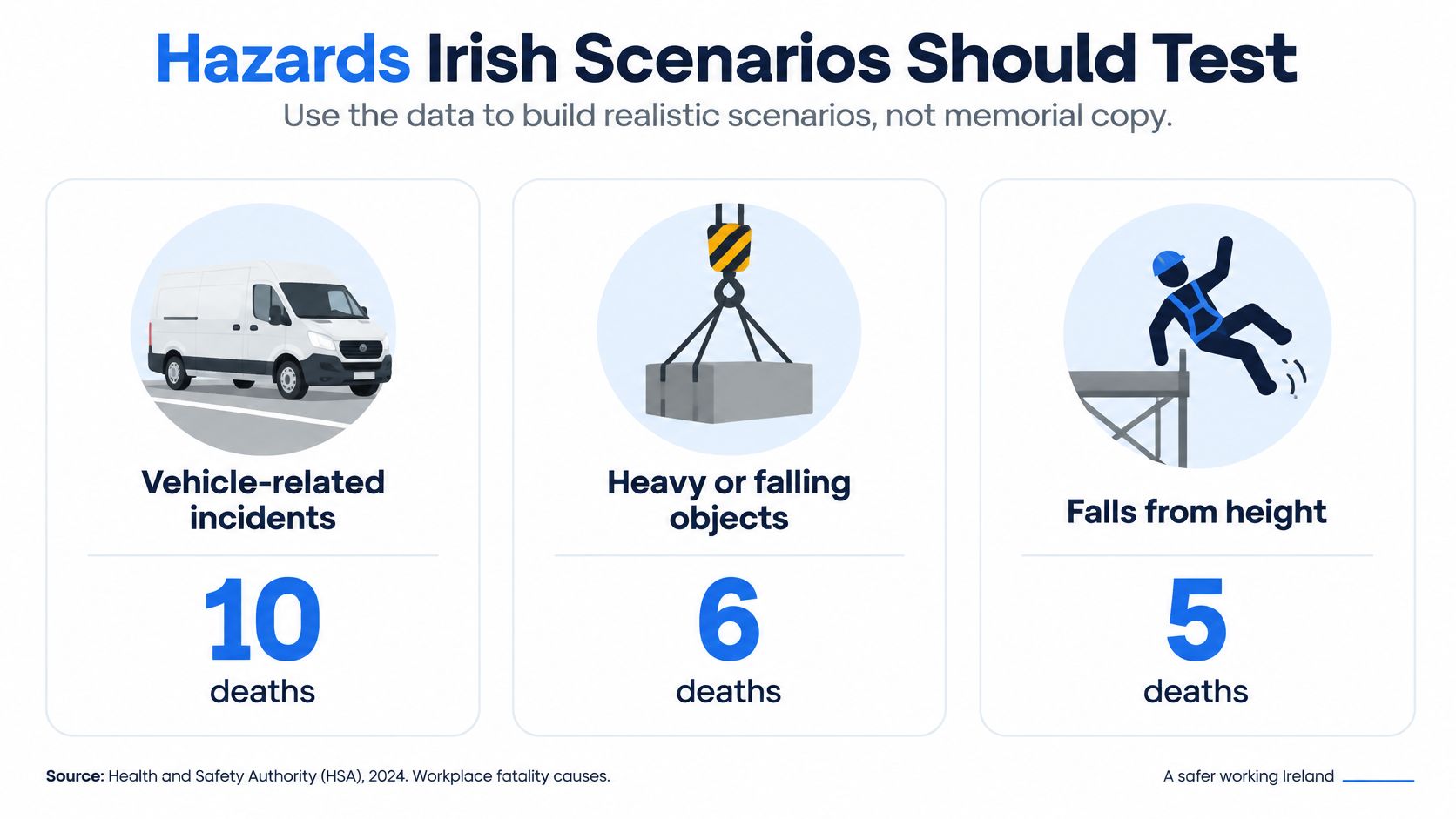
| Cause | Deaths in 2024 | Share of the 36 | Behaviour to assess |
|---|---|---|---|
| Vehicle-related incidents | 10 | 10 of 36 | Segregate people from vehicles and control reversing |
| Heavy or falling objects | 6 | 6 of 36 | Plan lifts and keep people clear of suspended loads |
| Falls from height | 5 | 5 of 36 | Plan the work, inspect equipment, and know the rescue action |
| Three causes combined | 21 | 21 of 36 | Each objective names the hazard, control, behaviour and check |
| Workers aged 55 or over | 22 | Not a separate mechanism | Pace, visual clarity and reinforcement for mixed-age crews |
Turn each cause into a decision
For vehicles, test segregation and reversing. The learner picks the pedestrian route, stops work when a banksman or driver loses sight of the other, and uses the agreed signals. A slide that says be careful around vehicles assesses nothing, because it never asks for a decision.
For heavy or falling objects, test lift planning. The learner identifies the load, the lifting equipment, the exclusion area and the point at which they refuse to walk under a suspended load. If your safety statement locates the risk in storage and stacking, put the scenario there.
For work at height, test planning, inspection and rescue. The learner chooses suitable equipment, spots the defect that takes it out of service, and states what happens if a colleague is left suspended or injured. Rescue is part of the assessed outcome.
Design for the crew you have
The same release records that 22 of the people killed were aged 55 or over. Treat pacing, visual clarity and repetition as design controls for mixed-age crews. Use readable text, give learners time on safety-critical steps, and repeat the same decision in a second scenario so the learner has to make it twice.
Practical rule: If a module cannot point to one of these mechanisms or to a hazard in your own safety statement, drop it or rewrite it.
Each learning objective should name a documented hazard, a preventive control, an observable behaviour and one assessment item. File the approved script, version, review record and assessment blueprint beside the course. When a control changes, that traceability tells you which scene to rewrite and which learners need to see the new version.
Evidence That Stands Up at Audit
A completion tick and a competence record are not the same thing. Treating them as equal is the most common weakness in a training file. The learner watched the module, so the system marks them compliant, but nobody can show they can apply the control on Monday morning.
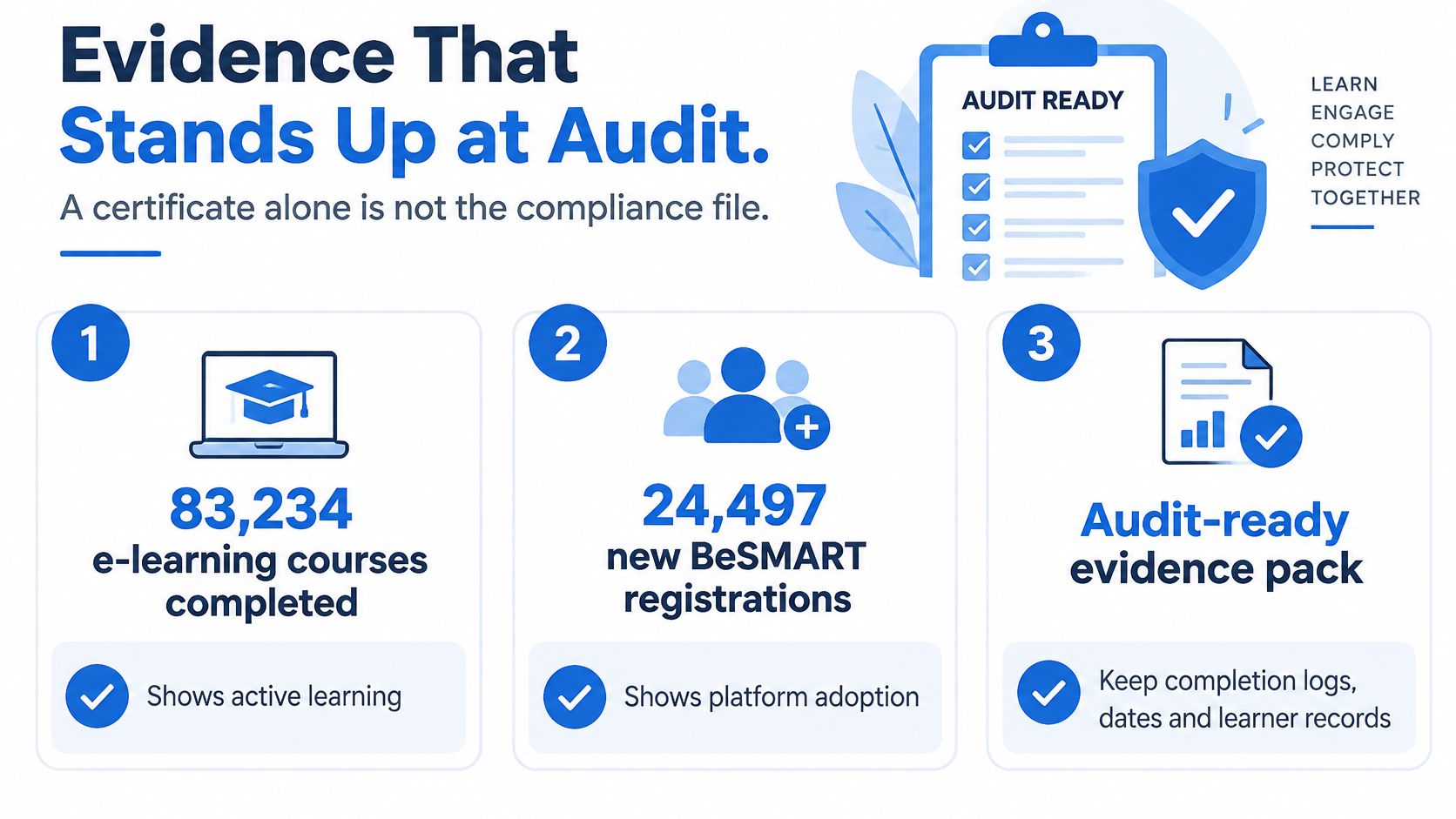
The Health and Safety Authority reported 83,234 e-learning courses completed in 2025 and 24,497 new registrations for its BeSMART risk-assessment platform on its enterprise and employee supports infographics page. That's substantial digital engagement. It doesn't, by itself, demonstrate workplace behaviour for your staff, your site or your task.
Separate two kinds of evidence
- Attendance evidence: learner name, course title, version, date and completion status.
- Competence evidence: a role-specific scenario decision, an assessment result tied to the control, and supervisor confirmation that the person may do the task.
- Corrective evidence: what happened after a fail, a near miss, a role change or an expired card, including who closed the action.
Build one trail for each person and task. It should connect the jurisdictional requirement, the training version, the assessment result, the manager sign-off and any corrective action. If one link is missing, say so in the file and fix it rather than relying on a verbal assurance later.
Don't overclaim results
A drop in incidents after training doesn't automatically prove the course worked. Staffing, workload, equipment, weather and supervision all affect incidents. Use post-training indicators carefully, including supervisor observations, repeat assessment errors, near-miss reports and overdue refreshers, and describe them as indicators rather than proof.
For SMEs and multi-site employers, review records when roles change, cards expire, procedures are revised, or an incident shares a cause with the course. Keep contractor and agency rows in the same system as employees so exceptions don't hide in email inboxes. Well organised corporate training solutions should make that review easier, not create a second set of files.
Before publishing or using materials for training, verification by a suitably qualified person must be arranged, particularly for safety, technical or compliance training. Your internal approval remains central, particularly where a course explains safety-critical actions or local requirements. The audit question is simple. Which procedure version did this person pass, and who signed that they may do the work?
Small Construction Sites and Missing Cards
Small doesn't mean low risk. An HSA review of 23 construction fatalities recorded during 2022 to 2024 found that 19, or 83%, occurred on sites with only 1 to 4 workers, in its review of construction fatalities in the Republic of Ireland.
This site check image shows the moment where card verification should happen, before high-risk work starts.
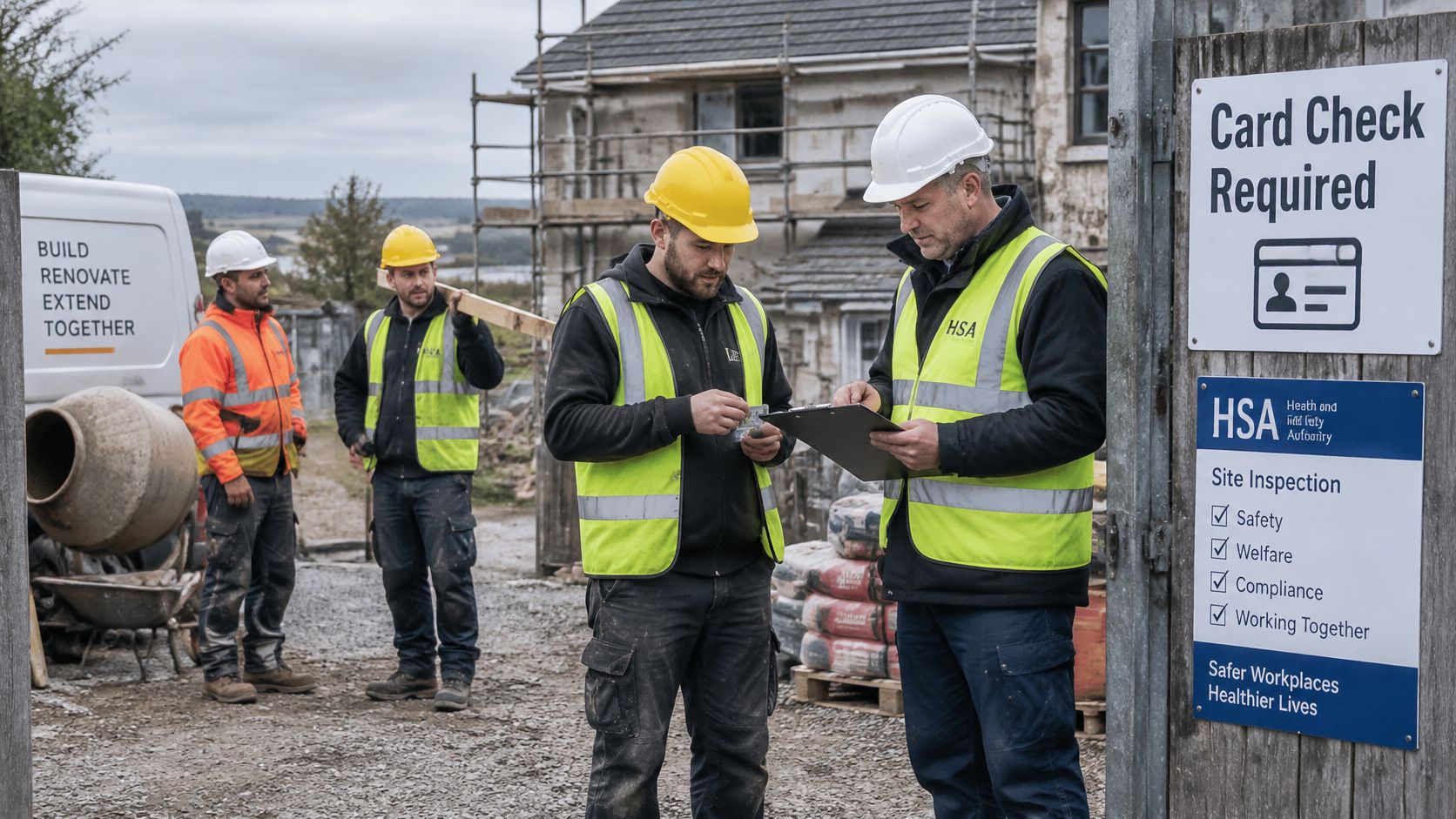
The review also found that, where mandatory SOLAS Safe Pass training was required, 6 fatalities involved workers who had not completed it. Where mandatory CSCS training was required, 2 fatalities involved workers who had not completed the required training. Informal supervision and a single induction tick aren't controls at that scale.
Run five checks before work starts
- Identity: confirm the person in front of you matches the record.
- Card status: confirm Safe Pass or CSCS where the task requires it, including expiry.
- Role eligibility: confirm the card and experience match the specific task, not just site presence.
- Site induction: confirm this site's hazards, routes, emergencies and current controls were covered.
- Supervisor confirmation: record who authorised the person to start high-risk work.
Put a short decision question in the course itself. Does this task need Safe Pass, CSCS competence, an additional site induction, or escalation to a supervisor? Store the answer with the learner record and the site record, so a later reviewer can see why work was allowed.
Consider a subcontractor-heavy job. The main contractor assumes the agency checked the card, the agency assumes the site checked it, and nobody owns the exception. That's how a missing card survives three organisations without anyone acting improperly.
The video below is useful as a prompt for discussing how that assumption forms on a busy morning.
A governed workflow with expiry monitoring and exception reporting closes that gap. It turns mandatory training from a paper chase into an operational control, which is what a one to four person site needs most.
How to Update Courses When Rules Change
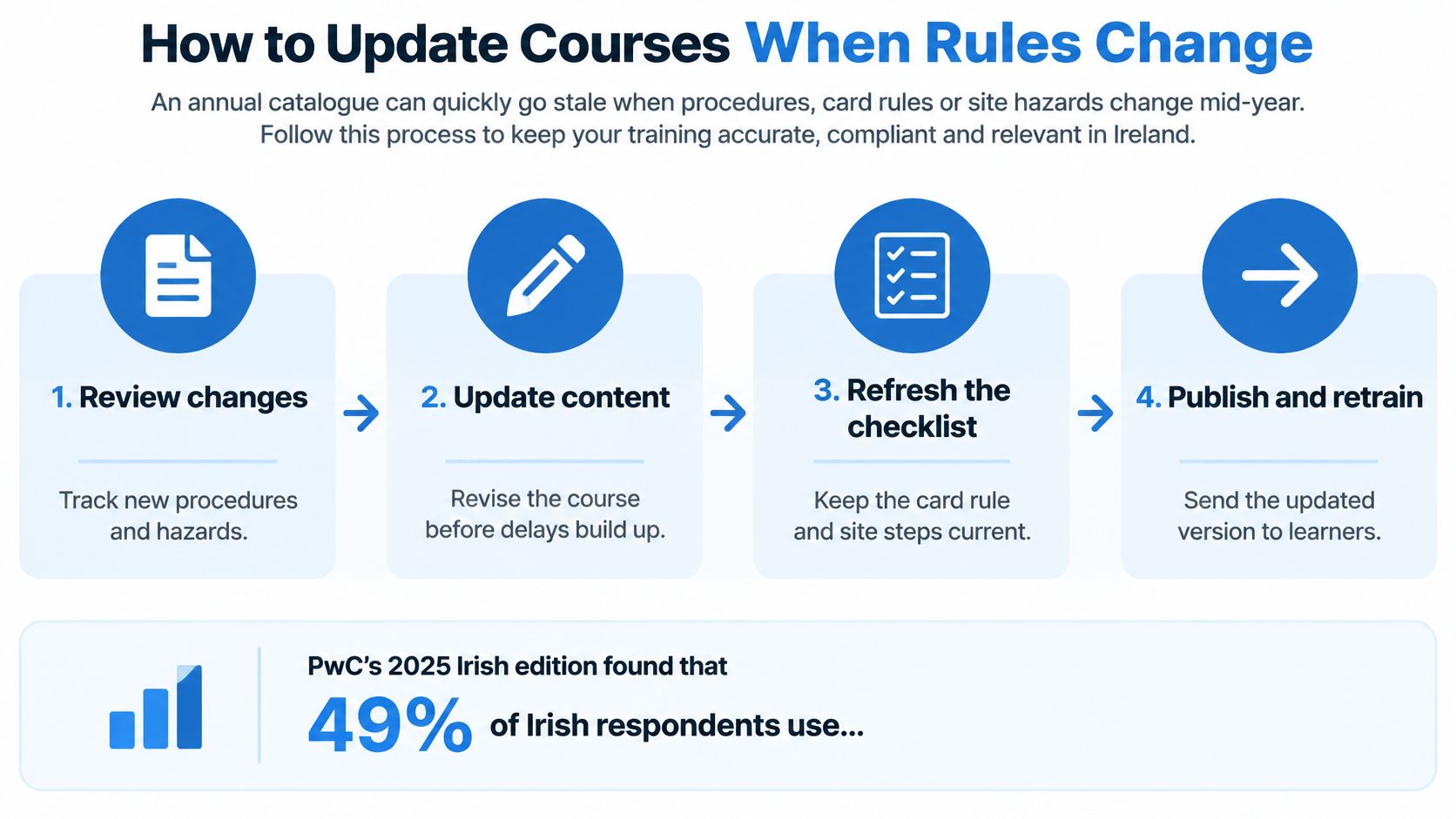
An annual catalogue goes stale when a procedure, a card rule or a site hazard moves mid-year. PwC's 2025 Irish edition found that 49% of Irish respondents use technology for at least 11 compliance activities, and training was the most widely reported technology-enabled activity at 85%, in its global compliance survey report. Speed is already normal. Governance is the gap.
Use one change-control model
Watch authoritative sources. Use HSA guidance, your safety statement and the current site procedure. Record the source and date of each change so the file shows why the version exists, and don't build a revision from social copy or an unverified script.
Map the change to roles and tasks. A chemical storage change may only affect storemen and cleaners. Leave unaffected staff off the reassessment list.
Obtain competent-person or HSEQ review. Send the revised script for approval before learners see it, and record who approved it.
AI generation does not by itself establish that a course meets a law, standard, accreditation requirement or an employer's training obligations. A fast draft still needs a named reviewer who understands the Irish requirement and the local procedure.
Issue targeted learning or reassessment. A short module on the changed step is often better than forcing everyone through the full course again. For a changed control, ask the learner to apply the new step rather than replay the old one.
Notify, record and retain. Tell affected learners, record the new result, and keep the superseded script and version for audit.
Multilingual crews make the mapping step harder and more important. A procedure update may require revised narration, subtitles or a supervisor-led briefing for one group and a short written update for another. Treat language as part of role mapping, so the safety change still lands on time.
Good triage by risk for regulatory change keeps the effort proportionate. A changed chemical storage control gets reassessment and supervisor checks. A reworded definition gets version control and notification.
If you can't name who approved version 3 and who was re-notified, the faster pipeline has added risk.
Choose a Package That Can Be Signed Off
Score the library you already have. Answer yes or no, without giving partial credit for good intentions.
- Irish hazard and control: does the module name a hazard in your safety statement and the control you use?
- Behaviour check: does the assessment test a decision or action, not only attendance?
- Cards verified: are construction and contractor cards checked before work starts?
- Named approval: can you identify who approved the current version?
Two or more no answers mean a renamed overseas course should be rebuilt, not subtitled. Subtitles don't fix wrong controls, missing card checks or an assessment that asks about another country's procedure.
A jurisdiction-ready brief is short. Share the approved procedure, the audience, the Republic of Ireland as the jurisdiction, the desired course length, and the sector rows you ticked. Existing procedures, examples and brand guidance help make content specific, but they're optional for starting the legal and learning check.
Then choose the handoff that matches your capacity. An editor-ready pack suits an in-house team that can finish the course. A finished course suits teams with no edit capacity. Realistic hazard scenes are acceptable in safety training when they teach a real control, provided the scene serves the decision you're assessing.
Loresson is one governed option, not the only one. It's an AI-assisted production service directed by experienced learning, compliance and HSEQ specialists, operated from Ireland by Acorn Star, which has provided compliance training for organisations across Europe since 2018. Your approval still owns the final course.
Pick one high-risk task this month. Match it to the sector table, then repair that module's script, assessment and sign-off or commission a single course against that brief.
Start with one Irish hazard, one approved procedure and one assessment that proves the behaviour, and let us help you turn it into a course your competent person can sign off with confidence. Visit Loresson to brief a jurisdiction-specific compliance course with the script, version and approval record kept ready for audit.