

Which is more serious: one deliberately humiliating remark made in front of a team, or six weeks of small, quiet exclusions aimed at the same person?
Most managers answer from instinct. Ask them to name the policy route each one should take, and the certainty disappears. That gap is what dignity at work training exists to close, and it explains why the useful question for a course designer isn't "what does the policy say" but "what did you just see, and where does it go next".
A dignity at work course is not a values presentation with a quiz attached. It's the learning that teaches staff to recognise conduct that undermines dignity, respond safely in the moment, and record what happened in a way that holds up later. Get the classification right and the procedure follows. Get it wrong and a complaint travels down the wrong route for weeks.
Table of Contents
- Why Employers Run Dignity at Work Training
- Core Topics a Dignity at Work Course Covers
- Telling Bullying, Harassment and Single Incidents Apart
- How Reporting Routes and Procedures Work
- Workplace Scenarios and Where Training Falls Short
- Confirm the Course Is Ready Before Launch
Why Employers Run Dignity at Work Training
The request usually arrives from a team leader who has been told, twice, that a colleague's comments are "just his way". Or from a manager who took a tearful disclosure at ten to five on a Friday and spent the weekend unsure whether to write anything down. Neither person needs a lecture on respect. They need to know what they just heard and what happens next.
The closest everyday comparison is a fire drill. A fire drill doesn't teach staff that fire is dangerous. It teaches them which stairwell to use when the alarm sounds, so nobody has to work it out in a corridor full of smoke. Conduct training works the same way. You rehearse the response while everyone is calm, so the first attempt isn't made during the incident.
The Irish picture gives employers a measurable reason to run it. In 2024, 7.0% of people reported experiencing discrimination in the workplace, according to the Central Statistics Office. Among those who experienced workplace discrimination, bullying or harassment was the most commonly identified focus at 35% of reported experiences, ahead of work conditions at 26%.
Read that carefully before you put it on a slide. The 35% describes reported experiences among people who faced discrimination. It is not the share of all Irish workers who were bullied, and a course that implies otherwise will lose credibility with the first sceptical line manager in the room.
The same CSO release shows the age split within that group. 42% of workers aged 25 to 34 who experienced workplace discrimination identified bullying or harassment, compared with 35% of those aged 18 to 24. Separately, 16% of Irish workers aged 18 to 24 reported experiencing sexual harassment at work during the previous two years, according to the CSO's Equality and Discrimination Survey. That last figure settles an argument about content: induction for early-career staff has to cover the sexual harassment route explicitly, not as a footnote to a general respect section.
Design rule: if a module can't be assessed by watching someone make a decision, it's awareness content, not training.
Three outcomes are worth committing to before you write anything. Learners should be able to recognise the behaviour in front of them, respond safely whether they're the target, a witness or the manager receiving the disclosure, and record what happened without drifting into investigation. Everything else, including the legal explanation, serves those three. Organisations that treat the topic as one component of a wider health and safety training programme often find the safety framing does more work than the values framing, because it brings risk assessment, reporting and review with it.
Core Topics a Dignity at Work Course Covers
Seven topics carry the weight of a dignity at work course. Read the table as a course map rather than a contents page. The middle column states what a learner must be able to do, and the right-hand column states what you should be able to show afterwards.
| Topic | What learners must be able to do | Evidence to record |
|---|---|---|
| Respectful conduct and standards | Recognise behaviour that undermines dignity in everyday interactions | Scenario quiz score and policy sign-off |
| Bullying | Identify repeated inappropriate behaviour and tell it apart from a single incident | Classification score on branching cases |
| Harassment and sexual harassment | Classify unwanted conduct and identify the applicable policy route | Completion and assessment record with policy version |
| Bystander intervention | Interrupt harmful behaviour safely without escalating risk | Observed decision in a role-play scenario |
| Reporting routes | Name the informal and formal channels and the designated contact | Pre and post confidence-to-report survey |
| Manager responsibilities | Respond to an informal disclosure consistently and preserve confidentiality | Manager assessment and refresher date |
| Documentation and confidentiality | Record facts without investigating beyond authority | Knowledge check on confidentiality boundaries |
Where induction stops and manager training starts
All staff need the first four topics. A well-built induction gives everyone the vocabulary, the classification skill and the confidence to say something early. Managers need the last three on top of that, and compressing them into the same twenty-minute module is where most programmes fail.
The distinction that matters is between knowing a policy and applying it. A learner who can recite the reporting route but freezes when asked who they'd ring first has not met the outcome, no matter what the completion record says. The same applies to a manager who can list the seven grounds covered by equality law but can't describe what they'd say in the first two minutes after a disclosure.
Keep four things on file: completion, assessment results, refresher dates, and the policy version in use at the time. Together they answer the only question an auditor or a tribunal really asks, which is what this organisation taught, to whom, and against which version of its own rules.
Try this review test on a course you already run. Pick one row, give yourself sixty seconds, and write a single question that would prove a learner can do the thing in the middle column. If you can't write one, the module is explaining rather than training, and that row is your first gap to close.
Telling Bullying, Harassment and Single Incidents Apart
Most dignity at work confusion comes from treating bullying and harassment as points on one severity scale. They aren't. They're two separate legal and operational pathways, and the conduct that triggers one doesn't necessarily trigger the other.
The Irish Human Rights and Equality Commission defines harassment as unwanted conduct that violates a person's dignity or creates an intimidating, humiliating or offensive environment. The Irish bullying Code of Practice defines bullying as repeated inappropriate behaviour, direct or indirect, that undermines an individual's right to dignity at work.
Repetition is what separates bullying from a single incident. It is not what separates serious from trivial.
That sentence does most of the teaching. A single serious incident can be harassment, and it can be extremely serious indeed, while never meeting the bullying definition. Equally, a single incident that doesn't meet either threshold may still be an affront to dignity, and dismissing it because "it only happened once" is the fastest way to lose a good employee.
Two cases, two routes
Consider one sharp remark in a Monday meeting. A manager publicly mocks a team member's accent, once, and moves on. Nobody repeats it. Under the definitions above, that's a single serious incident sitting on the harassment pathway, and it warrants a formal response despite the absence of repetition.
Now consider a month of belittling comments aimed at the same person, delivered in meetings, in side channels and in a weekly review. Each individual remark might survive scrutiny on its own. The pattern doesn't. This is the bullying pathway, and it moves from informal resolution to formal complaint if the pattern continues.
| Conduct | Repeated pattern needed? | Usual policy route | Example |
|---|---|---|---|
| Single serious incident | No | Harassment policy route, possibly formal | One unwanted, humiliating remark of a sexual nature |
| Bullying | Yes | Bullying policy, informal then formal | Repeated public belittling over several weeks |
| Harassment | Not always | Harassment policy route | Unwanted conduct creating an intimidating environment |
| Sexual harassment | Not always | Harassment and sexual harassment route | Unwanted sexual comments or advances |
| Reasonable management action | Not applicable | Performance process | Setting deadlines and giving clear, respectful feedback |
The last row causes more grief than any other. Setting a deadline, rejecting a piece of work, or giving direct feedback on performance is not bullying, provided it's delivered respectfully, applied consistently, and doesn't come with humiliation attached. Managers often overcorrect here and stop managing altogether, which damages the person they were trying to protect.
Classification drives the route, so a wrong sort sends a concern down the wrong path. Build the exercise around five short cases and ask learners to sort each one and name the route. Mark the route, not just the label. A learner who spots the bullying but sends it to the harassment process still needs correction.
How Reporting Routes and Procedures Work
The Irish Code of Practice on the Prevention and Resolution of Bullying at Work, issued jointly by the Health and Safety Authority and the Workplace Relations Commission, came into effect on 23 December 2020, replacing the 2007 HSA Code and the 2002 Labour Relations Commission procedure, as set out in the Government of Ireland announcement. It applies across all Irish employments, including fixed workplaces, homeworking and mobile work.
The Code sits on top of the employer's duty under the Safety, Health and Welfare at Work Act 2005 to manage work activities so far as reasonably practicable to prevent improper conduct likely to endanger employees' safety, health or welfare. That's why the reporting route isn't an HR courtesy. It's a control.
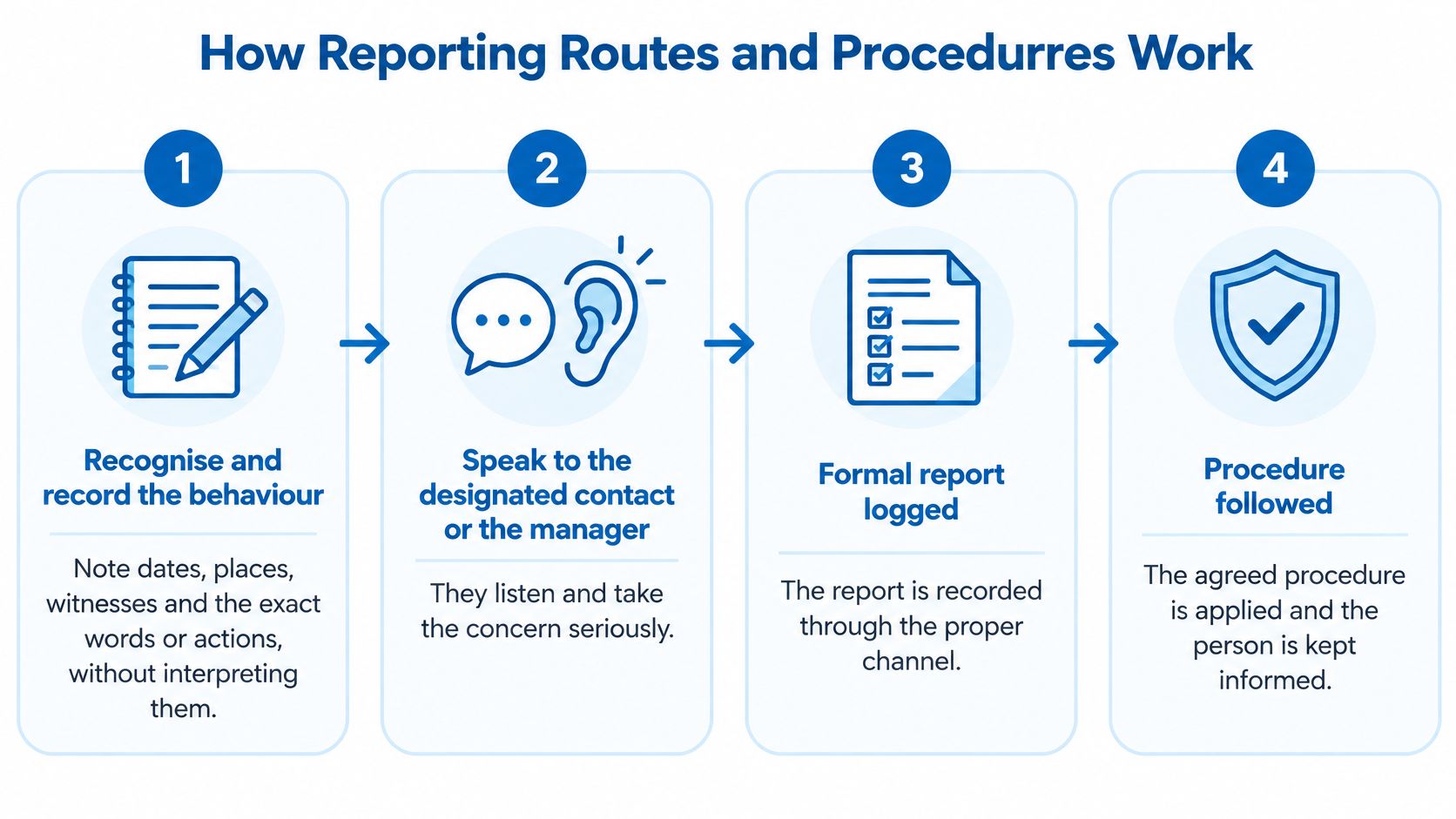
Teach the route as five steps. Keep each one short enough that a learner can repeat it back a week later.
- Recognise and record the behaviour. Note dates, places, witnesses and the exact words or actions, without interpreting them. Interpretation is for the investigation, and a contemporaneous note is worth more than a persuasive summary written three weeks later.
- Speak to the designated contact or your manager. That person listens, takes the concern seriously, and routes it onward. They should not start investigating, because a well-meant early investigation can contaminate a later formal process.
- Choose informal resolution where it fits. A facilitated conversation or mediation works for many early concerns, and it should end with an agreed change rather than a vague understanding that things will improve.
- Make a formal complaint in writing if the informal route fails or the conduct is serious. Record which version of the policy applies. Organisations that revise their procedures regularly, often through a structured policy development course, need that version trail to stay meaningful.
- Investigate, decide, and review. Someone with authority investigates, an outcome issues, and the employer reviews whether the policy has delivered its intended effect.
Where confidentiality ends
Confidentiality is narrower than many assume. Information moves to the people who need it to act, and no further. A manager who shares a disclosure over lunch has broken the process even if their intentions were kind. Say the boundary out loud in training, because learners will otherwise assume either total secrecy or open discussion, and both assumptions cause damage.
The Code also expects employers to monitor and record incidents and use the resulting statistics to improve prevention. Learners should leave able to name the route for their own workplace and the first person they'd contact. If they can't, the module has taught a legal framework rather than a procedure.
Workplace Scenarios and Where Training Falls Short

Four scenarios do more work than twenty slides of definitions. Each one should require the learner to name the conduct, name the route, and pick the first safe action.
- The joke in a remote call. One colleague is ridiculed by name while eight people are on video and nobody speaks. That's a dignity issue in the moment and a possible harassment concern if it targets a protected characteristic. First safe action is a short, calm interruption, then a private message to the person targeted.
- The customer who keeps abusing the agent. Repeated verbal abuse from a customer isn't a resilience problem for the employee. It's a risk the employer must control, through escalation scripts, permission to end the call, and a debrief afterwards.
- The banter that excludes. Inside jokes, a group chat that one person is left out of, a lunch nobody invites them to. Individually trivial, cumulatively corrosive. The learning point is that exclusion is a pattern, and patterns are what the bullying route exists for.
- The manager whose criticism becomes a campaign. Persistent, personalised criticism of one employee, delivered in front of others, week after week. Learners hesitate most at this example, because the conduct looks managerial. Ask them to test it against consistency: does everyone get the same treatment, and is the feedback about the work?
Why one-off delivery leaves the hard questions unanswered
Irish evidence suggests much of this training remains a compliance ritual. 38% of surveyed organisations reported providing no workplace-bullying training at all, and among those that did, 62% delivered it at induction while only 44% repeated it regularly, as reported in the Irish Examiner.
That pattern produces evidence of completion without evidence of capability. Mandatory annual clicking can coexist with a workforce that has never rehearsed a bystander intervention and managers who improvise their first response. Measure the things that predict behaviour instead: whether employees can separate conflict, reasonable management action, bullying, harassment and sexual harassment, and whether managers respond consistently while protecting confidentiality and procedural fairness.
Roles where the harm comes from the work itself
Generic respectful-behaviour content misses the source of harm in healthcare, contact centres, moderation, policing, social care and emergency response. Figures in a workplace health and well-being report from Northern Ireland's Department for the Economy show verbal abuse reported by 25.9% of Republic of Ireland workers at least a few times a year, bullying and harassment by 16.1%, threats of violence or abuse by 9.9%, and actual violence or abuse by 5.8%.
Practical rule: when abuse arrives through the work design, the control belongs to the organisation, not to the employee's coping skills.
These roles need risk assessment, post-incident support, incident recording and clear boundaries for refusing unsafe interactions. The gap in most programmes is that interpersonal conduct and occupational safety get taught in separate rooms, even though repeated verbal abuse and exposure to disturbing material undermine dignity, mental health and retention in exactly the same way.
Confirm the Course Is Ready Before Launch
Before anything goes live, run a short gate. A course that fails any item goes back for revision rather than launching with a caveat attached.
- Check the source of truth. Confirm the course names the 2020 Irish Code and your own policy version, with the date of the last policy update visible in the materials.
- Audit the scenarios. Power imbalance, remote contact and customer aggression should all appear. If every scenario is two colleagues in a meeting room, the course doesn't match the workplaces your staff occupy.
- Set the measures in advance. Agree a pre and post scenario score and a confidence-to-report question before launch, so evaluation isn't invented after the fact.
- Schedule refreshers against policy changes, not just an annual reminder. A revised procedure invalidates the old module more effectively than the calendar does.
- Get a qualified reviewer to sign it off. Before publishing or using the materials for training, verification by a suitably qualified person must be arranged, particularly for safety, technical or compliance training. AI generation does not by itself establish that a course meets a law, standard, accreditation requirement or an employer's training obligations, so a named human reviewer has to check every factual claim and approve the content. Build that review into a documented training course development sequence, so the check happens before the gate rather than after it.
Our own process follows the same logic. A qualified HSQE specialist reviews every claim in a Loresson course and signs it off before it leaves us, and your internal approval stays central, particularly where a course explains safety-critical actions or local requirements.
Cross-check against the seven-row course map. Any module without a matching assessment is a gap to close before launch, not after. Keep completion, assessment results, refresher dates and the policy version on file so the employer can show what was taught and when.
Finish with one decision. Name the person who will approve this course this month, and the date by which they'll do it. Without that, the course sits in review indefinitely while the incidents keep arriving.
If your dignity at work course needs to move beyond definitions and into branching decisions, mock disclosures and role-play, Loresson builds bespoke cinematic workplace training from your own policy, procedures and jurisdiction, ready for deployment in your LMS. We produce the script, storyboard, narration, scenarios and assessments around your classifications and reporting routes, with a qualified HSQE specialist reviewing every claim before sign-off. Visit Loresson with your policy document and the audience you need to train, and we'll shape the course from there.