
You've probably seen this already. A manager books a policy development course for a compliance lead, a regional manager, or an HR team, expecting them to come back able to draft, defend, and implement policy with confidence. Two days later, they have a cleaner template, a few new terms, and no usable Regulatory Impact Assessment, no monitoring plan, and no idea how to turn approval into action.
That gap is the whole problem. In Ireland, policy work is supposed to be grounded in evidence, feasibility, and legitimacy, not just polished writing, and a course that ignores that reality wastes budget and leaves teams exposed when the policy meets audit, consultation, or frontline delivery.
Table of Contents
- Why Most Policy Training Misses the Mark
- What a Policy Development Course Actually Covers
- Who the Course Is Built For
- Learning Outcomes and Syllabus Examples
- Choosing the Right Delivery Format
- From Syllabus to Workplace Output
- What to Look for When You Commission a Course
- A Short Decision Guide for the Next Working Week
Why Most Policy Training Misses the Mark
The usual failure mode is simple. A compliance lead sits through a well-run classroom session, takes notes on structure, gets a glossary of policy terms, and leaves with a nicer way to say the same thing. Then the work starts, and the lead still has to decide what evidence to use, how to test options, how to document implementation, and what to show an auditor if the policy is challenged.
That is where most courses collapse. They teach the appearance of policy, not the mechanics of policy. The difference matters because a draft that sounds sound can still be weak if it rests on one source, ignores delivery constraints, or never defines who owns the next step.
Practical rule: if a provider can't show you the artefacts learners will produce, you're buying a writing workshop, not policy capability.
Ireland's policy context makes that sharper. The official framework treats policy quality as the interaction of data and evidence, feasibility and implementation, and legitimacy, with evidence used across the whole policy process, not parked at the start. The central question for buyers is whether the course builds that chain of reasoning, or just teaches cleaner prose and a few buzzwords about consultation.
A credible course should help learners handle the messy middle, where a proposal is approved but still needs ownership, sequencing, and monitoring. If a provider can't explain how a learner gets from policy intent to operational plan, the course will look fine in a brochure and fail in practice.
What a Policy Development Course Actually Covers
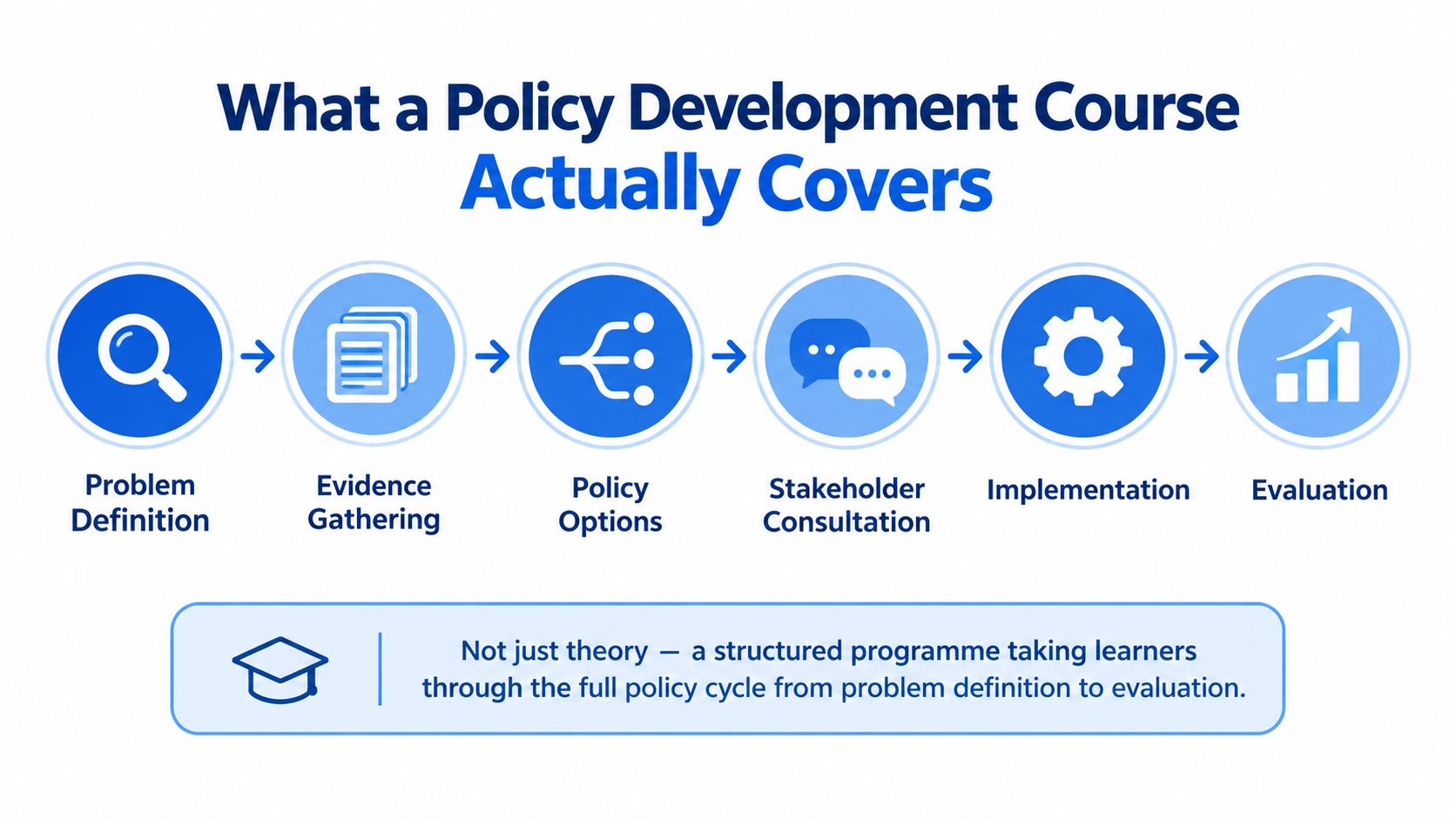
A proper policy development course follows the whole policy cycle, not just the drafting stage. In Irish terms, that means learners should move through the three technical pillars of data and evidence, feasibility and implementation, and legitimacy, then see how each pillar shapes the final recommendation. A course that only covers one pillar is incomplete.
The cycle should start with the decision question
The first task is framing the problem clearly. Learners need to define what decision is being made, what success looks like, and which groups are affected. If they can't do that, every later stage becomes noisy and expensive.
From there, they should map evidence properly. That means distinguishing primary and secondary sources, understanding source quality, and building a simple evidence base that can survive challenge. Irish guidance is explicit that reusing suitable existing data can save time and resource, which is why source criticism and triangulation belong in the syllabus, not in an appendix.
Options, consultation, implementation, evaluation
Once the problem is framed, learners should compare policy options rather than defend a favourite. Consultation then tests whether the proposal is legitimate and workable, especially when delivery is spread across departments, agencies, regional bodies, or frontline teams. Implementation planning turns that decision into ownership, sequencing, and controls.
Evaluation closes the loop. A learner should finish the course able to state what will be measured, when, and against which baseline. The point is not academic completeness, it's operational clarity.
Not just theory, a structured programme taking learners through the full policy cycle from problem definition to evaluation.
The strongest courses produce something tangible at every stage, a problem statement, an evidence map, an options matrix, a consultation note, an implementation plan, and a review framework. If the syllabus doesn't point to those outputs, it's probably too thin for serious buyers.
Who the Course Is Built For
A good provider doesn't pretend every learner belongs in the same room. The right policy development course is built for a clearly defined audience, because a policy analyst, a senior approver, and a line manager do not need the same level of depth or the same type of practice.
Public-sector and civil-service staff need a shared policy craft standard. They have to write in a way that survives scrutiny, links to evidence, and travels across departments. In regulated industries, the audience is usually compliance, EHS, HSEQ, legal, or operations leaders who need defensible policy that can stand up to audit, incident review, or board challenge.
Private-sector L&D, HR, and operations teams are a different case. They often need internal policy capability for the first time, which means the course has to balance rigour with readability and give them templates they can use. A vendor who speaks only to government or only to corporate governance usually misses part of that audience.
The assumption level matters just as much as the topic. A mixed cohort of analysts and senior approvers often produces a workshop that satisfies nobody, because one group wants method and the other wants judgment. Good providers say plainly what baseline they expect, and they design accordingly.
If you're buying for multi-country teams, localisation matters too. A course that needs to work across jurisdictions should be shaped for local policy language, examples, and procedural expectations, which is why production teams often pair it with localisation support.
Buyer test: if the provider can't tell you who the course is for in one sentence, they haven't defined the audience tightly enough.
Secondary audiences matter as well. Training providers, consultancies, and researchers moving into practice often need a version that can be branded, reused, or adapted for client work. That's not a nice-to-have. It's the difference between a one-off class and a usable capability asset.
Learning Outcomes and Syllabus Examples
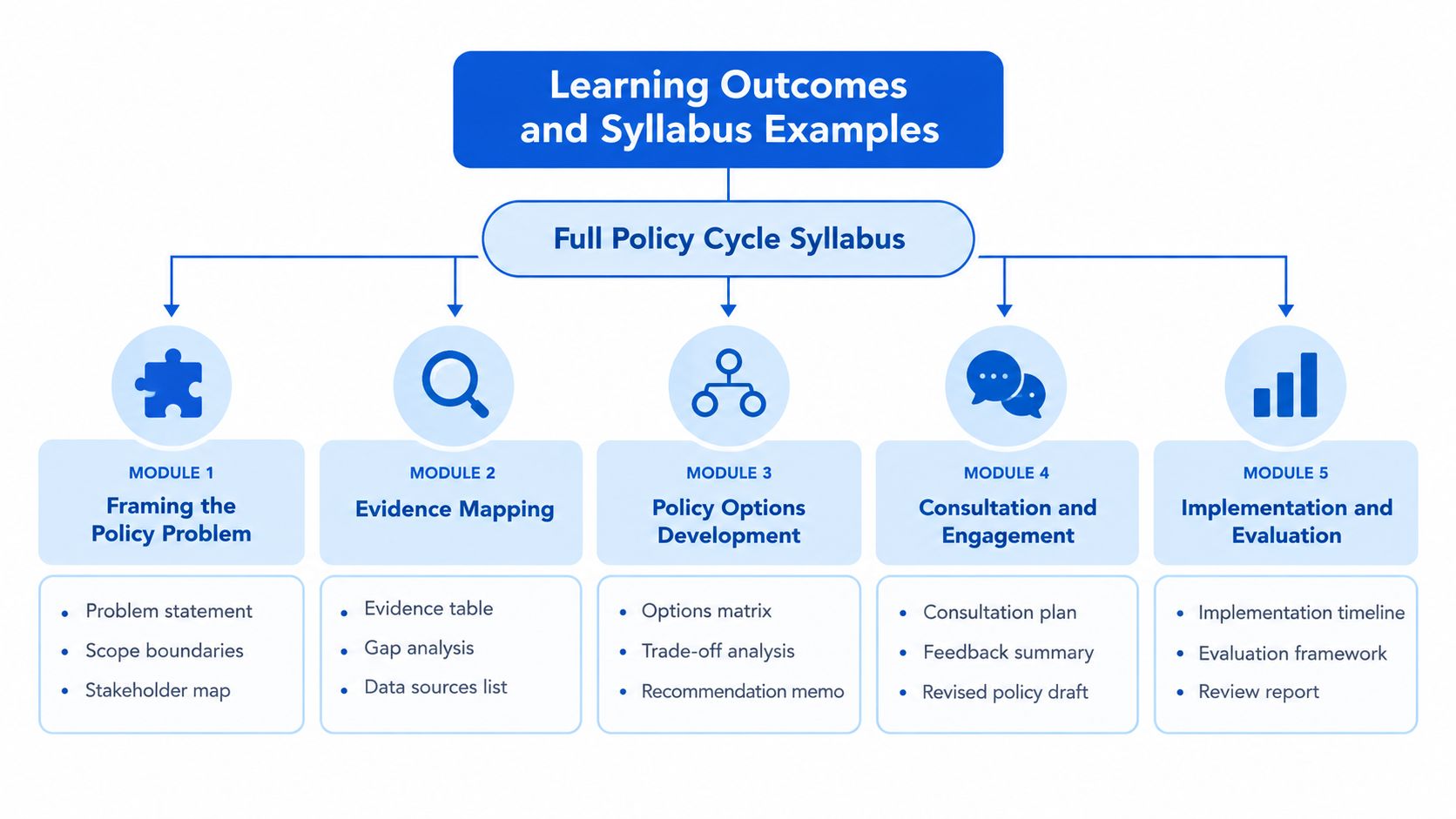
A serious syllabus is easy to spot because it names the work product for each module. If the outline is all verbs like “understand”, “explore”, and “discuss”, you're looking at a soft course. If it names artefacts, it's closer to the genuine thing.
What the modules should produce
- Framing the policy problem should end with a problem statement, scope boundaries, and a stakeholder map. The learner needs to show they can define the issue before trying to solve it.
- Evidence mapping should end with an evidence table, a gap analysis, and a data sources list. That's how you separate useful evidence from noise.
- Policy options development should end with an options matrix, a trade-off analysis, and a recommendation memo. Judgment gets tested here.
- Consultation and engagement should end with a consultation plan, a feedback summary, and a revised draft. A good course doesn't treat consultation as theatre.
- Implementation and evaluation should end with an implementation timeline, an evaluation framework, and a review report.
In Ireland, Regulatory Impact Assessment is the cleanest benchmark for judging whether a vendor understands policy practice. Guidance defines RIA as a systematic assessment of expected economic, social, and environmental effects, including costs, benefits, risks, and alternative approaches. That means learners should be able to set a baseline, identify affected groups, assess compliance burden, and compare the preferred option against credible non-regulatory alternatives.
A course that ignores RIA is usually too shallow for decision-makers. A course that does RIA well usually does the rest of the syllabus well too, because it forces clear thinking about options, assumptions, uncertainty, and implementation constraints.
A strong syllabus ends in a capstone proposal with a linked implementation and evaluation plan, not a multiple-choice quiz.
If you want a useful comparison sheet, ask vendors to show where each module lives, what artefact it produces, and how the final capstone is assessed. That tells you more than the module titles ever will.
Choosing the Right Delivery Format
The right format depends on who's attending and what they need to do after the course. A senior approver usually needs sharper discussion and faster synthesis. An analyst usually needs practice, templates, and room to build artefacts they can take back to the team.
| Format | Best for | Time-to-competence | Jurisdiction fit | Indicative cost |
|---|---|---|---|---|
| In-person intensive | Senior approvers, policy leads, mixed leadership groups | Fast for alignment, moderate for skill transfer | Strong if the provider knows the local context | Usually higher |
| Online self-paced | Individual learners, refresher training, distributed teams | Slower unless paired with coaching | Weak unless heavily localised | Usually lower |
| Blended | Analysts, managers, internal capability-building | Good balance of pace and practice | Strong when built around local templates | Mid-range |
| Bespoke commissioned | Public-sector bodies, regulated firms, multi-role cohorts | Fastest path to usable workplace outputs | Strongest, because it can use your own procedures | Varies by scope |
Generic global courses are usually a poor fit for public-sector and regulated-industry buyers. They can teach concepts, but they rarely capture the Irish policy cycle, local RIA practice, or the kinds of delivery constraints that matter in practice. If your team needs to use the output internally, jurisdiction-specific content isn't optional.
Bespoke formats are worth serious consideration when you need the course wrapped around your own templates, approval routes, or policy language. That's where commissioning a custom build starts to make more sense than trying to force-fit a generic outline.
From Syllabus to Workplace Output
The clearest quality signal is assessment. A policy course that tests only knowledge can tell you whether someone recognises a term, but it can't tell you whether they can produce something a manager, board, or regulator can use.
The mapping should be obvious. Framing becomes a problem-framing memo. Evidence mapping becomes an evidence briefing pack. Options development becomes an options paper with recommendations. Consultation becomes a stakeholder feedback summary. Implementation and evaluation become a monitoring and evaluation plan.
That is the kind of output auditors and oversight bodies ask for. They want to see logic, traceability, and documented judgement, not just a certificate of attendance. A course that produces those documents is doing real organisational work.
What strong assessment looks like
- Defensible policy proposal: The learner explains the problem, the evidence, and the chosen option in one coherent package.
- Monitoring plan: The learner links the policy to practical indicators and review points.
- Implementation risk log: The learner shows where delivery could fail and who owns mitigation.
- Consultation evidence: The learner records how external or internal feedback changed the draft.
That assessment design matters because it changes Monday morning behaviour. A learner who has already built the artefacts once is far more likely to repeat the discipline at work. A learner who only answered questions in class usually reverts to habit.
What to Look for When You Commission a Course
A commissioned course should be judged on substance, not polish. The instructor's CV matters, but the syllabus artefacts matter more, because those are what learners leave with and what your organisation keeps using.
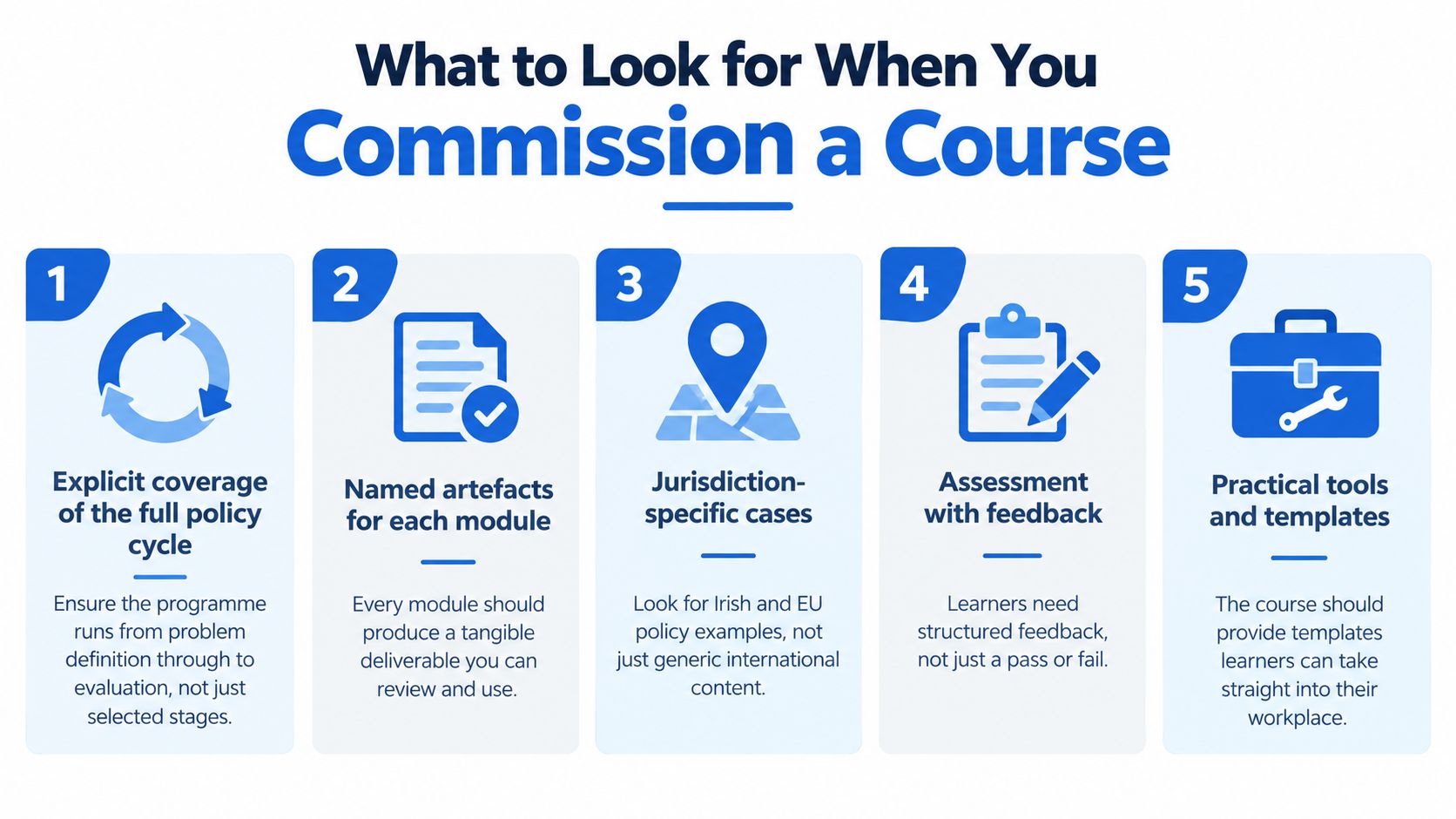
The non-negotiables
- Full policy cycle coverage. Make sure the programme runs from problem definition through to evaluation, not just selected stages.
- Named artefacts for each module. Every module should produce a deliverable you can review and reuse.
- Jurisdiction-specific cases. Look for Irish and EU policy examples, not generic international filler.
- Assessment with feedback. Learners need structured feedback, not just a pass or fail stamp.
- Practical tools and templates. The course should provide materials learners can use straight away.
One thing most RFPs get wrong is overweighting the presenter and underweighting the output. A brilliant facilitator can still deliver a weak course if the syllabus is thin. A solid course with the right artefacts will usually outperform a flashy one every time.
AI now belongs in the conversation too. A modern policy course should cover verification of AI-generated evidence, prompt and source documentation, bias and equality checks, human sign-off, and the limits of automated support. In public-service settings, leaving that out creates a visible capability gap.
If you're commissioning at scale, especially for branded or jurisdiction-specific delivery, bespoke production becomes the rational option rather than the fancy one. Custom e-learning development is the route when your templates, approval routes, and compliance obligations need to shape the course itself.
Commissioning rule: if the outline doesn't show the artefacts, don't assume the artefacts exist.
A Short Decision Guide for the Next Working Week
Start by naming the need. If the team only needs policy literacy, buy something lighter. If they need to draft well, choose a course that teaches evidence, options, and consultation. If they need to deliver policy in practice, insist on the full cycle.
Next, match the format to the audience. Senior approvers usually benefit from an intensive format that pushes decision quality. Analysts and policy teams usually need blended learning or bespoke delivery, because they need time to build artefacts and see how the method fits their actual work.
Then shortlist two or three providers and ask for the full syllabus, the assessment method, and sample artefacts. If their outline doesn't map to the full policy cycle with named outputs, move on. If the off-the-shelf options fail that test, commission a bespoke course instead.
That's the sensible move because weak policy artefacts don't stay weak in one workshop. They show up again in every review, every approval cycle, and every audit conversation that follows.
If you want a policy development course built around the full cycle, not just drafting, Loresson can shape it around your own templates, jurisdiction, and approval needs. Visit Loresson to discuss a bespoke course that gives your team artefacts they can use at work.