
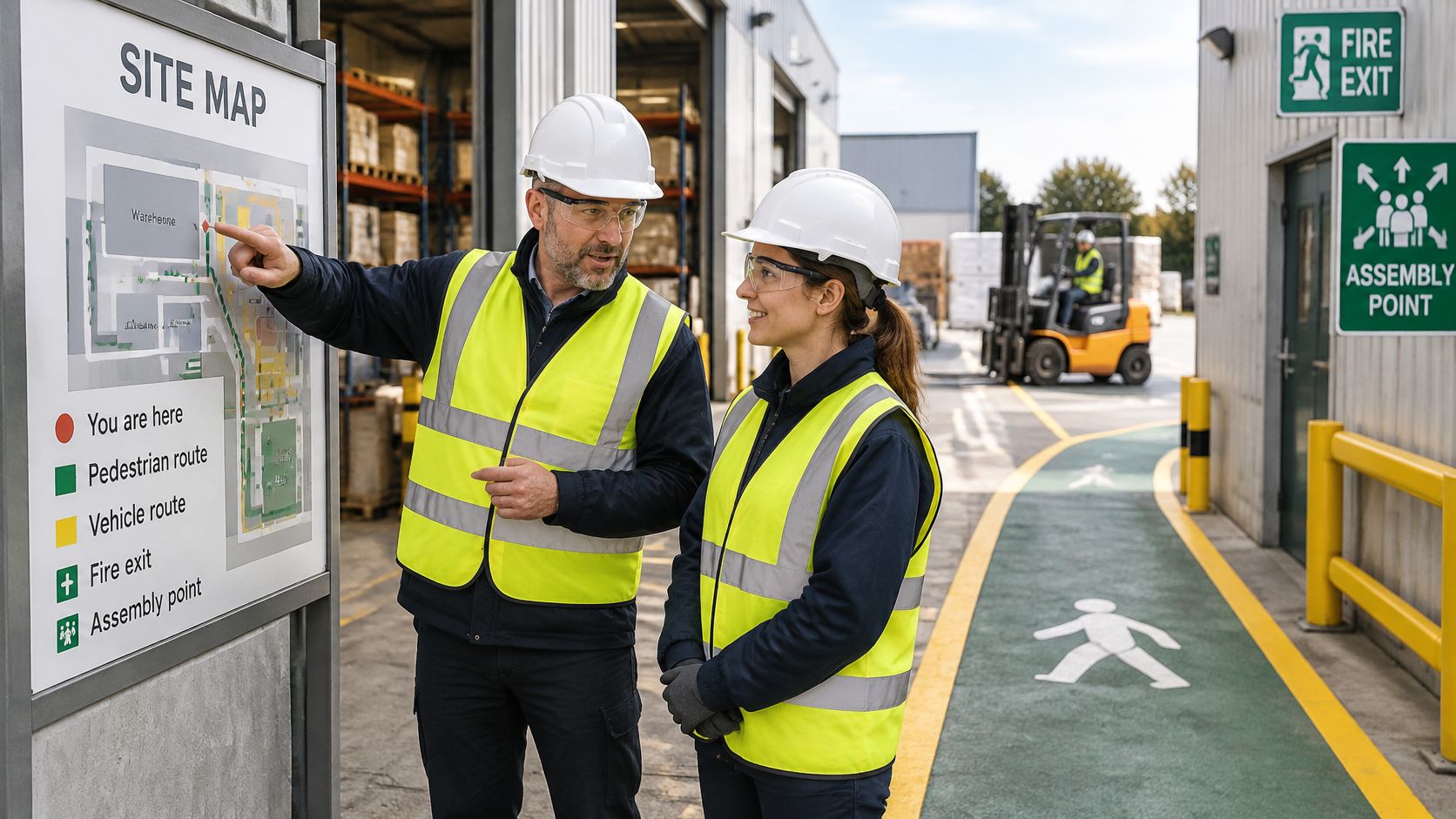
Ireland recorded 33 work-related fatalities in 2024, a figure the Health and Safety Authority described as a record-low rate, and 10 of those deaths involved vehicles, according to the HSA's January 2025 announcement. The total is worth knowing. The number that should hold a manager's attention is smaller and more specific: the distance between a worker who knows the reversing route, the exclusion zone and the name of the person to tell, and one who was handed a vest and pointed at a bay.
Health and safety induction is where that distance closes or doesn't. Run properly, it's a risk control with defined triggers, a competence check and an access decision attached to it. Run as paperwork, it's a signature that proves someone sat in a room.
Table of Contents
- What Every Health and Safety Induction Must Cover
- Why Induction Works as a Risk Control
- Tailoring Induction to Sector and Site Risks
- Build, Verify and Gate an Induction Before Work Starts
- When an Induction Must Be Repeated
- Covering Contractors, Visitors and Non-Workers
What Every Health and Safety Induction Must Cover
The Health and Safety Authority recorded 43 fatal work-related incidents in 2023, including 39 worker deaths and four deaths involving non-workers, at a national rate of 1.6 deaths per 100,000 workers, down from 2.8 per 100,000 in 2014, as set out in the HSA's 2023 fatalities release. Two details in that release explain why a generic welcome presentation keeps failing. Farming accounted for 16 fatalities and construction for 11, together more than 62% of the year's total, while 53% of the people who died were self-employed and 51% were aged over 55.
That last pair matters more than it looks. Self-employed people and older workers are often the ones who receive the thinnest induction, because the systems are built around new employees arriving through HR.
Here is the content floor, the topics every induction has to cover before anyone is exposed to risk.
| Topic | What the Worker Must Learn | Example |
|---|---|---|
| Employer and legal framework | Who is responsible and what the safety statement says | Named safety officer and where the statement is kept |
| Significant hazards | Hazards in their work area and task | Forklift routes and live electrical panels |
| Control measures | The controls that protect them and why they exist | Guard in place, exclusion zone, permit-to-work |
| Reporting routes | How to report hazards, near misses and injuries | Site logbook or supervisor, with a stated timeframe |
| PPE | What to wear and how to check fit and condition | Safety boots and hearing protection for a named area |
| Emergency arrangements | Alarm sound, assembly point, first aid and fire exits | Assembly point at car park gate B |
| Supervision boundaries | Who directs their work and tasks they must not do alone | No lifting above a set height without a second person |
| Welfare and facilities | First aid room, toilets, rest areas and break times | First aiders' names on the noticeboard |
Eight rows, and they're not equal. The framework, reporting and welfare rows travel between sites. The hazard and control rows belong to one location and one task, and they have to be rewritten for every site the worker enters.
Rewrite, don't recycle: the hazard and control rows come from the site risk assessment. Copy them from another site's pack and you brief a worker on a risk they'll never meet while leaving them blind to the one outside the door.
Why Induction Works as a Risk Control
A new starter arrives at a distribution yard on their first morning. They're handed a high-vis vest at the gate, signed in, and sent to the loading bay. The bay shares its route with reversing articulated lorries, and nothing they've been told so far mentions that.
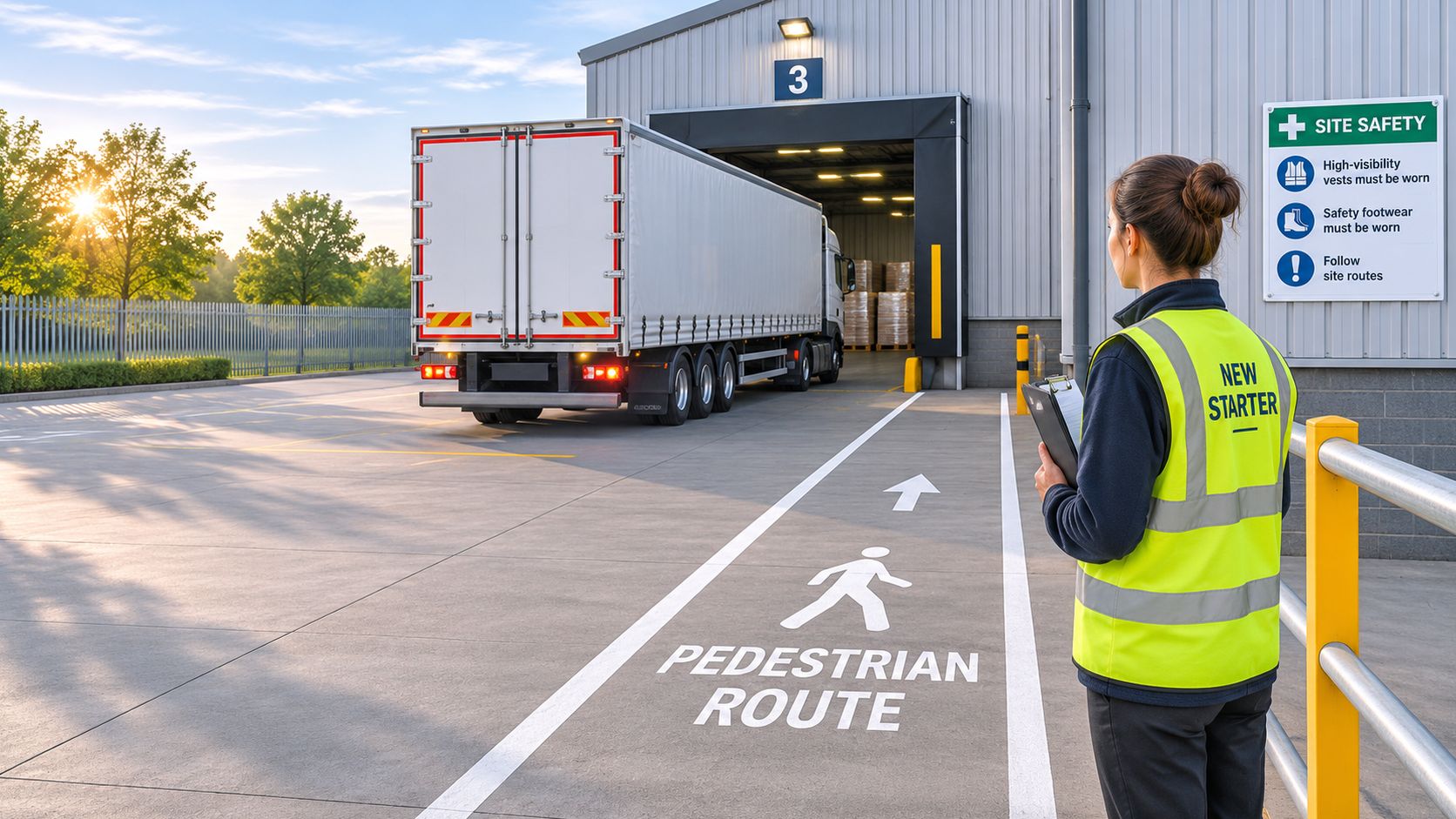
Nothing about that morning is unusual, which is why it's worth taking apart. Three things had to be true for the new starter to go home uninjured. They had to recognise the hazard, meaning a lorry whose driver cannot see them. They had to know the control, meaning the marked pedestrian route, the exclusion zone and the banksman. And they had to know who to tell when a parked trailer blocked the route.
Induction is the handrail fitted before the stairs are used, not a warning sign hung at the bottom.
The mechanism is that direct. Workers can't apply a control they don't know exists, can't avoid a hazard they've never been shown, and won't escalate a problem they don't know how to report. The HSA's guidance on safety and health management systems requires training and induction for contractor personnel before work begins, and treats induction of new starters, including part-time and temporary workers, as a specific training-needs assessment. The same guidance is clear that the content has to be role- and site-specific and that a competency check belongs inside it, because attendance alone doesn't demonstrate that a worker can spot a hazard or pick the right control.
That distinction is where most programmes fall apart. An attendance sheet answers a compliance question. A competence check answers a safety question.
Where the content itself has to be rebuilt from your own procedures rather than bought off the shelf, health and safety training libraries work as a starting point for the common core, not as a substitute for the site module.
Test any induction against three questions a worker should be able to answer without notes. What can hurt me here? What stops it? Who do I tell? If the answer to any of them needs a page number, the induction hasn't landed yet.
Tailoring Induction to Sector and Site Risks
Injury rates aren't evenly spread, so induction content shouldn't be either. The HSA's annual review of workplace injuries, illnesses and fatalities reported the highest rates of injuries resulting in four or more days' absence in Construction at 16.9 per 1,000 workers, Transportation and Storage at 12.7 and Industry at 11.3.
| Sector | Injuries With 4+ Days' Absence per 1,000 Workers | Hazards the Induction Must Lead With |
|---|---|---|
| Construction | 16.9 | Vehicle–pedestrian interaction, falls, temporary works, lifting, changing work zones |
| Transportation and storage | 12.7 | Traffic management, loading operations, reversing, manual handling, fatigue |
| Industry | 11.3 | Machinery guarding, isolation and lockout, chemicals, noise, process emergency response |
| Agriculture | Not reported in this dataset | Vehicles, machinery, unfamiliar site boundaries |
Construction tops that table, so its induction leads with the hazards doing the damage: pedestrians and vehicles sharing a yard that changes shape weekly, falls from height, temporary works, lifting operations and work zones that move during the shift. Transport and storage leads with traffic management, loading, reversing, manual handling and fatigue. Industry leads with machinery guarding, isolation and lockout, chemicals, noise and a process-specific emergency response, because the correct action during a chemical release isn't the correct action during a fire.
Agriculture doesn't appear in that rate table. That's a gap in the dataset, not an all-clear. Its induction still leads with vehicles, machinery and site boundaries, and the access problem is sharper on a farm than almost anywhere else.
The two-stage model
Split the programme in two. Stage one is the common Irish legal and organisational core: the safety statement, responsibilities, reporting routes, PPE standards, emergency arrangements and supervision boundaries. Stage two is a verified task and site module built from the hazards of that location and that job.
The split solves the cost objection. You write the core once, then spend your effort where the risk differs.
A five-hazard test to run this week
Take the current site risk assessment and write down the top five hazards. Then open the site module and check that each one appears, with a named control and a named owner. Any hazard that doesn't appear is a gap you can close before the next starter arrives, and it takes an hour.
The same logic explains why two jobs with the same title need different modules. A warehouse operative in a distribution centre and a warehouse operative in a manufacturing plant share a job description and almost nothing else. One faces reversing trailers and loading bays, the other faces forklifts, packaging lines and isolation procedures. Where an induction has to run across several plants, manufacturing safety training content that already assumes machinery, lockout and process hazards saves rebuilding the common core site by site.
Build, Verify and Gate an Induction Before Work Starts
Induction fails in predictable places, and most of them sit upstream of the training room. The pack gets written from a template, the template outlives the risk assessment, and the record proves attendance rather than capability. Building it in the other direction takes about a day and holds up far longer.
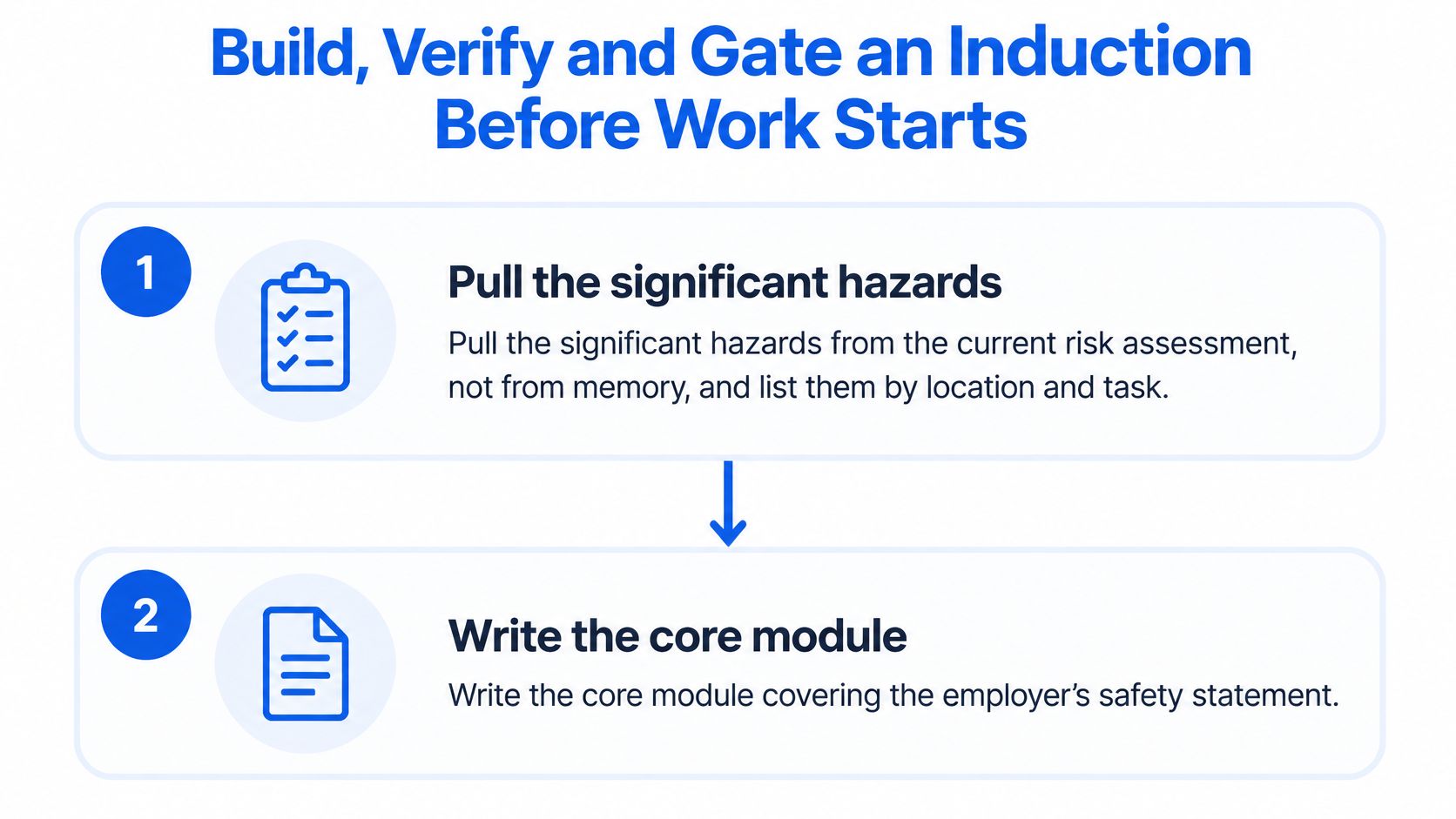
- Pull the significant hazards from the current risk assessment. Not from memory, and not from last year's pack. List them by location and task, so a hazard attached to the loading bay doesn't end up in a classroom module about fire exits.
- Write the core module. Safety statement, responsibilities, reporting routes, PPE, emergency arrangements, supervision boundaries. This is the part that follows the worker between sites.
- Build the site or task module from that hazard list. One named control per hazard, one named owner per control. If nobody owns the control, the module is describing an intention rather than a system.
- Choose the delivery format and adapt it. Demonstration, photographs, pictograms and an interpreter where needed. A worker who reads slowly or speaks limited English needs the same understanding, not a shorter version of the same leaflet.
- Add a competence check. At least three scenario questions, or a practical walk-round of the work area where the person shows you the exclusion zone, the exit and the assembly point. Record the pass, not just the session.
- Record the outcome properly. Worker, work area, role, trainer, date, language or accessibility adaptations, assessment result, and the expiry or refresher trigger. This is the difference between an auditable record and a name on a sheet.
- Link the record to site access or authorisation to work. No valid record, no entry to the hazard zone. That single connection turns induction from a compliance artefact into a preventive control.
Written procedures make the module easier to build and easier to defend: the SOP training approach of working from the approved procedure keeps the induction tied to the document people are expected to follow.
The readiness gate
Before anyone starts, confirm that every person type on site has a defined briefing in the access framework. Agency staff, contractors, visitors and delivery drivers each need a named briefing, a named verifier and a stated condition under which access is refused. If a person type has no entry in that framework, the gap stays invisible until the morning someone walks into a hazard zone with no briefing at all.
Set a review date, but trust the trigger more than the calendar. Any incident, any near miss, and any change to a traffic route, a piece of plant or a procedure reopens the relevant module. A twelve-month review cycle catches nothing that happened on the site last Tuesday.
The slip that undoes it
The most common failure is writing the module once from a template and never revisiting step one. Risk assessments change, layouts change, and the induction describes a site that no longer exists.
The rule that keeps induction honest: if the risk assessment changed and the induction didn't, the induction is out of date, whatever its completion rate says.
Two safeguards are worth building in. First, rerun step one every time the risk assessment is revised, and date the module against it. Second, have a suitably qualified person check any course material against your actual procedures before it's used. That applies with extra force to AI-generated content, which needs review against the client's real procedures and applicable requirements, because generation doesn't guarantee regulatory compliance. Our own starting point for that review is the client's approved procedure, learning need, audience, jurisdiction and desired course length, and verification by a suitably qualified person is arranged before any material is published or used for training. When we produce a course, a qualified HSQE specialist reviews every claim and signs it off before it leaves us.
When an Induction Must Be Repeated
The most common induction failure isn't a missing induction. It's the same induction, repeated unchanged, for years.
The HSA states that employees require occupational safety and health training at different points in their employment, not only when they first join an organisation, as noted in its workplace education resources. The need is measurable: Ireland recorded 11,086 reported non-fatal workplace injuries in 2025, 6% more than in 2024 and 13% above the previous five-year average.
Repetition without context creates completion fatigue. People click through the same slides, tick the same box, and learn nothing about the thing that has changed. Shorter, targeted refreshers triggered by a real change do more for safety than an annual re-run of a long module nobody reads.
Six triggers are worth writing into the policy, each with a response and a named person who records it.
- Moving between sites or areas. A worker transferred from a warehouse to a workshop needs the site module again, not the whole programme. The receiving supervisor records it.
- Starting a new task, machine or permit-to-work requirement. Response is the task module plus a practical check, recorded by the competent person who signs the permit.
- Taking on a supervisory role. Response is a briefing on supervision duties and emergency responsibilities, including who they must account for in an evacuation. The line manager records it.
- Returning after an extended absence. Response is a short review of what changed, with the absence period defined in the policy so nobody has to guess. HR or the supervisor records it.
- A contractor or employer change on the same site. Response is a check of the contractor's own record plus the site rules, because site rules don't travel with the contractor. The site manager records it.
- A changed traffic route, layout or procedure, often after a near miss. Response is a 20-minute walk-through of the new arrangement, recorded by whoever owns the change.
Notice what these triggers have in common. None of them is a date. Each one is a change in what the worker is exposed to, and each one is cheap to respond to if you catch it early.
The content of a refresher should test decisions rather than recall. Give the worker a changed traffic route and ask which way they walk. Give them an unfamiliar permit-to-work requirement and ask what they do before signing. Give them a near miss and ask who they'd tell first.
Covering Contractors, Visitors and Non-Workers
Ireland's latest HSA review reports 63 fatal work-related incidents in 2025, including seven non-worker victims, with 56 involving workers, as recorded in the annual review of workplace injuries, illnesses and fatalities 2024-2025. That seven should end the idea that induction is an employee onboarding exercise. The same review's 2024 figures put agriculture at 12 deaths and construction at five, both sectors where people who have never completed an employee programme are routinely on site.
Can a contractor rely on their employer's induction?
Only partly, and the confusion costs lives. The contractor's own induction covers their employer's systems, their equipment and their task hazards. It cannot cover your traffic routes, your assembly point, your permit rules or the area of your site that changed layout last month. Both records are needed, and the site manager has to verify the second one before work starts.
What must a visitor know before entering a live site?
Four things, and no more than four. Where the assembly point is, which zones are restricted, which route they must not take, and who is escorting them. A visitor who can't repeat the emergency route shouldn't be past reception, however short the visit.
How do you brief someone with limited English or no safety background?
Demonstration beats translation. Walk the person to the exit and the assembly point, use pictograms for PPE and no-go areas, bring in an interpreter for anything involving permits or isolation, and finish with a practical check where they show you rather than tell you. The goal is understanding, not delivery.
The gap across all three questions is a decision framework. Most sites have a visitor leaflet and no answer to who verifies understanding, what supervision applies, and when access gets refused.
| Person | Briefing Needed | Who Verifies Understanding | Refuse Access When |
|---|---|---|---|
| Visitor | Escorted briefing on emergency assembly, restricted zones and the no-go route | Host or reception | Visitor cannot repeat the emergency route |
| Delivery driver | Vehicle routes, marked waiting area and site speed limit | Site supervisor or gatehouse | No one can confirm the route to the bay |
| Contractor | Full site module plus the contractor's own task hazards | Contractor's competent person and site manager | Contractor induction record cannot be shown |
| Agency or temporary worker | Full employee induction, the same as permanent staff | Line supervisor | Competence check has not been passed |
Fill that table in for your own site this week. The person types you can't complete are the ones currently entering your workplace on trust.
If your induction still lives in a slide deck that predates your current risk assessment, Loresson produces bespoke workplace health and safety induction courses covering site rules, emergency arrangements, hazard reporting, vehicle routes, pedestrian segregation, exclusion zones, manual-handling limits and reporting lines, with scripting, narration, interactive scenarios, assessments and LMS-ready packaging, reviewed by a qualified HSQE specialist before it leaves us. Send us your approved procedure, learning need, audience, jurisdiction and desired course length, and that becomes the operational brief we build from. Start at Loresson.