

You've got an approved procedure, a near miss in the log, and a completion report that says everyone's trained. Then you watch the task on shift and two workers do it two different ways. That's the usual failure of SOP training. The document exists, the course was finished, but nobody can show the worker can perform the right version, in the right sequence, under real conditions. I would rebuild from that one task, not from your whole library.
Table of Contents
- Choose Your First SOP and Gather the Brief
- Scope the Task Before Writing Any Course
- How to Turn an SOP Into a Course in Six Steps
- Scripting Critical Actions for Real Work Conditions
- Assessment That Proves Competence, Not Recall
- Deploying, Versioning and Refreshing SOP Training
Choose Your First SOP and Gather the Brief
Pick one high-risk SOP that's already in use and has either caused a near miss or changed recently. Don't start with an easy win. A procedure nobody worries about won't expose weak scripting, weak assessment, or missing version control.
Confirm you're holding the approved version before anyone writes a line. Record its version number, review owner, and the jurisdiction it must match. If two sites are using different drafts, stop and resolve that first. Training built on an unapproved draft creates audit evidence against you.
The Five Items in the Brief
Collect these five items and nothing workable is left to guesswork:
- Approved procedure: The current, signed document, not a slide summary of it.
- Intended audience: The exact roles who perform the task, including supervisors who'll assess it.
- Jurisdiction: The country and site rules the course must reflect.
- Learning objectives: The safe behaviours the worker must show, written as actions.
- Course length: The time you can realistically take people off the floor to complete it.
That's the same operational brief we ask clients to share, covering the approved procedure, learning need, audience, jurisdiction and desired course length. Whether your in-house team builds it or an external partner does, a qualified HSQE specialist should review every claim and sign it off before release. Keep your own sign-off step too, especially for safety-critical actions and local requirements, because you remain responsible for what you deploy.
Set the date for the first observed assessment within 30 days of publishing now, while you're briefing. That forces the course to be tested on real workers, not on a reviewer's opinion. Procedure training sits alongside site induction and onboarding for a reason. It's operational, not decorative.
Practical rule: A course is finished when the worker can do the task, not when the video ends.
Scope the Task Before Writing Any Course
A long procedure turned into a long course is the most expensive mismatch in SOP training. You get a video nobody finishes, or a slide deck that produces quiz passes and no change on the floor. Scope first, and let risk decide the format.
For each SOP, record the task name, who performs it, hazards present, controls in place, the jurisdiction the procedure must match, and the review date. Then sort it into a tier. The Central Statistics Office summary of HSA data recorded 10,441 non-fatal workplace accidents reported in 2024, with workers accounting for 96% of those cases. Frontline staff carry that risk, so they need training tied to their actual equipment, substances, environment and hazards, not generic content aimed at managers.
Training Format and Proof by SOP Risk Tier
| Risk tier | Example task | Training format | Assessment |
|---|---|---|---|
| Low, routine, few hazards | Completing a daily log sheet | Short video plus checklist | Knowledge check and one supervisor sign-off |
| Medium, equipment or chemicals | Changing a cleaning solution in a dosing unit | Scripted lesson with on-machine demonstration | Observed demonstration before unsupervised work |
| High, safety-critical or manual handling | Lifting heavy loads from a pallet | Scenario-based module with role-play and coaching | Observed practice of each critical step, repeated after 30-90 days |
Each tier changes more than length. It changes who teaches, where practice happens, and what proof you'll accept. I would rather see a short, correct module for a low-risk task than a polished production that treats every procedure as equally dangerous.
Say a warehouse picker uses a pallet jack. Don't force the whole SOP into one tier. Split it. The route and load-check steps can sit in a low-risk module with a checklist. The lifting step belongs in a high-risk module with observed practice of each critical step, repeated after 30 to 90 days. That split respects people's time and puts your assessment effort where injury is most likely.
How to Turn an SOP Into a Course in Six Steps
This sequence turns a document into competence. The flow below shows the order I would follow for every procedure, whatever its tier.
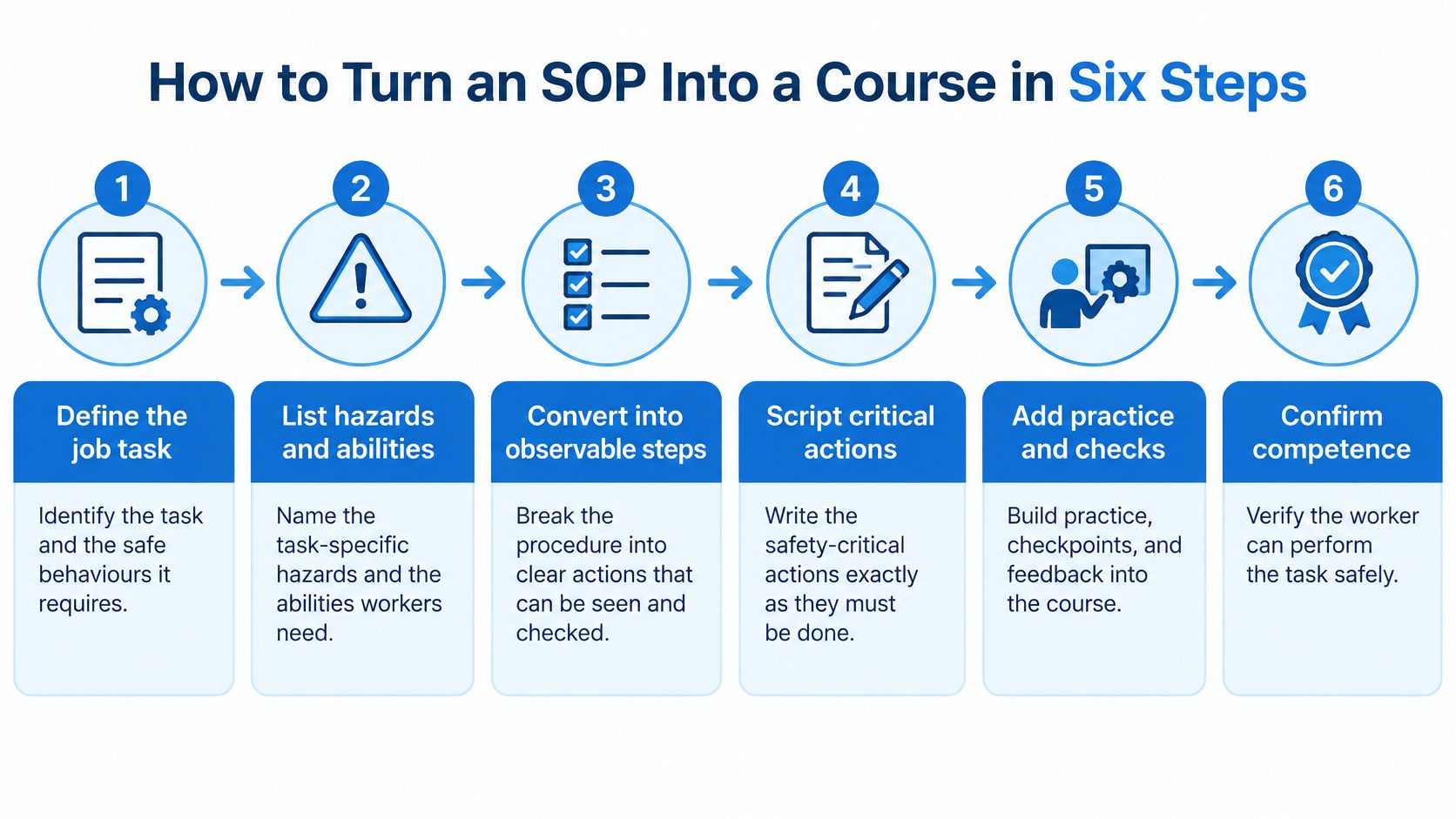
1. Define the job task and required safe behaviours. Name the task as the worker knows it, then list what they must do, not what they must know about. The common slip is copying the SOP title and calling that an objective. "Understand the lifting procedure" can't be observed. "Position feet, test the load, lift with legs" can.
2. Identify task-specific hazards and worker abilities. Tie hazards to this task, this equipment and this location. Generic hazard lists teach people to nod. Also note what the worker needs to be able to do, including reading gauges, judging weight, or calling for help. If the ability isn't there, training alone won't fix staffing or design.
3. Convert the procedure into observable steps. Most courses fail at this point. Dense paragraphs hide sequence, so rewrite every action as a verb-led line with its control beside it. Add decision points, controls and escalation rules where the worker must choose. If a step can't be seen or checked, split it until it can.
4. Teach through formal instruction plus job-specific coaching. The HSA safety and health management systems guidance states employers must provide instruction and training necessary for employee safety under Section 10 of the Safety, Health and Welfare at Work Act 2005. It also says training includes off-the-job learning, individual or group instruction, and on-the-job coaching, but cannot compensate for inadequate risk controls or poorly designed equipment. Pair the lesson with a coach on shift, and fix broken controls instead of scripting around them. Structured training course development should build that coaching into the plan, not leave it to chance.
5. Assess knowledge and practical application. A quiz checks recall. It doesn't check hands, posture, sequence or judgement under time pressure. Require a documented demonstration or supervisor observation for safety-critical steps, and treat a failed demonstration as a retraining trigger, not a disciplinary shortcut.
6. Retain evidence of completion, assessment and review. Keep the record an auditor can follow without asking you to explain it. That means the person's name, SOP version, assessment outcome, assessor and date, stored where you can retrieve them quickly.
The short video below shows how a scripted demonstration can carry steps 3 and 4 without turning the procedure into a lecture.
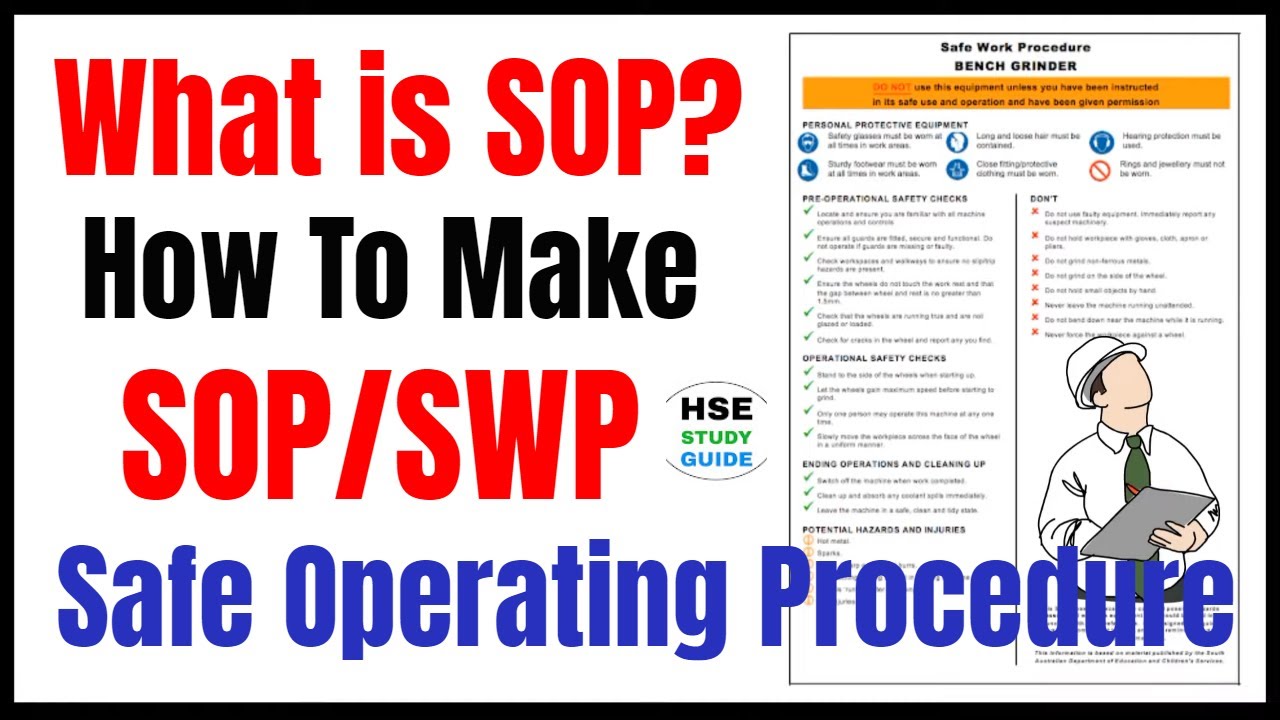
Before you publish, run one test. Could someone who's only watched the module perform the first three steps of the task correctly? If not, the module needs another pass. Don't let a launch date overrule that answer.
Scripting Critical Actions for Real Work Conditions
Say a line operator works in a noisy plant and can't hear the alarm sequence. If your script relies on sound, the training fails before the shift starts. Show the visual cue and the lockout step as on-screen text and as a physical checkpoint the worker touches, sees and confirms. The same rule applies to any critical action that depends on a sense the workplace overwhelms.
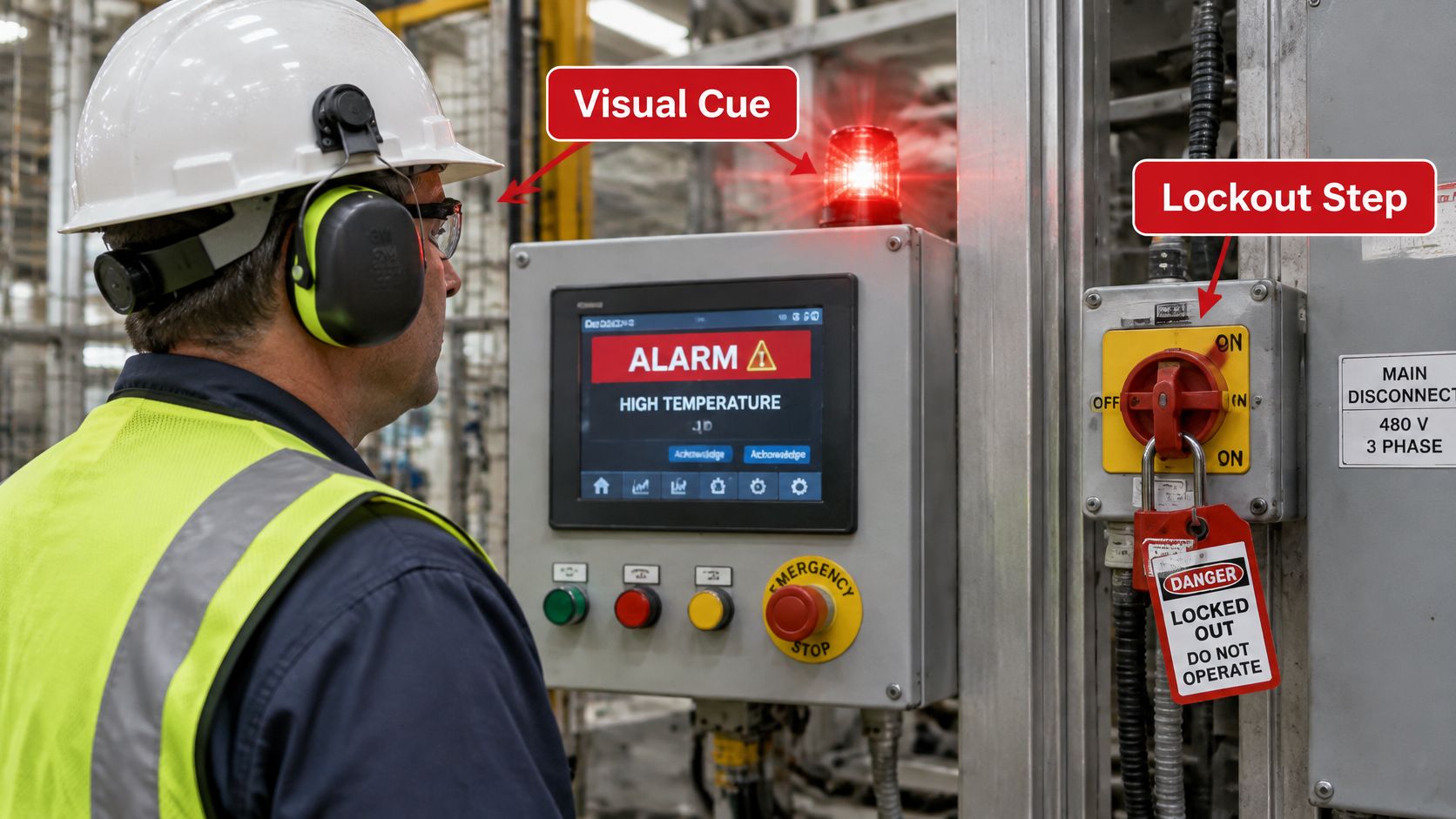
Map the environment before you storyboard. The HSA introduction to human factors identifies individual factors, job factors and organisational factors as interacting sources of error. Job factors include procedure design, equipment, lighting, noise, vibration and heat. Organisational factors include leadership, safety culture and safety-critical communication. Treating non-compliance as a memory problem ignores all of that.
Turn Each Factor Into a Storyboard Rule
- One critical action per shot: Don't bundle isolate, lock and test into a single wide frame. The worker needs to see each action and its checkpoint.
- Frame at the worker's eye line: Show hands, controls and labels from the position the operator stands in, not from a camera-friendly angle.
- Script the deviation: Show a missing guard, a blocked exit, or a load that shifts, then show the recovery decision. Workers rarely follow a procedure perfectly on a bad day, so teach the stop point and the escalation.
- Keep language action-oriented: Short lines, active verbs, no paragraph read aloud over footage.
New starters carry more than their share of risk. A single annual refresher doesn't answer that pattern. Intensify induction, observe critical tasks before unsupervised work, and repeat observation after 30 to 90 days. Well-planned elearning content development should make those early checks easy to schedule and record.
Put the SOP revision, the date and the approver on the storyboard before anyone records a frame. If the procedure changes after the shoot, the video becomes a false record, and an auditor will ask which version the worker was trained against. A course that cannot answer that question is not evidence of competence.
List every critical action, then confirm each one has a shot and a checkpoint. Any action without both is a gap in the storyboard, not a detail to fix later.
Feed recurring errors back into the procedure, equipment or supervision. If three workers miss the same step, your script, your controls, or your staffing need attention before the workers get another reminder.
Assessment That Proves Competence, Not Recall
Completion data looks reassuring until an incident review asks a harder question. Could this worker do the task? The Health and Safety Authority infographics page reported 83,234 e-learning courses taken in 2025 and 503,451 taken cumulatively from 2019-2025. That volume shows demand for digital learning. It doesn't show transfer to workplace behaviour, task execution, or risk reduction, and I wouldn't present it to an auditor as proof of competence.
Assessment Methods and the Evidence Each One Gives
| Method | What it proves | Evidence strength | Best use |
|---|---|---|---|
| Multiple-choice quiz | Recall of steps | Low | Early knowledge check only |
| Scenario decision questions | Judgement at decision points | Medium | Deviations and escalation rules |
| Observed demonstration | Ability to perform critical steps | High | Safety-critical and manual tasks |
| Supervisor sign-off on live work | Performance under real conditions | High | Before unsupervised work and after 30-90 days |
| Completion record alone | Only that the module was opened | Very low | Never as the sole evidence |
Pair scenario decision questions with an observed demonstration for every safety-critical step. The scenario tests whether the worker spots the blocked exit or the unstable load. The demonstration tests whether they act correctly when their hands are on the job. You need both, because judgement without execution, and execution without judgement, both fail in real conditions.
Record four things every time: the assessor's name, the SOP version number, the date, and the outcome. Link that evidence to the relevant risk assessment or safe system of work. In multi-site organisations with centralised policies and shared reporting, that link is what stops one site training version three while another assesses against version five.
Decide who may assess before you launch. A trained supervisor can assess medium-risk tasks where they perform the work themselves and know the controls. High-risk work needs a qualified assessor who can judge technique, not just sequence. Contractors and temporary workers need the same evidence before they touch the task. Their agency paperwork doesn't transfer competence to your site, your equipment, or your version of the procedure.
Before publishing or using materials for training, arrange verification by a suitably qualified person, particularly for safety, technical or compliance training. That's a control on the course itself, separate from assessing learners. Organisations building this into wider corporate training solutions should keep that distinction clear in their records.
Track one operational metric above completion rates: the share of new starters who pass the observed demonstration before unsupervised work. If that share drops, look at the script, the coaching and the task design before you blame attention spans.
Deploying, Versioning and Refreshing SOP Training
Version control is where good SOP training either holds together or falls apart. Print the SOP version number in the footer of every slide, video and checklist. Record which version each worker completed and was assessed against. When a new version goes live, retire the old one in your learning management system on the same day, so nobody can complete outdated content by following an old link.
Keep the retired version archived for audit history, but remove it from every active pathway, induction pack and shared drive shortcut. I've no patience for the argument that staff will spot the date. They won't, and they shouldn't have to.
Refresher and Review Triggers for SOP Training
| Trigger | Action | Timing |
|---|---|---|
| Scheduled review | Check the SOP still matches the work | At least yearly or as set in your policy |
| Manual-handling refresher | Repeat task-specific training | No more than three years, sooner if the work changes |
| Equipment or procedure change | Publish new version and retrain affected roles | Before the new version goes live |
| Incident or near miss | Review the step involved and retrain the affected roles | After the review, before the next shift on that task |
| New starter or role change | Observed competence check | Before unsupervised work |
| Failed demonstration | Retrain and reassess | Before the worker returns to the task |
Refresher timing should follow risk, not the calendar alone. The HSA manual-handling training guidance states approximately one-third of workplace injuries reported to it are caused by manual-handling activities, and describes these injuries as a leading cause of work disability. It also indicates refresher training should occur at intervals of no more than three years, or sooner when the work, equipment or work area changes. Training isn't universally mandatory for every employee. It depends on assessed risk, particularly risk of back injury, and where risk exists it must be specific to the tasks involved.
Apply that principle narrowly and fairly. If pallet height changes on one line, retrain the roles that lift at that height. Don't send the whole site through a generic refresher that teaches office staff nothing and lifters too little. Scheduled reviews, at least yearly or as set in your policy, should confirm the SOP still matches the work as it's done, including workarounds staff have developed since the last review.
Name a review owner for every SOP in the version record. That person owns the trigger check, the retraining list and the retirement of old content. Without a named owner, updates depend on someone remembering, and memory isn't a control.
If you've got an approved procedure that's still being taught from slides or shadowing alone, send Loresson the procedure, audience, jurisdiction, learning objectives and course length you need, and we'll shape it into a scripted, assessed course your supervisors can verify on the floor. Visit Loresson to start with that one high-risk SOP and build evidence your auditor can follow.