

The Health and Safety Authority annual review for 2023 to 2024 recorded 36 fatal work-related incidents in 2024, including 29 involving workers and 7 involving non-workers. In the same year, 10,441 non-fatal injuries were reported. These figures show why training must address both severe incidents and the injuries workers experience in everyday tasks. A completion tick only records that someone finished a course. It does not show whether they can make a safer decision when work is late, noisy or unfamiliar. Scenario practice tied to actual workplace hazards can help learners rehearse those decisions, while versioned course records show what instruction they received.
Table of Contents
- What Health and Safety Elearning Is
- Formats and the Evidence They Leave
- Benefits HSEQ Teams Actually Feel
- Compliance Records an Auditor Will Ask For
- Design That Changes Decisions on Site
- Courses That Match Real Work
- Choosing a Supplier and Keeping Sign-Off
What Health and Safety Elearning Is
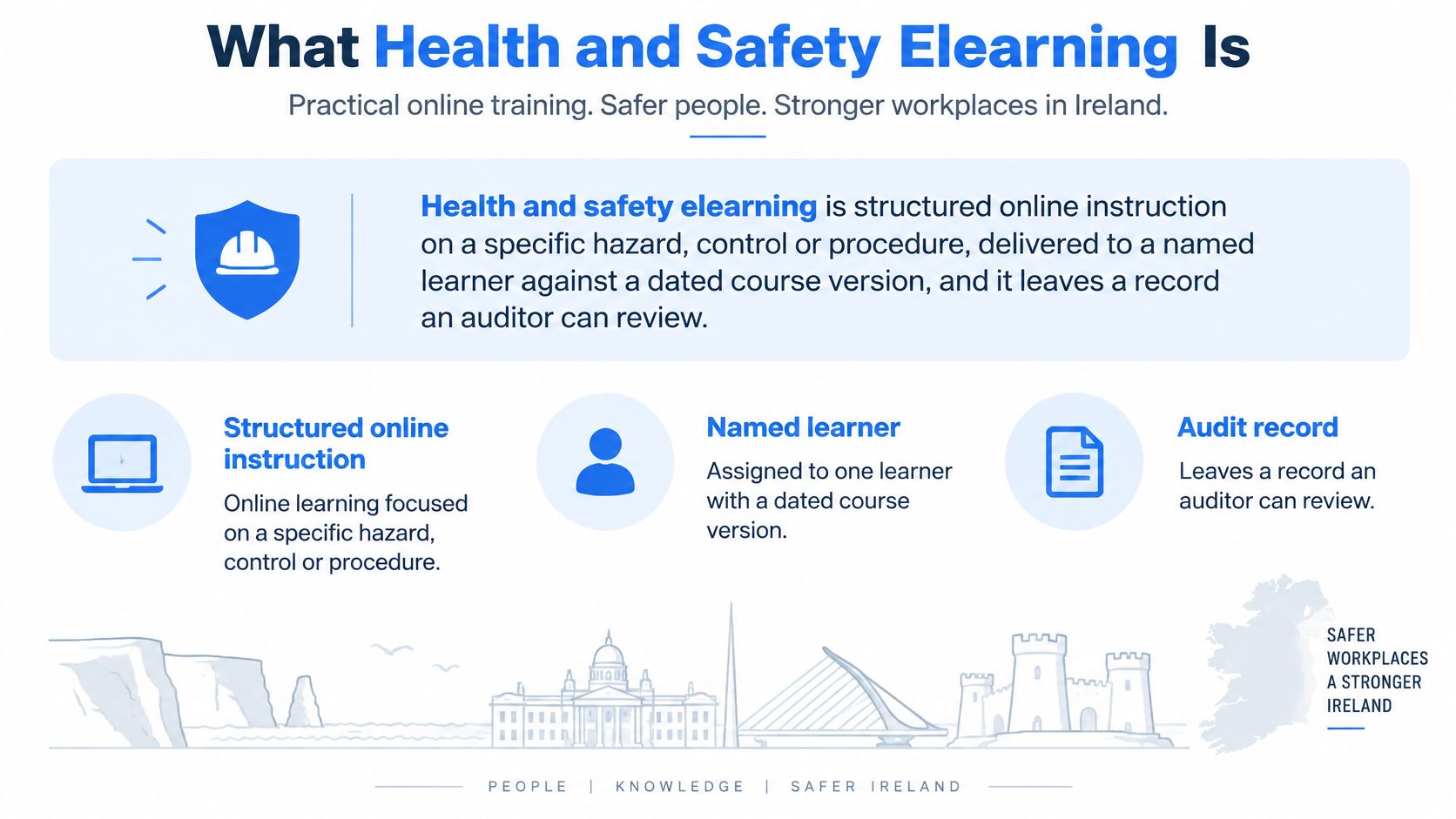
Health and safety elearning is structured online instruction on a specific hazard, control or procedure, delivered to a named learner against a dated course version, and it leaves a record an auditor can review. You can reuse that sentence in a brief, a tender or an internal policy. If one of those parts is missing, you may still have useful material, but you don't yet have defensible training.
A video that somebody happened to watch isn't enough on its own. There's no named learner, no proof they saw the current version and no reliable way to connect the viewing to a risk assessment or site rule. Elearning becomes training when the content, the person and the record are tied together.
The definition is summarised in the infographic below.
A Fire Door, Not a Corridor Talk
Think of the course as a fire door. Every starter, contractor and night shift worker passes through the same controlled opening, in the same condition, regardless of which supervisor is on duty. A corridor talk changes with memory, time pressure and confidence. A controlled course gives everybody the approved instruction and records that they received it.
That consistency matters because your programme has to do two jobs at once. It must prepare people for low frequency, catastrophic hazards, such as vehicle movements, falls, stored energy or a failed isolation. It must also reduce the much larger number of ordinary injuries that come from manual handling, slips, rushed lifting, poor housekeeping and skipped checks.
Two Parameters for Every Course
- Cover both ends of the risk: Teach the control that prevents a life changing event and the habits that prevent routine strains, cuts and collisions, because a programme focused only on dramatic hazards misses most harm.
- Build for reinforcement: Plan induction, short refreshers and retraining after a procedure changes, rather than treating one completion date as permanent competence.
Scenario practice helps connect those two parameters. Instead of asking a learner to recite a definition, you show a blocked walkway, an awkward load or a missing guard and require a decision. The learner has to select, apply or escalate the control, which is much closer to the judgement needed at work.
A record is defensible when an auditor can trace who learned, what version they learned and when they completed it.
Those three elements hold the definition together. A named learner prevents anonymous traffic from being counted as training. A versioned course shows which approved instruction was current at the time. A stored record lets you retrieve the evidence months later, after staff have moved teams or a contractor has left site.
Formats and the Evidence They Leave
Judge each format by the decision it helps a learner make and the evidence it leaves behind, not by how modern it looks.
| Format | Best use | Record it can leave | Weak if used alone |
|---|---|---|---|
| Cinematic video | Hazard recognition and procedure walk-through | Versioned script and completion of that version | Viewing is not a decision |
| Scenario or roleplay | Time-pressure choices and difficult conversations | Decision or conversation scored against a rubric | No standard if scoring is vague |
| Knowledge assessment | Gate before certification | Score, attempts, pass or fail and timestamp | Recall is not behaviour on site |
| Short refresher module | After a procedure, incident or rule change | Retraining tied to the new version | Too thin for first induction |
| Searchable job aid | Lookup at the point of work | Access only if the platform logs it | Reference is not training |
Cinematic Video
Video is strongest when people need to recognise a hazard or see a sequence performed in the right order. A walk from a site gate to a work area can show pedestrian routes, exclusion zones, signs and reporting points in one consistent pass. Every learner hears the same approved explanation, and a person who misses a detail can replay that part.
Its weakness is equally clear. A completed view proves exposure, not judgement. If the learner never has to identify the hazard without prompts or choose a control, you can't claim the video tested anything.
Scenario and Roleplay
Scenarios suit moments where the safe action competes with production pressure. Say a forklift is waiting, a pedestrian route is blocked and a colleague says the lift will only take a minute. The learner must stop the task, redirect people or escalate, then see the consequence of each choice.
Roleplay extends that principle to conversation. It can practise challenging a rushed permit, refusing an unsafe customer request or telling a supervisor that a guard has been removed. The useful record is the decision or conversation outcome scored against a rubric, for example whether the learner named the hazard, stated the control and escalated when challenged. A vague satisfaction score tells you almost nothing.
Assessment, Refreshers and Job Aids
A knowledge assessment works as a gate before certification when it has a stated pass mark. Store the score, attempt count and timestamp, and require remediation before another attempt if the learner fails. That proves recall or applied judgement at a threshold, depending on how well the questions are written.
A short refresher has a narrower job. Issue it when a method, risk assessment or site rule changes, and tie completion to the new version. Don't ask a five minute update to carry a full first induction, because new starters still need context, hazard recognition and practice.
A searchable job aid supports the moment of work. A one page isolation sequence, spill response card or manual handling decision guide can be valuable at the point of use, but lookup isn't induction and access logging isn't assessment.
Pairing rule: Induction usually needs video plus a decision assessment, safety critical conversations need roleplay plus a scored outcome, and a changed method needs a short module linked to the new document version.
Stacking more formats doesn't fix weak tracking. Five polished assets can still fail if the platform can't show who completed which version and what result they achieved. Before you commission anything, mark one primary format for your course and name the single record you'll keep as evidence.
Benefits HSEQ Teams Actually Feel
Irish employees aren't being asked to adopt an unfamiliar habit from scratch. The Central Statistics Office household digital consumer behaviour release for 2024 found that 34% of Irish internet users completed an online course in 2024. Among people who undertook some form of online learning that year, 64% said the purpose was professional or work-related.
That matters for adoption. Short courses, video demonstrations, assessments and searchable reference material already fit how many people learn for work. You're building on an established behaviour rather than spending the first month teaching staff how to use the medium.
Four Operational Gains
- Same induction everywhere: Starters, contractors and remote crews receive the approved course without waiting for a room, a trainer or a single site date.
- Faster refreshers: When a method changes, you can assign the revised module immediately instead of rebuilding a classroom schedule around shifts.
- Shorter production path: An approved procedure can move into scripting and course production more quickly when your internal team has limited video or design capacity.
- Replayable instruction: Learners can revisit a sequence before a task, which a one off toolbox talk can't guarantee once the group disperses.
Those gains reduce friction, travel and scheduling delays. They also make it easier to keep induction consistent across depots, client sites and home based staff. Consistency is valuable, but it isn't the same as effectiveness.
Familiarity with online learning doesn't prove that a particular course reduced injuries.
Treat convenience as the delivery benefit, not the safety outcome. The harder test is whether people choose safer controls after training, and that requires course design and workplace follow up built for behaviour.
Compliance Records an Auditor Will Ask For
An online course doesn't replace the employer's duty to assess risk, provide instruction and supervise work. The Safety, Health and Welfare at Work Act 2005 is the statutory base for those duties in Ireland, so never present a module as the duty itself. AI generation does not by itself establish that a course meets a law, standard, accreditation requirement or an employer's training obligations.
Online delivery can operate at national scale, but scale makes record design more important. The Health and Safety Authority 2024 annual report announcement reported nearly 74,000 online training courses delivered through its learning platform in 2024. It also reported more than 20,000 new users for the BeSMART risk assessment tool, taking total users above 130,000.
| Control | Minimum record | Fails if |
|---|---|---|
| Completion | Named learner, date and course version | Only a video view or anonymous hit |
| Assessment | Pass mark, attempts and remediation before certification | Attendance with no scored decision |
| Identity | Unique account per learner | Shared login for a crew or site |
| Version control | Script linked to the procedure or risk assessment version | Undated file with no source document |
| Retraining | Rule that assigns a new module when the procedure changes | One induction treated as valid forever |
| Jurisdiction | Record states the country or site rules the script follows | One global course assumed to fit every site |
Build the Evidence Row by Row
Completion must identify the learner, date and content version. A play count may help a communications team judge reach, but it won't satisfy an auditor asking whether a specific contractor completed the current site induction. Use SCORM or xAPI tracking so completion status, assessment scores and timestamps can be exported from the LMS.
Assessment needs a threshold and a consequence. Store each attempt, send a failed learner into remediation and issue certification only after a pass. Scenario items should demand a decision, such as choosing the correct control when a manual handling hazard is observed, rather than asking the learner to repeat a slogan.
Identity requires a unique account for each person. Shared crew logins destroy attribution, even if the whole team watched together in good faith. If group delivery is unavoidable, keep a separate verified attendance and assessment process that your own policy accepts.
Version, Jurisdiction and Sign-Off
Link the script to the procedure or risk assessment it explains, including the document version. When that source changes, the retraining rule should assign the revised module to the affected roles. For groups with sites in more than one country, state the jurisdiction the script follows so Irish requirements aren't mixed with another site's rules.
Before publishing or using materials for training, arrange verification by a suitably qualified person, particularly for safety, technical or compliance content. On a governed production, a qualified HSQE specialist reviews every claim and signs the course off before release, while the client's internal approval remains central for safety critical actions and local rules.
Design That Changes Decisions on Site
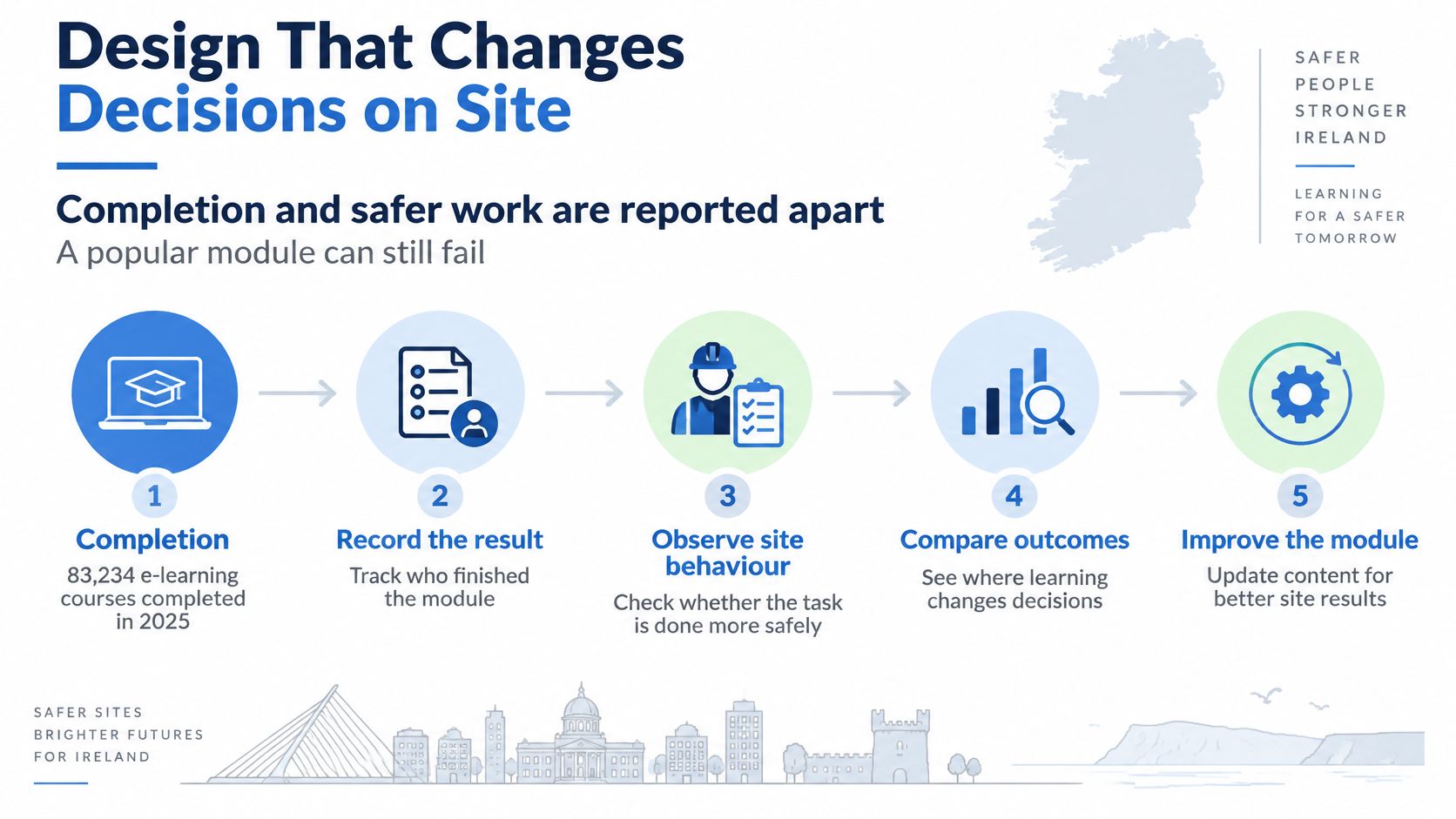
A high course completion rate does not prove that workers make safer choices. The Health and Safety Authority infographics page records 83,234 e-learning courses completed in 2025 alongside 61 fatal work-related accidents. Of those fatalities, 44% occurred in agriculture, forestry and fishing, and workers aged 55 or older accounted for more than 59%.
These figures do not show that e-learning caused or prevented harm. They highlight a gap between activity and outcomes. If completions rise while unsafe decisions persist in high-risk work, the organisation has a record of training activity, not evidence of safer work.
The process below connects course completion to reviewing site safety and performance.
Five Design Moves
- Name the unsafe decision: Focus on bypassing a guard, driving while fatigued or working alone without a check-in, rather than a broad title such as machinery awareness.
- Show the hazard: Set the decision in a recognisable yard, ward, kitchen, farm or warehouse, with cues the learner may encounter at work.
- Require a choice under pressure: Add a waiting vehicle, production deadline or colleague urging speed, then explain what can follow from choosing the wrong control.
- Tie the pass to the decision: Send a failed answer to short remediation and reassessment. Do not let the learner pass by clicking continue.
- Reinforce beyond the course: Ask supervisors to discuss the decision, include it in a toolbox talk, invite near-miss reports and reassess after a defined period.
Realistic depictions of hazards, accidents, injuries, emergencies and difficult conversations can serve a genuine learning purpose. The way a scene is shown can be adjusted. Realism should make the control clear, not rely on shock. Give learners enough context to recognise the hazard, then focus on the action they should take.
The video below illustrates how a workplace situation can become a decision exercise.
Measure One Thing Beyond Completion
Choose one observable measure before launch. For example, sample whether guards are replaced after cleaning, review the quality of near-miss reports, or repeat the same scenario decision after 90 days and compare choices. Keep the measure tied to the course objective. If behaviour does not change, revise the scene, question or supervisor prompt.
Target content to the risks of the role. Agricultural machinery, lone working, driving, fatigue and work involving older employees call for relevant examples and controls, rather than one generic awareness script. Strong elearning content development connects scenario practice and assessment to the hazards learners face.
An auditable short module can still leave decisions unchanged.
Courses That Match Real Work
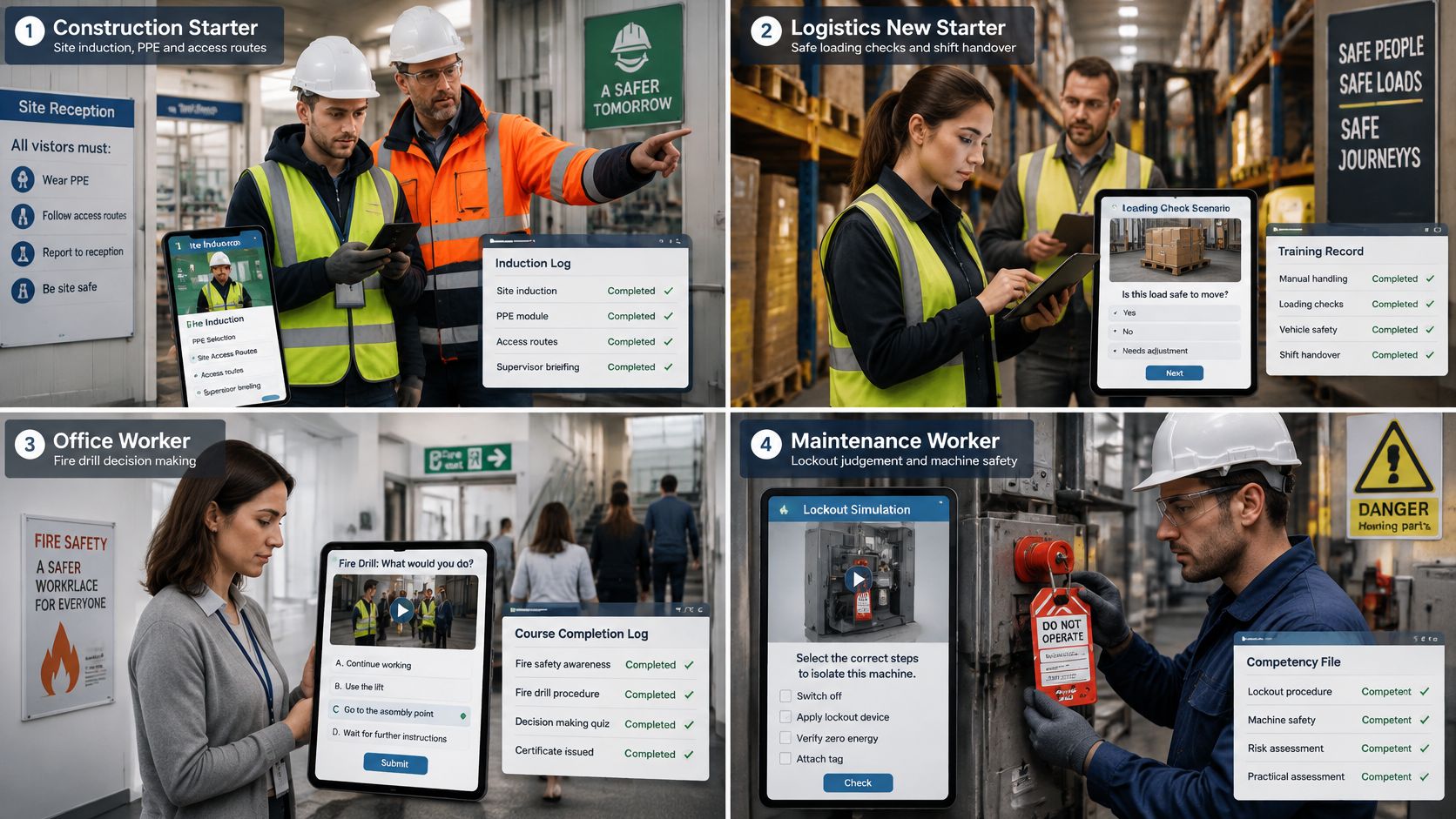
A useful course starts with a recognisable moment from the job, not a chapter list copied from a policy. The four examples below use different format mixes because the decisions, audiences and records differ.
The composite image below shows the range of workplace settings these examples cover.
Site Induction for Construction or Logistics
A new starter follows a cinematic walk from the gate to the work area, learning pedestrian routes, vehicle movements, sign in rules and emergency points. Midway through, a delivery blocks the marked walkway and a forklift approaches from a blind corner. The learner must stop, use the alternative route or contact the banksman rather than step into the vehicle lane. Good looks like choosing to stop the journey, and the completion is stored against the current site rules version. Fast, consistent induction training is valuable here only when that version link stays intact.
Manual Handling in Manufacturing or Facilities
The scene shows an awkward load at low level, partly obstructed by packaging, with a trolley available nearby. Instead of asking for a definition of a safe lift, the course asks the learner to choose the control before moving the load. A wrong answer returns them to a short demonstration of repositioning, team lifting or using the aid, then reassesses the decision. The record shows the eventual pass and the remediation path, which is stronger evidence than attendance at a talk.
Lone Working, Driving and Fatigue
A field worker finishes late, feels tired and considers skipping the final check-in to save time. The scenario explores what happens if they drive while fatigued or enter an isolated area without telling anybody. The safe outcome is to pause, check in and escalate the schedule problem. Follow the module with a supervisor prompt about journey planning and lone worker contacts, because another video won't fix a rota that routinely creates fatigue.
Difficult Conversations in Hospitality or Contact Centres
A customer asks an employee to ignore a safety restriction, or a colleague pressures them to keep serving while a wet floor area remains open. Roleplay lets the learner practise refusing the unsafe request, stating the control and escalating to a manager. Score whether they stay polite without surrendering the control. Good looks like a clear refusal plus escalation, not a cheerful conversation that ends with the hazard still exposed.
Localisation changes the examples, legal references, signage, vehicles and site language. Irish agriculture and construction need different emphases from a UK warehouse or a wider European facility, even when the underlying decision structure stays the same.
Choosing a Supplier and Keeping Sign-Off
Assemble the brief before you talk to any producer. Share the approved procedure you're authorised to share, the intended audience, the jurisdiction, the learning objectives and the desired course length. Existing examples and brand guidance can make the course more specific, but they're optional starting material rather than a barrier.
| Criterion | Ask for | Red flag |
|---|---|---|
| Tracking standard | SCORM or xAPI export of completion, score and version | Only a video view or a PDF |
| Version control | Script linked to the procedure or risk assessment it explains | Undated script with no source reference |
| Jurisdiction | Named country or site rules the script follows | One global course assumed to fit every site |
| Qualified review | Named HSQE or compliance specialist signs each claim | Generator output released unchecked |
| Editor handover | Editable source files or a finished package for your LMS | Locked format with no export route |
| Localisation | Hazard examples and legal references adapted per market | Translated text only |
Test the Answers, Not the Demo
Ask the supplier to show a sample record export, not only a polished scene. You need to see how learner identity, score, attempts, completion date and course version appear in your LMS. If they can't explain the tracking route, set them aside regardless of how good the footage looks.
Then inspect version control and jurisdiction. A script should point back to the procedure or risk assessment it explains and state the country or site rules it follows. Translation alone isn't localisation, because hazard examples, terminology, escalation routes and legal references may all need to change.
Qualified review is the next gate. Ask who checks the safety claims, what competence they hold and where their sign-off is recorded. Internal approval stays with the employer, especially where the course instructs a safety critical action or describes a local rule that only your organisation can authorise.
Loresson is an AI-assisted production service directed by experienced learning, compliance and HSEQ specialists, rather than a generator left to invent requirements. It fits when you need a bespoke workplace course built from your brief, with cinematic media, narration, graphics, assessments and optional roleplay, delivered editor ready or finished for your LMS. That model sits within broader corporate training solutions when induction, procedure training and people skills need a consistent production route.
Before commissioning, keep three checks. Confirm the script cites the procedure and jurisdiction, the package exports completion, score and version, and a qualified person signs the claims before release.
Bring us your approved procedure, audience, jurisdiction and the unsafe decision you need to change, and we'll shape it into a bespoke, version controlled health and safety elearning course with assessment and qualified HSQE review. Visit Loresson to start with a brief that your HSEQ team and your auditor can both defend.