

Agriculture and construction accounted for more than two-thirds of Ireland's recorded work-related fatalities in 2023, according to the Health and Safety Authority's fatality report. That concentration makes the HSE officer's purpose clear: turn broad safety commitments into controls that work around actual machinery, vehicles, people and changing tasks.
HSE stands for health, safety and environment, although this guide focuses on the Irish workplace safety, health and welfare function. The job isn't measured by how many policies someone writes. It's measured by whether managers understand their responsibilities, workers can follow safe arrangements, and the employer can show that those arrangements operate during real work.
Table of Contents
- What an HSE Officer Owns and What They Do Not
- How the Competent Person Runs the Control Cycle and Inspection Evidence
- A Delivery Yard Example from Hazard to Review
- Hazards That Should Come First in Ireland
- Skills and Qualifications That Count as Competence
- Psychosocial Risks a Checklist Does Not Control
What an HSE Officer Owns and What They Do Not
An HSE officer carries out a competent-person function within an Irish employer's safety system. The officer organises and advises on prevention, while the employer remains responsible for managing the undertaking safely. Appointing someone with a safety title doesn't transfer that responsibility.
The HSA Annual Report 2024 recorded 34 work-related fatalities, the lowest annual total since the authority's establishment in 1989, and found that only 28% of inspected workplaces had a safety representative. The authority identified several reasons for missing representatives, including employers not facilitating the role, vacancies, limited awareness, small workforces and reliance on other communication arrangements.
These are different problems. An employer might have access to technical safety advice but lack meaningful worker consultation. Equally, appointing a representative doesn't supply the technical competence needed to assess complex work.
Who owns what in an Irish workplace safety system
| Role | Legal position | Core duty | Does not own |
|---|---|---|---|
| Employer | Workplace safety duty holder | Safety Statement, risk assessment, resources and decisions about residual risk | Cannot pass legal accountability to an officer or representative |
| HSE officer | Competent-person function | Hazard register, task assessments, control recommendations, owners, due dates and verification | Management approval or authority to accept risk merely because of the job title |
| Safety representative | Worker consultation role | Raise concerns, represent workers and participate in consultation | Responsibility for completing or signing the employer's risk assessment |
| HSA inspector | National workplace safety regulator's inspector | Examine the Safety Statement, assessments and compliance evidence; provide advice or take enforcement action | Running the employer's daily safety system |
The officer keeps the hazard register, assessment arrangements and review dates organised. The representative brings workers' concerns into the process and may meet an inspector, but isn't the person responsible for signing the employer's assessment. The inspector examines the employer's arrangements and supporting evidence rather than taking over site management.
Give responsibility enough authority
A common organisational mistake is to make the officer responsible for closing every finding without giving them purchasing authority, control over schedules or access to senior management. An officer can identify an unsafe loading area, but the operations manager may need to approve a layout change and arrange the work.
Write that distinction into job descriptions and action records. Give the officer a clear escalation route when managers leave a significant control unresolved, rather than expecting repeated reminder emails to solve the problem.
Practical rule: The person tracking an action isn't necessarily the person with the authority to complete it.
Name the employer's accountable decision-maker and the competent person in your own workplace. Check that the Safety Statement makes their responsibilities visible, alongside the arrangements for worker consultation.
How the Competent Person Runs the Control Cycle and Inspection Evidence
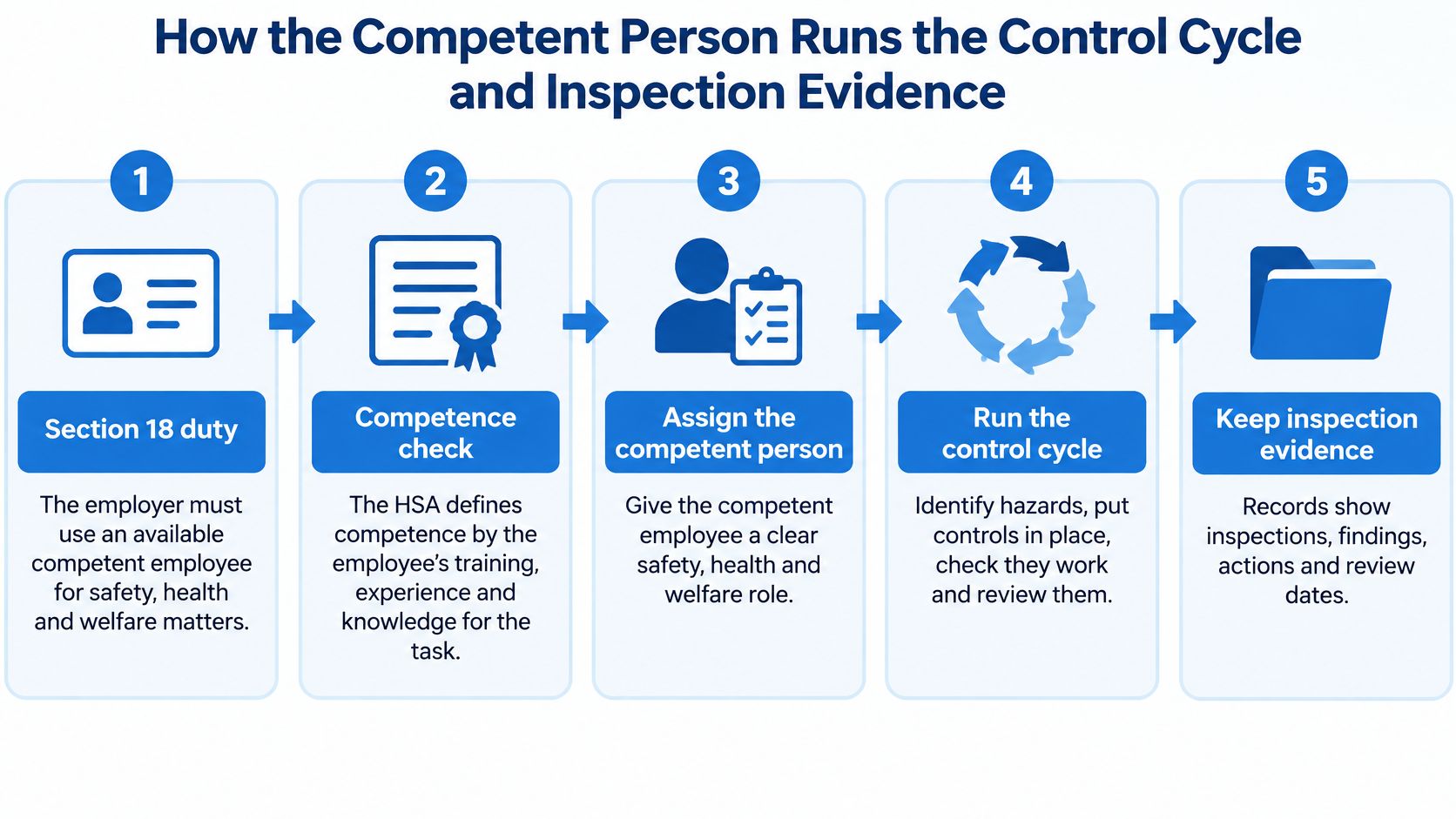
Section 18 of the Safety, Health and Welfare at Work Act 2005 requires an employer to use an available competent employee for safety, health and welfare matters. The HSA Safety Representatives Resource Book describes competence in terms of appropriate training, experience and knowledge for the task, hazards and size of the undertaking. The Act also requires employers to identify hazards, assess risks and set out how safety will be managed in the Safety Statement.
An HSE officer helps keep the control cycle moving, much like a gauge board helps a workshop spot readings that need attention. The officer can identify a problem and check whether it was addressed, while the employer retains responsibility for managing the work.
The appointment and oversight arrangements should support that practical role.
Run a traceable control cycle
Keep a hazard register. Record the source of harm, who may be exposed and where. The officer can coordinate the register, drawing on supervisors' and workers' knowledge of the work.
Assess the task or activity. Examine routine work, foreseeable interruptions and points where tasks or people overlap. Record who contributed and have the manager responsible for the work approve the assessment.
Choose controls using the hierarchy. First consider whether the hazard can be eliminated. Then assess substitution and engineering measures before relying on instructions or personal protective equipment.
Assign an owner and due date. Name the person with authority to deliver the change. The officer may advise on the control, while the responsible manager commits resources and approves the arrangements.
Verify effectiveness. Observe the task while the control is in use. Record who checked it, what they found and what evidence supports the finding. A purchase record alone does not show that a control works.
Review when conditions change. Revisit the assessment after significant change, or when it no longer reflects the work. Keep the approval and review history clear.
Make each signature's purpose explicit. Use labels such as prepared by, consulted, approved by and verified by, rather than placing names beneath an unexplained approval box.
Build evidence an inspector can follow
Ireland recorded 63 work-related deaths in 2025, including seven non-workers, according to the HSA Annual Review of Workplace Injuries, Illnesses and Fatalities 2024–2025. That figure is a reminder to account for everyone exposed to work, including contractors, temporary crews and visitors.
An inspector may examine the Safety Statement, workplace-specific assessments and compliance evidence, and speak with the safety representative or safety manager. A connected record makes the employer's decisions easier to follow than a large folder of unrelated documents.
For each significant hazard, make these records easy to find:
- Identification and approval: Who raised the hazard, assessed it and authorised the work with its remaining risk.
- Communication and competence: How affected people were briefed, how understanding was checked and how subcontractor capability was assessed.
- Verification and escalation: What showed whether the control worked, when it was checked and who receives overdue actions.
Training materials can form part of this evidence trail. A qualified HSQE specialist reviews every claim in a Loresson course and signs it off before it leaves Loresson. Before publishing or using materials for training, arrange verification by a suitably qualified person, particularly for safety, technical or compliance training. Internal approval remains central when a course explains safety-critical actions or local requirements.
Test the records against your highest-risk task. If the hazard identifier, responsible risk approver, verification evidence or review date is missing, the record does not yet show a complete control cycle.
A Delivery Yard Example from Hazard to Review
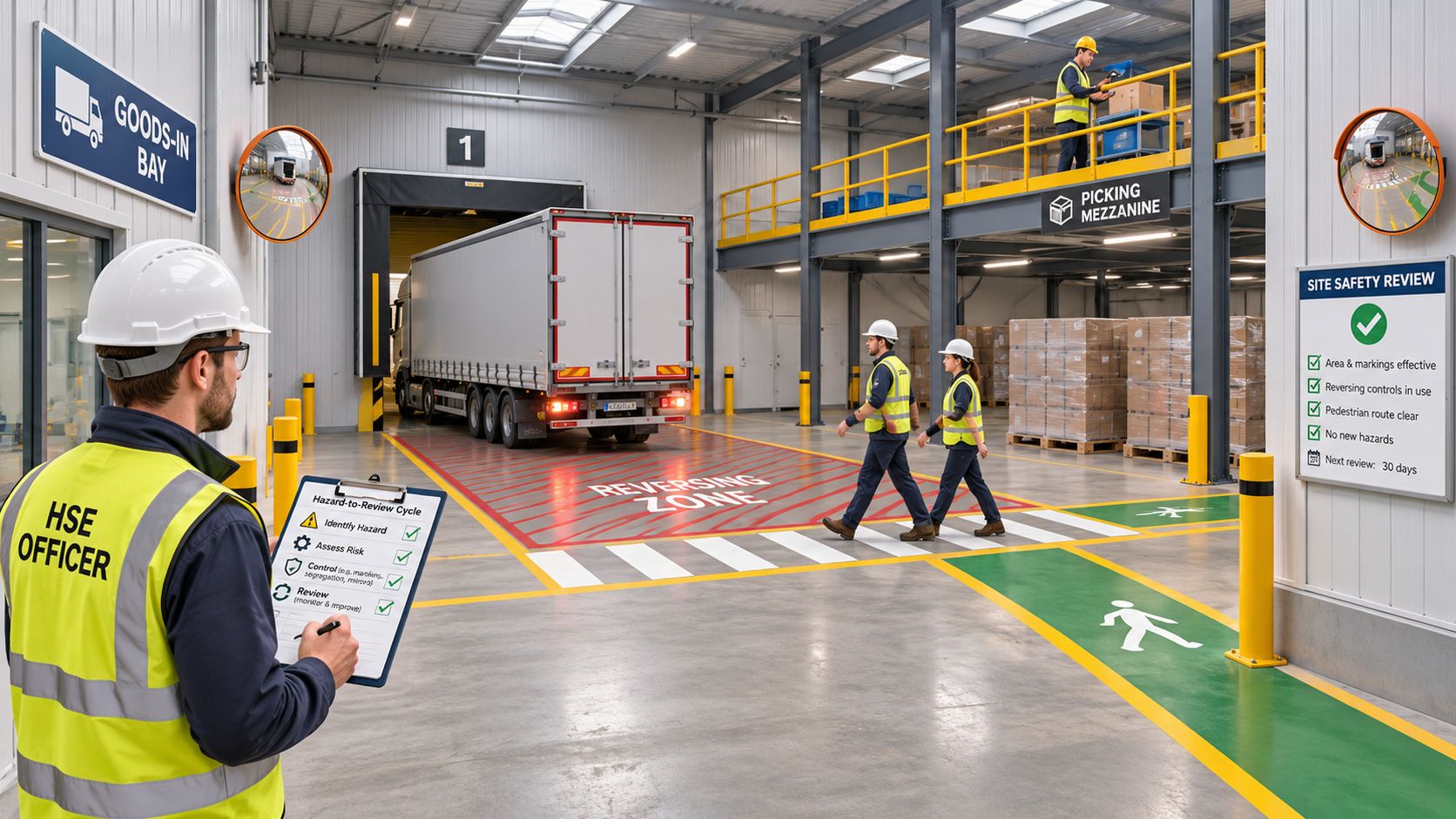
Say a goods-in yard has reversing trucks, pedestrians crossing between parked vehicles and a mezzanine used for picking. Deliveries arrive while warehouse staff prepare outgoing orders. The HSE officer starts by watching that overlap, not by downloading a generic traffic policy.
The hazard register records vehicle movement and work at height separately. The task assessment follows a morning delivery from arrival to departure, including the driver leaving the cab, staff unloading and pedestrians trying to reach the warehouse entrance.
The yard layout makes those interfaces easier to examine.
Change the route before changing the briefing
The officer asks whether the delivery route can avoid reversing. Where reversing remains necessary, the warehouse manager arranges physical separation between the manoeuvring area and the pedestrian approach, with a marked walkway leading to a protected entrance.
High-visibility clothing supports that arrangement; it doesn't replace the barrier. The officer also checks whether workers would have a practical reason to bypass the walkway, such as a locked door or pallets obstructing the route.
At the mezzanine loading point, the manager selects a suitable fixed loading-gate arrangement that maintains protection during material transfer. The assessment covers access, loading and recovery from foreseeable emergencies. A harness briefing alone wouldn't resolve an unprotected edge.
Make ownership visible
The action record gives the warehouse manager responsibility for the barrier installation by an agreed Friday, identified by its actual calendar date. The delivery contractor owns the banksman briefing where the assessed arrangement requires a banksman, including agreed signals and the instruction to stop if visual contact is lost.
The self-employed driver receives the site-specific arrival instructions before the first reversing movement. The supervisor checks relevant competence and understanding instead of assuming that experience elsewhere means familiarity with this yard.
| Weak arrangement | Working arrangement in this scenario |
|---|---|
| Traffic poster beside the office | Arrival instructions delivered before the driver enters the manoeuvring area |
| Unsigned generic assessment | Task assessment approved by the manager responsible for goods-in |
| Barrier listed as complete | Observation confirms that pedestrians use the protected route |
| No review date | Recorded review arrangements and clear change triggers |
During a pre-start observation, the supervisor checks whether the walkway stays clear and the loading gate maintains protection throughout picking and transfer. If staff still cut across the vehicle route, the officer investigates why before declaring the arrangement effective.
A new haulier, changed storage layout or near miss prompts a fresh look at the task. Run one of your own high-risk activities through the same practical test this week, from arrival or set-up through to completion and review.
Hazards That Should Come First in Ireland
In the HSA's 2023–2024 review, 33 people died in work-related incidents in 2024. The HSA Annual Review of Workplace Injuries, Illnesses and Fatalities 2023–2024 identifies 10 vehicle-related deaths, six involving heavy or falling objects, and five falls from height. Together, these three clusters account for 21 of the 33 deaths, or about 64%. Eighteen victims, 55%, were self-employed.
Irish fatality clusters an HSE officer should weight first
| Cluster | Position in the 2024 dataset | What it means | First control to verify |
|---|---|---|---|
| Vehicle-related deaths | Largest fatal cluster | Vehicle interfaces deserve early attention | Pedestrian segregation, reversing and delivery controls |
| Heavy or falling objects | Next-largest listed cluster | People must be kept outside potential load paths | Lift planning and load security before lifting |
| Falls from height | Another major fatal cluster | Access and edge exposure need engineered protection | Suitable access, edge protection and rescue arrangements |
| Self-employed workers killed | More than half of victims | Employment status doesn't remove exposure | Competence and applicable permit checks before work starts |
The infographic shows the same 2024 fatality figures.
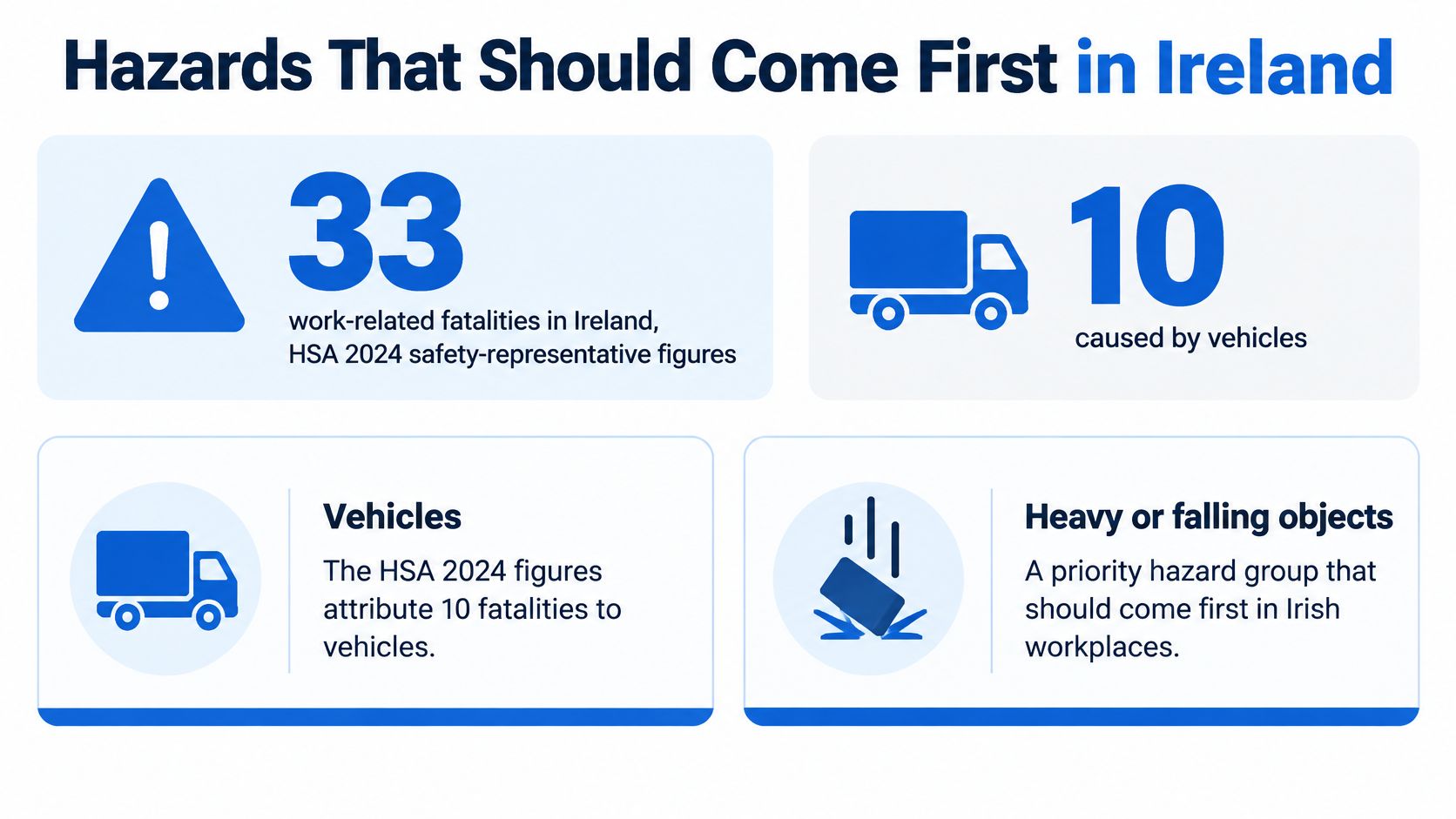
National patterns help identify hazards worth checking, but they don't set the priority for every site. A workshop without lifting operations may need to focus first on machine guarding, hazardous substances or maintenance isolation. Use the figures to test whether your risk assessment has missed a serious exposure, then judge priority against the work done.
Verify the exposure, not the policy
For vehicle movements, walk the delivery route during normal operations. Check blind corners, overflow parking, shared doors and routes people use to reach welfare facilities.
For lifting, examine the load, lifting accessories, ground conditions and exclusion arrangements before the lift starts. For work at height, check how workers reach the task, stay protected and can be recovered if something goes wrong.
Manual load handling and suspended loads need different controls. Manual handling training can support safer handling methods, but it cannot replace lifting aids, sound storage design or controls that keep people out of a load's fall zone.
A completed policy proves a document exists. A field check shows whether the control protects people.
Track the share of high-risk tasks with verified pre-start controls, corrective-action close-out time and repeat findings by location or contractor. Set a clear test for “verified”: a tick alone is not evidence that the arrangement works.
In agriculture, construction and other changing workplaces, check the machinery, access arrangements and contractor interfaces present on the day. Rank tasks by exposure to vehicles, falling loads and work at height, then direct attention to the controls people rely on in practice.
Skills and Qualifications That Count as Competence
A course certificate alone doesn't establish competence for every HSE officer assignment. The practical question is whether the person can apply their learning to the employer's hazards, recognise the limits of their knowledge and obtain specialist help when necessary.
Don't approach recruitment as a search for a single licence that settles every requirement. Evaluate the qualification, relevant experience and demonstrated work together, rather than treating a familiar awarding-body name as proof of site readiness.
Qualification pathways for an Irish HSE officer
| Pathway | What it shows | Best fit | Limit |
|---|---|---|---|
| On-the-job experience plus short courses | Local hazard knowledge and focused learning | Small, lower-risk workplaces with suitable support | Weak alone for complex plant or multi-site work |
| NEBOSH General Certificate or equivalent | Broad grounding in risk assessment and safety principles | General officer recruitment where practical capability is also assessed | Doesn't establish site-specific or sector-specific competence by itself |
| NEBOSH Diploma, relevant degree or QQI higher-education award | Greater safety-management depth | Multi-site or higher-hazard responsibilities, alongside relevant experience | Still needs current knowledge of local operations |
| Safe Pass, CSCS or similar cards | The access, awareness or task competence covered by the particular scheme | Relevant construction access or specified activities | Doesn't establish competence for the whole officer role |
These are recruitment decision aids, not interchangeable awards or a universal appointment standard. Check the actual syllabus and assessment, especially where a candidate's qualification title sounds broad but their recent work has been narrow.
A person with strong office-based policy experience may still need support around machinery isolation. A technically experienced maintenance worker may understand plant hazards well but need development in consultation, investigation and clear written assessments.
Look for usable working skills
Ask the candidate to explain a task to a supervisor in plain language. Can they distinguish the hazard from the possible injury, select a stronger control and explain what would make them stop the work?
Useful evidence includes:
- Task assessment writing: Instructions that match the sequence workers follow, including interruptions and abnormal conditions.
- Constructive challenge: Questions that expose gaps in a contractor's method statement without turning the review into a paperwork contest.
- Consultation: Listening to workers and respecting their representative's role rather than speaking for everyone.
- Action discipline: Clear owners, realistic dates, verification records and timely escalation.
- Incident handling: Calm fact-gathering, preservation of relevant evidence and recognition of when specialist support is needed.
Use compliance training in Ireland to address identified learning gaps, not to obscure missing practical supervision. Match development activities to the decisions the person will make.
A useful hiring test is to ask for an appropriately anonymised assessment the candidate prepared, the control that was implemented and the date it was checked during work. Ask what they changed when the first solution didn't work.
Psychosocial Risks a Checklist Does Not Control
Secondary reporting of the Ireland sample associated with the EU-OSHA OSH Pulse 2025 Ireland material indicates that 35% experienced severe time pressure or work overload, while 32% reported work-related stress, depression or anxiety during the preceding year. These are survey findings, not a diagnosis of your workforce, but they give a clear reason to examine how work is organised.
An HSE officer's job doesn't end with visible physical hazards. Workload, conflicting instructions, poor communication and unacceptable behaviour also need an organised response. A completed stress checklist won't establish whether management has changed the conditions creating the exposure.
Use an organisational workflow
Triage and protect confidentiality. Establish whether there's an immediate safety concern and explain who needs to receive the information. Don't promise absolute secrecy that the organisation can't maintain.
Separate individual support from system assessment. A personal case may need HR or occupational-health involvement. The wider assessment asks whether staffing, targets, supervision or work design expose others to similar pressures.
Map the work with workers. Examine demand peaks, interruptions, conflicting priorities and unclear handovers. Don't turn consultation into employee surveillance or ask workers to disclose diagnoses.
Agree organisational controls. Management might change a target, provide cover at peak periods, clarify escalation or fix an unstable rota. Assign responsibility to someone who can alter those conditions.
Review exposure and participation. Record who was consulted, what changed and whether workers still describe the same problem. Use operational indicators such as unresolved workload escalations rather than collecting medical outcomes.
Keep the evidence proportionate
Suppose a customer-service team receives urgent work through several channels, with no agreed priority order. The officer can map those competing demands, help management establish a single allocation process and check whether supervisors use it.
That doesn't require access to health records. Nor should the officer diagnose a worker or investigate a bullying allegation without the appropriate remit and procedure.
Strong evidence of prevention shows what changed in the work, not how much sensitive information the employer collected.
Dignity at work training can help people recognise unacceptable conduct and use reporting routes. It must sit alongside fair procedures and management action, rather than substitute for them.
Start with a system risk you can examine without health information: conflicting deadlines, unpredictable rotas or repeated interruptions during safety-critical tasks. Ask workers where the pressure arises, name the manager who can change it and agree how you'll check the result.
Loresson creates bespoke site induction, onboarding and procedure training from your approved workplace requirements, with assessments and optional interactive role-play. Visit Loresson with a priority task, your audience and the applicable jurisdiction to discuss training that helps workers practise the controls your HSE officer needs to verify.