

Which online safety training course should you buy if “safety” could mean phishing, a factory hazard, data privacy or a child disclosing harm? The course title alone won't tell you what duty it supports, what behaviour it teaches or what evidence you'll have afterwards.
Start with the behaviour you need to change and the record you'll need to keep. Then choose a course family, format and assessment that fit. That sequence helps prevent a common mistake: treating a polished completion certificate as proof that someone can act safely.
Table of Contents
- Types of Online Safety Training Courses at a Glance
- Learning Formats and Which One Fits Your Team
- Learning Outcomes That Show a Course Worked
- How to Judge the Quality of a Course
- Where Cinematic and AI-Assisted Production Fits
- Compliance Readiness and Briefing the Provider
Types of Online Safety Training Courses at a Glance
Online safety training isn't one product. It covers course families with different audiences, risks and reference points, and an organisation may need several at once.
| Course type | Typical audience | Core topics | Common reference points |
|---|---|---|---|
| General online safety awareness | All staff, schools and families | Phishing, passwords, privacy and reporting | Organisational policy and national awareness programmes |
| Occupational health and safety (HSE/OSH) | Site, factory and office staff | Hazard recognition, safe systems of work and incident reporting | UK HSE guidance and Ireland's HSA guidance |
| EHS (environment, health and safety) | Operations, facilities and site managers | Environmental controls, permits, hazard management and emergency response | Environmental and workplace procedures, permits and risk assessments |
| HSEQ (health, safety, environment and quality) | Managers in manufacturing, logistics and engineering | Integrated procedures across safety, environment and quality | Integrated management systems, including ISO 9001, 14001 and 45001 |
| Cyber security awareness | Every employee with system or data access | Recognising phishing, protecting credentials and handling sensitive data | Organisational ICT policy and incident procedures |
| Data protection and privacy | Staff who handle personal data | Lawful handling, subject requests and breach reporting | UK GDPR and EU GDPR |
| Child safeguarding and online safety | Youth-facing staff and employees who are also parents or carers | Disclosure, escalation, image-based abuse, scams and grooming signs | National safeguarding guidance and local reporting pathways |
| Employee induction and policy | New hires and staff changing role | Acceptable use, conduct and reporting channels | Internal policy and induction standards |
Ireland's first Action Plan for Online Safety, launched in 2018, established the issue as a cross-government priority, and more than 140,000 young people signed up for Safer Internet Day in 2019, a 37% increase on 2018, according to the National Advisory Council for Online Safety progress report.
Read the course family, not just the title
HSE and OSH usually point to physical occupational risks and safe work practices. In Ireland, the Health and Safety Authority (HSA) is a relevant reference point; UK HSE guidance may also matter to organisations working across jurisdictions. EHS adds environmental controls, such as handling waste or following permit procedures. HSEQ brings quality management into the combined system, so learning may cover how safety, environmental and quality processes work together.
Cyber security and data protection are related, but they aren't interchangeable. A cyber course might teach someone to report a suspicious link; a data protection course might teach them how to handle a request about personal information. A child safeguarding course needs yet another response: how to listen to a disclosure and follow the appropriate escalation pathway.
The distinction buyers often miss is that HSE and EHS describe families of physical and environmental risk, while compliance describes obligations that an auditor, regulator or client can check. Compliance can apply to any of the course families in the table.
A driving licence category tells you what you may drive, not whether you drive safely. In the same way, the course label doesn't prove that its content fits your workplace or changes the needed behaviour. Match each job role to the relevant rows before looking for a provider.
Learning Formats and Which One Fits Your Team
Choose a format by asking what the learner must be able to do. The format is the vehicle; the target behaviour is the destination. A learner can absorb a policy rule from a short module, but recognising a fake invoice or calmly responding to a disclosure calls for practice.
| Format | Best for | Strengths | Limits |
|---|---|---|---|
| Self-paced e-learning | Knowledge and policy for dispersed staff | Scales efficiently and can track completion and scores | Little practice; learners can click through without thinking |
| Live virtual session | Discussion, questions and policy clarification | Real-time interaction with a facilitator | Scheduling across shifts is difficult |
| Blended, e-learning plus workshop | Hazards that must be seen or handled | Combines broad coverage with hands-on checks | Needs more coordination and lead time |
| Video-led cinematic course | Realistic incidents that are hard to describe on slides | Shows situations unfolding in context | Costs more to produce and each script needs expert review |
| Scenario and roleplay practice | Conversational and decision-making skills | Builds practice under realistic pressure with feedback | Requires careful design and branching logic |
| Microlearning refresher | Reinforcing critical rules between full courses | Short, frequent and easy to update | Can't replace full induction or assessed competence |
| In-person classroom | Equipment use and physical practical tasks | Allows direct supervision and hands-on correction | Is expensive to repeat and harder to fit around shifts |
Self-paced e-learning is often a practical choice for dispersed teams that need consistent policy knowledge and completion records. A live virtual session suits a group that needs to discuss how a policy applies to its work. If a hazard has to be seen, handled or checked in context, blend online learning with a workshop or site walk-through. Classroom instruction remains important when people need supervised practice with equipment.
For a difficult conversation, watching a scene and then choosing what to say can prepare learners for roleplay. A short video can make the context concrete; a branching scenario can show how a decision changes the next step. Microlearning then works as a refresher, not a substitute for the full course or practical assessment.
Irish delivery offers a useful example of why digital formats matter at scale: reporting for the 2023–2024 programme says online-safety training reached approximately 9,000 educators and school leaders through a combination of online courses, webinars, workshops, conferences and face-to-face support, according to the Irish Safer Internet Centre public report.
Practical rule: Choose the format that lets people practise the behaviour, then check that it works with your learning management system (LMS) and assessment requirements.
Learning Outcomes That Show a Course Worked
A finance clerk receives an invoice email that looks genuine. It includes a payment link and an urgent deadline. The course has worked if the clerk pauses, avoids entering credentials and reports the message through the organisation's chosen channel.

That example shows why a completion certificate isn't enough. It records participation, but it doesn't prove what someone can do. Define the intended outcome in three levels:
- Knowledge: The learner can name the rule for checking unexpected payment requests.
- Recognition: The learner spots warning signs in a realistic invoice email.
- Action: The learner avoids the link and reports the email using the organisation's process.
Make the evidence match the behaviour
Write outcomes with observable verbs such as identify, report, isolate, escalate and record. “Understand phishing” is difficult to verify. “Identify a suspicious payment link and report it through the designated channel” gives a trainer, manager or assessor something specific to check.
The 2025 Ireland Digital Decade country report says that 69.16% of Irish firms included staff awareness-raising and training actions by 2022, within the wider group of firms implementing ICT-security measures, as reported in the Ireland Digital Decade country report. For course design, that points towards treating awareness as an operational control: map objectives to actions such as recognising phishing, reporting incidents, protecting credentials and handling sensitive data.
Collect evidence that can show whether learners met the standard. Depending on the course, records might include pass status, attempts, scores, remediation and refresher dates. Behavioural indicators can sit alongside those records, such as simulated-phishing results, incident-reporting speed and policy violations. A dashboard can help managers spot where additional practice is needed without treating one quiz score as the whole story.
A course should connect assessment to the work people really do. For a finance team, that may mean making safe decisions about payment requests. For a workplace requiring incident reporting, learners may need to practise what information to record and who to notify. Corporate training solutions can include digital learning and bespoke training, but the organisation still needs to define the behaviours and evidence it requires.
Try this test before approving any course: write each outcome as a sentence beginning, “The learner will”. If you can't describe something you could watch happen, the outcome needs to be made more specific.
How to Judge the Quality of a Course
A course can look polished and still fail to teach the right action. Judge it by its objectives, content review, assessment and records, not by production values alone.
| Criterion | What good looks like | Red flag |
|---|---|---|
| Learning objectives | Each names an observable learner behaviour | Objectives use “understand” or “be aware” |
| Authorship and review | A named subject expert wrote or verified the content | No named reviewer or only a generic production credit |
| Currency | Version and last-review dates are visible and current | No history; procedures or thresholds may be outdated |
| Role and hazard fit | Modules map to roles, sites or hazards in the risk assessment | One generic module for every audience |
| Assessment design | Scenarios test decisions under realistic conditions | Recall questions only, or completion counts as a pass |
| Learner records | Name, date, attempt, score, pass status and version are retained | Only a completion date is recorded |
| Refresher and update cycle | Refreshers reflect hazards and changes in law or procedure | No refresh cycle or update owner |
| Accessibility and language | Captions, transcripts, readable pace and localised examples are available | Audio-only content with no transcript or alternative |
Ask questions you can verify
Start with the learning objectives. Does each one name an action, such as reporting a near miss or checking a request before sharing personal information? Then ask who wrote and reviewed the content and whether the reviewer has current subject expertise. A generic production credit doesn't tell you who verified a safety procedure.
Check the version date and last review date. Ask whether a change in law, policy or workplace procedure triggers another review, and who owns that update. Content that was accurate when created can become unsuitable when local procedures or responsibilities change.
Look for a clear match between the course and the intended audience. A warehouse worker, office administrator and site manager may face different risks, so the same generic module may not give each person useful practice. The course should connect its examples and assessment to the relevant job roles and hazards.
Inspect the assessment before approving it. A recall question can check whether someone remembers a rule; a scenario question can check whether they can apply it. Ask what the LMS records, whether those records can be exported and whether each record identifies the course version a learner completed.
Run the difficult question yourself
Take the course and deliberately choose the wrong answer to its hardest question. Does it explain the consequence, provide useful feedback and require the learner to try again, or does it allow an easy pass? If you can complete the assessment without thinking about the decision, it isn't testing much.
Other red flags include completion-only tracking, no named reviewer, examples that could belong to any industry and no update process. These are issues of instructional design as much as compliance. E-learning content development can turn procedures and learning needs into structured course materials, but the organisation still needs to set its review and approval requirements.
Where Cinematic and AI-Assisted Production Fits
A teacher who is also a parent is told that a child's classmate has shared an image. A useful course doesn't just say “report it”. It shows an unhelpful response and a more supportive one, then gives the learner a chance to practise listening, documenting and escalating through the right channels.

That kind of course needs to teach more than passwords and screen time. Irish research from the 2024–25 academic year found that 26% of children aged 8–12 and 36% aged 12–15 used chatbots for homework, friendship or information; it also found that 47% of children aged 8–12 and 73% of those aged 12–15 did not tell a parent when something online bothered them, according to CyberSafeKids' 2025 report. That makes trust, disclosure, AI-enabled risks and clear escalation pathways important learning topics for parents, carers and youth-facing staff.
Use realism where it serves the learning
Cinematic production can make a situation easier to understand by showing what happens, who is involved and how a conversation develops. Learners can watch a situation unfold, learn how to approach it, then practise in a live virtual conversation. Branching roleplay can let them try a response, see what follows and practise again.
AI-assisted production can help create realistic scenarios, more versions of a case or content shaped around a particular workplace. Realistic depictions of hazards, accidents, injuries, emergencies and difficult conversations are appropriate when they support a genuine learning purpose. The material can be adapted in how it presents those scenes.
But AI generation doesn't establish that a course meets a law, standard, accreditation requirement or employer obligation. A suitably qualified person needs to verify safety, technical or compliance content before it's used, and the client's internal approval remains central for safety-critical actions and local requirements. Corporate training video production can support cinematic course creation, but production method is not a substitute for review.
Use a studio or in-person session when learners must handle equipment or practise a physical task under supervision. Choose AI-assisted production when speed and realism are useful for knowledge and scenario work, while keeping qualified human review and hands-on practice wherever an error could have physical or legal consequences.
Compliance Readiness and Briefing the Provider
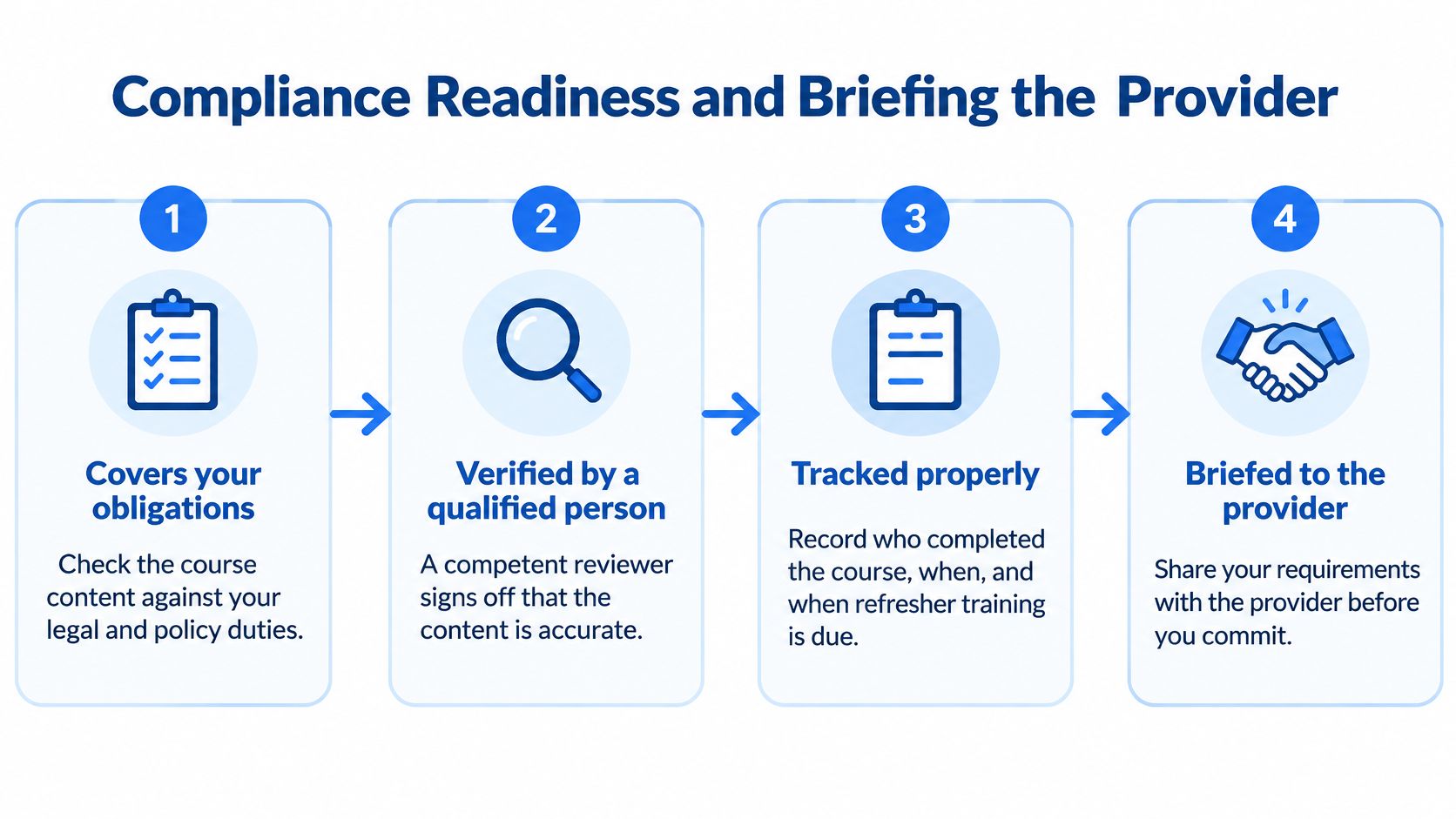
A course is compliance-ready when you can show that it covers the relevant obligations, was verified by a qualified person and is tracked in a way that suits your organisation. A useful design is a set of short, updateable modules linked to hazards and roles, rather than one static course for everyone.
Ireland's HSA recorded 83,234 enrolments in its online learning courses during 2025, with cumulative usage of 503,451 courses from 2019 to 2025, according to the HSA's online learning infographic. The authority's mix of general and topic-specific learning supports a practical approach: connect modules to defined work risks, and keep completion records segmented by site, role, hazard and refresher cycle.
Work through seven checks before sign-off
Identify the obligation and jurisdiction. Name the law, contract or standard the course must support, and establish where it applies. Common slip: assuming one country's rules apply everywhere.
Assign a qualified reviewer. Arrange for a suitably qualified person to verify technical content before anyone uses it for training. Common slip: publishing an unreviewed script.
Map modules to roles and hazards. Use the current risk assessment to connect each module to a job, site or hazard. Common slip: expecting one module to serve every location and role.
Set the refresher trigger. Choose a review or refresher cycle that reflects the hazard, and identify changes that could require an update. Common slip: applying one blanket date to every subject.
Confirm the LMS records. Check that the system can retain the learner's name, date, course version, score and pass status, and that you can export those records. Common slip: keeping a completion record that can't be retrieved when needed.
Agree the approval route. Identify who inside the organisation signs off safety-critical actions and local requirements. Common slip: treating the vendor's approval as a replacement for internal approval.
Set update triggers and brief the provider. Agree who owns changes prompted by a law change, serious incident or revised procedure. Then give the provider the approved procedure, learning need, audience, jurisdiction and desired course length. Common slip: leaving ownership of future updates unclear.
Keep the course and its records connected
The provider needs a clear operational brief, while your compliance or safety lead needs to approve the material before it's used. Ask how the finished course will fit into your LMS, who verifies its technical content and who maintains it after launch. A bespoke build may move quickly, but speed doesn't replace review or internal sign-off.
For each module, keep a record of the behaviour it targets, the procedure it reflects, the reviewer who approved it and the version delivered to learners. That makes it easier to identify which groups need a refresher and to update a particular module when a procedure changes, rather than rebuilding the entire programme.
Write three target behaviours and one refresher trigger on a single page, then share it with the provider and your compliance lead before approving a script. That gives both parties a concrete basis for shaping and reviewing the course.
Loresson creates bespoke workplace training with cinematic media, assessments and optional interactive roleplay, prepared as editor-ready or finished packages for LMS deployment. If you're planning an online safety training course, visit Loresson to discuss the audience, jurisdiction, procedures and behaviours your course needs to address.