

A new employee finishes an online course, passes the quiz and starts work. When a real situation arises, they're unsure which procedure to follow. Their manager can't explain why that course was selected, what the employee was expected to do differently or how anyone checked whether the learning transferred to the job.
That's the practical cost of a weak training policy. A course may have been delivered, but the organisation hasn't connected learning to capability, consistent behaviour or business needs. A clear training policy in HRM helps make that connection, so training is planned, relevant and evaluated rather than assigned by habit.
Table of Contents
- Why Training Policy Matters in HRM
- What a Training Policy Is and Why It Matters
- Core Components of an Effective Training Policy
- How to Draft a Training Policy Step by Step
- Governance and Measuring Training Effectiveness
- Balancing Compliance Training with Strategic Reskilling
- Aligning Training Policy with Organisational Strategy
- Key Takeaways and Next Steps for HR Teams
Why Training Policy Matters in HRM
Training decisions often happen in the middle of busy work. A team needs a refresher, a new starter needs induction and a manager asks for a course after a procedure changes. Without an agreed policy, HR may respond to each request separately, with no clear way to prioritise needs, assign ownership or check the outcome.
A training policy gives those decisions a consistent basis. It sets out how the organisation identifies learning needs, who receives training, what delivery methods are suitable and how effectiveness is assessed. It also clarifies what managers, employees and HR are responsible for, so a training request doesn't depend on who happens to raise it.
The policy isn't just a document to file away. It's a working part of human resource management, linking workforce planning with competency management and organisational capability. If a business is introducing new equipment, for instance, the policy can prompt HR and operational managers to identify which roles need instruction, what safe performance looks like and how supervisors will verify it.
Practical rule: Don't define success as “the course was delivered”. Define what an employee should know or be able to do afterwards, then decide how you'll check.
A useful policy also helps HR explain why one learning need takes priority over another. A safety-critical procedure, a role-specific skill gap and a longer-term digital capability need may all matter, but they don't necessarily call for the same timing, format or assessment.
The sections that follow provide a practical basis for defining the policy, drafting its core provisions, measuring workplace application and making room for both mandatory learning and strategic reskilling. The aim is a policy your managers can use to make decisions, not a statement of intent.
What a Training Policy Is and Why It Matters
A training policy is an organisation's formal statement of how it plans, supports and evaluates employee learning. It describes the purpose and scope of training, who is accountable, how learning is delivered and funded, and what evidence will be kept to assess results.
Ireland's Central Statistics Office defines continuing vocational training as training that is planned in advance and organised or supported by an enterprise. That definition matters because it connects training with deliberate workforce planning and the development of employee competencies, rather than treating every course as an isolated event. The CSO's 2020 survey covered private-sector enterprises with at least ten employees and an estimated target population of approximately 22,800 enterprises. More than 68% provided some form of continuing vocational training, broadly comparable with the EU average of 67% (CSO background notes on the Continuing Vocational Training Survey).
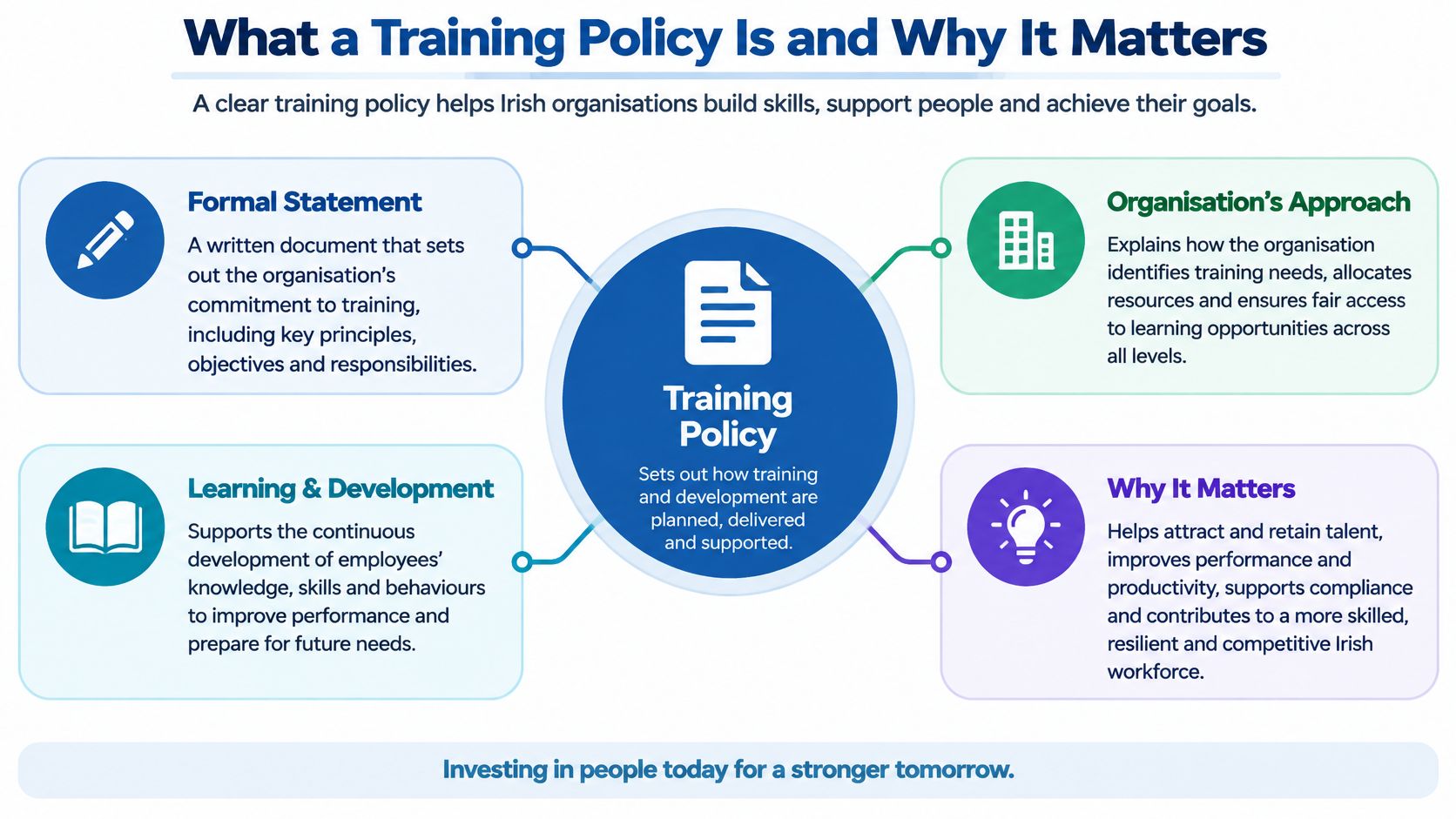
From informal requests to measurable decisions
A formal policy makes it possible to ask consistent questions: What capability does the work require? Which employees need training? Is a course, coached practice or another method appropriate? What will count as evidence that the learning helped?
Those questions distinguish a planned system from informal, discretionary decisions. If a manager chooses training based on immediate availability, one team might receive useful practice while another receives a generic module that doesn't match its tasks. A policy creates shared criteria for selecting and reviewing provision.
The Irish survey also provides a recurring evidence base for examining training strategies, participation, intensity, delivery methods and costs. Its history reaches back to the first Irish survey, which covered 1993 and was conducted in 1994. The five-year survey cycle gives employers and policymakers a way to compare training investment over time, rather than relying solely on managerial impressions.
In practice, the policy is both a guide and a record of how the organisation makes learning decisions. That makes it a cornerstone of modern HRM: it gives employees and managers clearer expectations and gives HR a more consistent basis for allocating resources and evaluating outcomes.
Core Components of an Effective Training Policy
A useful policy connects the reason for training to the evidence that it made a difference. If those links are missing, the organisation may have a well-formatted document but still lack a dependable process.
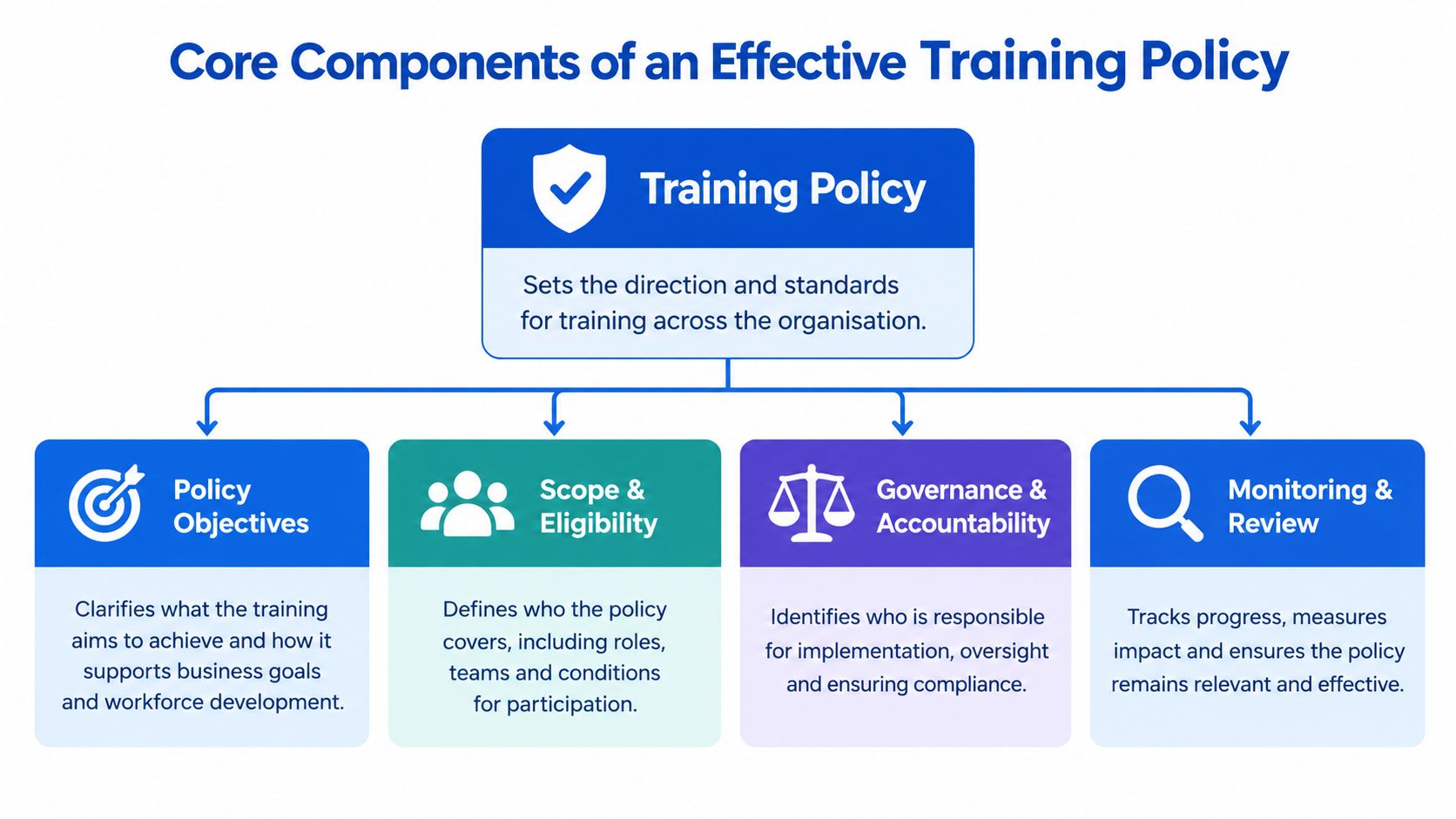
Set direction and define coverage
Objectives state what the policy is intended to achieve. An objective might be to prepare employees to use a revised procedure safely, support role-specific competence or develop capability for planned business changes. Keep objectives connected to work outcomes rather than describing learning as an end in itself.
Scope and eligibility explain who the policy covers and how training needs are identified across roles. Clarify how it applies to new employees, existing staff, managers and other relevant groups. If a course applies only to particular duties, say how the organisation identifies those employees.
Assign ownership and resources
Governance and responsibilities make accountability visible. HR may maintain the policy and records, managers may identify role-based needs and verify application, and employees may be expected to take part and demonstrate learning. Name who approves new or revised training and who checks that materials match current procedures.
Delivery and funding set out how learning is selected and supported. Options may include guided practice, internal facilitation, external provision or online learning. Irish historical data illustrates why these choices deserve active oversight: CSO comparisons report that expenditure on training courses rose from €140 million in 1993 to €851 million in 2005, while the number of employees participating in training courses increased from 204,000 to 409,000 over the same period (CSO comparison of Continuing Vocational Training Survey rounds). Those figures describe past survey rounds, but they underline the importance of deciding how budgets and participation are managed.
Require evidence and maintenance
The policy should specify evaluation and record-keeping. Attendance records show exposure; practical assessment or supervisor observation can indicate whether an employee can apply the learning. State what records are retained and who can access them.
Finally, define review and version control. Assign responsibility for checking materials after a procedure or policy changes, and make clear how approved updates reach affected employees. This helps prevent outdated instructions or inconsistent explanations from travelling through different teams.
How to Draft a Training Policy Step by Step
Drafting works best as a consultation and governance exercise, not as a search for a generic template to copy. The policy must reflect the organisation's work, risks, roles and capacity to deliver learning.
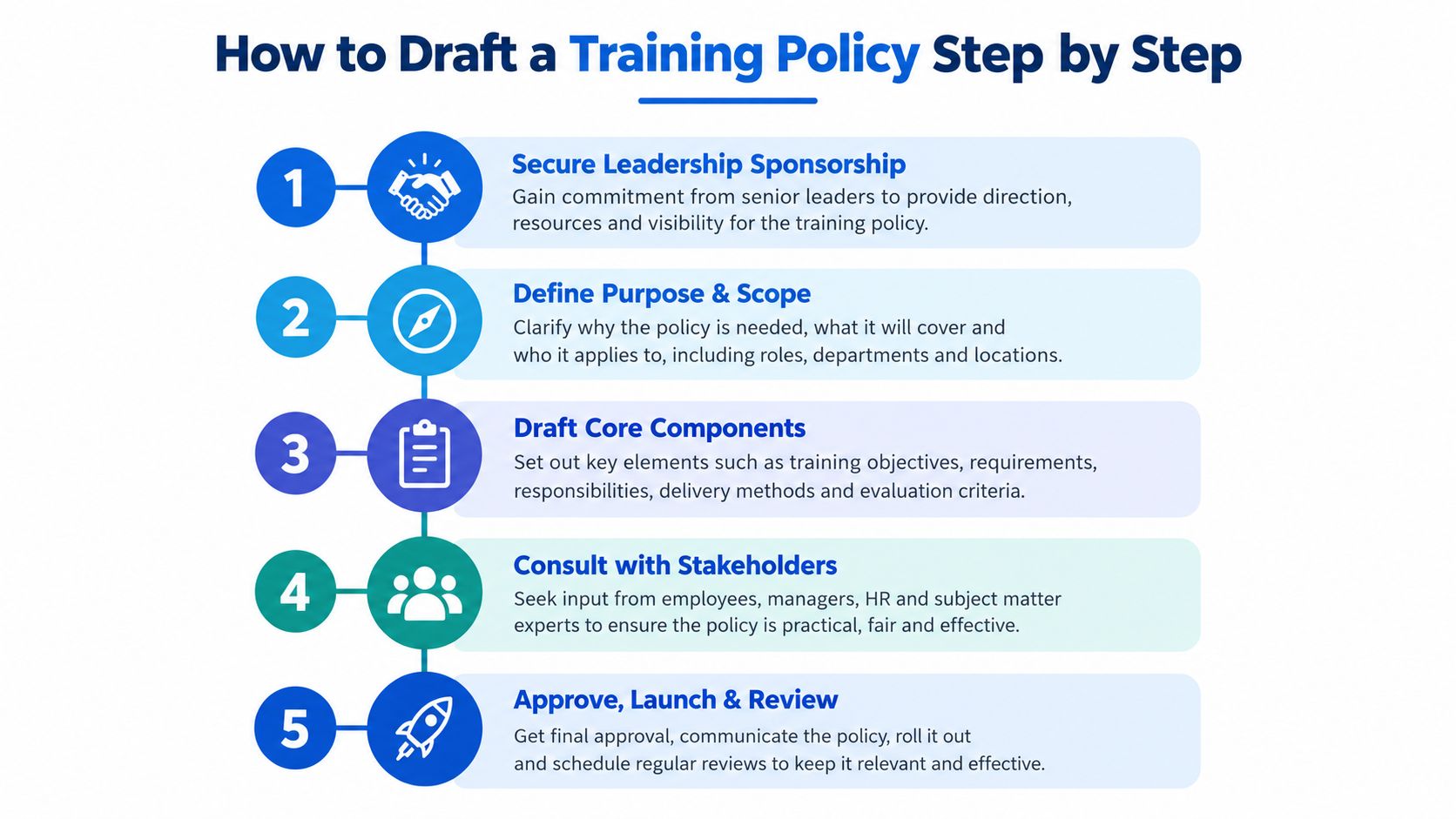
Start with the decisions the policy must support
Secure leadership sponsorship. Agree who will approve the policy and how managers will support its use. Sponsorship matters because training decisions affect time, budgets and operational priorities, not just HR administration.
Define the purpose and scope. Describe what the policy is for, which employee groups it covers and how it relates to other organisational procedures. Keep the purpose specific enough to guide decisions.
Assess needs before choosing courses. Ask managers and employees where tasks, business changes or performance requirements create capability gaps. The OECD reports that Irish employers who assess future skills needs are more likely to provide continuing training than employers who don't conduct such assessments (OECD Skills Strategy Ireland). Treat the analysis as a way to prioritise provision, not as paperwork to complete after courses have already been chosen.
Turn priorities into a workable policy
Translate the identified needs into objectives and suitable delivery methods. For example, an employee learning a revised procedure might need a short explanation followed by supervised practice, while a broader knowledge topic might be taught through a facilitated session. If you need a structured approach to shaping learning materials, training course development can be considered as part of the design process.
Next, agree how training will be funded and who owns each part of the process. Specify who approves learning, who maintains materials, how employees are informed and what managers must verify. Then write the policy in plain language, with clear expectations, a named approver and a controlled version so employees can identify the current document.
Consult the people expected to use it. A supervisor may spot a practical barrier that wasn't visible during drafting, such as a shift pattern that makes a proposed delivery method difficult. Revise the document, approve it through the organisation's governance process and tell employees where to find it.
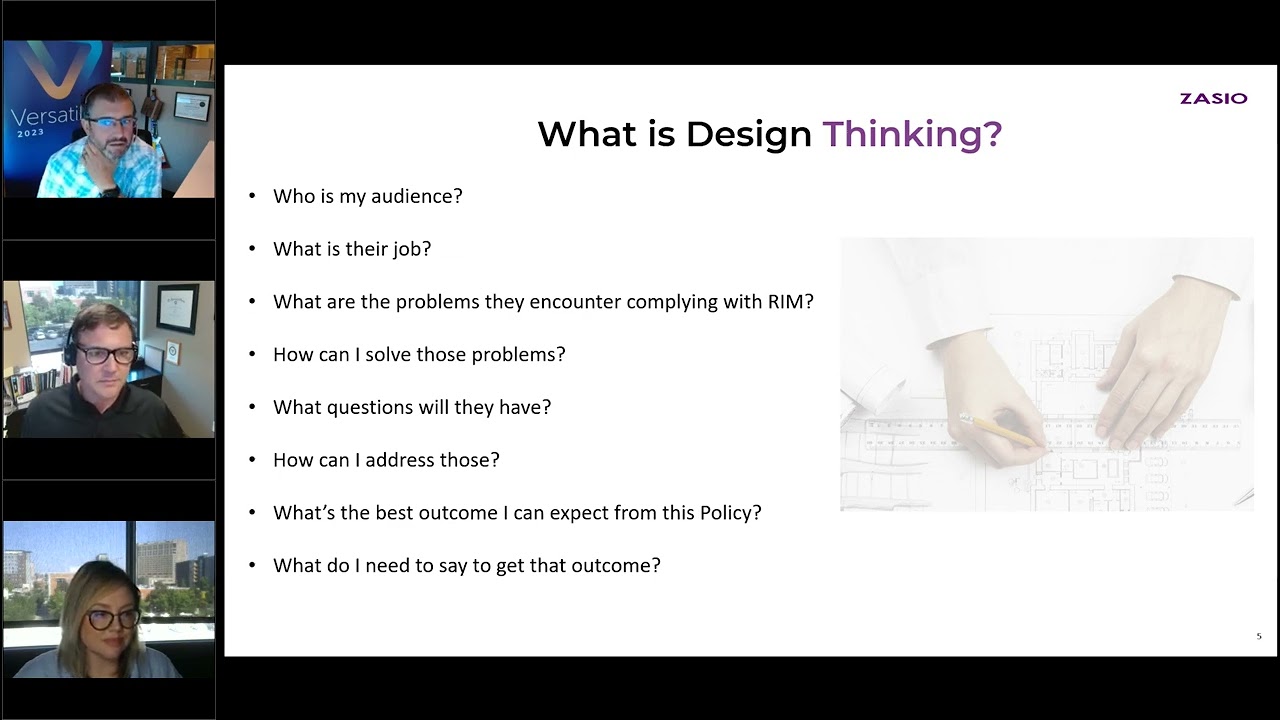
Use the following video as a prompt for considering how learning materials can be developed and delivered:
Launching the policy starts the review cycle. Set out how the organisation will assess whether training remains relevant, whether employees can apply it and whether changes to work require updates. A copied template can be a starting point, but it can't replace those organisation-specific decisions.
Governance and Measuring Training Effectiveness
A warehouse operator finishes a manual-handling refresher and the system logs a pass. Three weeks later, a supervisor spots the same operator lifting incorrectly. The training record says the learning happened; the floor says otherwise. Governance exists to close that gap, turning policy commitments into repeatable practice.
HR maintains the policy and coordinates oversight. Managers identify needs within their teams and check whether employees can apply what they learned. The organisation controls updates too, so a revised procedure and its supporting training change together rather than drifting apart.
Workplace-based learning fits naturally into this model. As noted earlier, Irish enterprises that provide training rely on on-the-job delivery at a higher rate than the EU average, so oversight often happens where the work is done. A new hire might discuss a task, practise it under supervision and have a manager verify the key actions before working alone.
One governance detail worth building in early is reporting mandatory compliance training separately from development and reskilling activity. A single completion total can hide the fact that nearly all logged hours went to required courses, leaving strategic capability building invisible until a skills gap surfaces.
Measure exposure and application separately
A completion record works like a sign-in sheet: it shows who encountered the material, not who understood it or can use it. Pair attendance data with measures matched to the learning objective, such as an assessment, a practical demonstration or supervisor verification.
| Metric Type | Example Metrics | What It Shows |
|---|---|---|
| Participation | Coverage by role, completion records | Who has received the assigned learning |
| Knowledge | Assessment pass rate, scenario responses | Whether employees can demonstrate understanding |
| Application | Practical demonstration, manager-observed use | Whether learning appears in work behaviour |
| Operational follow-up | Time-to-competence, refresher completion after changes | Whether people reach expected capability and remain current |
Choose measures that answer a real management question. If training covers a procedure change, a scenario assessment can check how employees decide, while observation checks how they perform. Incident trends add useful context, though on their own they cannot prove training caused an improvement.
Keep the process proportionate. Record the method, responsible person and follow-up action alongside each training record, and compare your oversight model with corporate training solutions for consistent multi-team delivery when you need the same standard applied across locations or shifts. Review the evidence whenever materials change or employees struggle to apply a procedure, so measurement supports the policy rather than becoming an administrative burden.
Balancing Compliance Training with Strategic Reskilling
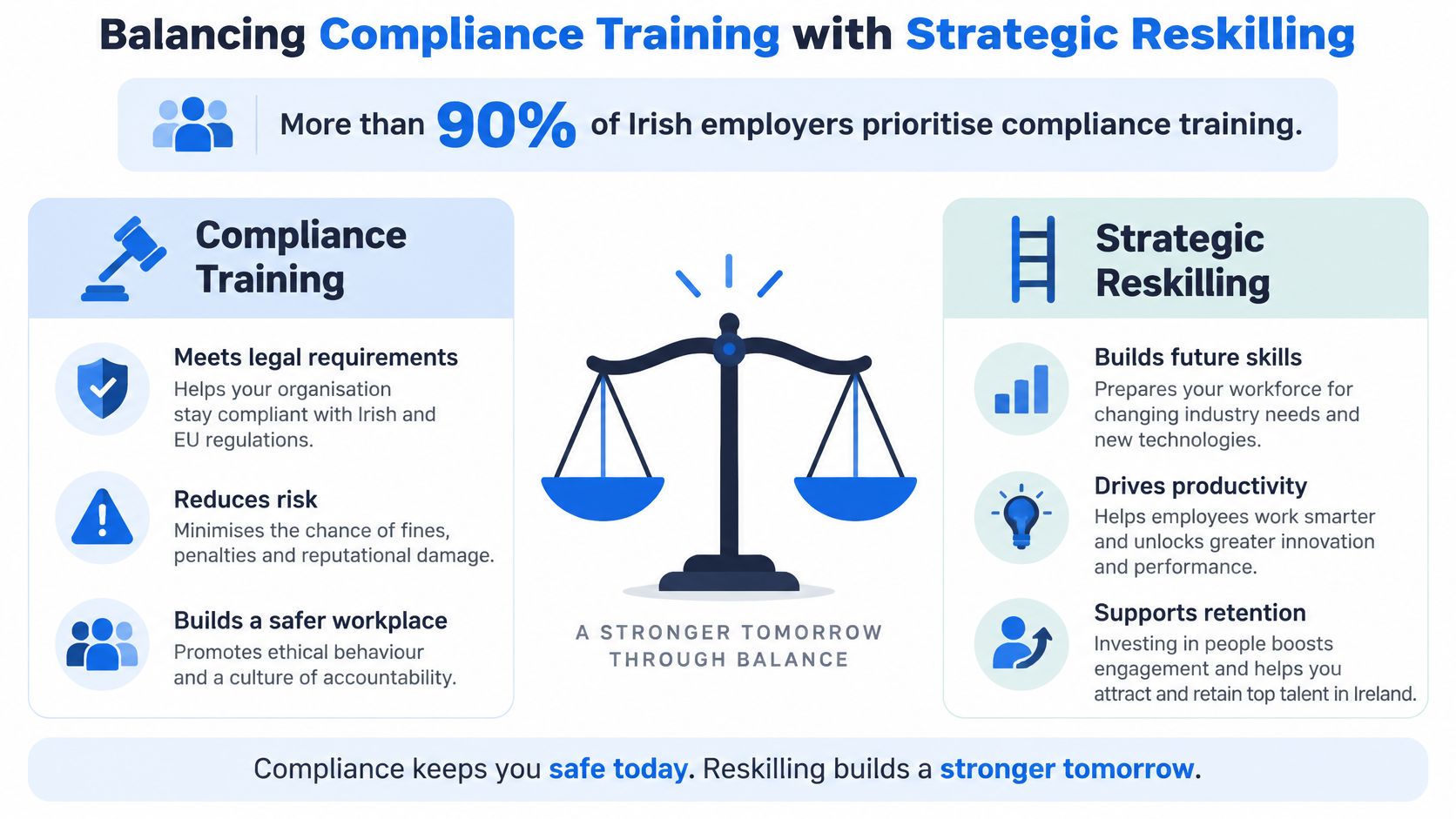
Compliance learning and strategic reskilling serve different purposes. The first helps employees understand requirements relevant to their work; the second builds capability for changing tasks and future business needs. A policy that counts every completed course in one undifferentiated total can conceal whether the organisation is investing in both.
Irish workforce evidence makes this a real allocation question. More than 90% of organisations in Ireland planned to implement AI programmes, and 86% expected to increase investment in reskilling and upskilling existing employees. Yet ICT training provision among Irish enterprises with more than ten employees fell from 23.21% in 2022 to 21.58% in 2024, below the EU average of 22.29% (CIPD Ireland's discussion of future skills needs). A busy training calendar, therefore, doesn't necessarily mean that employees are building the capabilities the organisation will need.
Manage training as a portfolio
Separate planned learning into three portfolios, each with its own purpose and evidence:
- Legal and safety assurance: Training employees need to understand relevant requirements and work safely. Review it when obligations, procedures or job responsibilities change.
- Role-critical performance: Learning that supports reliable delivery of current duties, such as using equipment or following a service process.
- Future-skills readiness: Development for emerging work, including digital capability, AI-related tasks or sustainability requirements where relevant to the organisation.
This structure doesn't make compliance optional. It makes competing demands visible, so recurring courses don't automatically take all available learning time and budget. Managers can explain what must happen now, what supports current performance and what needs deliberate investment to reduce future capability gaps.
Make the allocation rules explicit. For example, require managers to identify the work need, the employee groups affected and the expected evidence before requesting a new course. Then protect capacity for future-skills learning and review whether employees can apply it to real tasks. Organisations can also use specialist health and safety training where work risks call for focused learning.
The central policy question isn't which courses are required. It's how the organisation will meet current obligations while maintaining room to prepare its people for changing work.
Aligning Training Policy with Organisational Strategy
Training becomes more useful when managers can connect it to a business priority. A policy that says “support employee development” offers little guidance when leaders must decide which learning to fund. A policy that links objectives to safety, service quality, digital change or leadership capability gives them a clearer basis for choosing.
Irish employer data shows that organisations already take an active role in learning. The HEA National Employer Survey reports that 87% of employers engage in continuing professional development or lifelong learning in some form. Among employers providing workplace training, 82% deliver it in-house (HEA National Employer Survey 2024). That makes alignment especially important: when employers own much of the delivery, they also need to ensure the content reflects business priorities and is consistent across teams.
Make the strategic link visible
Start with a business objective, then identify the capability employees need to support it. If an organisation is introducing a new digital process, HR and managers can identify which roles will use it, what competent use looks like and how to assess application. For a safety objective, they can define the behaviour or task that training should support, then agree who will observe it.
Present training proposals in that same sequence: business need, employee group, learning objective, delivery method and evidence of application. This gives leadership a practical way to compare requests and understand why a proposed investment matters. It also helps managers explain to employees how learning connects with the work they do.
Internal delivery offers flexibility, but it needs control. Use approved materials, consistent learning objectives and a clear process for revising content. Keep a record of who approved a change and how affected employees were informed. Where external expertise is needed, use it to address a defined capability gap rather than outsourcing routine communication without a clear purpose.
Finally, bring evaluation evidence back to decision-makers. Explain whether employees completed the learning, demonstrated the expected competence and received follow-up where gaps remained. That makes training easier to discuss as a strategic investment, while showing leaders where the policy needs to adapt.
Key Takeaways and Next Steps for HR Teams
A training policy works when it guides real choices: which needs take priority, who is responsible, how learning is delivered and what evidence will show that it helped. Irish survey data offers a useful reminder that employer training is substantial, but participation alone doesn't establish whether employees can apply learning or whether provision matches future needs.
Use this checklist to turn policy intent into a working process:
- Secure ownership: Confirm who approves the policy, maintains it and checks that teams follow it.
- Analyse needs: Ask managers and employees to identify capability gaps linked to work requirements and planned business change.
- Set clear objectives: Describe what employees should know or do after training, not merely which course they should attend.
- Choose suitable delivery: Match the method to the task, using workplace practice where employees need to demonstrate actions in context.
- Measure competence: Keep participation records, but add assessments, demonstrations or supervisor checks where they fit the objective.
- Balance the portfolio: Maintain capacity for legal and safety assurance, current role performance and future-skills readiness.
- Schedule review: Revisit the policy and materials when work, procedures or capability needs change.
Keep the first draft usable. Managers should be able to understand their responsibilities without translating HR jargon, and employees should be able to find out what learning applies to their roles. If a metric doesn't help the organisation make a decision or verify competence, reconsider whether it belongs in the policy.
An evidence-based approach replaces assumptions with documented needs, defined responsibilities and observable outcomes. Start by reviewing one current training request against those criteria, then use what you learn to strengthen the wider policy.
Loresson helps organisations develop bespoke workplace training courses with scripted content, narration, graphics, assessments and optional interactive role-play, prepared for LMS deployment. If your HR team is shaping policy, induction or compliance learning, visit Loresson to explore production options for turning workplace requirements into practical training.