

A lifting-equipment course goes live on Monday. By Wednesday a supervisor on the floor stops a trainee mid-task. Step four in the module describes a sequence the site stopped using last spring. Nobody was careless. The script came from a generic manual, the language was clear, and the review notes said "looks fine". The problem was that fluent writing can sound right when a threshold, a sequence or a legal duty is already out of date. Learners then repeat what the course tells them.
If you design courses, run an e-learning agency, own HSEQ or compliance, or lead L&D, you already know this pattern. The people who know the work are busy, and almost none of them were trained in instructional design. Working with subject matter experts only stays manageable when you treat them as a source of facts and judgements, not as unpaid writers. The first decision is what to ask each expert for, not how much copy to produce. Get that decision right and accurate content moves faster, and reviews stop stalling halfway through a draft.
Table of Contents
- Why Expert Input Decides Whether Training Works
- Four Contributions to Ask From Every Expert
- How to Run a Knowledge Interview That Captures Real Practice
- Validating Content Without Making the Expert the Bottleneck
- Turning Expertise Into Practice and Assessments
- Common Problems With Experts and How to Fix Them
- Set Up Your First Expert Review Cycle
Why Expert Input Decides Whether Training Works

A polished script is not the same thing as a correct procedure. Writers smooth sentences. Experts notice that the lock-out order changed, that the load limit applies only on a level floor, or that the escalation route in the module is the one from the old site, not this one. When that check is missing, the course teaches a confident mistake.
Irish and European workplace data shows why that check is not a nice extra. An EU peer review of Ireland's occupational-safety approach, drawing on ESENER2, found that health-and-safety experts identified time pressure in 43% of establishments, matching the EU-28 average, and that half of Irish employers had insufficient information on how to assess psychosocial risks, while 80% of Irish enterprises with at least 20 employees had an action plan on bullying and harassment, compared with 48% across the EU-28, according to the European Commission peer review. Policies can exist on paper while the people who must apply them still lack the specialist judgement to turn those policies into decisions. Training that only restates the policy leaves that gap open.
What the expert is actually for
The expert gives you the current step, the exception, the risk ranking and the sign-off. You, or your production partner, turn that into instruction people can follow. Teams that reverse this, and ask the expert to "just write the module", wait weeks for a draft that still needs redesign.
That split is what makes training course development hold up after launch. A course built on a named source, a named reviewer and a reason to revise will survive a supervisor's spot check. A course built on a well-written generic manual will not.
A sentence can be grammatical and still describe a control the site retired last season.
Four Contributions to Ask From Every Expert
Most stalled reviews start with one overloaded request: "Can you look at this and tell me if it's right?" Split the ask before the meeting. The CIPD HR practices in Ireland report found that 91% of organisations report some form of skills shortage, while only 25% report a regularly updated, forward-looking skills strategy, and that 74% of Irish learning professionals name time and resource constraints as a major barrier, with 60% saying competing operational demands are prioritised over learning and development. You will not get unlimited hours from the one person who knows the task. Bound the hours.
| Contribution | What to ask | What not to ask | Who signs off |
|---|---|---|---|
| Factual authority | Is this step, threshold or term correct today? | Write the script or choose the wording | The SME |
| Operational exceptions | What happens when the usual steps do not apply? | Design the assessment | The SME with a frontline supervisor |
| Risk prioritisation | Which mistakes cause harm or fines, and which are minor? | Decide the course length | The SME and the HSEQ lead |
| Approval | Is this version safe to publish for this audience and jurisdiction? | Proofread minor wording | The accountable manager |
Why the split keeps the expert out of the bottleneck
An expert asked to write a script becomes the bottleneck. An expert asked to confirm a threshold can answer in minutes. More review is not automatically safer. Unstructured review expands scope, produces conflicting interpretations, and leaves changes with no owner.
Take a manual-handling course and walk the four rows.
Factual authority. You ask the SME whether today's safe working load, the grip points and the team-lift rule match the current procedure. You do not ask them to choose verbs or shorten a paragraph. They sign the fact, not the prose.
Operational exceptions. A supervisor who still does the task tells you what changes on a wet floor, with a damaged pallet, or when the usual second person is off sick. They do not build the quiz. You record the exception, and both names sit on that row.
Risk prioritisation. The SME and the HSEQ lead rank which errors cause injury or a breach, and which are untidy but minor. Course length stays with the learning lead, because length is a design constraint, not a safety judgement.
Approval. The accountable manager confirms this version is safe to publish for this audience and this jurisdiction. They are not there to catch a comma.
What to do before the first meeting
Sort every open request into one of these four groups. Delete anything that sits in the "what not to ask" column, or reassign it to the learning specialist. If a request cannot be phrased as a yes, a threshold, an exception or a publish decision, it is not an expert task yet.
Practical rule: one question, one owner, one sign-off. If the email asks for three of those at once, split it before you send it.
How to Run a Knowledge Interview That Captures Real Practice
Choose the person before you book the hour. The colleague who performs the task on the floor is often more useful than the manager who owns the policy, and on safety-critical work you usually need both. Cap the first interview at 60 minutes. Split a longer topic into two sessions so the expert still has time for the review rounds that follow.
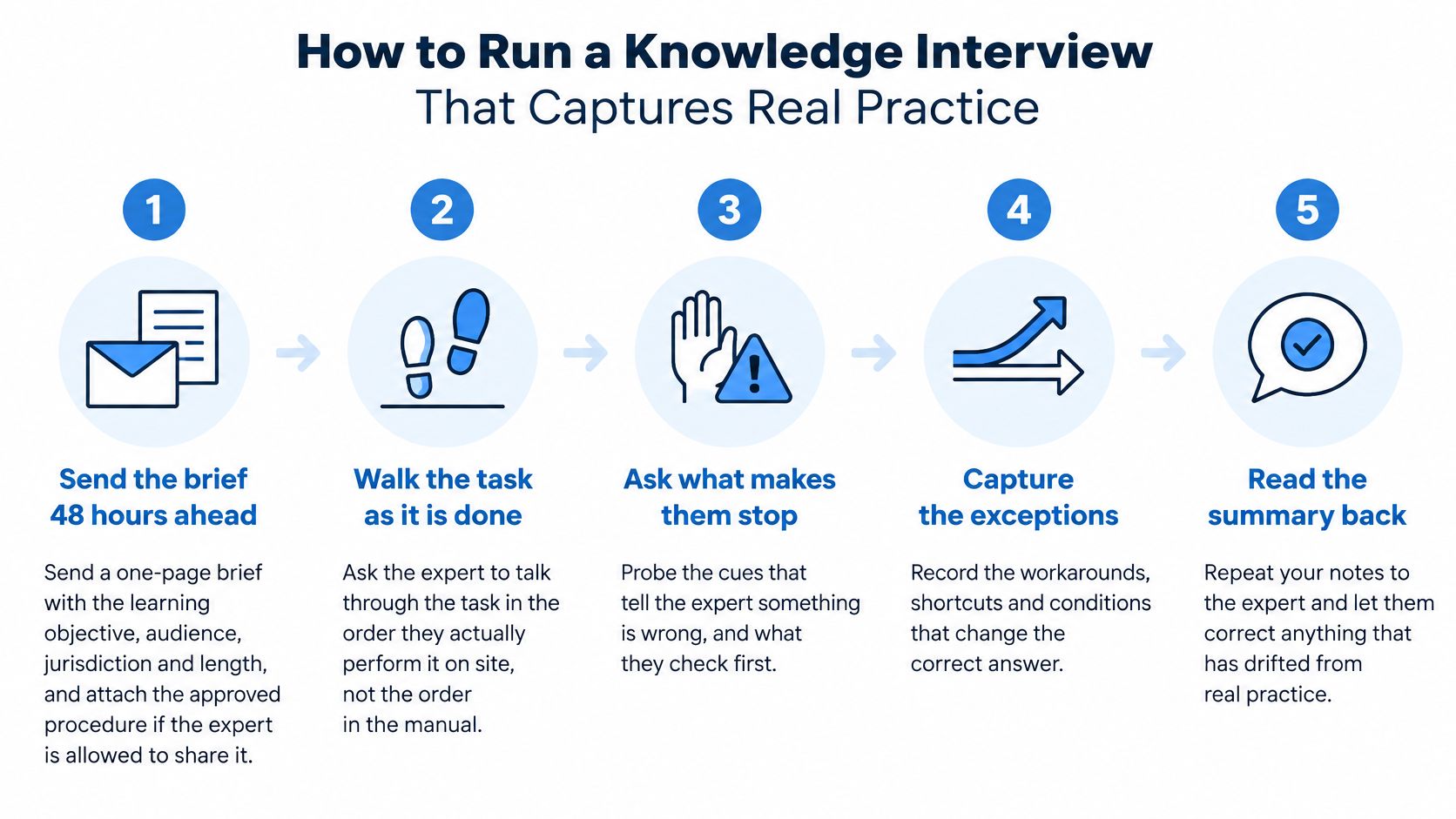
The interview, step by step
- Send a one-page brief 48 hours ahead. State the learning objective, the audience, the jurisdiction and the course length, and attach the approved procedure if the expert is allowed to share it. People prepare better when they know which decision you need, not which story you want.
- Walk one real task from start to finish. Ask them to talk through the job in the order they do it on site, not the order in the manual. Policy language hides the cues that start the task.
- Capture trigger, sequence, thresholds and escalation. Write down the moment they act, the order of steps, the number or condition that changes the decision, and who they call when it goes wrong. Every time they say "it depends", stop and record the condition.
- Ask what a supervisor watches for, and what blocks the task on a busy shift. Correct behaviour fails for ordinary reasons: missing kit, a radio that doesn't reach, two people off sick. Those barriers belong in the course, because they are where learners will hesitate. This is also where SOP training either matches the floor or drifts back into the binder.
- Log every answer in a shared sheet with a source column. Each fact should trace to a document name or a named person. If you cannot name the source, you do not have a fact yet.
- Read a short summary back. Agree the three points most likely to be misunderstood by a new starter. Correction in the room is cheaper than correction after storyboarding.
- Close on a review date and one open question. Name the date of the next pass, and the single point that needs a second opinion. Leave with a decision, not a promise to "circle back".
The slip that wastes the hour
A 90-minute session full of stories and no decisions feels productive and produces a transcript. Stories are useful only when you convert them into a testable rule: if this cue appears, do this, and call this person if the cue is absent.
A good interview ends with a list. Triggers, sequences, thresholds, escalation routes, and the conditions that change the correct answer. That list is what the learning specialist builds from. The recording is backup, not the asset.
Validating Content Without Making the Expert the Bottleneck
Review works when each pass has one job and one exit. Four rounds cover a compliance or HSEQ course without asking the same person to do everything.
| Review round | Reviewer | What it checks | Exit condition |
|---|---|---|---|
| Source check | The SME | Procedure and legal threshold match the source document | Every objective is linked to a source |
| Scenario check | The SME with a frontline worker | Scenarios match real operating conditions | Exceptions are listed and approved |
| Language check | Learning specialist | Terms match the organisation's vocabulary | No open terminology questions remain |
| Final approval | Accountable manager | The version is safe to publish for this audience | Signed approval is logged with a date |
The register that makes the trail auditable
In Ireland this is a consultation workflow, not a courtesy read at the end. The Health and Safety Authority workplace safety and health management guidance states that employers must consult employees in advance and in good time on matters that may substantially affect safety and health, including risk-prevention measures, risk-assessment outcomes, safety statements, safety information, the engagement of safety and health experts, the organisation of training, and the introduction of new technologies. Involve the relevant SME before scripting. Record decisions and assumptions. Get explicit approval against the procedure, the hazard controls and the jurisdiction.
Keep an evidence register. Each learning objective and each scenario carries an approved source, a responsible expert, a review date and any unresolved question. Say an HSEQ induction has 60 objectives. Eleven of them have a plausible paragraph and no named approver. Those eleven do not ship. The register makes that visible before a learner sees the module, and it shows what to reopen when equipment, process, legislation or site conditions change. Operational workers and safety representatives should help name the core problems, not be shown a finished decision.
Who must sign before anyone is trained
Safety-critical actions and local requirements stay with the client's own approval. Before you publish or use the materials for training, arrange verification by a suitably qualified person, particularly for safety, technical or compliance training. A learning specialist can confirm that the language is learnable. They cannot stand in for that verification.
Set each round to close in ten working days. Name one owner who can end a disagreement. If two reviewers want different words for the same control, that owner picks the source that governs and logs the choice. Silence is not approval.
Turning Expertise Into Practice and Assessments
A warehouse quiz asked new forklift drivers to recite the maximum trolley load. Almost everyone passed. On the job, the load that was safe on a level aisle was not safe on the ramp to dispatch, and the course never asked anyone to notice the ramp. Recall of a figure had been treated as proof of competence. The decision that mattered never appeared in an item.

From interview notes to something you can observe
Take the trigger, the sequence, the thresholds and the evidence of completion from the interview and write them as performance criteria the expert can check against the work.
- Trigger: what the person sees, hears or is told before they act.
- Sequence: the order they follow when the trigger is present.
- Threshold: the number, condition or cue that changes the action, such as a ramp, a damaged load or a missing second person.
- Evidence: what a supervisor can see that the step was done, not what the learner can recite.
A study of HRD practitioners in Ireland examined 15 factors considered most relevant to transfer of learning and identified trainer effectiveness, organisational linkage and the training-event climate as particularly significant areas for further research, as reported in the International Journal of Training and Development. The interview has to capture how the task runs under real conditions, which systems reinforce it, what supervisors watch, and what blocks correct behaviour. Otherwise the assessment measures the classroom, not the shift.
Three scenarios worth putting in front of the SME
Ask the SME to mark these up against how the site varies, rather than approving a generic explanation. Each item should force a decision.
- Two rules conflict. A near-miss where the load is within the rated limit but the floor is ramped and a pedestrian route crosses the aisle. What do they do first?
- Someone asks for an exception. A customer, or a supervisor, wants the trolley moved before the check is finished. What is allowed, and what is refused?
- The shift is short. Two people are off sick and the usual team lift is impossible. What is the escalation, and what work stops?
For elearning content development, that markup is the difference between a quiz and a rehearsal. Before any item is approved, answer four questions: which decision this item tests, what a wrong answer looks like on the job, which source governs the answer, and who signs the item.
The short film below shows how a floor conversation surfaces the decision a written procedure leaves out. Use it as a model for the questions in your own scenario review, not as a script to copy.

Common Problems With Experts and How to Fix Them
These four symptoms show up on almost every compliance build. They are process failures, not personality problems. The Health and Safety Authority guidance on safety representatives is clear that representatives need adequate employer-funded training, that they should understand the hazards and safe systems in their own workplace, and that specialist input may be required. The same guidance recommends refresher training every three years, or sooner when workplace risks or legislation change. A course with no revision trigger will teach last year's control long after the site has moved on.
| Symptom | Likely cause | Fix |
|---|---|---|
| Expert keeps rewriting the script | Expert was asked to write, not to check | Give them a fact sheet to mark up instead of a blank draft |
| Reviews drag past two weeks | Several reviewers and no single owner | Name one approver and a fixed deadline for each round |
| Two experts give conflicting answers | Different sites or procedures in use | Record which source governs and escalate to the accountable manager |
| Outdated rule reaches learners | No revision trigger on each objective | Add a review date and a change trigger to every objective |
Fixes you can start this week
Rewrites. Send a marked fact sheet: step, threshold, source, yes or no. Do not send a blank document and ask for "thoughts". When the expert edits tone, thank them and put the wording back with the learning specialist.
Drift past two weeks. One approver, one date. Everyone else comments to that person. A review with five equal voices does not finish.
Conflicting answers. Two sites often run two versions of the same task. Write down which procedure governs this audience. If the disagreement is about a legal or safety threshold, pause the build. The accountable manager decides which source wins. Do not average the two answers into a third rule nobody authorised.
Stale rules. Every objective carries a review date and a change trigger, such as a revised procedure, new equipment or a change in legislation. Without that line, nobody knows when the module is lying.
What it costs to leave them
A review with no owner can push a compliance launch back by weeks, while the old course, or no course, stays in front of learners. A conflicting answer that reaches the module becomes the official answer, because people trust what the course says over what a poster in the canteen says.
If two experts disagree on a safety threshold, stop building. A finished module with the wrong number is worse than a late one.
Pick the symptom that matches the project in front of you. Apply that row's fix before the next review meeting, not after the next missed deadline.
Set Up Your First Expert Review Cycle
You do not need a new platform to start. You need four weeks, a named owner, and material your organisation is allowed to share.
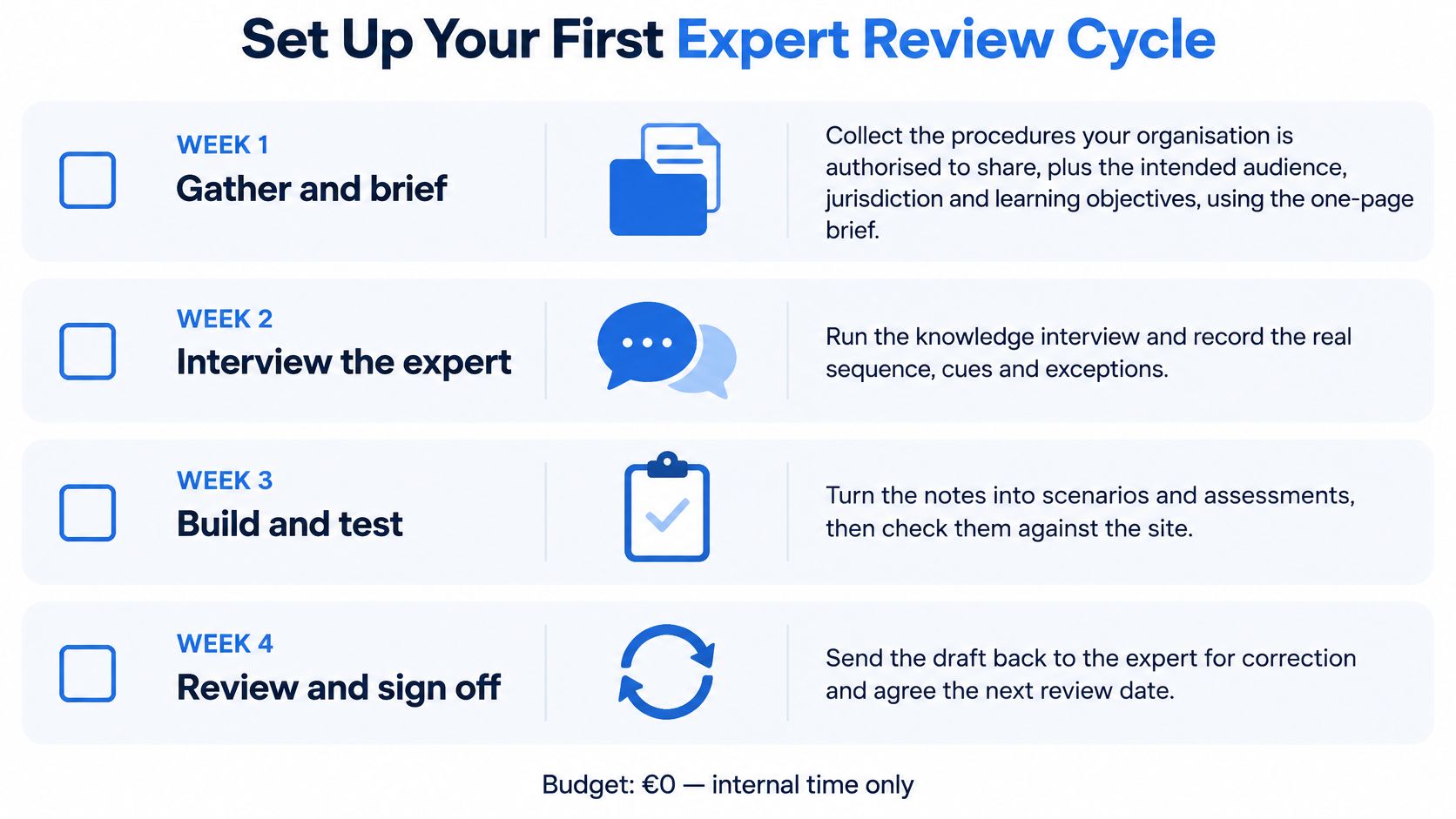
The four weeks
Week 1, gather and brief. Collect the procedures you are authorised to share, plus the audience, the jurisdiction and the learning objectives. Use the one-page brief from the interview: objective, audience, jurisdiction, length. If you are commissioning production rather than building entirely in house, the same inputs are enough to start. Share the topic, audience, location and length, and add procedures, examples or brand guidance if you have them.
Week 2, interview and register. Run one knowledge interview. Open the evidence register the same day, with a source, an owner and a blank for unresolved questions on every objective you expect to teach.
Week 3, source check and scenario check. Complete those two rounds, each with a fixed deadline. Do not open the language check until both have an exit.
Week 4, approval and the revision trigger. The accountable manager signs. Attach the trigger that will reopen the module, such as a procedure change or a change in legislation, and book the next review date before the file is closed.
Start checklist
- Named owner: one person who can close a disagreement.
- Authorised sources: procedures you may share, not a personal copy from a previous employer.
- Approved brief: audience, jurisdiction, objectives, length.
- First review date: in the diary before the interview ends.
- Time budget: hours agreed with each expert across the four weeks, so operational work is not expected to absorb the review.
Loresson, an AI-assisted workplace training production service, can work from those same inputs, with scope and price set only by an accepted quotation. Internal approval stays with you wherever the course explains safety-critical actions or local requirements.
Book the first interview this week. Send the one-page brief 48 hours before it. Leave the meeting with a source, a sign-off name and one open question, not a promise to read a draft sometime.
Loresson produces bespoke workplace courses, including scripting, cinematic media, narration, graphics and assessments, with subject matter experts checking content against the procedure and the jurisdiction before anything is used for training. If your next module depends on a busy expert and a procedure that must stay traceable, Loresson can take the brief, the audience and the sources you are authorised to share and turn them into a course your own approver can sign.