Why Training Companies Are Replacing Video Studios With AI Pipelines
An AI video production pipeline replaces studio bookings, crew and reshoots with a script-to-video workflow that runs in days instead of weeks. Training companies are adopting this approach at scale, not as an experiment. The content behind the script still needs the same expert check the old studio process always required.
Why Training Companies Are Moving Away From Studios
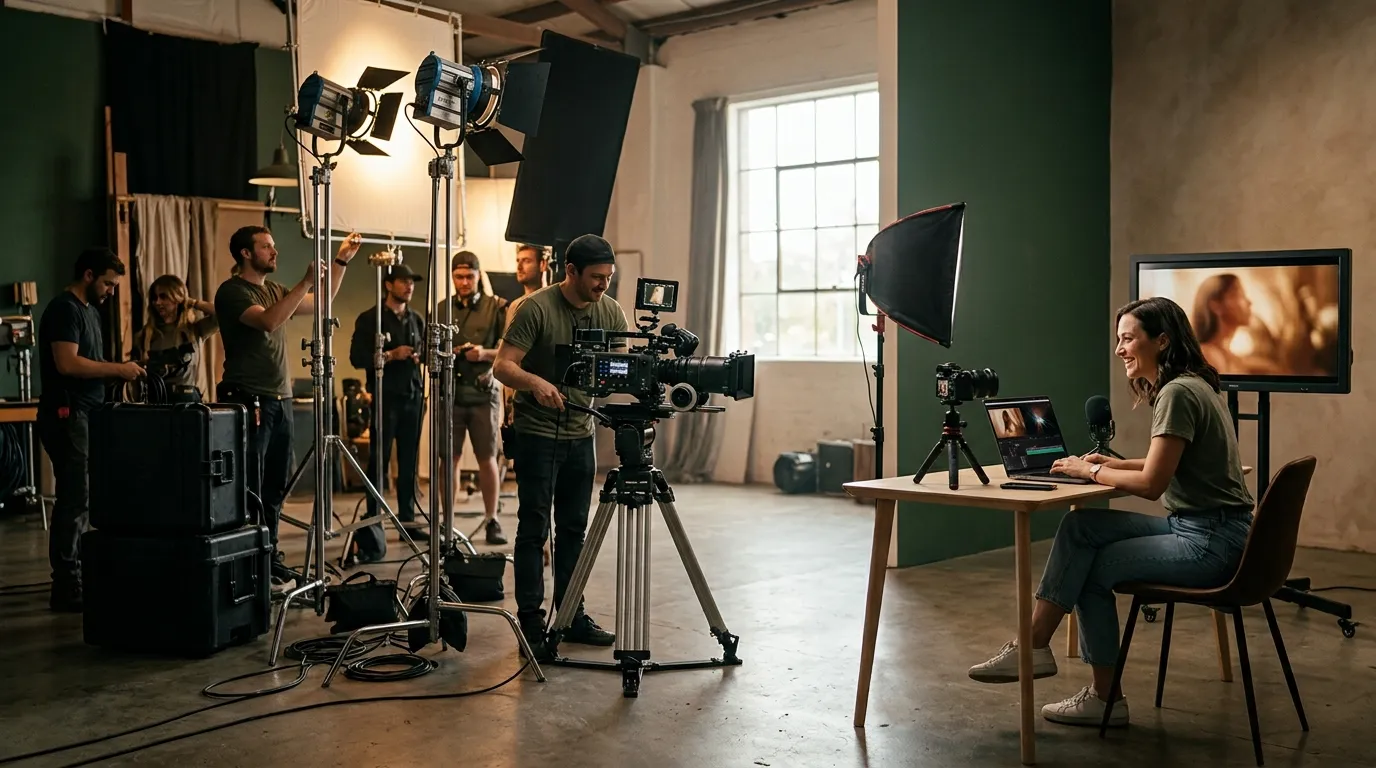
A traditional studio booking used to be the first step in making a training video. Book the space, hire the crew, schedule the presenter, then hope nothing changes before the shoot date.
That first step has quietly disappeared for most instructional content. Training providers now start with an approved script and go straight to a finished video, without touching a camera.
The shift is not about chasing a trend. Course libraries need constant updates, and a studio-dependent process could never keep pace with rules that change every quarter, sometimes with only weeks of notice.
Buyers across the UK, Ireland, US and Australia are watching this shift for a practical reason. Each country updates its own health and safety and reporting rules on its own schedule, and studio bookings never matched that pace.
The old process also had a hidden cost that rarely showed up until it was too late. A studio date booked weeks in advance could not easily move if a script needed a last-minute legal correction, so teams sometimes shipped content they were not fully happy with rather than lose the booking and start the whole scheduling process over again.
What an AI Video Production Pipeline Actually Replaces
The term gets used loosely, so it helps to be specific. A genuine AI video production pipeline replaces four things a studio process always required.
It removes the need to book a physical location or studio space. It removes the need to schedule a crew around a presenter's availability. It removes the reshoot, since a script edit can regenerate the video instead. It removes the language bottleneck, since one script can produce several languages without separate shoots.
Each of these used to add real time to a project, not just cost. A single missed availability window for a presenter or a crew member could push a launch back by weeks, sometimes past the deadline the video was meant to support.
None of this removes the need for a good script or a proper legal check. It removes the physical and logistical steps that used to sit between an approved script and a finished video.
The Adoption Data Behind This Shift
Claims about AI adoption in training are easy to make and hard to verify. Synthesia's AI in Learning & Development Report 2026 gives a clearer picture, though it is worth reading as an industry survey from a vendor in this space, not fully independent research.
According to that report, approximately 87% of L&D teams are currently using AI for training and development, with only 2% reporting no adoption plans at all. Most respondents are past the experimentation stage entirely.
Speed is the clearest driver. The same report found 84% of L&D teams reporting faster production as a direct result of AI adoption. Within production specifically, teams reported using AI most for voice generation, at 63%, followed by content and quiz drafting at 60%, video creation at 52%, and translation at 38%.
This data lines up with what training buyers are asking for directly. Faster production, fewer dependencies on studio bookings, and less exposure to reshoot costs when a rule changes partway through a course library rollout.

Traditional Studio Workflow vs AI Video Production Pipeline
The comparison worth making is what actually changes at each stage, not just the headline speed claim.
|
Stage |
Traditional Studio Workflow |
AI Video Production Pipeline |
|---|---|---|
|
Location and studio booking |
Required, adds days to the schedule |
Not required |
|
Crew scheduling |
Required, adds coordination overhead |
Not required |
|
Legal and regulatory review |
Days to weeks |
Days to weeks, unchanged |
|
Updating for a rule change |
Reshoot, full studio process again |
Script edit and re-generation |
|
Multi-language versions |
Separate shoots or dubbing per language |
Same script, multiple languages |
|
Content accuracy |
Depends on the review process |
Depends on the review process |
The two rows that never change sit in the middle and the bottom. Legal review and content accuracy depend on people, not on which pipeline produced the video.
Where an AI Video Production Pipeline Still Needs a Studio or a Human
Being honest about limits matters more than sounding impressive. An AI video production pipeline handles scripted, presenter-led content very well. It has real limits elsewhere.
Genuine location footage, such as a real factory floor or a specific job site, still benefits from an actual shoot in many cases. Complex physical demonstrations involving fine hand movement remain a weak point for AI-generated video generally.
These are not small gaps that will simply vanish with the next update. They reflect the actual shape of what current tools do well and what they still do poorly, and buyers deserve a straight answer on both.
No pipeline, however fast, can judge whether a stated legal threshold is correct. That check still needs a subject matter expert, and no amount of production speed changes that requirement.

Why a Faster Pipeline Doesn't Remove the Need for Expert-Checked Content
A fast AI video production pipeline can only be as trustworthy as the script it starts from. Speed does not fix an inaccurate legal claim, it just delivers that claim to learners faster than a studio ever could.
This is the real difference between an AI company selling pipeline speed as the whole pitch and a compliance specialist using an AI video production pipeline within a checked framework. Removing studio logistics is a production choice. Legal accuracy in the script is never optional.
Acornstar treats expert-validated, jurisdiction-specific content frameworks as the starting point. The pipeline speeds up everything downstream of an approved script, not the judgement required to approve it in the first place.
What This Means for Buyers Evaluating an AI Video Production Pipeline
Ask any provider two direct questions. Which stages of their pipeline actually removed studio dependency, and which stages, like legal review, stayed exactly where they were?
If a provider claims their entire process, including legal review, has been compressed by the pipeline, treat that as a warning sign rather than a selling point. Genuine pipeline speed comes from removing studio logistics, not from skipping the check that protects learners.
It also helps to ask how a provider handles corrections once a course is live. A rule change should trigger a script edit and a fresh review, not a scramble to re-book a studio and a crew that may no longer be available.
An AI video production pipeline is now a mainstream choice, not an experimental one, based on real adoption data rather than vendor demos alone. The question worth asking is not whether the pipeline is fast. It is whether the content moving through it was checked before it ever reached the pipeline at all.
Frequently Asked Questions
What is an AI video production pipeline in the context of training video?
It is a script-to-video workflow that replaces studio booking, crew scheduling and physical filming with generation from an approved script. It typically includes voice generation, presenter visuals and multi-language output, but it does not include the legal or regulatory check, which still needs a human expert.
How widely have training companies actually adopted AI video production pipelines?
Adoption is high and mainstream, not experimental. Synthesia's 2026 AI in Learning & Development Report found approximately 87% of L&D teams already using AI in training production, with 84% reporting faster production as a direct result. Only 2% reported no adoption plans at all.
Does switching to an AI video production pipeline reduce the need for legal review?
No. Removing studio logistics and reshoots has no effect on whether the underlying content is legally accurate. That check still requires a subject matter expert and should take the same time and care regardless of how the video itself gets produced.
What should buyers ask before adopting an AI video production pipeline for compliance training?
Ask specifically which stages of the pipeline removed cost and time, and confirm that legal and regulatory review still happens as a separate, unhurried step. A provider unable to explain that separation clearly may be compressing the wrong part of the process.