

You can have a tidy training matrix, spotless completion records, and a room full of people who still do the job the old way. That's the problem most organisations are sitting with right now. The course is done, the box is ticked, and the risk is still there.
Health and safety training only matters when it changes what people do on the floor, in the cab, at the dock, or on the ladder. If it does not change behaviour, it is admin dressed up as prevention. Irish employers have a statutory duty to make sure training, instruction and supervision are tied to actual workplace risk, so the question is not whether people clicked through a module, but whether they can perform safely when it counts.
Table of Contents
- Why Most Health and Safety Training Quietly Fails
- The Statutory Duty Behind Every Programme
- Choosing the Right Delivery Format
- What a Defensible Curriculum Actually Contains
- Assessment That Goes Beyond the Quiz
- Where to Put the Practice Time
- Running the System Without an HSEQ Team
- Measuring Whether It Actually Worked
Why Most Health and Safety Training Quietly Fails
The failure usually shows up in the same place. A supervisor checks the training list, everyone has completed the annual module, and the quiz scores look fine. Then the shift starts, and the same shortcuts, sloppy handovers and unsafe habits are still there.
That gap exists because most programmes treat learning as an event. Real safety is a system. If the worker never practises the task, never gets watched doing it properly, and never gets corrected when they drift, the certificate is just a piece of paper.
The certificate is not the control
Training is only one control measure. It supports the safe system of work, but it does not replace it. If the job involves vehicle movement, lifting, working at height or emergency response, the learner needs more than a slideshow and a quiz.
Practical rule: if the training file only proves attendance, it does not prove competence.
The strongest programmes link what people learn to what they do. That means the course content reflects the hazard, the supervisor checks the behaviour, and the record shows whether the person can carry out the task safely. If your current approach would be hard to defend after a serious incident, it's not strong enough.
The Statutory Duty Behind Every Programme
Ireland's legal starting point is the Safety, Health and Welfare at Work Act 2005, which came into operation on 1 September 2005 and puts a direct duty on employers to provide appropriate information, training, instruction and supervision. Employees also have a duty to attend required training and complete assessments. That's not optional development activity, it's a control measure built into the law itself. The supporting Safety, Health and Welfare at Work (General Application) Regulations 2007, amended through 2023, are described by the HSA as a cornerstone of workplace safety legislation. Read the law through that lens and the message is plain, training has to be linked to hazards, job duties, supervision and documented competence. Ireland's HSA legal guidance sets out that duty clearly.
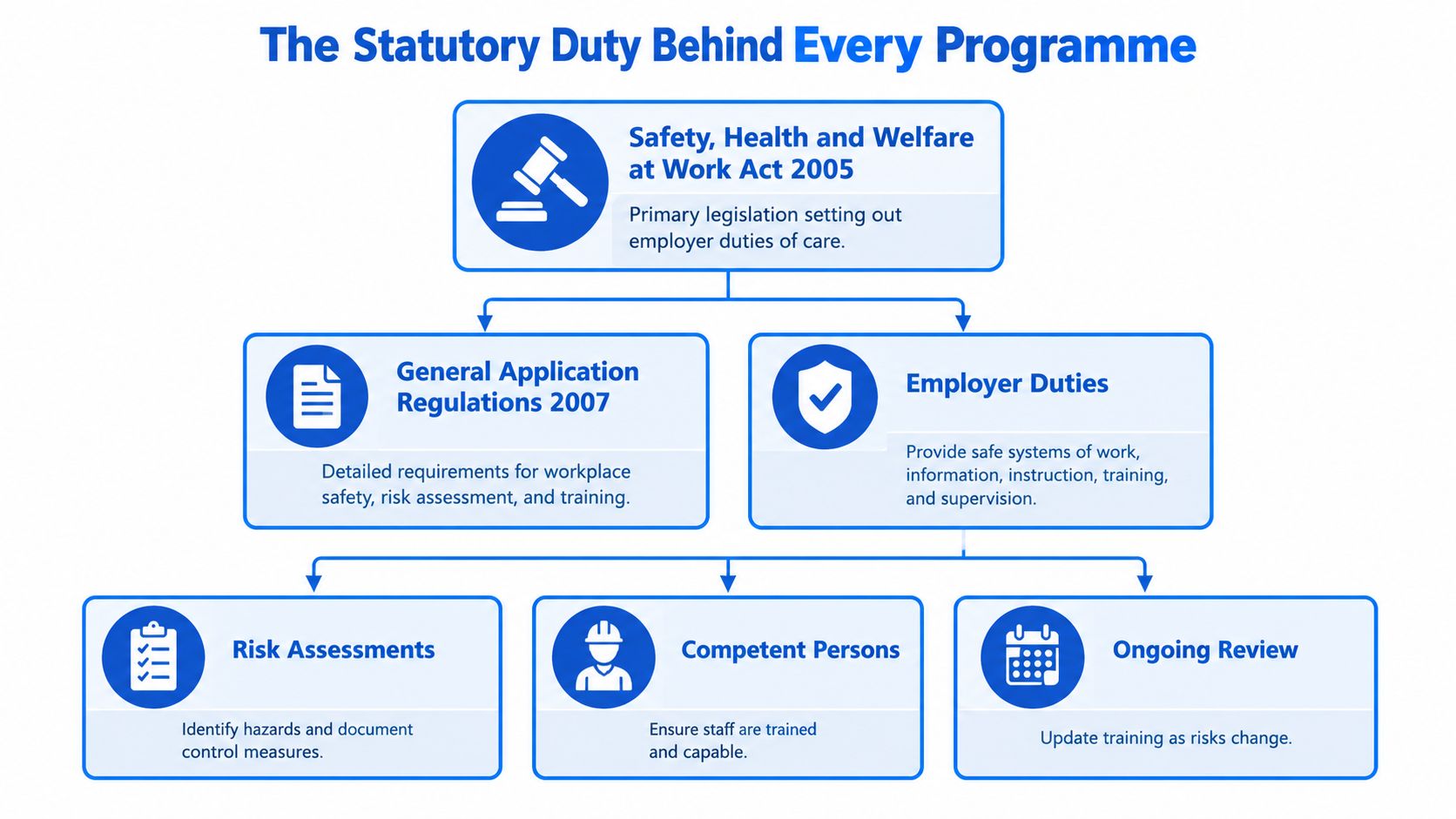
What an inspector expects to see
The HSA says safety and health training can include formal off-the-job courses, individual or group instruction, on-the-job coaching and counselling. That broad definition matters because it lets you build blended training instead of pretending every control can be taught in a classroom. It also means you can't hide behind a course completion record if there's no evidence of supervised practice.
The audit trail needs to be usable. Record the role, the hazard covered, the learning objective, the assessment result, the approver or instructor, the delivery date and the refresher trigger. If those fields aren't there, you've got documentation, not defensible evidence.
Why the legal floor is higher than a yearly module
The Act and the regulations push employers towards a system where training sits inside safety management, not beside it. That is exactly why a good programme maps each lesson to the relevant risk assessment and safe system of work. It also explains why the article keeps coming back to competence, not content.
For a practical policy structure that sits cleanly beside training, see this policy development resource. The point is simple: if the law requires instruction, supervision and proof of competence, then your training has to be built as part of the management system, not as a once-a-year compliance ritual.
Choosing the Right Delivery Format
Different formats solve different problems. Stop asking which format is best in the abstract. Ask which one builds the behaviour you need, leaves a record you can trust, and works across your sites.
Match the format to the outcome
Classroom delivery is strong when you need discussion, demonstration and supervised practice in one room. It struggles when you need scale. E-learning scales cleanly, but too often it stops at knowledge and never reaches performance. Video-led training adds realism, especially when procedures are awkward or site-specific, but it only works if you use it as part of a larger assessment and supervision plan.
On-the-job coaching is the most honest format because it shows whether the person can do the task. It is also the hardest to record properly, which is why so many teams underuse it. Blended delivery is usually the right answer, but only if each format does what it does best.
The HSA's broad definition of training allows that mix, which is useful because it means you can combine formal learning, direct instruction and coached practice without forcing everything through one channel. For production teams thinking about how to present procedures clearly on screen, video-led course production is usually strongest when it is built around real tasks rather than generic narration.
| Format | Builds observable competence | Audit-ready evidence | Scales across sites |
|---|---|---|---|
| Classroom | Strong for guided practice | Moderate | Limited |
| E-learning | Weak on its own | Strong for completion records | Strong |
| Video-led | Moderate if tied to assessment | Strong if paired with records | Strong |
| Blended | Strongest overall | Strongest overall | Strong |
| On-the-job coaching | Strongest for performance | Depends on record quality | Limited unless standardised |
| Immersive or VR | Strong for scenario practice | Moderate | Moderate |
Takeaway: choose the format by learning objective, not by budget habit.
The trade-off you should defend
If the task is simple rule awareness, e-learning may be enough as an awareness layer. If the task is high-risk and procedural, you need coached practice and observation. If the task changes by site, a blended model gives you the control you need without pretending one delivery method can carry the whole burden.
The mistake I see most often is over-investing in polish and under-investing in practice. Nice graphics do not make a worker competent. Supervised repetition does.
What a Defensible Curriculum Actually Contains
A defensible curriculum is a chain of evidence. It shows what the worker needs to know, what they need to do, how they're checked, and what happens if they can't yet do it safely.
A short induction built for a warehouse or manufacturing site
Start with the hazards that exist on the site, not the topics someone copied from a generic template. For a logistics or manufacturing induction, the first module should cover vehicle routes, pedestrian segregation, exclusion zones, manual handling limits, emergency alarms and reporting lines. Each topic needs a direct link to a safe system of work and a visible behaviour.
Then move straight into demonstration. Show the expected route through the site, the correct way to approach a moving vehicle area, the hand signal or radio call used locally, and the stop-work point if conditions change. If the worker cannot repeat that back or demonstrate it, the module is not finished.
Build the curriculum in the order work happens
Use a sequence that matches the shift, not the slide deck.
- Induction: site layout, hazards and reporting.
- Task instruction: the exact procedure for the role.
- Emergency response: alarms, muster points and escalation.
- Equipment competence: checks, limits and prohibitions.
- Refresher trigger: what changes, incident, supervision finding or procedure update forces retraining.
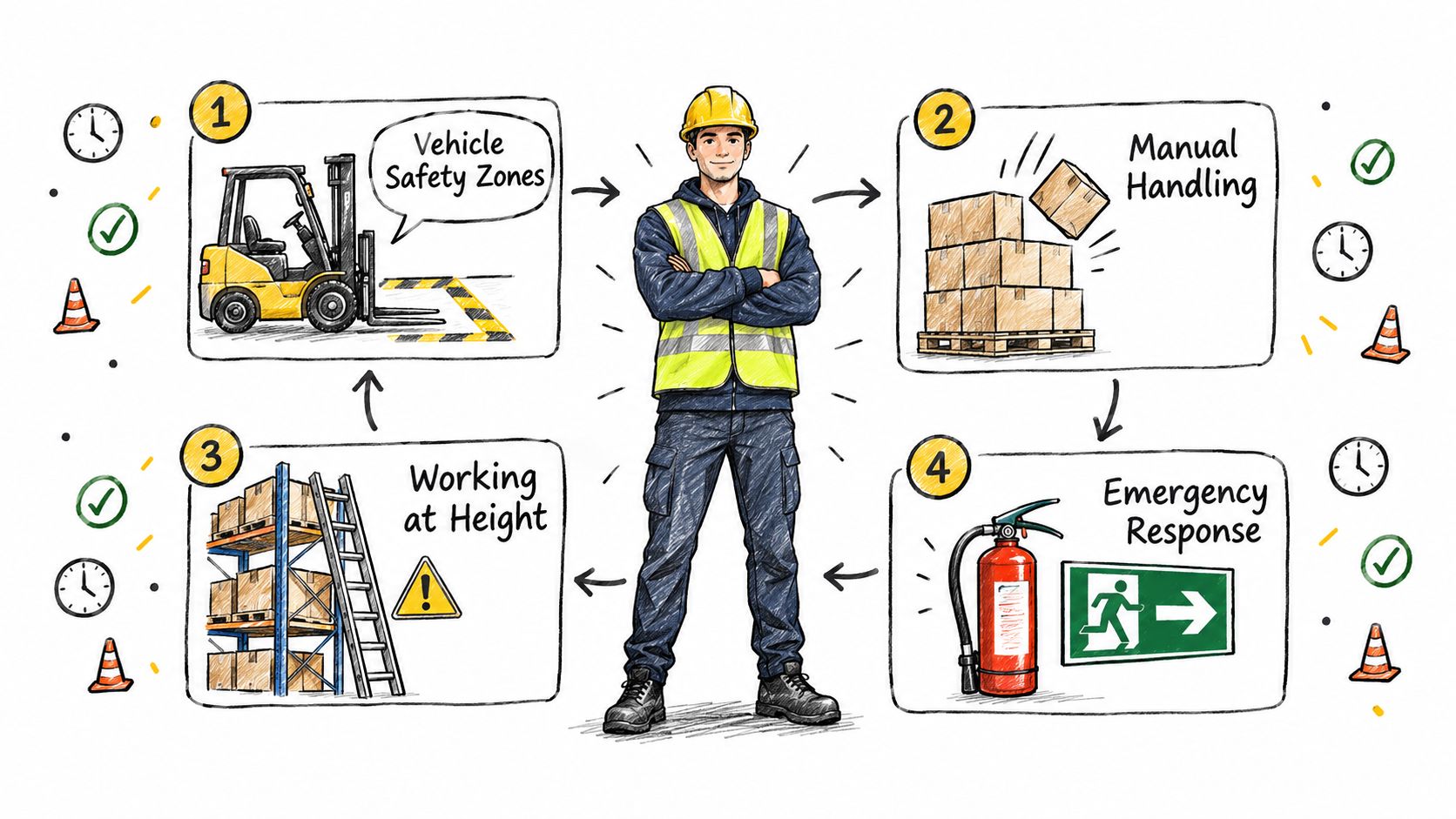
A curriculum is not a topic list. It is a proof trail that a person can do the job safely.
That is the standard you should be working to. Anything less leaves too much to assumption.
What to map every lesson against
Every lesson should tie back to three things, the hazard, the safe system of work and the observable behaviour. If a lesson can't be mapped that way, cut it or rewrite it. A good induction doesn't try to teach everything. It teaches the things that stop people getting hurt on this site, in this role, with this equipment.
Assessment That Goes Beyond the Quiz
A quiz tells you whether someone recognised the right answer on the day. It does not tell you whether they can apply it under pressure. Too many programmes stop at the easiest possible evidence and call it competence.
Use a tiered assessment path
Start with a short knowledge check, but don't confuse that with sign-off. Move from written or digital questions into scenario decisions, then into observed performance on the actual task. That sequence matters because each stage proves something different.
- Knowledge check: confirms rule awareness and terminology.
- Scenario decision-making: shows whether the learner can choose the right control.
- Observed performance: proves they can carry out the task in practice.
If language or literacy varies across your workforce, adjust the delivery method, not the standard. Use plain language, visual prompts, translated support where needed, and oral questioning if that is the cleanest way to test understanding. The bar stays the same.
What goes in the training record
A defensible record should show who was assessed, by whom, on what task, against what standard, on what date, and what the result was. If the worker needs re-assessment, record the reason and the follow-up date. If they passed the quiz but failed the practical, say so plainly.
Assessment should also include structured feedback. People improve faster when they know exactly what was right, what was unsafe and what needs to change before sign-off. That feedback is part of the control, not a nice extra.
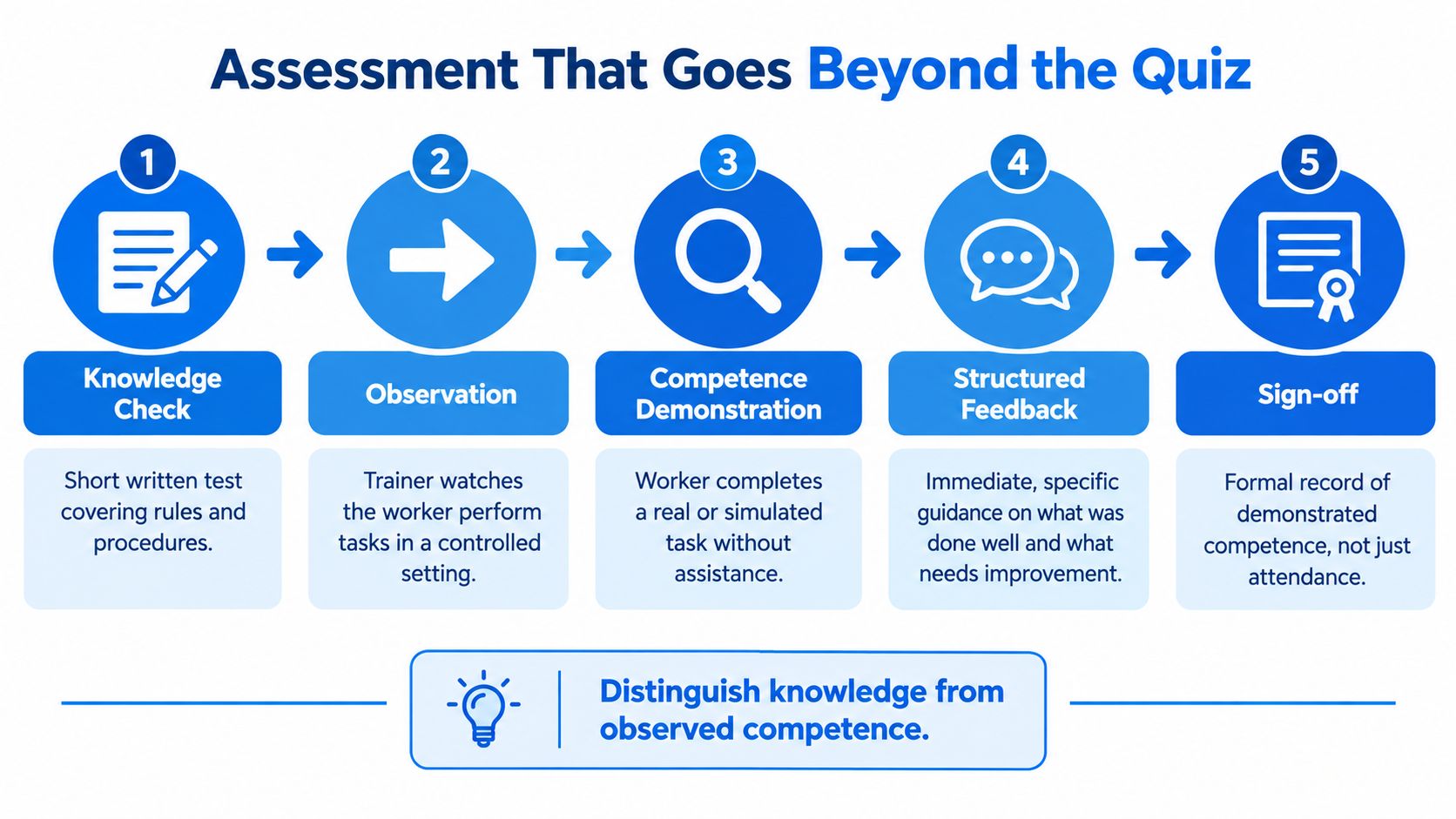
What “passed” should mean
“Passed” should mean the person can perform the task safely without assistance, in the conditions they'll face. If that sounds strict, good. Anything weaker gives you paperwork comfort and operational risk.
Where to Put the Practice Time
A fatality review from the HSA points to where practice time belongs. Vehicles caused 10 deaths, heavy or falling objects caused 6, and falls from height caused 5. Those three mechanisms accounted for 21 of 33 fatalities, or 64% of the national total HSA 2024 fatality release. Stop treating every topic as equal. Train hardest on the work that can kill.
Put more rehearsal into the high-consequence work
If your business involves vehicle movement, lifting, loading, work at height or segregation problems, those tasks deserve the most scenario time. Generic induction material will not fix them. Build drills around the failures that happen, a pedestrian straying into a route, a suspended load crossing an exclusion zone, a worker climbing without the right access, a supervisor allowing a deadline to override control.
The same 2024 fatality release shows that 22 of the 33 fatalities involved people aged 55 or over and self-employed workers accounted for 18 deaths. That points to a training model that is not one-size-fits-all. Older workers and self-employed personnel need clear visuals, realistic site scenarios and role-specific checks, not assumptions that the same delivery suits everyone.
Segment the content, not just the audience
Use the data to split your delivery in practical ways.
- Older workers: use larger visual prompts, slower demonstrations and tighter focus on site-specific changes.
- Self-employed personnel: keep the procedure lean but exact, because they often do not get the informal supervision permanent staff receive.
- Contractors: make the local rules and stop-work triggers unmistakable.
- Refresher groups: focus on drift, near misses and changed conditions, not the full induction again.
The point is simple. Put practice time where failure hurts most, and make the standard fit the hazard, not the other way around.
Running the System Without an HSEQ Team
Most small businesses don't have a training problem, they have an ownership problem. Courses are easy to find. Owning the follow-through is what gets skipped.
Build a lean operating model
Assign one named person to approve content, track refresher triggers and keep the records current. If nobody owns it, nobody fixes it. Then map every course to the Safety Statement and the current risk assessments, not to an old folder of generic slides. That way, the training stays attached to the hazards the business faces.
The HSA's learning platform figures show the scale of the demand. It reported more than 20,000 new BeSMART.ie users in 2024, taking total users above 130,000, and its learning platform delivered nearly 74,000 online courses in 2024. In 2025, e-learning activity rose to 83,234 courses, and the Authority added new short courses on human factors and apprentices working in hospitality HSA learning platform figures. Demand is there. Governance is what usually goes missing.
What a workable small-business system looks like
A lean system should do five things well:
- Localise the content: use the actual site, equipment and workflow.
- Schedule supervisor checks: make observation part of the shift, not an annual event.
- Version-control the records: keep enough history to answer an audit question quickly.
- Set refresh triggers: incident, change in task, change in equipment, or performance drift.
- Keep one owner accountable: that person chases completions, updates and evidence.
For teams trying to structure that ownership without building a full department, this resource for health and safety teams is the kind of organisational thinking worth borrowing, even if the internal resources are modest.
The main mistake in small firms is assuming that because the team is small, the system can be informal. It can't. A smaller workforce just means each weak point matters more.
Measuring Whether It Actually Worked
If you only track completions, you'll never know whether training is reducing risk. You need leading indicators that show behaviour, not just attendance.
Watch the right signals
Use a small set of measures and review them regularly.
- Supervisor observations: are people doing the task the way they were trained?
- Near-miss reports: are workers identifying issues before harm happens?
- Training-record completeness: can you show role, hazard, assessment and sign-off?
- Refresher compliance: are refreshers happening when they should?
- Re-assessment pass rates: are people improving after feedback?
A simple 30-day start works better than a big redesign. Pick the highest-risk task, map the current course to it, run one observed assessment, close the gap you find and record the fix. Then repeat on the next task. That gives you a real loop between training and safety control.
If you can't show one observed competence check, you don't yet know whether the course works.
The best programmes don't brag about course completion. They show safer decisions, cleaner supervision and fewer repeat errors. That's the point of the whole exercise.
If you want training that reflects workplace practice, not just the theory, Loresson can help you turn procedures, assessments and site-specific behaviours into course assets that are easier to review, localise and defend. Use it when you're ready to replace generic completion culture with training that stands up in the workplace.