
The most popular advice for choosing elearning content providers is to judge the sample course. Watch it, score the polish, ask learners if they'd finish it, then compare the per-module quote. That advice is backwards.
A polished sample tells you almost nothing about what you'll pay or when learners can start. The factors that really drive price are the audit trail and the handoff scope. Who reviews the script against your policy, who signs it off, who edits and packages it, who tests it in your LMS, and who owns the editable files when the procedure changes next quarter. Skip those questions and the cheap, fast quote gradually turns into weeks of internal labour.
I buy on a different measure. Turnaround ends at a signed-off, LMS-tested course, not at a first draft. Every comparison below uses that test, because that's the only date your learners, auditors and site managers care about.
Table of Contents
- Elearning Content Provider Types at a Glance
- Five Criteria for Comparing Providers
- Why Fast Turnaround Still Needs an Audit Trail
- Who Finishes the Course
- Price Drivers and Feature Tradeoffs Buyers Miss
- Localisation and LMS Readiness Before You Sign
- Buyer Checklist and Where AI Production Adds Value
- Choose the Provider Type That Fits Your Situation
Elearning Content Provider Types at a Glance
| Provider type | Best for | Typical turnaround | Turnkey or handoff | Audit trail |
|---|---|---|---|---|
| Off-the-shelf content library | Generic soft skills and common compliance topics | Immediate access | Turnkey, limited tailoring | Vendor version history only |
| Full-service custom studio | Brand-led, video-heavy courses | Weeks to months | Turnkey | Varies, usually through project records |
| Freelance instructional designer | Single modules and niche subjects | Depends on availability | Handoff, you assemble and host | Depends on contract terms |
| AI-assisted production service | Procedure-based and compliance training at volume | Hours to one week (company-stated) | Editor-ready pack or fully finished | Scripts, review records and version history |
| In-house team with contractors | Ongoing, high-volume programmes | Fast once set up | Hybrid | Fully controlled, but dependent on staff |
Off-the-shelf libraries give you a finished course today. GoodHabitz-style catalogues work well for communication, resilience and other human skills where your examples don't need to match a site, a machine or a clause in your handbook.
Full-service custom studios build around your brand and your locations. Bluecarrot-style animation and video providers suit flagship, video-heavy work, but you're committing to longer timelines and you need to agree how project records evidence each decision.
The Middle Ground Most Buyers Actually Use
A freelance instructional designer suits one niche module when you already have an editor and an LMS administrator. Without them, you've bought a script, not a course.
AI-assisted production services sell scoped packages with a company-stated expected timeline of 24 hours to one week. Test that figure. Ask whether it ends at draft, review or LMS-tested sign-off, and whether you receive an editor-ready pack or a finished course.
An in-house team with contractors gives you control and speed once the roles exist. It's also fragile. One resignation can take your version history and your production capacity with it.
Providers overlap. Many sell two or three of these models, so the table describes the dominant model, not a strict category. A generic data-protection refresher suits a library. A site-specific working-at-height induction does not, because it must match your permit process, your equipment and your jurisdiction.
The more a course must match a specific procedure, jurisdiction or internal policy, the less a generic library will fit, however polished it looks.
Five Criteria for Comparing Providers
Auditability decides more purchases than buyers admit, especially for regulated work. If an auditor asks who approved a statement in the course and against which policy version, a finished video file isn't an answer. You need sources, reviewers and dates you can retrieve quickly.
| Criterion | How it works in practice | Strong answer | Red flag |
|---|---|---|---|
| Turnaround | Time from brief to signed-off, LMS-tested course | Dated milestones covering draft, review and sign-off | A single quoted duration with no breakdown |
| Auditability | Traceable record of sources, reviews and versions | Script with sign-off log and version history | Only the final video file is supplied |
| Turnkey versus handoff | Who edits, renders, packages and tests | Written scope listing every delivered file | Assets 'provided' with no edit timeline |
| Localisation | Whether script, on-screen text and voice are separable | Editable source files and subtitle files supplied | Re-recording needed for every language |
| LMS readiness | Packaging standard and tracking data | SCORM or xAPI package tested in your own LMS | 'Works with any LMS' with no test run |
How to Score Without Fooling Yourself
Score each criterion 1 to 3. Give 1 for an assertion, 2 for a written process, and 3 for evidence you've inspected, such as a sample sign-off log or a pilot tested in your own LMS. Don't average the scores blindly. Weight them for the job in front of you.
For regulated training, weight auditability heaviest, then LMS readiness. For a fast-moving product launch, turnaround and localisation may matter more, provided the content risk is low. Write the weighting into the brief before you see demos, or the best-looking sample will rewrite your priorities for you.
- Turnaround: Ask for dates for script approval, media production, review, LMS test and final sign-off, not one delivery date.
- Turnkey versus handoff: Ask who edits, renders, packages and fixes the package if tracking fails.
- Localisation: Ask for the script, on-screen text and voice tracks as separate, editable elements.
LMS readiness needs a named standard, such as SCORM or xAPI, and a test in your environment. Completion, resume and score pass-back behave differently across systems, and you'll find that out either in a pilot or after launch.
A provider can score well on production quality and still fail the other four. That's not a near miss. For corporate buyers, it's a failed rollout with attractive screenshots.
Why Fast Turnaround Still Needs an Audit Trail
A quote of 24 hours or one week can mean very different things. Some providers count to a first draft. Others count to a module that has passed review and run in an LMS. Confirm which milestone the price covers before you compare quotes.

Take a 30-minute working-at-height course drafted in a day. A subject-matter expert still has to check the sequence against your procedure, compliance has to confirm the wording against the source policy, and someone has to test completion and score tracking in the LMS. Those steps take days, and skipping them doesn't shorten the project. It moves the risk to the learner.
The audit trail is the set of artefacts proving that work happened. You want the source policy reference, script version, reviewer name and sign-off date, change log and publication record. Keep them together, not scattered across email threads.
That record is what an auditor reaches for first. They ask who approved a specific statement in the course and against which version of the policy it was checked. If the answer sits in a deleted email thread, a completion certificate on the LMS won't help you. Providers who quote to draft stage often aren't pricing in the review cycles or the records those cycles produce, which is why two similar-looking quotes can differ by more than speed.
Set the record depth by risk. Low-risk onboarding can accept a lighter record. Regulated working-at-height or data-handling training needs the full trail, checked against the milestones and the buyer checklist before you sign.
Who Finishes the Course
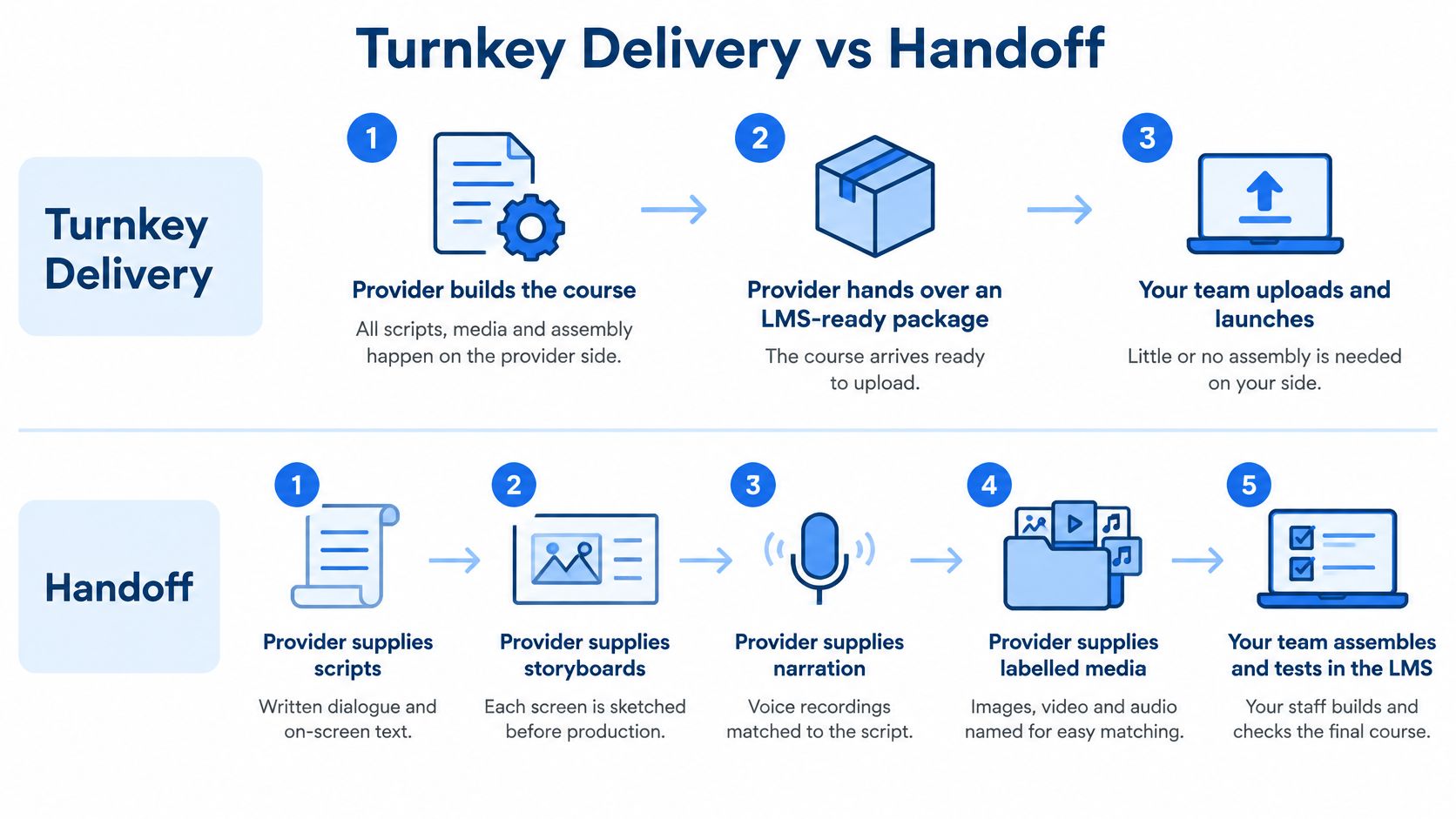
Turnkey delivery means the provider hands over an LMS-ready package. Your team uploads it, runs final checks and launches it. Handoff delivery means the provider supplies scripts, storyboards, narration and labelled media, and your team assembles the course.
Where Ownership Changes Hands
The production flow runs brief, script, storyboard, narration, media production, edit, LMS packaging, testing and updates. Under a handoff, the stages that typically move to you are editing, rendering, packaging and LMS testing. Those aren't clerical finishing touches. They're where timing, accessibility and tracking problems surface.
Fragmented assets can add days of assembly work for an editor who has to match files to screens and rebuild interactions. An editor-ready pack, with structured and labelled media tied to the script, reduces that work but doesn't remove it. Someone still has to build, review and test the final timeline.
Some AI-assisted services offer either model. You can take the editor-ready pack for an in-house team, or a fully finished production handled end to end. An AI-assisted editor may be described as upcoming in this market, so don't plan staffing or launch dates around tooling you can't use today.
- Turnkey suits you if: You have no spare editor, no LMS administrator time, or a fixed launch date you can't move.
- Handoff suits you if: You have both roles available and you want direct control over assembly and future edits.
- Mixed model: The provider finishes the course, and you retain editable source files for updates.
Practical rule: A handoff saves money only if you have an editor and an LMS administrator with time to finish the work. Otherwise you're buying a discount and paying it back in hidden labour.
Get the scope in writing, file by file. If the quote says media will be provided but doesn't name formats, naming conventions, subtitle files or an edit timeline, you don't yet know what you've bought.
Price Drivers and Feature Tradeoffs Buyers Miss
The quote is the smallest part of the cost. A per-module price hides customisation, review cycles, language versions and the next policy update. That's where budgets drift, usually after you've committed publicly to a launch date.

| Cost driver | Lower-cost option | Higher-cost option | Hidden cost to check |
|---|---|---|---|
| Content source | Licensed library module | Bespoke script with expert review | Licence limits and generic examples needing rework |
| Production format | Narrated slides | Cinematic video with consistent cast | Re-shoot cost when policy changes |
| Review and sign-off | Vendor self-check | Independent SME and compliance sign-off | Review cycles add days to the timeline |
| Localisation | Subtitles only | Full voice-over and on-screen text per language | Each language re-rendered and re-checked |
| Updates | Vendor schedules updates | Editable source files retained in-house | Fee per revision or per update cycle |
| Interactivity | Click-through quizzes | Role-play and branching scenarios | Authoring time and testing effort in the LMS |
Where the Tradeoff Bites Later
A library licence looks cheap until you have to work around examples that contradict your procedure. At that point you either accept learner confusion or pay for customisation that erodes the saving. Neither option was in the original comparison.
Narrated slides cost less to produce and less to amend. Cinematic video with a consistent cast holds attention and makes scenarios believable, but a policy change can mean re-shooting or regenerating scenes rather than editing a line of text. Your choice of elearning authoring tools for editable course production affects how painful that amendment is, so ask before production, not after.
Localisation multiplies work per language. Voice, on-screen text, subtitles, rendering and quality checks all repeat, so a five-language rollout can cost several times a single-language course. Interactivity multiplies testing in the same way. Every branch in a role-play needs a correct path, a plausible wrong path and a score that reaches the LMS.
Some AI-assisted providers state reductions of 90% or more in production cost and delivery time versus traditional bespoke video-led training. Treat that as a company-stated claim to test, not a saving to bank. Ask for a quote on identical scope, including review, packaging and one update, then compare like with like.
Finish with two questions for every provider. What's the price per revision, and do I keep the editable source files if I leave? If either answer is vague, the headline price is not the price.
Localisation and LMS Readiness Before You Sign
Price localisation per language before you sign, not after. Ask for a written list of elements that change per language, covering narration, captions, graphics, downloadable documents and assessment feedback, then get a per-language quote that includes review and re-packaging. A provider who prices translation only will invoice the re-engineering separately. Professional elearning localisation services that supply separable script, text, voice and subtitle files are easier to audit, because reviewers can check each element against the approved script without re-watching rendered video.
Ask who keeps the translated files. If translated voice tracks and subtitles stay on the provider's servers, your handoff scope shrinks with every language you buy, and leaving means repurchasing work you already paid for.
Run the LMS Pilot Properly
Name the packaging standard in the contract. You'll commonly see SCORM 1.2, SCORM 2004 and xAPI, and they don't behave identically. Then upload a pilot module to your own LMS before paying for the full course.
- Complete the module: Confirm completion records correctly for a test learner.
- Leave and resume: Check bookmark resume returns the learner to the right place.
- Fail and retake: Confirm score pass-back, attempts and pass status update as expected.
Test on the devices your staff really use. A course that plays cleanly on an office laptop can still stall on a shared tablet, a personal phone on mobile data, or a site connection with limited bandwidth. Check mobile playback, subtitle display at small screen sizes and load time on a weak connection before you sign anything off. A signed-off, LMS-tested course means tested where learners will take it, not where the demo was given.
If the pilot shows friction, specify shorter modules, downloadable versions and lower-bandwidth renditions rather than assuming staff will work around the problem.
There's an edge case. A single-language course for a desk-based team on a stable LMS doesn't need full localisation readiness. Don't pay for architecture you'll never use.
Buyer Checklist and Where AI Production Adds Value
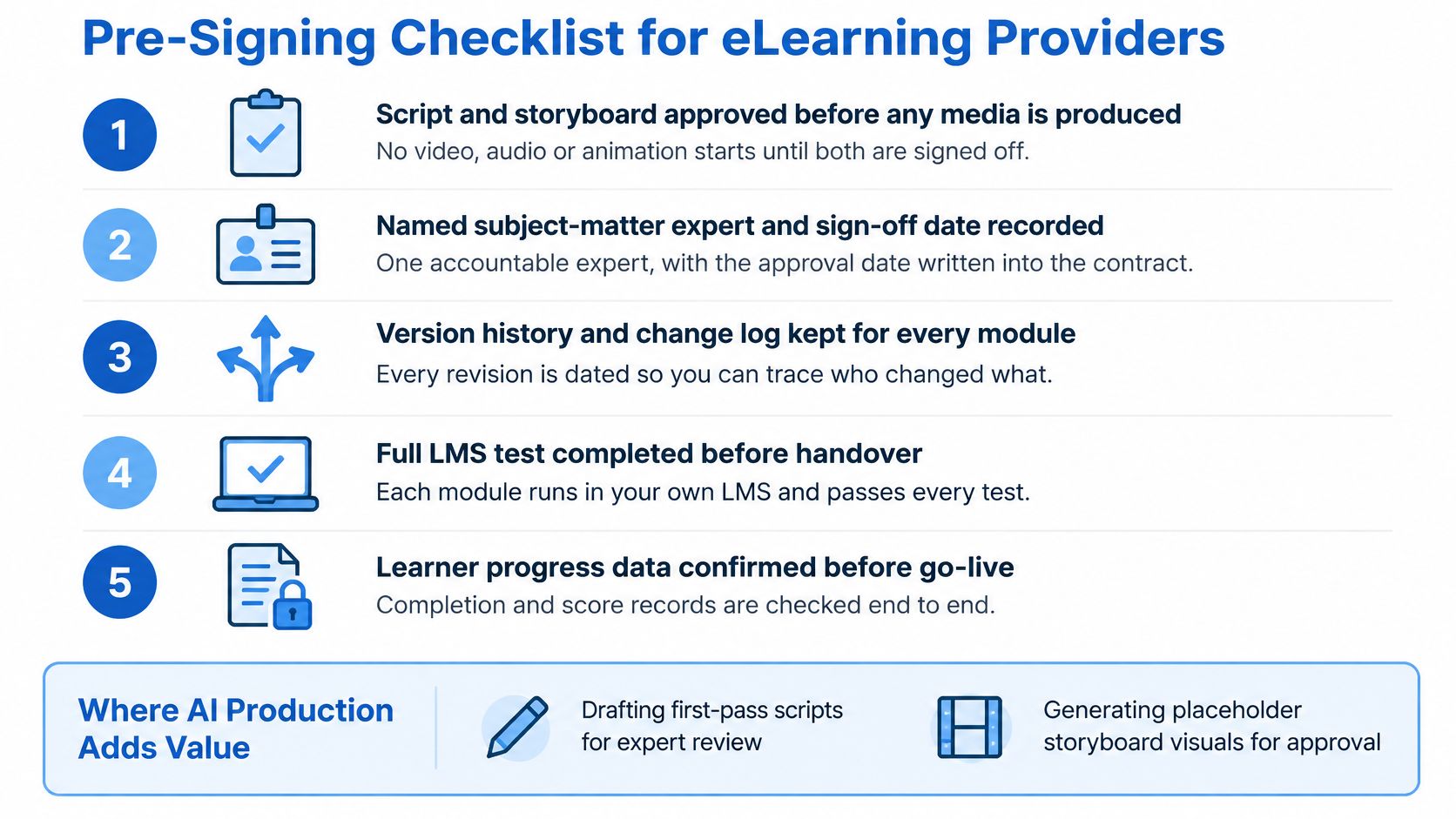
Don't sign until you can evidence each item below. A verbal assurance in a sales call won't help when an auditor, a translator or your LMS administrator asks for the file.
- Script and storyboard: Approved before any media is produced.
- Named expert: Subject-matter expert and sign-off date recorded.
- Version history: Change log included for every module.
- Accessibility: Checks listed, including captions and readable on-screen text.
- LMS pilot: Passed with completion and score tracking confirmed.
- Localisation sources: Separable script, text, voice and subtitle files supplied.
- Update terms: Fees, turnaround and included revisions stated.
- Exit rights: Editable source files confirmed if you leave.
Check each item against the quoted scope. A price that ends at first draft buys less than a price that ends at a signed-off course that passed your LMS pilot.
Where AI Genuinely Helps
AI-assisted production earns its keep on volume work. Hand the provider an approved policy or procedure, and it can return a draft script with role-specific scenarios in days rather than weeks. Verify that before signing: send one of your own source documents, review the draft it produces and check which sections of the document the draft drew on.
Consistency is the second gain. A provider reusing the same character references, narrator voice and terminology can hold a uniform style across a long series where freelance teams drift. Ask for two finished modules on different topics and compare voiceover, on-screen wording and design. If they read as if different companies made them, the claim fails.
The third gain sits in the handoff. Labelled assets, separate audio tracks, subtitle files and editable source material shorten every future update. That structure pays off in elearning content development from approved source material where regulations change and courses need reissuing. Confirm in the contract that files arrive editable and named, so your team can replace one line of narration without buying a new module.
Buyers don't need generic prompting lessons. They need bespoke modules connecting approved tools, confidentiality rules, human oversight and escalation routes to particular jobs, with assessments mapped to internal policy.
AI speeds drafting. It doesn't transfer accountability. Accuracy still depends on expert review, and the checklist must keep that review visible.
Choose the Provider Type That Fits Your Situation
Generic soft skills, no tailoring needed. Choose an off-the-shelf library and accept limited customisation. You'll launch quickly, and the content risk is low because nothing site-specific is being taught.
Brand-led flagship course, with time and budget. Choose a full-service custom studio and plan in months. Agree milestones, review ownership and update costs early, because late changes to filmed or animated scenes are expensive.
Procedure-based or jurisdiction-specific compliance at volume. Choose an AI-assisted production service with governed review, where the audit trail matters as much as the media. Decide whether you want an editor-ready pack or a fully finished course, and confirm sign-off records before scaling.

Mature in-house team with LMS skills. A handoff model can work well. You've got the editor and administrator capacity to finish, test and maintain the course without hidden delays.
Anchor every brief in the job to be done. In 2024, 34% of Irish internet users completed an online course and 64% of online learners cited professional or work-related purposes. Name the job task, the assessment method and the evidence of completion in every commission.
Be fair about limits. An AI-assisted service isn't right where learners need live in-person practice, supervised assessment or a heavy brand film built around real locations and senior leaders on camera.
Commission one pilot module first. Check its script and review log, test it in your LMS, and scale only after it passes.
If you need procedure-based or compliance training produced quickly without losing the audit trail, Loresson offers editor-ready packs or fully finished, LMS-ready courses with documented scripts, review records and version history. Visit the site to scope a single pilot module, test it in your own LMS, and decide on evidence rather than a sample reel.