

You've been asked to organise training, but the warehouse can't release everyone together, the night shift rarely sees the trainer, and the approved procedure is still waiting for sign-off. Meanwhile, your manager wants proof that the course will reduce mistakes, not just generate completion certificates.
That's a learning and development problem, but the answer doesn't start with choosing an eLearning platform. It starts with working out what people need to do differently, what's stopping them, and how they'll practise without disrupting the operation.
Table of Contents
- What Learning and Development Covers at Work
- How to Run a Needs Analysis First
- Choosing Formats and Modern Delivery Methods
- Fitting Learning Into Work That Never Stops
- Building the Course From Brief to Sign-Off
- Measuring Performance and Avoiding Failed Programmes
- Set Your First Learning Priority This Quarter
What Learning and Development Covers at Work
Training is one route on a transport network. Learning and development, or L&D, is the planning that decides which routes exist, who needs them, and when people can realistically travel.
In plain English, L&D means planned activities that build people's knowledge, skills and behaviour so they perform better and the organisation meets its goals. The work includes courses, but also coaching, supervised practice and support that employees use while doing their jobs.
Say a warehouse introduces a new stock-management system. Staff might need a guided lesson on scanning deliveries, practice handling an incorrect shipment, and a reference card beside the scanner. New supervisors might also need help giving feedback when scanning errors recur.
Those activities belong together, even though they don't all look like training.
Training, development and performance support
Training builds a particular capability, such as processing a return. Development prepares someone for broader responsibilities, such as managing a team. Performance support helps someone complete the task in front of them, such as a decision tree for an unusual customer request.
The distinction matters because managers sometimes commission a course when employees really need a clearer checklist, or expect a leadership workshop to replace feedback from their own manager.
Core L&D activities and what each one is for
| Activity | Main purpose | Typical example |
|---|---|---|
| Induction and onboarding | Get new hires working safely and productively | Site induction for a new warehouse starter |
| Compliance training | Support legal or regulatory duties | Manual handling refresher scheduled under the organisation's training plan |
| Skills training | Build a specific capability | Using a new CRM for sales staff |
| Leadership development | Prepare people for larger roles | A cohort programme for newly promoted team leaders |
| Performance support | Help people at the point of need | Short job aid for a rarely used procedure |
| Coaching and mentoring | Improve behaviour through feedback | Manager observes and debriefs a customer call |
A shared planning session helps operations, HR and subject specialists agree which activity the job actually requires.

What this means for an Irish employer
The scale of organised workforce learning is substantial: Skillnet Ireland's annual report records 84,515 trainees supported through 9,208 workforce-development programmes in 2025. That gives managers useful context, but participation alone doesn't tell you which activity your team needs.
Start with the task, not the catalogue. If a sales adviser knows the refund policy but struggles to explain it calmly, another policy presentation misses the gap. Conversation practice and feedback are a better fit.
Apply a simple test to any proposed activity: what should someone do differently at work afterwards? If you can't answer, the activity isn't yet doing L&D's job.
How to Run a Needs Analysis First
A needs analysis is a structured check of the performance problem before you spend money solving it. Its most useful outcome can be a decision not to build a course.
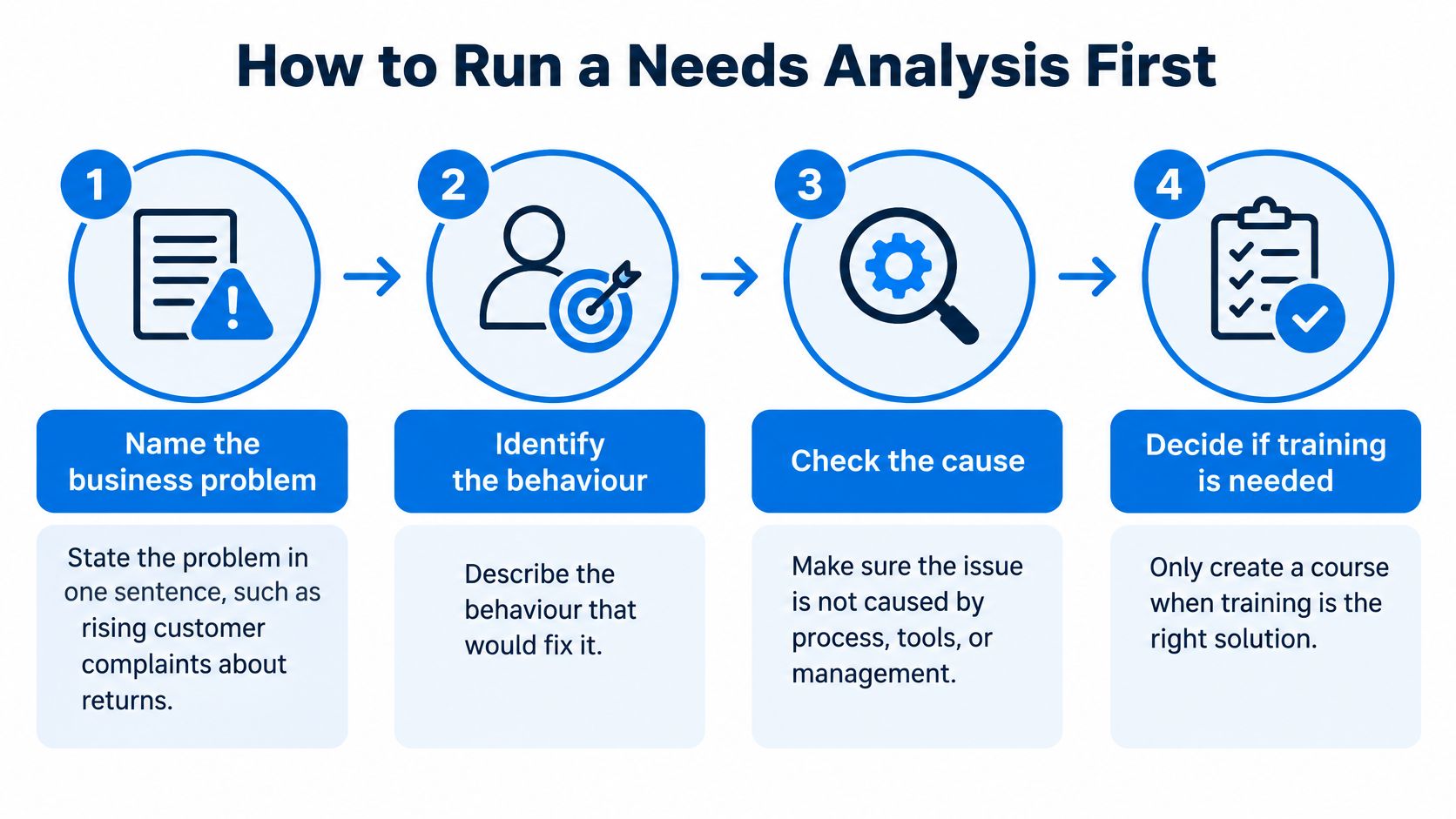
The process diagram gives the main decision points. Your working notes should also capture access, assessment and responsibility.
Work backwards from the problem
Name the business problem. Write a sentence such as: customer complaints increase when staff process returns incorrectly. Avoid requests such as improve customer service, because nobody can design a meaningful assessment around something that broad.
Identify the required behaviour. Describe the action a competent employee would take, including the decision points. Observe the task across different shifts and conditions rather than relying entirely on a manager's description.
Map the audience and access. Record who performs the task, where they work, what equipment they use and when supervisors can release them. A desktop course isn't an accessible solution for someone who has neither a desk nor permission to leave their station.
Check the cause. Separate gaps in knowledge and skill from problems with tools, process or motivation. Training can address the former, but it won't repair a scanner, remove a conflicting target or make unavailable equipment appear.
Collect the operational inputs. Bring together the approved procedure, learning need, audience, jurisdiction and desired course length. At Loresson, we use these inputs to establish the operational brief rather than guessing how the workplace runs.
Choose evidence of success. Decide what the learner must demonstrate and where you can observe it. If the task involves selecting an escalation route, test that decision rather than asking learners to recognise the policy title.
Record a go or no-go decision. State whether training is needed, what other changes must happen and who owns them. Don't allow a course request to conceal an unresolved operational problem.
A missing trolley isn't a learning gap
Consider a hypothetical warehouse team that skips a handling step. A manager asks for refresher training, but observation shows employees already understand the procedure and can demonstrate it correctly.
The trolley they need is routinely stored away from the work area. Repositioning it and assigning responsibility for returning it addresses the immediate obstacle; additional instruction is only justified if a separate capability gap remains.
Practical rule: Before asking what employees need to learn, ask what prevents a competent employee from doing the task correctly today.
Use this video as a discussion prompt with the people who'll help define the learning need.

Finish with a one-page brief containing the problem, required behaviour, audience, working conditions, likely cause, approved source material, assessment and decision owner. Keep unresolved questions visible rather than filling them with assumptions.
You can draft that page in an afternoon. You may need longer to verify it, especially if the procedure differs between sites or the people doing the job disagree with the written instructions.
Choosing Formats and Modern Delivery Methods
Choose a format by the action the learner needs to perform. The comparison below uses task-based length rules rather than treating a particular runtime as proof of quality.
Delivery formats compared by use, length and effort
| Format | Best for | Typical length | Production effort | Practice opportunity |
|---|---|---|---|---|
| Instructor-led session | Complex skills needing feedback | Enough time for demonstration, practice and debrief | Medium, mainly facilitator time | High, live practice |
| Self-paced eLearning course | Standard knowledge and compliance content | Determined by the objectives and assessment | Medium to high | Low to medium, usually quizzes |
| Microlearning | Refreshers and single procedures | A short unit covering a single task | Low to medium | Low, one question or task |
| Video demonstration | Showing a process or workplace setting | Long enough to show the complete action clearly | Medium to high when filmed, lower when AI-assisted | Low, watch and recall |
| Interactive scenario or roleplay | Judgement, customer conversations, escalation | Enough time for decisions, consequences and feedback | High | High, learner makes choices |
| On-the-job coaching | Habit change under real conditions | Ongoing | Low to produce, high in manager time | Very high, real work |
Match the format to the behaviour
For factual knowledge, a concise explanation, microlearning unit or demonstration may be enough to prepare someone for assessment. For judgement, use branching scenarios that require the learner to distinguish between plausible options. For physical skills, provide supervised practice with the actual equipment.
Regulated or safety-critical topics also need controlled content and documented assessment appropriate to the task. An attractive video doesn't remove those responsibilities, and a self-paced course shouldn't be presented as sufficient practical instruction where supervised competence is needed.
Consider a hypothetical forklift refresher. A video shows an operator approaching an obstructed aisle, then a scenario asks what to do when a pedestrian enters. The learner must decide whether to stop, communicate and follow the site's approved separation arrangements.
Show enough context before presenting the consequence. If learners can't see the sightline, pedestrian route or relevant site rule, the scenario tests guessing rather than judgement.
The digital activity can prepare the learner, but it doesn't establish operating competence by itself. The authorised assessor still needs to check the relevant practical actions under controlled conditions.
Use short content without making it shallow
A microlearning unit should cover a coherent action, not a random slice of a longer presentation. For example, it could teach the sequence for reporting a damaged delivery, followed by a realistic decision about what information to record.
Video is useful when movement, layout, or tone matters. Coaching is more effective when the learner needs correction while attempting the task. Combine them where necessary, but don't add media just because the authoring tool allows it.
Production effort isn't learning value. A polished explanation without practice can be less useful than a plain scenario with good feedback.
Interactive conversation adds another option. Learners can watch a situation unfold, learn an approach, then enter a live virtual conversation and practise it themselves.
Realistic safety scenes need restraint and purpose. We permit depictions of hazards, accidents, injuries, emergencies and difficult conversations where they serve a genuine learning purpose, and may adjust how those scenes are shown.
Teach responsible AI use in the employee's role
The Department of Enterprise's coverage of the 2025 Working in Ireland Survey reports that 42.8% of employees in the Republic received employer training in generative AI, while only around half worked for organisations with an official AI policy. Tool familiarity therefore shouldn't be treated as evidence that someone can use AI appropriately in their work.
For a customer-service agent, useful practice might involve a chatbot inventing a refund rule. The learner must check the approved policy, correct the response, protect customer information and decide whether escalation is necessary.
For a supervisor, the scenario might involve an AI-generated incident summary that omits an important fact. The learning task is verification and accountability, not producing a more elaborate prompt.
Apply these controls to AI-related learning:
- Expert-reviewed script: Have the relevant specialist verify the proposed actions and explanations.
- Policy-matched scenarios: Use the organisation's approved rules for data handling, authorisation and escalation.
- Decision-specific feedback: Explain why each choice is appropriate or unsafe, including plausible mistakes.
- Version control: Identify the policy and tool context so changes can trigger a targeted update.
AI-assisted production can help create training assets. It doesn't replace the human decision about whether the advice is correct.
Fitting Learning Into Work That Never Stops
Access is an operational issue, not only a question of employee enthusiasm. The report on barriers and enablers to employee upskilling participation records Ireland's lifelong-learning participation rate at 16% in Q4 2024 and identifies work demands, unsuitable course length or timing, work–life pressures, cost and weak employer support as barriers.
Shift workers, site-based teams, micro-enterprises and people with caring responsibilities need arrangements that don't assume a quiet afternoon at a desk. Giving someone a login without protected time is not meaningful access.
Design around the actual working day
Match each obstacle with an operational decision:
- Limited release capacity: Divide learning at meaningful task boundaries and book cover with the supervisor.
- Unpredictable workloads: Provide an agreed completion window and a route for rebooking interrupted learning.
- No regular desk access: Test the course on the devices employees can use, including shared terminals.
- Competing responsibilities: Keep required learning within planned work arrangements rather than shifting it into personal time.
- Weak follow-through: Make outstanding learning visible to the person who controls the roster, not only to HR.
- Difficulty recalling a procedure: Pair the learning with a short, accessible job aid.
For employee onboarding training, separate information a starter can learn before entering a work area from checks that require a supervisor on site. Don't compress the site-specific safety check merely to make the online module shorter.
A hypothetical induction could combine a short preparatory module with a gate-side check of access routes, emergency arrangements and local hazards. Record the practical check as well as the digital completion.
Check who your arrangements exclude
Age differences deserve attention without becoming stereotypes: the CSO's quality education findings show that 64% of Irish adults aged 25–34 participated in lifelong learning in 2022, compared with 35% of those aged 55–69. Don't infer individual ability or preferences from those group figures.
Offer clear navigation, accessible text, captions and help using the platform to everyone. Check participation across shifts and relevant workforce groups where appropriate, rather than assuming a healthy overall completion rate means equal access.
The final access test is practical: can this employee complete the activity in an agreed operational window, with the equipment and support available? If not, change the arrangement before blaming engagement.
Building the Course From Brief to Sign-Off
Once you've confirmed the need and chosen the learning approach, treat production as a controlled workflow. Building assets before agreeing the source material creates avoidable rewriting and makes approvals harder.
Follow a controlled production sequence
Lock the brief. Confirm the approved procedure, audience, jurisdiction, learning objectives and target scope. Mark unresolved local differences so a writer doesn't accidentally turn an assumption into an instruction.
Write the complete script. Include what learners see and hear, the actions they must practise, feedback and assessment. A slide list isn't enough for a reviewer to judge whether the learning is accurate or usable.
Arrange qualified verification. Before publishing or using materials for training, verification by a suitably qualified person must be arranged, particularly for safety, technical or compliance content. Identify that reviewer early and allow them to inspect the actual instructions, not just the course title.
Build the selected assets. Produce narration and visuals for demonstrations, repeatable units for microlearning, or choices and consequences for scenarios. Keep terminology consistent with the approved procedure and the equipment employees use.
Bind assessment to the content version. Store the practice task, feedback and pass rule with the material they assess. Otherwise, an updated procedure can leave learners answering questions about an obsolete process.
Prepare deployment and evidence. Test navigation, scoring, accessibility and completion recording in the intended learning environment. Retain the script, assessment, reviewer comments and approval record as a traceable handover.
Assign ownership after launch. Name who receives procedure changes and decides whether the course needs revision. Set a review date, but also define triggers such as equipment changes, revised policy or an incident exposing unclear instructions.
Make approval a decision, not a formality
A useful sign-off record states what was reviewed, which version was approved and whether any restrictions remain. Technical approval, learning-quality review and deployment testing answer different questions, so don't assume a single signature covers everything.
Approval checkpoint: Could a reviewer trace an instruction on screen back to an approved procedure and identify who authorised it?
When internal capacity is limited, keep the same controls for outsourced eLearning content development. At Loresson, we shape source material into structure, script, storyboard, narration and learning flow, then prepare the output for review, refinement and launch under the customer's brand or platform.
Your internal approval remains central, especially for safety-critical actions and local requirements. Agree the handover format and platform requirements before production so the finished material can be reviewed and deployed without improvised conversion work.
Measuring Performance and Avoiding Failed Programmes
A learner can understand a technical process yet struggle to explain a risk, coordinate with a colleague or choose an escalation route. Those are different capabilities, and your evaluation needs to distinguish them.
SOLAS reported more than 25,000 employees taking up Skills to Advance places in 2024, particularly in sustainability, digital and robotics, while its National Skills Bulletin identified demand for communication, teamwork, leadership, project management and data analysis. For managers, the implication is practical: assess how employees use technical knowledge with other people, not just whether they can recall it.
Separate completion from competence
Four levels of training evaluation
| Level | Question it answers | Example measure | When to collect |
|---|---|---|---|
| Reaction | Did learners find it useful and relevant? | Short post-session survey | Immediately after |
| Learning | Did they gain the knowledge or skill? | Pre- and post-test, practical check | Before and after |
| Behaviour | Are they applying it on the job? | Supervisor observation, scored scenario | After employees have had an opportunity to apply it |
| Results | Did the business outcome move? | Error rates, near misses, rework, audit findings | At agreed reporting intervals, against a baseline |
These levels answer different questions. A positive survey doesn't establish learning, and a passed quiz doesn't establish workplace application.
A scored scenario can test competence under simulated conditions. Supervisor observation of real work provides stronger evidence that the employee is applying the behaviour in the operation.
For example, an HSEQ objective might require an employee to recognise a hazard, choose the approved control, explain the decision to a colleague and document the action. The assessment should sample those actions rather than merely asking for a definition of risk.
Diagnose failure before adding content
Consider a hypothetical manual handling course where almost everyone passes the knowledge test but unsafe handling continues. Before commissioning a longer refresher, watch the task and inspect the learning design.
Perhaps employees never practised the required movement. Perhaps supervisors tolerate shortcuts, or the workspace makes the approved method difficult. Each explanation calls for a different response.
A leadership programme can have strong attendance while managers continue giving vague feedback. Review an actual feedback conversation, with appropriate consent and confidentiality, and check whether the manager states the observed behaviour, its impact and the next action.
The remedy might be a focused coaching check-in after the manager has attempted the conversation. Another presentation on leadership theory won't necessarily address that omission.
Common warning signs include:
- High scores, weak practice: The assessment rewards recognition but never requires a decision or demonstration.
- Strong launch, no owner: Nobody updates the course when the procedure changes.
- Repeated deferrals: Supervisors haven't been given cover or authority to release staff.
- Conflicting instructions: Training and local operating documents describe different actions.
- Positive feedback, unchanged work: Learners enjoyed the experience but didn't rehearse the behaviour that matters.
Build a measurement plan managers can use
Choose a baseline before launch. Use an existing operational measure where possible, and define its boundaries: which team, task, site and reporting period are included.
For returns processing, the results indicator might be the proportion of checked cases requiring correction. Pair it with a behaviour check showing whether advisers verify eligibility, explain the decision and record the reason correctly.
Keep a simple measurement record:
- Baseline owner: The person responsible for extracting a consistent starting measure.
- Behaviour observer: A supervisor or assessor using a shared checklist.
- Results indicator: The operational outcome the programme is intended to influence.
- Review decision: Who will decide whether to continue, revise or stop the intervention.
Don't attribute every improvement to training. Staffing, workload, equipment and process changes can affect the same outcome, so record them alongside the results.
For corporate training solutions, the useful question isn't how much content employees consumed. It's whether the intended action became more reliable, under the conditions in which the organisation needs it performed.
If knowledge improves but behaviour doesn't, investigate the opportunity to practise and the support available at work. If behaviour improves but the business measure stays flat, check whether you selected the right behaviour and whether enough relevant work has occurred to judge the result.
Set Your First Learning Priority This Quarter
Choose a performance gap with a clear business consequence and an outcome you can already monitor. Don't begin by launching a catalogue of courses.
A useful first priority is narrow enough to observe, important enough to justify release time and stable enough that you're not teaching a procedure about to change. Correct processing of a particular return type is easier to manage than a broad ambition to improve customer experience.
Make these decisions this week
Complete the needs analysis. Record the task, audience, shifts and likely cause of the gap. Include what employees say prevents correct performance, and verify it rather than treating the first explanation as settled.
Select the learning approach. Choose demonstration, scenario, practice or coaching according to the required behaviour. Treat production effort as a constraint to manage, not the main definition of value.
Capture the starting position. Save the baseline and its measurement rules before anyone receives the intervention. Otherwise, you'll struggle to distinguish improvement from a change in reporting.
Book the operational capacity. Agree release arrangements with the manager responsible for the roster. Include equipment, access support and practical supervision where needed.
Assign continuing ownership. Name the person who can authorise changes and the event that should trigger a review. Ownership needs to survive the launch.
Confirm verification. Arrange the suitably qualified reviewer and define what they must approve before publication. Don't leave this decision until the finished course is waiting to go live.
Leave with a decision-ready page
By Friday, aim to hold a concise brief naming the gap, observable behaviour, audience, format, evidence of success, owner and review arrangements. That page is your commissioning document and your test of whether the work is ready to proceed.
If it can't name an observable behaviour, stop and clarify the problem. If it names the behaviour but nobody can provide time to practise it, resolve that operational constraint before commissioning assets.
At Loresson, our process is to share the need, shape the course, build the experience, and review and deliver. A clear managerial decision at the start gives everyone involved a sound basis for those stages.
Your first learning priority doesn't need to transform the whole organisation. It needs to solve a defined problem, fit the working day and produce evidence you can use to make the next decision.
Loresson produces bespoke training for onboarding, people skills and workplace learning, shaped around your procedures and operating context. Visit Loresson with your approved source material, audience and learning need to discuss a course that fits the work and gives employees meaningful opportunities to practise.