

A team lead and a junior colleague start seeing each other in March. Nobody announces it. By June the junior colleague is on the project everyone wanted, and two people on the team are noting every rota change since Easter.
When it surfaces, the question won't be whether two adults are entitled to a private life. It will be whether work was allocated fairly, whether the person who said no to a drink was treated worse afterwards, and whether anyone could have flagged the pattern before it hardened into a grievance.
Most organisations have a policy that answers none of that. It sits on the intranet, three years old, and says employees should maintain appropriate professional boundaries at all times. That sentence has never settled a dispute. What settles disputes is a document that names the decisions a relationship can distort, the routes for raising a concern, and the protections that apply from the hour a report lands.
Table of Contents
- What a Workplace Relationships Policy Is For
- Core Components Every Policy Needs
- Setting Professional Boundaries Between Colleagues and Managers
- Disclosure and Conflicts of Interest in Practice
- How to Run a Fair Reporting and Investigation Process
- Measuring Whether the Policy Works
- Pre-Launch Checks and Manager Training
What a Workplace Relationships Policy Is For
The rota problem in that team is the central subject of a workplace relationships policy. Not romance, not morality, not what consenting adults do at the weekend.
Anyone drafting one needs to be clear about what it protects, because that decision shapes every clause that follows.

Three jobs sit inside the document, and a draft that does only the first is unfinished:
- Stop favouritism and coercion before they spread. Decisions about pay, rotas, projects and promotion must be traceable to a reason other than a personal relationship.
- Give every employee a route for concerns about conduct. Including the colleague who isn't in the relationship but has to work inside its consequences.
- Keep decisions defensible when a relationship touches them. A manager who has to explain a promotion six months later needs a record that stands up.
Ireland's evidence makes the case for controls rather than goodwill. A nationally representative ESRI study published in 2002 analysed more than 5,200 people in paid employment and found that 7% had experienced workplace bullying during the previous six months, with almost 3% experiencing it daily or several times per week. The finding that matters for policy design is that workplace characteristics predicted bullying more strongly than personal attributes, which makes management practice, reporting arrangements and job design the key levers.
The regulatory floor has firmed up since. A joint Workplace Relations Commission and Health and Safety Authority Code of Practice took effect on 23 December 2020, replacing separate 2002 and 2007 instruments. It applies to all employments in Ireland, including fixed workplaces, homeworking and mobile work, and sets out guidance on preventing bullying and managing complaints under the Safety, Health and Welfare at Work Act 2005.
A measurable risk plus a documented duty is why conduct, conflicts and procedure belong in one policy. Pull out any one of the three and the other two stop working.
Core Components Every Policy Needs
A policy can prohibit relationships and still fail the people affected by them. The gaps usually sit in scope, decision-making and procedure, so check that the draft covers all nine components below.
| Component | What it must specify | Common gap |
|---|---|---|
| Scope and definitions | Who is covered, including employees, contractors, volunteers and remote staff, and what counts as a relationship | Covers only romantic relationships |
| Professional boundaries | Expected conduct between colleagues and between managers and reports | Vague wording such as “appropriate behaviour” |
| Conflicts of interest | Relationships that could affect hiring, pay, rotas or promotion | No link to reporting lines |
| Disclosure | Who must be told, by when and what detail is shared | Blanket rule with no process |
| Reporting routes | Informal, formal and external options, with at least two channels | Only one named manager |
| Investigation and fair procedure | Triage, timelines, interim protections, decision authority and appeal | No time limits |
| Protection against retaliation | Protection for complainants, witnesses and respondents | Mentioned in one sentence |
| Records and review | Retention periods, policy owner and review date | Policy never reviewed after first issue |
| Training and sign-off | Who is trained, how often and who approved the text | Policy sent by email only |
Define scope carefully. A policy limited to romantic relationships can miss harassment, unequal treatment and other conduct involving power. A national survey of staff in 20 publicly funded higher-education institutions found that 33.5% of 3,835 respondents reported being bullied at work during the previous three years. In reported cases, the alleged perpetrator was most often a senior colleague, at 55%, according to the Department of Further and Higher Education report on staff experiences of bullying. That is why definitions should address power and conduct, not just relationship status.
Make boundaries observable. “Act professionally” gives staff and investigators little to apply. Name conduct the organisation can assess, such as public displays of affection at work, private messaging that disrupts work, or discussing a relationship in team meetings. Connect conflict rules to decisions that could be affected: hiring, pay, rota allocation, project assignment, appraisal, promotion and contract approval.
Disclosure needs a clear route and a narrow purpose. State who receives it, when it is due and what information is needed to manage the conflict. Reporting options should include a route outside the line-management chain, so a person can report concerns about their own manager.
Procedure must set out what happens after a report. Give the organisation a triage process, written timelines, interim protections, an authorised decision-maker and an appeal route. Name protection against retaliation for complainants, witnesses and respondents. Set a record-retention period, identify the policy owner and give a review date.
Training and sign-off make the rules usable and accountable. Specify who must be trained, how often, and who approved the policy. For teams drafting shared wording, a policy development course can provide a structured way to work through policy decisions.
A missing component leaves uncertainty about who is covered, what conduct is expected or how a complaint will be handled. Make each requirement explicit in the policy text.
Setting Professional Boundaries Between Colleagues and Managers
A relationship between colleagues may be consensual and still create pressure at work. The risk rises when one person can influence the other's pay, schedule, appraisal or opportunities. A useful policy distinguishes ordinary relationships from conflicts of influence and conduct that crosses a clear boundary.

- Colleagues without influence over each other. A relationship between people in different teams, with no authority over one another's work or employment decisions, should not itself be treated as misconduct. Both remain subject to ordinary workplace conduct rules.
- Relationships involving influence. If one person can affect the other's pay, rota, appraisal, training access or promotion, the policy should set out how to disclose the conflict and remove or limit that influence. A ban does not address the underlying power imbalance.
- Conduct that crosses a boundary. Coercion, offering promotion in return for dates, unwanted attention after a refusal, sexual messages, cyberbullying in a team chat, sharing private information, or pressure and exclusion after a break-up should be addressed as misconduct.
Where Each Situation Lands
- A manager asks a direct report to keep their relationship secret from the team. The relationship creates a conflict because of the reporting line, and the secrecy can shield the manager from scrutiny. The policy should direct the manager to make a confidential disclosure to HR and require an alternative reporting arrangement. Work discussions should remain professional.
- A colleague keeps messaging after being asked to stop. Continued contact after a clear refusal crosses a conduct boundary. The policy should explain how to report it, preserve relevant messages and, where appropriate, instruct the colleague to stop contacting the person through personal channels.
- A team member is left out of rota planning after a break-up. A scheduling decision can become retaliation. The policy should require the decision to be reviewed, including the relevant rota records, by someone who was not responsible for making it.
Power can affect whether a request feels freely chosen. A senior colleague asking a junior employee for a date may carry pressure even without an explicit threat. The policy should make clear that authority and influence matter when assessing conduct, and that a refusal must not affect someone's work or prospects.
Drafting test: Could a reasonable colleague see favouritism or pressure in this situation? If the policy gives no clear answer, the boundary is unfinished.
Disclosure and Conflicts of Interest in Practice
A relationship between colleagues does not, by itself, need to become an HR record. Require confidential disclosure when a relationship creates an actual or perceived conflict of interest, especially where one person can affect the other's pay, performance assessment, workload, promotion or access to opportunities.
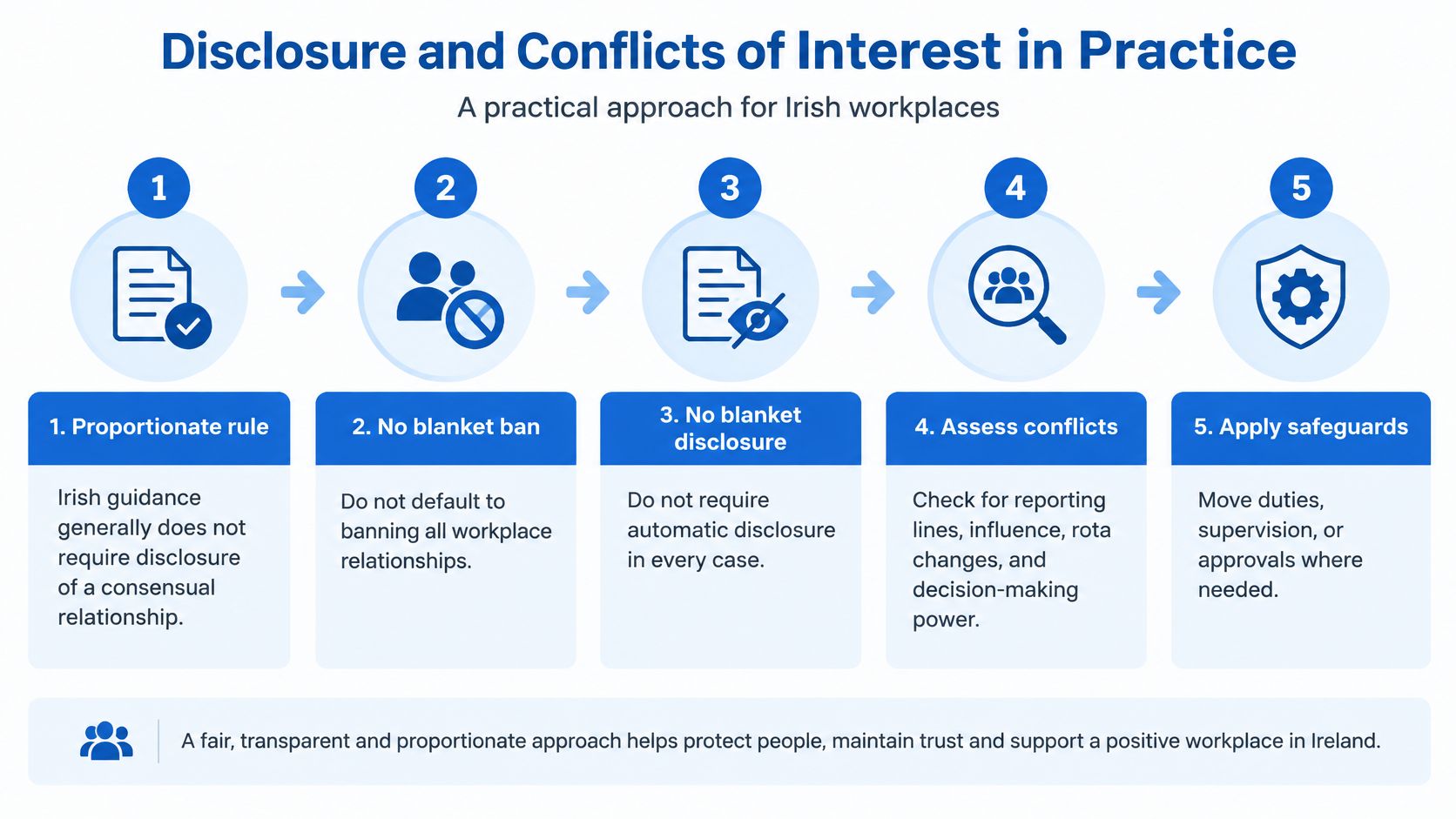
A blanket ban can drive relationships underground, leaving decisions harder to scrutinise. Requiring disclosure of every relationship intrudes on privacy and can make staff less likely to take the policy seriously. Set the threshold around influence, not romance.
| Situation | Disclosure needed | Safeguard |
|---|---|---|
| Manager and direct report in a relationship | Yes, to HR when the relationship starts | Change the reporting line or decision-maker |
| Manager and a peer's report, no reporting line | Only if one influences the other's work or pay | Recusal from related decisions |
| Two colleagues with no influence over each other | No formal disclosure required | Standard conduct rules apply |
| Relationship with a contractor or supplier | Yes, if the contractor affects the employee's decisions | Separate the contract approval from the employee |
| Remote team members in different locations | Yes, if one controls tasks, access or shift patterns | Documented approval for shift changes |
| Relationship ends and conduct becomes a problem | Report at once, even if earlier disclosure wasn't required | Interim supervision change and a support person |
| Relationship ends but both still work together | Report if pressure, avoidance or unfair treatment starts | Written conduct expectations and HR review |
After a Disclosure, Five Steps
- Receive it privately and record only what's needed. Note the people involved, the reporting line, decisions that could be affected and the safeguard agreed. Do not record personal details that have no bearing on the conflict.
- Check where influence sits. Review who approves pay, rotas, leave, recruitment decisions and performance ratings. The relevant question is whether either person can affect the other's working conditions or opportunities.
- Agree the safeguard in writing. Options include changing supervision, removing one person from relevant approvals or appointing a second signatory. State what will change and when.
- Limit access to the record. Give access only to people who need it to put the safeguard in place. A disclosure shared more widely can breach trust and expose private information.
- Review the arrangement after six months or when a role changes. A promotion, restructure or shift in responsibilities can make an existing safeguard ineffective.
If the relationship ends, apply the same conflict test to any continuing work decisions. Where pressure, exclusion, unprofessional messages or unfair treatment arise, the conduct clauses should set out what must be reported and addressed.
The short walkthrough below can help managers structure a private conversation about the relevant conflict and safeguard.

How to Run a Fair Reporting and Investigation Process
Publishing a policy and opening a reporting channel feels like the hard part is done. The evidence says otherwise. An ICTU-linked survey found that 81% of workers who experienced sexual harassment took no action, that only one in four of those who reported felt the employer handled it seriously and satisfactorily, and that 10% did not know they could report or how to do so, according to SIPTU's summary of the evidence. A channel nobody trusts isn't a control.
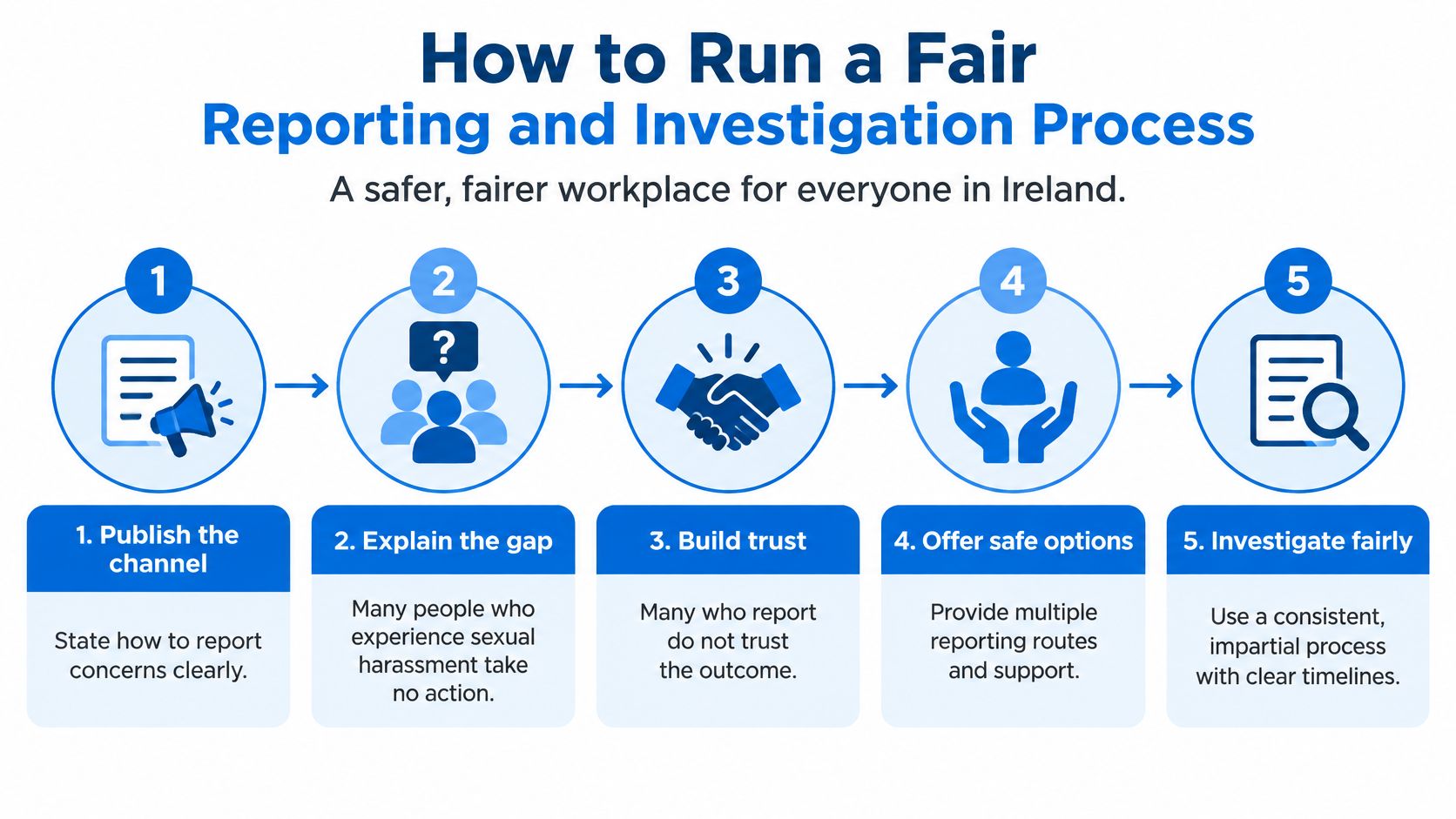
The same evidence records that perpetrators were most commonly male colleagues or managers, and that reported experiences included sexual jokes, unwanted advances, sexual messages and unwanted touching. Design the process for those reports, not for the tidy version.
Seven Steps That Survive Scrutiny
- Open two routes, not one. At least one channel must sit outside the line-management chain, because the person a complainant would naturally speak to may be the subject of the complaint.
- Triage at intake. Decide within a day whether this is harassment, bullying, discrimination, relationship pressure or a management dispute, and check for immediate risk such as isolation, threats or someone moved off work.
- Put interim protections in place before the investigation starts. A changed reporting line, a support person or a no-contact instruction costs little and prevents the retaliation that so often follows a report.
- Preserve evidence early. Messages, emails, rota records and access logs get copied and dated before anyone has a reason to tidy their inbox.
- Assign an investigator with no conflict of interest. Give them written terms of reference, a deadline and an agreed question list. Someone from the same team is the wrong choice when the allegation concerns that team's manager.
- Decide in writing and give reasons. Separate misconduct findings from management-performance decisions, so a later claim can't be built on a confused record.
- Offer an appeal, store the record and log the category. A second report about the same manager is the signal to act on, not to file.
Nobody should have to prove harassment before someone takes their concern seriously. The policy should say that a concern can be raised on the basis of what someone has seen or experienced, that informal resolution is available where both parties agree and no serious risk exists, and that a formal route stays open regardless.
Age matters here too. In 2024, 16% of workers aged 18 to 24 in Ireland reported experiencing sexual harassment in the workplace during the previous two years, according to the Central Statistics Office. Early-career staff are often the least likely to know the route and the most likely to be managed by someone with authority over their probation. Train first-line managers on the conversation and make sure new starters meet the reporting options in their first week, not their first crisis.
A report handled badly in the first 48 hours does more damage than the original conduct, because it tells everyone watching that speaking up was a mistake.
Measuring Whether the Policy Works
A relationship policy is failing if it records disclosures but misses the harm caused by power, reporting lines or retaliation. Track whether concerns are acknowledged promptly, handled within the policy's timelines and followed by completed corrective actions. Record outcomes by site, department, protected-ground category and manager, while limiting access to sensitive records.
Useful measures include:
- Time from report to acknowledgement, to check whether people receive a prompt response.
- Investigation duration, compared with the deadline in the policy.
- Substantiation rates, reviewed by allegation type and manager rather than treated as a target.
- Repeat incidents, including recurring concerns about the same people or team.
- Retaliation allegations, which can indicate that raising a concern carries a cost.
- Corrective-action completion, because an agreed action has little value if it remains unfinished.
Reading the Numbers Together
A rise in reports does not, by itself, show that the policy is failing. It may mean staff trust the process enough to use it. Look instead for repeat allegations, overdue investigations and concerns clustered around one manager. Those patterns point to places where the controls may not be working and where a targeted response is more useful than another all-staff email.
Formal complaints and staff perceptions measure different things. A Matrix Recruitment survey reported by RTÉ found that 88% of workers surveyed in Ireland said workplace bullying remained a significant issue, while almost one-third reported personally experiencing bullying or harassment, according to the survey report. Formal complaint figures can be much lower when concerns are not reported through official channels.
Practical rule: measure awareness and trust, not the number of declared relationships. Disclosure counts alone cannot show whether decisions stayed fair or whether staff felt safe raising concerns.
Avoid three measurement traps:
- Treating declarations as success. Disclosure numbers say little about whether power imbalances or conflicts were handled fairly.
- Using a blanket ban as the benchmark. It can push relationships out of view while leaving favouritism and conflicts unexamined.
- Leaving the policy untested. If a clause gives managers no clear action under pressure, it is not a working control.
The Workplace Relations Commission processed 7,316 complaint applications in 2024, according to its 2024 annual report. That figure is a measure of applications to the Commission, not proof that workplace relationship complaints are rising. Internally, the more useful test is whether staff can raise a concern, receive a fair response and work without retaliation. Once the measures are agreed, corporate training solutions can help prepare managers and staff to apply the policy consistently.
Pre-Launch Checks and Manager Training
Drafting is the easy half. These are the actions that decide whether the policy survives its first real complaint.
- Get internal approval on one version. HR, legal and senior management sign the same text. Internal approval stays with you, and it matters most where the wording explains safety-critical actions or local requirements.
- Have an employment-law adviser check it against current Irish requirements. The Safety, Health and Welfare at Work Act 2005, equality legislation and data-protection rules on disclosure records are the three areas that reliably generate amendments.
- Test the draft against three scenarios. A manager relationship, a break-up that affects work, and a remote team case. Any clause that gives no clear answer gets rewritten before publication, not after the first grievance.
- Arrange verification before any training material is used. Verification by a suitably qualified person must be arranged before publishing or using the materials for training, particularly where the content is safety, technical or compliance related.
- Train managers first, then staff. Managers decide what happens in the first hour of a report, and the difference between a triaged concern and a mishandled one is usually a conversation they've never rehearsed.
- Name the policy owner and set the review date. The metrics need an accountable person, and the review date needs to be in a calendar rather than in the text.
Scenario practice beats a read-and-sign email every time. Staff should work through repeated unreasonable behaviour, alleged sexual harassment, discriminatory treatment, a conflict of interest and retaliation after a complaint, and each scenario should test a decision: whether to go informal, when to escalate, how to protect both parties, and what may be shared. Record completion by role, location and policy version, and trigger a refresher on a policy change, a substantiated case, a promotion into management or a repeat incident.
If we're producing the training, we can start from the procedures you're authorised to share, along with the intended audience, jurisdiction and learning objectives, so the scenarios use your reporting lines rather than generic ones. Induction is where employees first encounter the policy, which makes fast induction training the practical place to fold it in.
This week, the first action is to name the policy owner and book the adviser review. Every later step depends on someone being accountable for the text and someone qualified having read it.
Loresson builds bespoke, cinematic workplace training courses, from the short policy explainer every employee watches in week one to the scenario-based module managers complete before they handle a first report. A 30-minute course is delivered as a complete handoff pack in about 24 hours, with script, narration and assessment structured so your HR team can review and sign off before anything goes live. If your workplace relationships policy is being rewritten this quarter, bring us the draft and the three scenarios you want people to practise, and Loresson will show you what the training could look like.