

The advice you'll hear most often about a workplace hygiene policy is to download a template, fill in the blanks, add a cleaning rota and pin it to the staff noticeboard. I'd push back on nearly every part of that. A template can't know which of your tasks puts a biological agent onto someone's hands, and a noticeboard doesn't restock a soap dispenser at 6am on a Sunday shift.
What separates a policy that holds up under inspection from one that merely looks tidy is the link between each rule and a hazard somebody assessed. Hygiene controls are risk controls. They belong in the risk assessment and the safety statement, with named owners, records and an escalation route, exactly as you'd handle machine guarding or chemical storage.
Three questions are worth answering before you rewrite a word: what the document must contain, which rules apply to specific tasks and methods such as hand hygiene, and how you'll communicate and maintain it after it's signed. Get those right and you have an auditable control. Get them wrong and you have shelfware with a review date on the cover.
Table of Contents
- What a Workplace Hygiene Policy Covers
- Matching Controls to the Hazard, Not the Calendar
- Core Components Every Policy Needs
- Hand Hygiene Rules by Situation and Method
- What Inspectors Look for and What to Keep On File
- Communicating the Policy So Staff Follow It
- Confirm the Policy Against Your Risk Assessment
What a Workplace Hygiene Policy Covers
A workplace hygiene policy is the written set of controls for biological, chemical and contamination risks at work. It has to say when hands are washed, how frequently touched surfaces and shared tools are cleaned, how welfare facilities, shared vehicles and equipment stay fit for use, and what staff do when they are ill, injured or moving between tasks.
Over-cleaning every surface on a fixed rota burns time and still misses the task that spreads contamination. Under-supervision fails the other way: the rule is written, the dispenser is empty, and nobody is named to act when a check fails. The policy earns its keep through those checks, the records of them, and a person who knows the escalation when a control is down.
A hygiene policy works much like a building's fire plan. The laminated notice is the least useful part of the arrangement. What counts is the drill that happened, the log of the last alarm test, and the person who knows to sweep the toilets on the way out.
The legal chain in order
In Ireland, none of this sits outside the law. The framework began with the Safety, Health and Welfare at Work Act 1989, which followed European Community Framework Directive 89/391/EEC and established the Health and Safety Authority (HSA) as the national regulator. It was substantially consolidated by the Safety, Health and Welfare at Work Act 2005, which came into operation on 1 September 2005 and places broad duties on employers to manage workplace risks, as the HSA's summary of health and safety law sets out.
The practical detail sits in the general application regulations made under that Act. Those rules deal with welfare facilities, cleanliness, ventilation, workplace accommodation and protection from harmful agents, and they are added to as sector and hazard-specific duties change. A procedure lifted from another country's template will not match that duty. Hygiene rules have to be written for the jurisdiction and kept in a form you can audit.
The test I apply to every line: if you can't point to the risk assessment entry a hygiene rule controls, either the rule or the assessment is wrong.
A hygiene policy that is not tied to your risk assessment, your preventive measures, the information you give employees and a documented review is not a policy in the legal sense. It is a wish list with a logo on it.
Matching Controls to the Hazard, Not the Calendar
A shared delivery van shows the gap faster than a template does. Three drivers use the same cab. A calendar policy says the cab is cleaned weekly. A hazard-based policy names the steering wheel, gear stick, door handle and handheld scanner, requires a wipe at each shift change, records it on the handover sheet, and assigns restocking to the depot supervisor. Only the second version still means something on a Monday morning.
Draft policies fail when they are really cleaning rotas. Floors get mopped on Tuesdays. Bins go out nightly. The page never says which hazard any of that controls. Set the control against the agent, the task and the people doing the work, or the rota is just a timetable.
Controls are not one list for every workplace. Handwashing facilities, ventilation, cleaning of frequently touched surfaces and shared tools, respiratory hygiene, instruction and active supervision all have a place, but only where the task creates that exposure. Hands need washing before eating, drinking or smoking. Cuts and grazes need prompt cleaning, not a plaster and a return to the job. A fixed cleaning day does none of that on its own.
Four questions a template leaves blank
- Who identifies the risk: a named role, not "management", decides which biological, chemical or contamination hazards the policy covers.
- Which control for which task: handwashing, gloves, disinfection or engineering controls differ by activity, and the policy has to say so task by task.
- What happens to shared assets: vehicles, machinery, tools, canteens and welfare areas need their own lines, because that is where contamination moves between people.
- Who verifies compliance: someone checks that supplies are stocked and behaviours are holding, and that person's name appears on the checklist.
I would not treat good hygiene as the same rule everywhere. Extra disinfectant or PPE, used without a task-specific assessment, adds cost, adds chemical exposure and hands out false reassurance. Leave supervision vague and the written policy becomes impossible to audit, because nobody can show whether any of it happened.
Disinfectant is not a substitute for a risk assessment. Neither is a glove.
Core Components Every Policy Needs
Use this table as the audit checklist for any draft, whether it's yours or one inherited from a predecessor. Read it top to bottom, and for each row ask what you could put on the table if an inspector asked for proof.
| Component | What the policy specifies | Evidence to keep |
|---|---|---|
| Scope and hazards | Biological, chemical and physical agents covered, by task | Hazard list linked to the risk assessment |
| Responsibilities | Named owner for checks, supplies and escalation | Signed list of roles and duties |
| Facilities and supplies | Named areas, stock levels and restocking checks | Completed inspection checklist log |
| Cleaning standards | Frequency and methods for frequently touched surfaces and shared tools | Cleaning schedule with sign-off |
| Welfare and shared areas | Canteens, toilets, changing areas and vehicles | Inspection log and defect reports |
| Escalation route | Who acts on a failed check and how quickly | Corrective action records |
| Review cycle | Triggers for updating the policy, such as incidents, audits or changes in work | Dated version and approval record |
Working through the rows
Start with scope and hazards, because everything downstream depends on it. The policy should name the agents you're controlling and tie each one to a task. A workshop handling solvents and a call centre sharing headsets have almost nothing in common except the word "hygiene".
Responsibilities is where most drafts collapse into a department. "HR is responsible for hygiene" is unenforceable. Name the person who checks the sinks on Monday, the person who orders soap, and the person who gets called when the check fails. Put all three on a signed role list.
For facilities and supplies, specify areas, minimum stock and the restocking check, then keep the completed log. An empty dispenser is not a minor inconvenience, it's evidence that the control failed. Cleaning standards need frequency and method, not just "regularly", and the schedule should carry a signature.
Welfare and shared areas cover toilets, canteens, changing rooms and vehicles. Escalation defines who acts and how fast. The review cycle names the triggers, and those triggers are almost always an incident, an audit finding or a change in how the work is done.
If you'd rather build the document properly than patch a template, the policy development course walks through the drafting and approval structure. Then go back to the table and mark every row you can't fill from your own site. A blank row is the first thing an inspector will test.
Hand Hygiene Rules by Situation and Method
A solvent-stained hand and a hand that has just left a shared scanner do not need the same control. Match the method to the contamination and the task. A wall dispenser with no rule behind it is not a control.
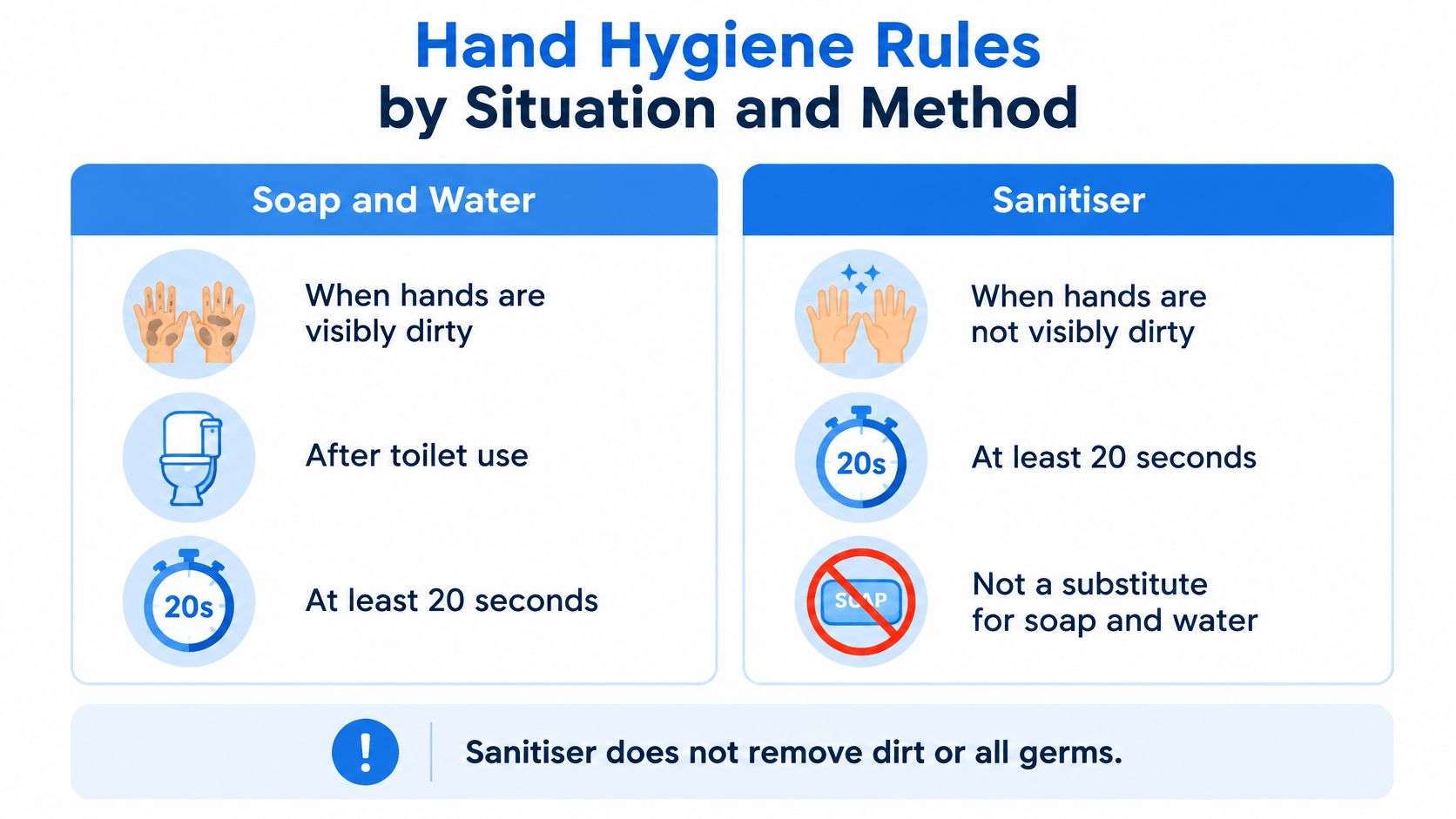
Use soap and running water when hands are visibly soiled, after toilet use, and before eating, drinking or smoking. Use sanitiser where a sink is not practical and the hands are not visibly dirty. Sanitiser does not lift soil. Treating it as a substitute for washing leaves the hazard on the skin and gives a false sense that the step was done.
The moments the policy must name
"Wash hands as required" tells nobody when to stop the job. Name the moments in the words staff will use on the floor. Before and after eating or food preparation. After coughing or sneezing. After changing tasks. After touching potentially contaminated surfaces. On entering and leaving workplaces or vehicles.
Gloves are the failure I see policies dodge. In food, healthcare and maintenance, peeling a glove off and moving straight to the next task is the habit the rule has to break. Gloves do not replace hand cleaning. The policy should say, in those words, that hands are cleaned after glove removal and after any contamination event.
Over-cleaning has a cost too. Sending people to a sink on a fixed timer, regardless of the task, burns time and trains them to ignore the rule when the work is dirty. Under-supervision is the opposite failure: sanitiser at every doorway, and nobody checking whether the bottle is empty or whether soiled hands were washed.
Stocking and restocking
- Kit each handwashing station with running water, soap, disposable paper towels and a touch-free waste bin.
- Place sanitiser only where it earns its place: entrances, lift lobbies, shared scanners, vehicle cabs and canteen doors.
- Inspect and restock against a documented checklist, not when someone happens to notice.
- Assign each check to a named person on each shift.
- Escalate deficiencies the same day, and write the corrective action down.
Use the table to lock method to situation before the policy is issued. A blank cell is a decision you have not made.
| Situation | Method | Use it when |
|---|---|---|
| Hands visibly dirty | Soap and water | Soil, grease, food residue or any visible contamination is present |
| After using the toilet | Soap and water | Every toilet visit, including when hands look clean |
| High-touch or high-footfall points | Sanitiser | Hands are not visibly soiled and a sink is not at the point of contact |
| Handwashing impractical | Sanitiser | No sink is reachable and hands are not visibly soiled |
| Before eating, drinking or smoking | Soap and water | Immediately before the break, at a stocked sink |
| After coughing or sneezing | Soap and water, or sanitiser if no sink is reachable | Soap and water when a sink is reachable; sanitiser only when it is not |
Show the method at induction, on the actual station people will use. A paragraph does not show whether palms, thumbs and fingertips were covered, and a poster on the wall does not show whether the step happened. The named checker on that shift is what makes the rule hold between training sessions.
What Inspectors Look for and What to Keep On File
A clean sink does not close an inspection. The questions that matter are whether the control matches the task, and whether a named person can show the record that keeps it in place. Over-cleaning with no supervision fails that test as surely as an empty dispenser.

Inspectors expect the hygiene arrangements, and the safety statement they sit on, to be available at the place of work. A policy that cannot be produced on the day is not a credible control, however thorough the cleaning rota looks on paper.
Two visits show how the file changes the outcome. One site has no soap at a single basin. The log names the checker, records the miss, and shows the restock the same day. That is a candidate for written advice: a gap, already corrected, with a trail. Another site has soap in the dispenser today, three weeks of blank checks, and nobody named against the station. The surface looks fine. The supervision does not. Seriousness and persistence decide whether advice is enough or a formal notice follows, and a repeated gap with no corrective record is the pattern that moves a visit toward a notice.
The file that answers the question
Hold these where the duty supervisor can retrieve them the same day:
- Documented arrangements: the current policy, dated and approved, linked to the risk assessment for each hazard and task.
- Accessible procedures: the rule for that task at the point of use, not locked in a folder.
- Inspection logs: completed checklists with a name and a date, including shifts where nothing failed.
- Training records: who was briefed, when, and on which version.
- Corrective actions: what failed, who fixed it, and how quickly.
An unbriefed shift is a missing line in that file. Health and safety training built from the procedure you are authorised to share, for the people who do the work, is what makes the briefing record real. Your own sign-off still governs any safety-critical step before that material is used on site.
The practical test is simple. Could this site produce every record above within a day of being asked?
Communicating the Policy So Staff Follow It
A policy nobody reads is a control that doesn't exist. The mistake is treating communication as an email with a PDF attached and a read receipt. Rollout works when it's built in a sequence.
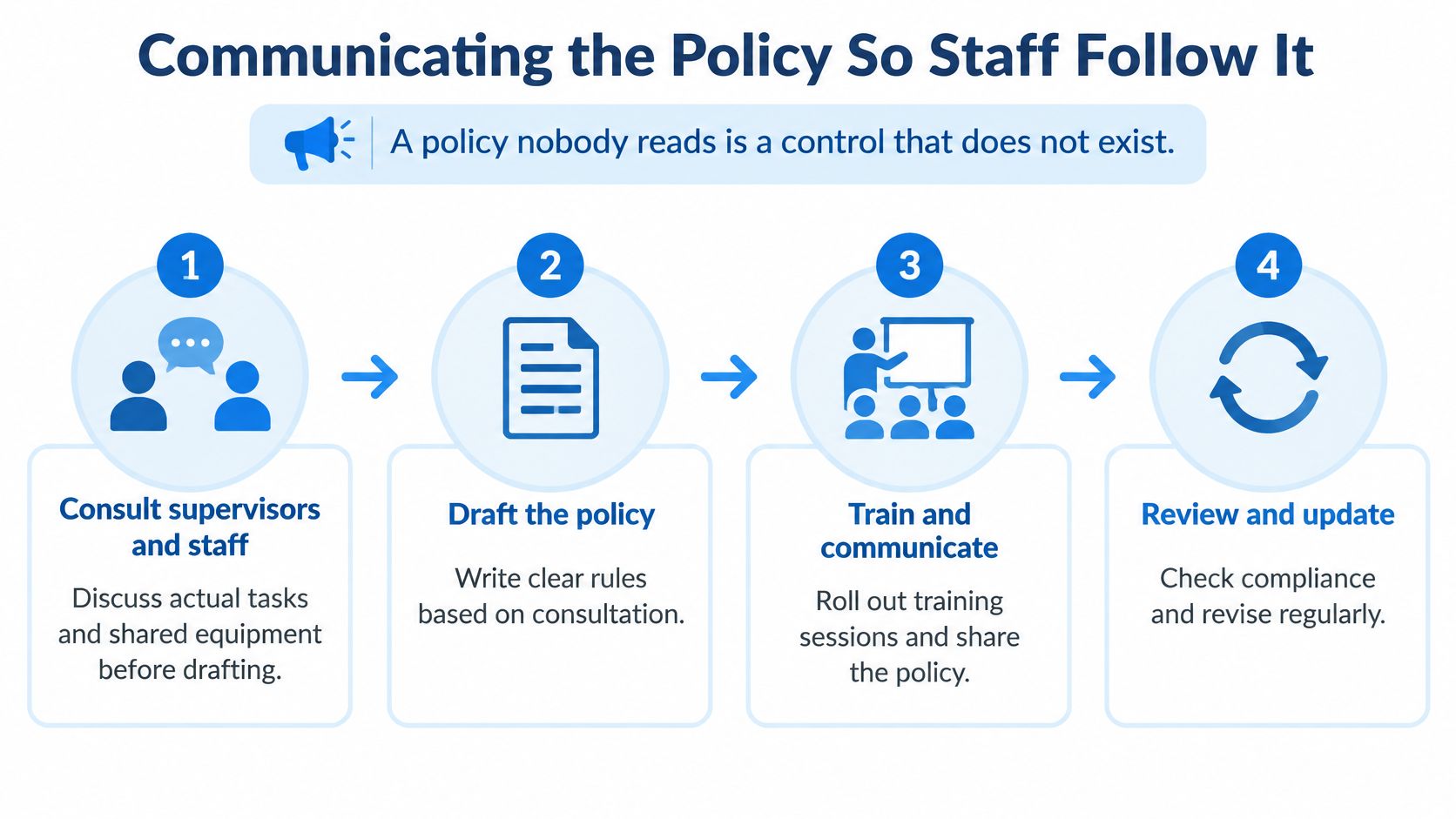
- Consult supervisors and staff first. Ask what happens with shared tools, vans and canteens before you write a rule that contradicts reality.
- Translate the policy into one-page task-level rules. The full document stays with the safety officer; the card goes where the work happens.
- Brief every worker and record attendance. Name, date, version. That record is the evidence.
- Post the key rule at the point of use. Sinks, canteen, changing areas, vehicle cabs, depot doors.
- Supervise and correct in real time. Waiting for the annual audit to fix a habit is how habits become culture.
- Review after every incident, audit finding or change in work. Update the version number and reissue.
What a usable card contains
Say a distribution depot runs three shifts across two sites. The full policy is a twelve-page document held by the safety officer. The card taped above each sink carries four things: the 20-second rule, the moments that require washing, the name and number of whoever restocks that sink, and the date of the last review.
That card is the part staff remember. It also fixes a common multilingual problem, because a card with clear icons and short sentences can be reproduced in the languages your team speaks, while a twelve-page policy never will be.
Practical rule: if the rule can't fit on one side of A4 at the point of use, it isn't finished.
Refresher briefings once a year, and again after any change to work or staffing, keep the record current. The full policy backs the card up and holds the detail an inspector may want. It never replaces the card. Onboarding is where most of this lands, which is why the employee onboarding training structure matters: the hygiene rule gets taught on day one, with the attendance record to prove it.
Confirm the Policy Against Your Risk Assessment
Before the policy is issued or used for training, run this sign-off check in an afternoon. It takes less time than defending a gap later.
- Trace every hazard to the assessment. Each hazard named in the policy should match a line in the current risk assessment and the safety statement. Where it doesn't, one of them needs amending.
- Test the components table. Every row needs a named owner and a record you could produce on request. A row without both is unfinished work.
- Close the hand hygiene gaps. Each situation on the method table needs a method and a minimum time, with no undecided cells left.
- Walk the escalation route as the night shift. Ask a supervisor to follow it without the safety officer present, including who restocks a sink and how fast. If they can't, the route is theoretical.
- Get qualified verification. Have a suitably qualified person check the safety and compliance content before signature. That step isn't optional when the material will be used for training, and it's how we handle sign-off on every course, with an HSQE specialist reviewing each claim before it leaves us.
Record the outcome of each check with a date and the checker's name, so the sign-off itself becomes evidence rather than a conversation. Mark any check the site can't pass today and give each one an owner and a deadline. What you then hold is a dated action list, which is exactly what a hygiene policy should generate.
Set the next review date on the cover page now, using the triggers you built into the review cycle. If the policy has no next review date, it's already out of date. When you start a course brief, you share the topic, audience, location and length, and you can add existing procedures, examples or brand guidance if you have them. That's the same discipline as the sign-off: the content gets specific because you supplied the context, not because someone guessed it.
Loresson turns an approved workplace hygiene policy into a course your people will finish, with scripting, cinematic footage, narration and assessments built from your own procedures and delivered in hours to a week, with HSEQ review and sign-off included. If the policy has to reach a multilingual, multi-site workforce instead of sitting in a folder, that's the gap we close. Visit Loresson to start with your topic, audience, location and course length.