

The most repeated advice on company policy for employees is to write the rule, drop it in the handbook, and collect a signature. That advice fails on an ordinary Tuesday. A signed PDF does not tell a supervisor whether a remote request can be refused, whether a public chatbot may draft a customer email, or whether a concern about a director is a grievance or a protected disclosure.
A policy that staff can follow is a behaviour system. It names the decision, the person who owns it, the limit, and the next step. If those four things are missing, people invent the answer, and the invented answers split by site, shift and manager. I would start with the decision someone has to make this week, not the value statement on page one.
Table of Contents
- Core Policy Areas and What Each Must Define
- Where Policies, Handbooks and Procedures Fit
- How to Write a Policy Employees Can Follow
- Communicating Policies So Staff Read and Apply Them
- Monitoring, Remote Work and Working Time Need Firm Limits
- Generative AI Policies Need Scenarios, Not Slogans
- Whistleblowing Policies Employees Can Actually Use
- Pick One Policy Area and Brief Its Training
Core Policy Areas and What Each Must Define
Six areas cover most of the decisions an Irish employer has to govern. Each row below is the minimum the document has to say, and the legal anchor it has to meet. A conduct rule that never mentions reporting, or a monitoring rule that never names a purpose, is not finished.
| Policy area | What it must define | Irish legal anchor |
|---|---|---|
| Equal opportunity and conduct | Prohibited discrimination, the reporting route, and equal access to training and promotion | Employment Equality Acts 1998–2015 |
| Remote and flexible working | Eligibility, the request procedure, response deadlines, and equipment and data-security rules | Work Life Balance and Miscellaneous Provisions Act 2023 |
| Employee monitoring | The monitored asset, purpose, lawful basis, retention period and access rights | GDPR and Data Protection Act 2018 |
| Working time and wellbeing | Maximum scheduled hours, mandatory rest and leave, an escalation route, and a psychosocial review | Organisation of Working Time Act 1997 and the Safety, Health and Welfare at Work Act 2005 |
| Generative AI use | Prohibited data categories, approved tools, human review and disclosure rules | GDPR and internal confidentiality duties |
| Whistleblowing | Protected disclosures, reporting channels, anonymity limits and anti-retaliation safeguards | Protected Disclosures Act 2014 |
How to read the six rows
Equal opportunity and whistleblowing carry the strongest legal duties. Get either wrong and a decision about hiring, promotion, discipline or a report can become a statutory complaint, not an internal disagreement. Conduct rules also sit beside how people treat each other day to day, which is why a workplace relationships policy belongs in the same set rather than in a side note.
Monitoring and generative AI create the most day-to-day confusion, because staff meet the tool before they meet the rule. Working time and wellbeing are the easiest to leave vague. "We care about balance" does not set a scheduling threshold or an escalation route.
In 2025 the Workplace Relations Commission completed 5,145 inspection cases, and 1,775 of them found contraventions, with 6,571 specific legislative breaches identified, according to the WRC 2025 annual report. A handbook that nobody can apply is how those gaps show up on site.
Practical rule: If a policy area is missing from the handbook, or its row has no named owner, review date and approval route, the policy is not yet doing its job.
Where Policies, Handbooks and Procedures Fit
Staff mix these three up, and managers often do too. A policy states the rule and the reason for it. A procedure sets the steps, the person to contact and the deadline. A handbook gathers the policies and procedures that apply to that workforce in one place.
Think of a building. The policy is the standard the building must meet. The procedure is the method the builder uses on site. The handbook is the guide handed to new tenants so they know which doors they may use and who to call when something fails.
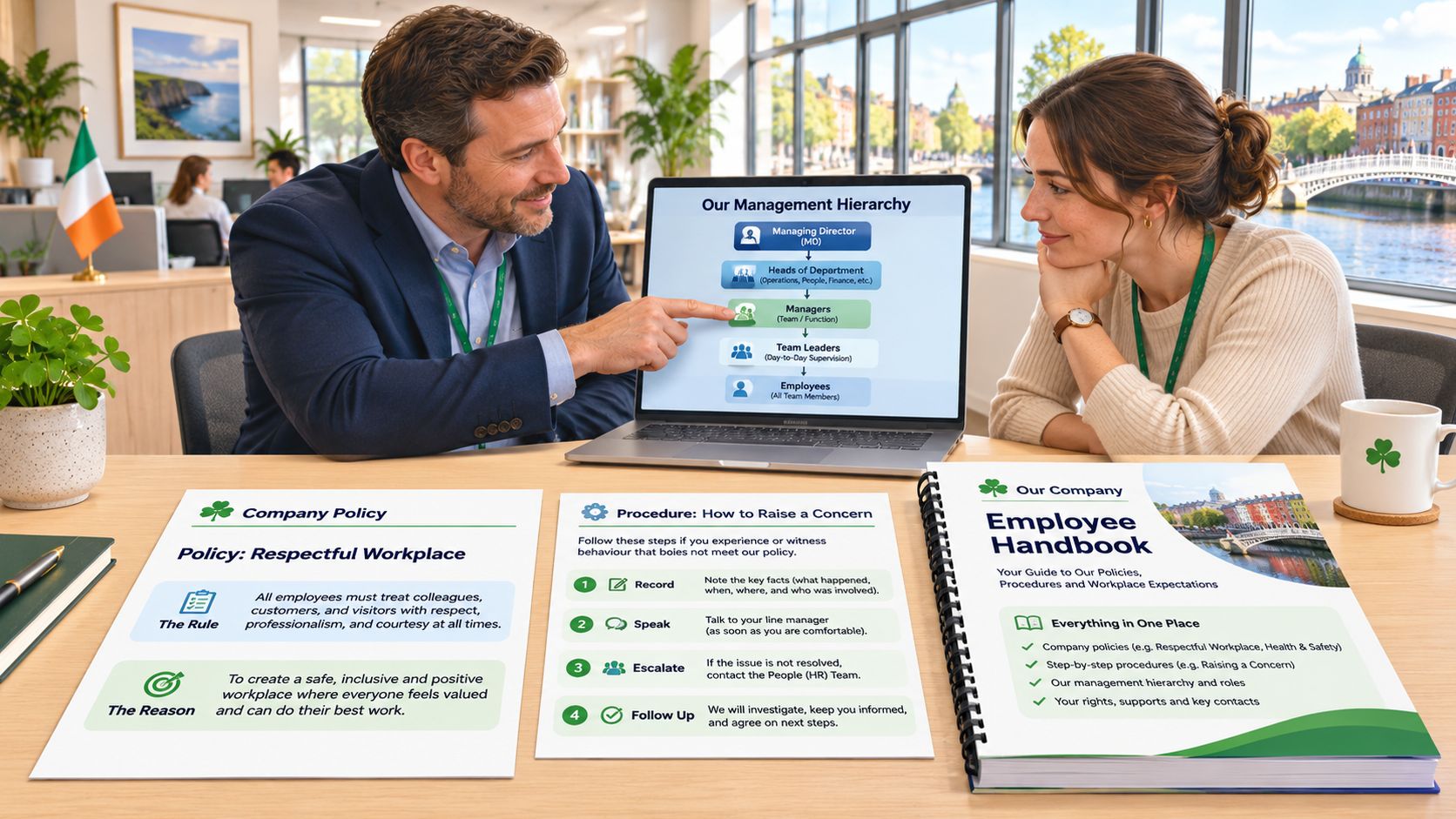
Irish employers cannot write that standard in a vacuum. The Employment Equality Acts 1998–2015 require equal treatment in recruitment, promotion, training, working conditions and pay, and they also protect people against discrimination connected with fixed-term employment. A learning-access or promotion policy has to meet that baseline. It should say who can apply, how decisions are recorded, and how someone challenges an outcome. A sentence about "fair opportunity" does not do that work.
Run this test on any document before you call it policy.
- Rule: Does it forbid, require or permit a specific action?
- Reason: Does it say why, in one or two sentences a manager can repeat?
- Owner: Is a role named, not a department in general?
- Review date: Is there a date and a version, not "reviewed periodically"?
If the page only describes a hope or a value, it is guidance. Keep it, but do not pretend it will decide a case.
How to Write a Policy Employees Can Follow
Draft the next policy in this order. Skip a step and the later arguments have nothing solid under them.
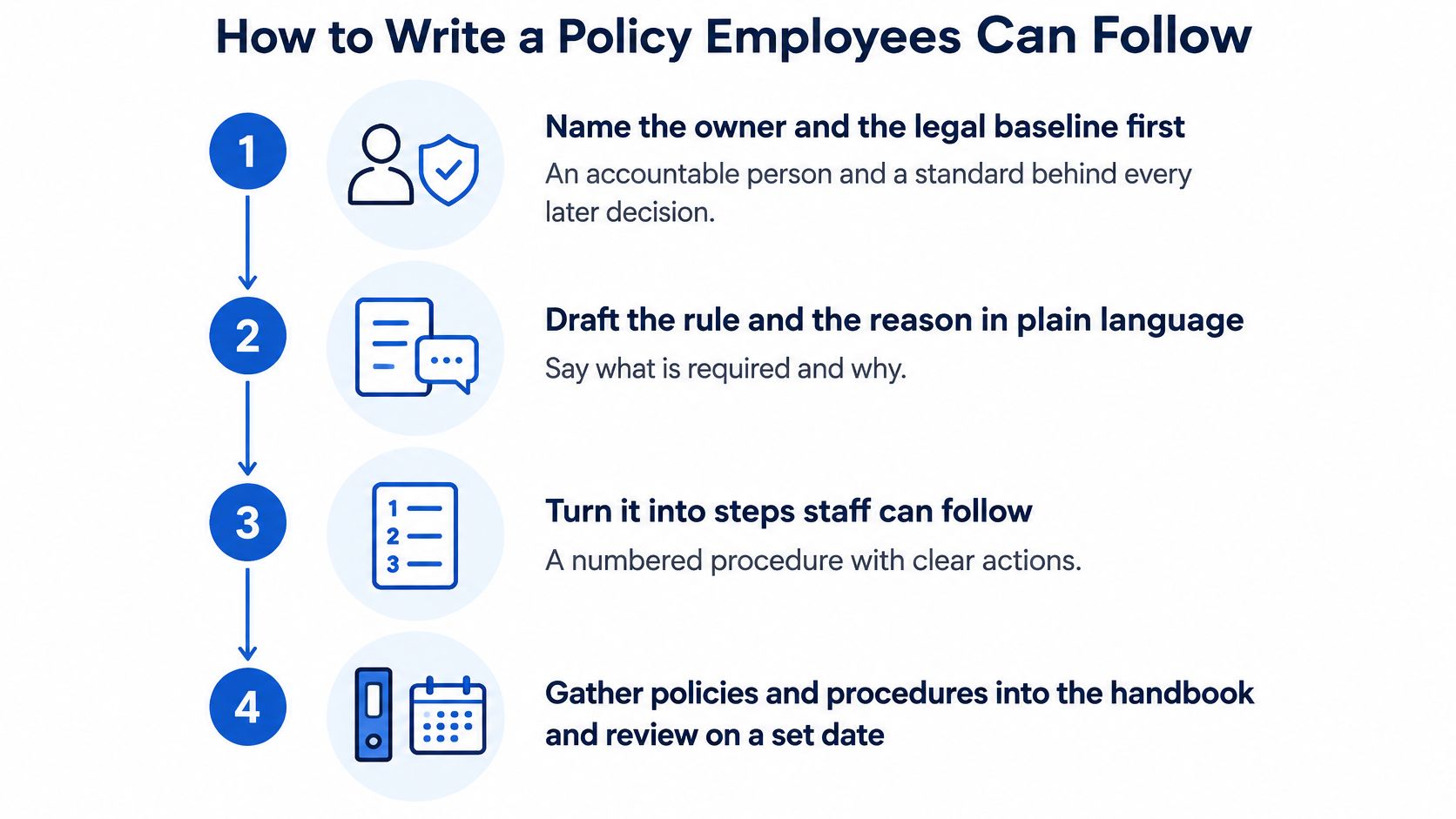
- Name the owner and the legal baseline first. Put a job title, not "HR", at the top, and name the statute or duty the rule has to meet. Every later exception then has an accountable person and a standard, instead of a debate about taste.
- Define scope before you write rules. Say who is covered, including employees, contractors and agency staff where they use your systems. Say which sites and home locations apply, and which tools are in scope. A remote laptop and a yard radio are not the same control.
- Write the definitions in plain language. Say what you mean by personal data, a working day, or a protected disclosure. Most disputes start with a word nobody defined, then harden into a grievance.
- State the rule, the reason and the exceptions, in that order. Keep each to two or three sentences. Exceptions buried in a footnote get used as loopholes. If there is no exception, say so.
- Set the procedure. Name who to contact, how a request or report moves, and the response deadline in working days. A rule without a route is a poster.
- Approve it through the business's own owner. HR, legal or compliance should review the draft, and the person accountable for that operation should sign it. Internal approval stays central, particularly where the text explains safety-critical actions or local requirements. The final decision is the employer's, not the drafter's.
- Add a version number, a review date and a change log. One line on what changed is enough. Staff and auditors both need to know which text was live on the day of the decision.
A policy development course is useful here only if it forces drafters through that sequence, rather than through slogans about culture.
The new-starter test
Hand the draft to someone who joined last month. Ask them to handle one realistic case without calling anyone. If they cannot name the rule, the exception and the next person to contact, the policy is not ready to publish.
Communicating Policies So Staff Read and Apply Them
Publication is a control, not a mailshot. Put each policy in one controlled location, link it from the handbook, and show the version number and review date on the first page. Two copies in two folders is how a supervisor quotes last year's rule.
Brief managers before launch. Supervisors get the first questions, and they need the same answers. Give staff a one-page summary of three things only: the rule, who it covers, and where to ask.
Build a short FAQ from questions people raise. Can I use a personal phone for work messages? Can a remote request be refused, and on what grounds? Can I raise a concern without giving my name? During a launch window of two to four weeks, send those questions to one named contact and add every new answer to the FAQ. That is how the document learns.
- One policy per meeting: Talk through a single decision, not a 40-page pack.
- Match the channel: For people without a desk or work email, use the shift-room noticeboard or the messaging group they already read.
- Keep the receipt: Record who received each version and when, so a later dispute can be checked against what staff were told.
- Tie review to a briefing: A changed date with no briefing means the old habit stays in place. SOP training works the same way. The step only sticks when the people who do the job hear the change.
Monitoring, Remote Work and Working Time Need Firm Limits
Vague wording does the most damage where the employer is watching, scheduling or locating people. In Ireland, vehicle tracking, email surveillance and internet monitoring are personal-data processing under the GDPR and the Data Protection Act 2018. The Data Protection Commission states that vehicle tracking must have a defined, lawful purpose and should not be used for general monitoring of employees' behaviour or whereabouts.
What a monitoring policy has to name
Write these fields before anyone switches a system on.
- Asset and purpose: The van, the mailbox or the endpoint, and the job the data does.
- Lawful basis and fields: Why you may process it, and which fields you collect.
- Access, hours, retention, deletion: Who can see it, during which hours, for how long, and how it is removed.
- Intrusive or systematic use: Complete a Data Protection Impact Assessment before deployment.
- Mixed-use vehicles: A privacy mode, with tracking limited to working hours.
- Covert monitoring: Only a narrow, documented exception for a suspected offence, with approval and safeguards.
Broad or continuous tracking makes the processing more likely to be excessive, purpose-incompatible or unfair. Purpose limitation and a short field list do the opposite.
The same logic for remote work and hours
The Work Life Balance and Miscellaneous Provisions Act 2023 creates a statutory right to request remote working, not an automatic right to work from home. A government review of that legislation reported that almost one million people in Ireland worked from home at least some of the time in the relevant year, including more than 500,000 who did so more than half of the time. Many staff used a pre-existing company policy rather than the statutory application route. That is why the policy needs eligibility, a request route, response deadlines, equipment and data-security rules, and a fair way to judge performance. "Manager discretion" with no criteria is how two teams get two answers.
Working time needs the same hard edges. Health and Safety Authority analysis found that approximately 55,000 workers in Ireland experienced a work-related illness in 2013 and that more than 790,000 working days were lost, with musculoskeletal disorders and stress, anxiety and depression representing 68% of work-related illness over 2002–2013, and a strong association between long working hours and stress, anxiety and depression, in the HSA summary on MSDs and stress. Set a maximum scheduling threshold, mandatory rest and leave, manager check-ins, and an escalation route when the workload cannot be finished inside those hours. A policy that only reacts after sick leave has already missed the signal.
Generative AI Policies Need Scenarios, Not Slogans
A policy does its real work at 4pm, when a staff member wonders whether they can paste a client email into a public chatbot. CIPD's 2025 HR Practices in Ireland study found that only 11% of organisations had communicated a clear plan for workplace AI, only 23% reported clear guidance on AI use, and just 16% had provided employee training, as set out in the CIPD HR Practices in Ireland 2025 report. Employees outside that minority improvise, and a line like "do not enter confidential information" leaves each of them to define "confidential" alone.
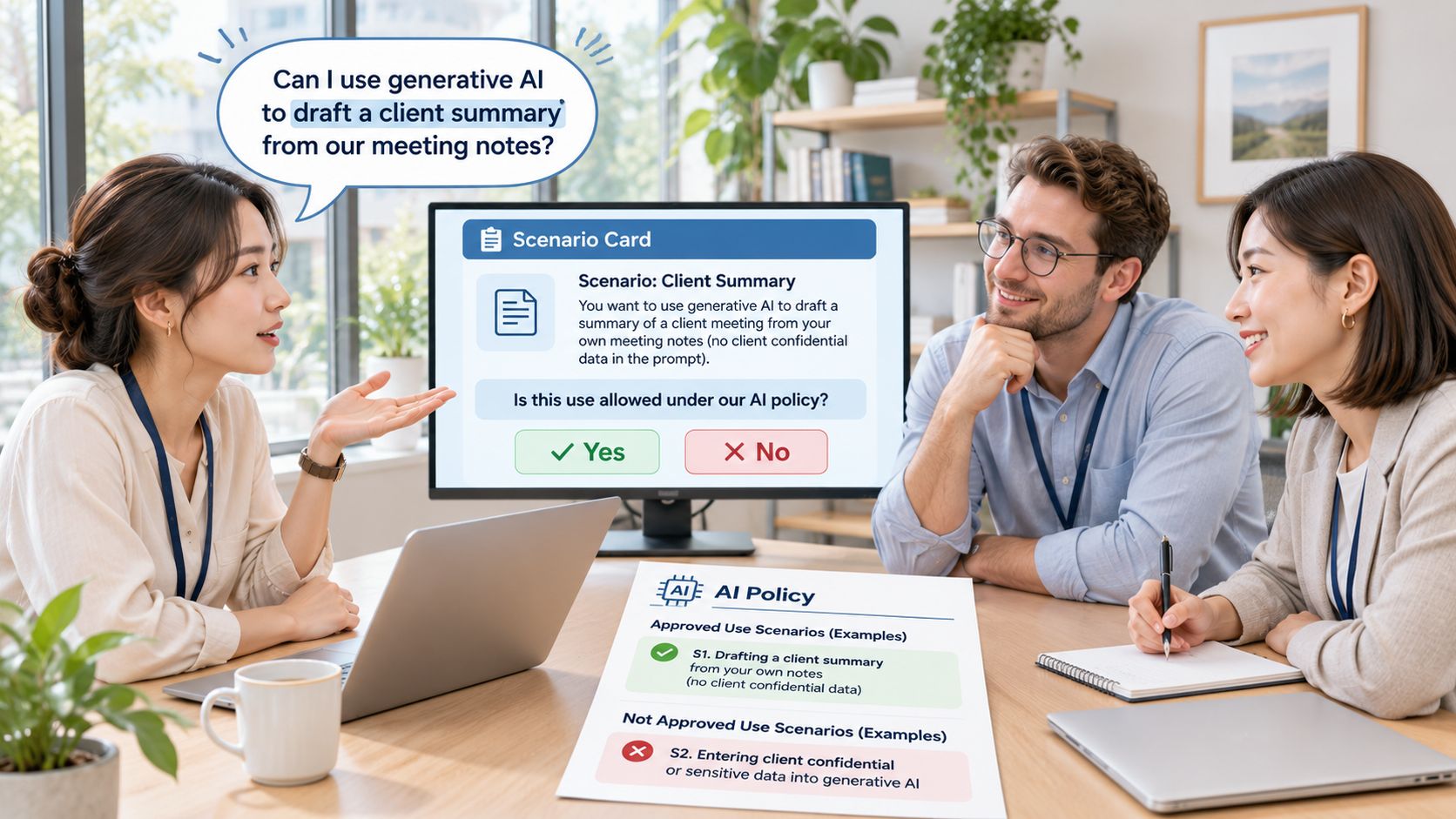
Questions the policy has to answer
- Tools: Which public chatbots are banned, and which approved tools may be used for drafting?
- Data: Which categories are off limits: customer data, employee data, unpublished financials, and sensitive personal data such as health or biometric records?
- Ownership and disclosure: Who owns AI-assisted work, and when must the user say a tool was used?
- Failure: What happens if the output is wrong, biased, or may infringe copyright, and who reviews it before it leaves the team?
Split use into two groups. Low-risk assistance is summarising a meeting note or drafting an internal reminder, still with a human read. High-risk use is recruitment screening, performance monitoring, work allocation, promotion or dismissal. High-risk use needs a named approval route before anyone turns it on, and a qualified reviewer on whatever comes out.
Give examples by department, or the rule stays abstract. A sales proposal must not include unpublished pricing in a public tool. HR interview notes stay out of chatbots entirely. A customer-service reply can be drafted in an approved tool, then checked by the agent before it is sent. Link the rule to confidentiality, equality, cybersecurity and the disciplinary procedure, and add an incident route for a bad paste or a biased output.
The short film below is a useful prompt for a team discussion on where a tool helps and where a person still has to decide.
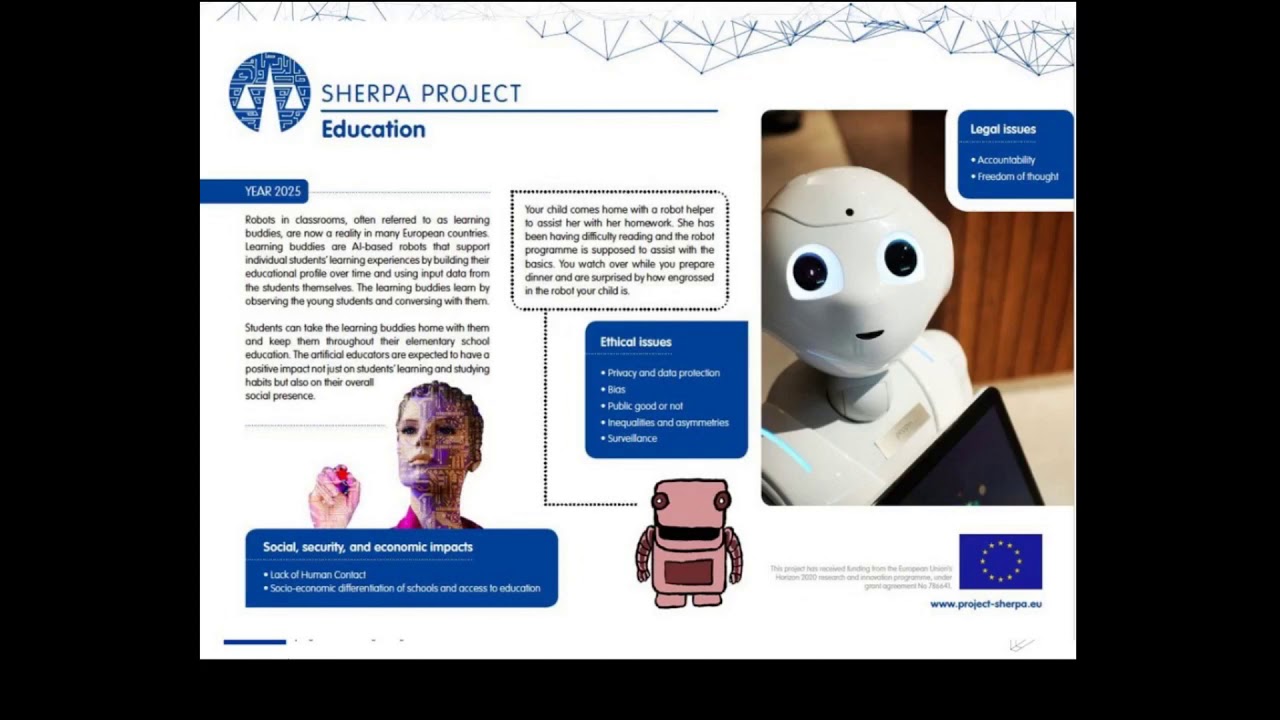
Publishing the page rarely changes the 4pm decision. Turn the four questions into ten-minute scenarios and a manager escalation exercise, run per department on each team's real material. The written policy then has one job: it is the script the behaviour is built from, and the behaviour is what gets checked.
Whistleblowing Policies Employees Can Actually Use
People decide whether to speak before they read your flowchart. They want five answers. What counts as a protected disclosure rather than an ordinary grievance? Can I report without my name, and what will anonymity not protect? Who sees my identity? What happens after I report? When may I go to an external body, a union, a solicitor or an advice service?
The stakes are not theoretical. Transparency International Ireland's 2025 Speak Up reporting found that 37.5% of whistleblowers reported some form of penalisation, a 70% increase since 2019, and that workers in organisations that made external advice available were 20% less likely to experience negative consequences, according to Transparency International Ireland. The same analysis found that 50% of women who reported wrongdoing said they experienced negative consequences, compared with 37% of men. A legally tidy hotline with vague confidentiality language is still unusable if it does not answer those worries.
The policy has to separate whistleblowing from grievances and ordinary complaints, state realistic limits on anonymity, describe anti-retaliation safeguards, and name independent internal and external routes. Awareness of those external organisations matters as much as the existence of the page.
| Reporting route | Best suited to | Confidentiality the policy must state |
|---|---|---|
| Line manager | Day-to-day practice concerns within one team | Who receives the identity and how far it is shared onward |
| Designated internal officer | Concerns involving a manager or a sensitive issue | Who sees the identity and how the report is recorded |
| Anonymous internal channel | Reporters who fear retaliation most | Whether follow-up is possible and what anonymity cannot protect |
| External prescribed body | Cases where the internal route has failed or is inappropriate | The body's remit and that it operates independently of the employer |
A route with no named recipient is not a route. It is a hope that someone decent will pick up the phone.
Managers need a separate drill. Receive the concern, write down what was said, do not start a private investigation that tips off the subject, and do not discuss the reporter's name beyond the people the policy lists. Practise that on suspected safety breaches, fraud, harassment, conflicts of interest, and concerns that involve senior leaders. The last of those is where informal "have a word" habits do the most harm.
Pick One Policy Area and Brief Its Training
A signature on a policy is not the same as an informed person. Training has to rehearse the decision, or the document stays on the shelf.
For whichever area you choose, use four pieces, not a single slide deck.
- A short module on the rule and the reason, in the same plain language as the policy.
- One scenario that forces a realistic choice, with a wrong answer that looks efficient.
- A manager module for requests, concerns and escalations, including when to stop and hand the case on.
- A brief acknowledgement that the person has read the current version and knows where to ask.
Track completion. Refresh the module when the policy changes, and log the version so an audit can show what staff were told and when. Scenario-based practice suits AI use, whistleblowing and monitoring best, because those rules depend on judgement rather than a single forbidden act.
Pick the policy area with the highest legal exposure in your operation. Gather three things before the next review cycle: the approved procedure you are authorised to share, the audience and jurisdiction, and the learning need, including how long the course should be. That brief is enough to outline training that matches the rule staff will be held to. A suitably qualified person in the business should still verify the material before it is used, particularly where the content is safety, technical or compliance training.
Company policy only changes Tuesday's decisions when people can practise the hard cases, not when they file another PDF. Loresson builds bespoke workplace training from your approved procedures, with scripting, narration, assessments and optional role-play prepared for your LMS, so a monitoring rule, an AI scenario or a speak-up route becomes something staff can rehearse. If you want that next outline scoped to your audience and jurisdiction, visit Loresson.