

Ireland's workplace training record exposes a gap that matters more than course completion: in 2015, only half of enterprises assessed the outcomes of their training activities, despite training-course activity representing 2.2% of labour costs. The question for employers isn't only what course to assign. It's what evidence will show that training addressed a real risk and changed what people do.
Table of Contents
- Why Compliance Training for Employees Is a Control Not a Course
- The Legal and Regulatory Drivers Behind Employee Compliance Training
- Structuring a Course Around Roles and Real Risk
- Assessments and the Evidence That Satisfies an Auditor
- Choosing How to Produce and Deliver the Training
- Localising Compliance Content Across Jurisdictions
- Building an Operating Rhythm for Ongoing Compliance Training
Why Compliance Training for Employees Is a Control Not a Course
In 2015, 77% of Irish private-sector enterprises provided training, and half of employees attended courses. Employees spent an average of 19.4 hours on courses during the year, with approximately 30% of that time devoted to health and safety, or about 5.8 hours per employee. Yet only half of enterprises assessed training outcomes. The Central Statistics Office training figures summarised by Ireland's Health and Safety Authority point to an imbalance: organisations delivered training and spent on it, but many didn't evaluate whether it worked.
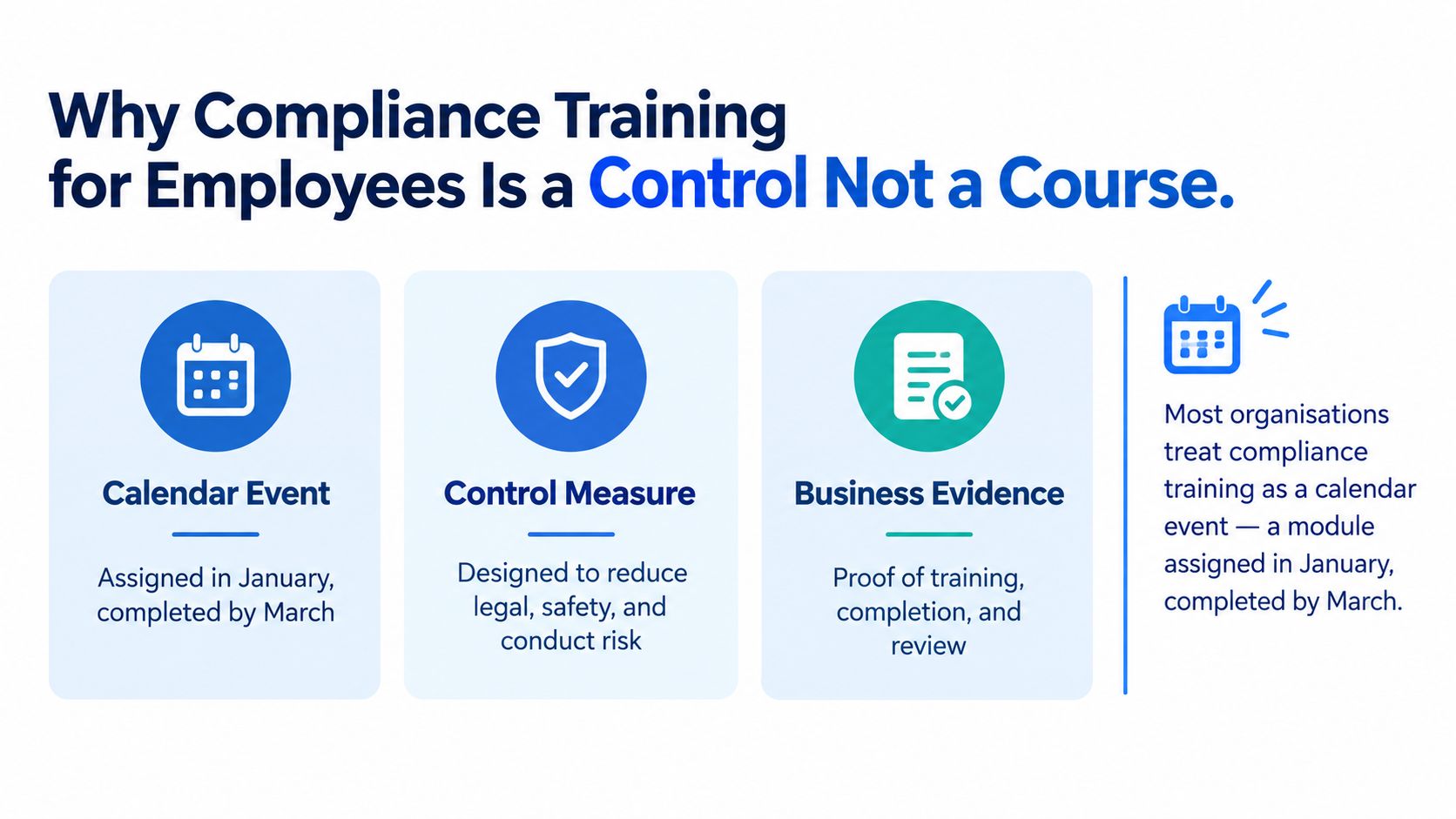
That's the difference between treating compliance training for employees as a calendar event and treating it as an auditable control. A calendar event records when someone was assigned a course. A control connects a risk to an intervention, identifies who needs it, records what they learned, and checks whether they can apply it. A completion tick can support that record, but it can't establish the whole chain.
Start with evidence, not a course catalogue
A course catalogue encourages a familiar question: which topic should we buy? Audit scrutiny usually leads somewhere more specific: which obligation or hazard is this training meant to address, and how can the organisation demonstrate that the right people received and understood it?
A defensible programme can answer those questions with a traceable set of records: the risk or requirement, the relevant employee group, the learning objective, the course version, the assessment result and any follow-up verification. If a procedure changes, the record should also make it possible to identify which learners need an update.
Practical rule: If a module's purpose can't be tied to a workplace risk, legal obligation or defined policy, its place in the mandatory programme needs reconsidering.
This approach doesn't mean every course needs elaborate production or an extended assessment. It means the evidence collected should match the risk. For one topic, a knowledge check may be a useful first test. For a task with a direct safety consequence, a supervisor may also need to verify performance at work.
Participation and expenditure are already part of many organisations' training activity. The weaker link is proof of effectiveness. Designing training as a control makes that missing link a design question, rather than an afterthought when an auditor asks what completion data demonstrates.
The Legal and Regulatory Drivers Behind Employee Compliance Training
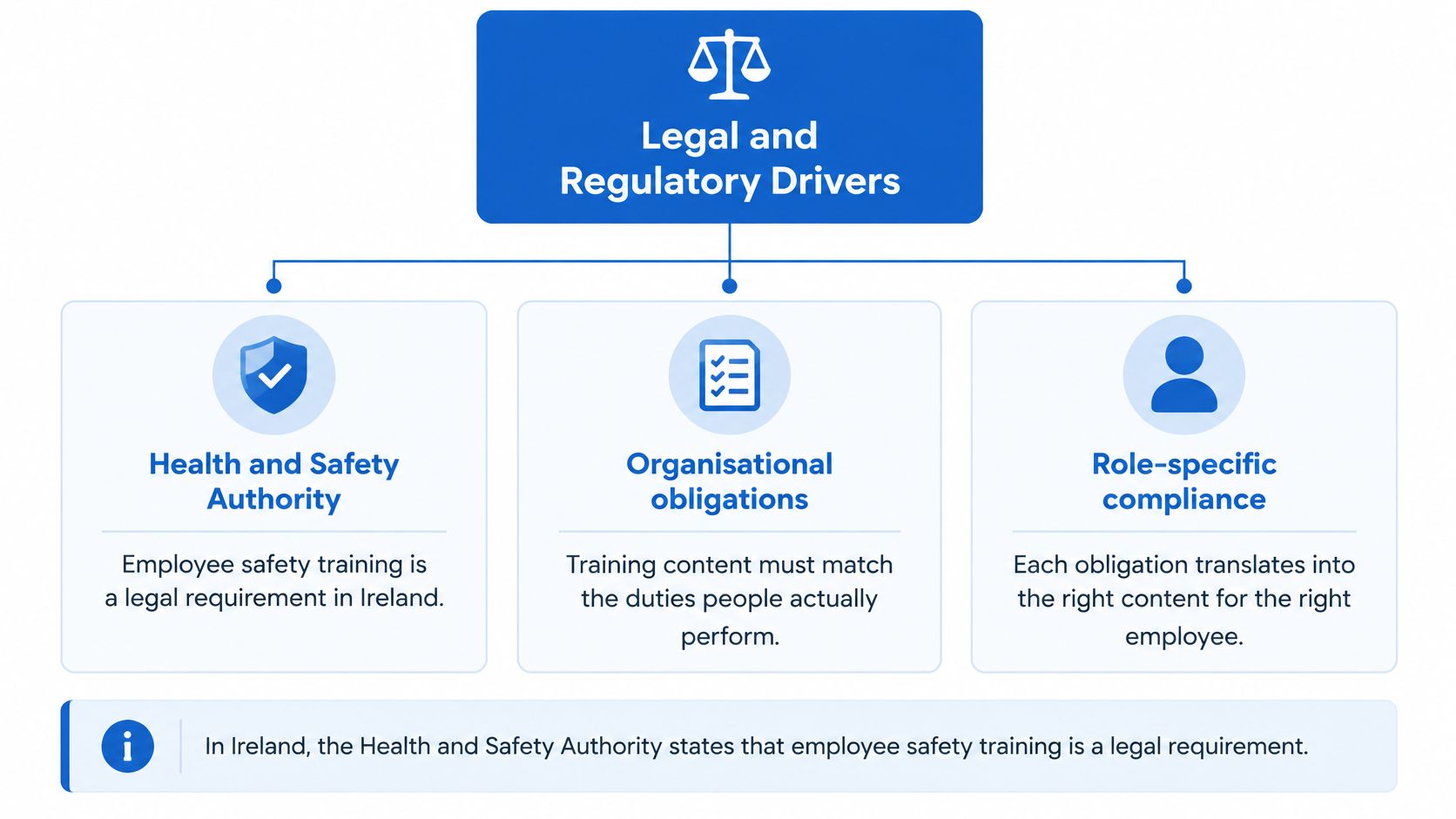
Section 10 of Ireland's Safety, Health and Welfare at Work Act 2005 places responsibility on employers to provide safety training. The Health and Safety Authority says health and safety training should form part of the training of everyone working at the workplace. The legal duty is the starting point: organisations must determine what instruction supports employees in carrying out their work safely, and retain evidence that the training reflects the relevant obligation.
The Central Statistics Office's 2020 enterprise training results show that more than two-thirds of Irish enterprises provided training, and more than one in three employees attended courses. Employees spent an average of 11.9 course hours, nearly 30% of which related to health and safety. In construction, safety accounted for 6.2 of 9.9 course hours per employee; in accommodation and food services, it accounted for 3.3 of 5.6 hours. The sector differences show why the legal basis for training needs to be translated into requirements that fit the work, rather than copied into a generic course.
Turn obligations into learning requirements
A regulation rarely specifies the wording or format of each training screen. Employers need to identify the decisions and tasks that could lead to non-compliance, define the behaviour required, and determine what employees need to learn or demonstrate.
For example, a general safety obligation may support instruction for all staff on recognising hazards and reporting concerns. A specific risk may call for additional training for the employees exposed to it. Each module should have a traceable connection to the applicable requirement, the intended audience, the content version and the assessment.
Regulatory changes require the same discipline. Assign responsibility for reviewing updates, record which obligations and internal controls may be affected, and document why training content was revised or left unchanged. A risk-based process for assessing regulatory changes can help teams decide which changes warrant action and identify the affected materials.

An obligation has little control value if employees cannot apply it to their work. The audit record should connect the requirement to the learning objective, the version delivered and evidence that employees understood what was expected.
Structuring a Course Around Roles and Real Risk
The Health and Safety Authority recorded 10,441 non-fatal workplace incidents in 2024, 3% more than in 2023 and 14% above the five-year average. Manual handling was the most common trigger. The Authority also reported 36 work-related fatalities, including worker and non-worker victims. The HSA annual review of workplace injuries, illnesses and fatalities makes a practical point for course design: a generic safety module can't substitute for instruction built around actual tasks and exposure.
Build backwards from the hazard
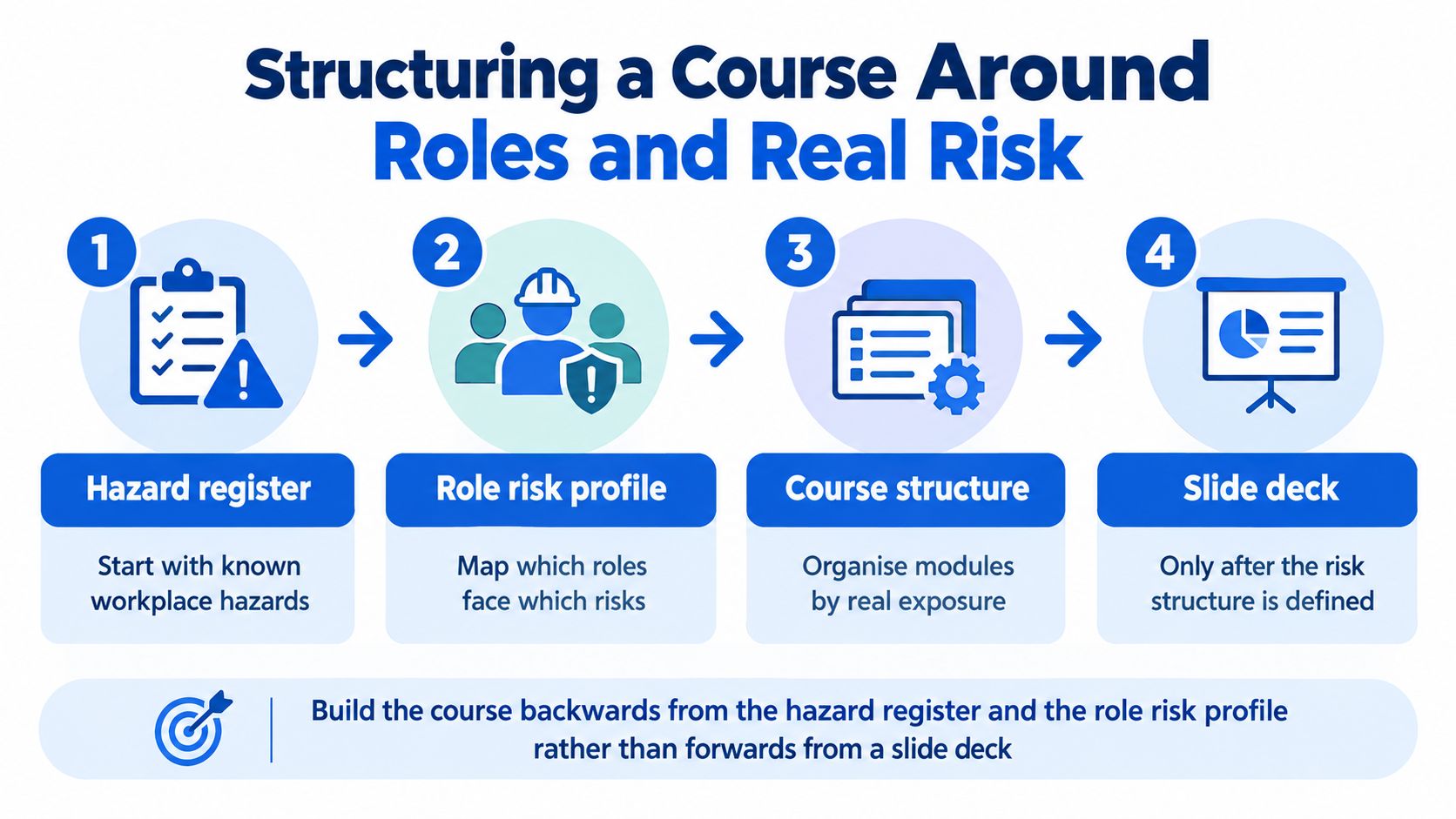
Begin with the hazard register and role profiles, not a slide deck. Identify the hazards, the tasks that expose people to them, and the roles expected to manage or respond to them. Then decide which learning belongs in a common foundation and which requires specialist instruction.
For manual handling, for example, instruction may need to address how to assess a load, when to use mechanical aids or a team lift, how posture affects the task, and when to stop and escalate unsafe conditions. A useful objective names an observable action: an employee should be able to identify when a load needs reassessment or explain how to report an unsafe handling condition.
Include the people who work on site
Induction and refresher pathways shouldn't be limited to permanent employees. Contractors, temporary workers and visitors may need site-specific instructions, particularly for emergency behaviour and local hazards. The right content depends on what each group does and where they work, not just their employment status.
Keep each module's learning objectives, legal references, assessment results and acknowledgement records linked to a version. Define a retraining trigger when a procedure, piece of equipment or risk assessment changes. That makes it possible to identify which people need updated instruction and to show which version they received.
A course should have a stated reason to exist, a defined audience and a behaviour that someone can verify.
This design choice also affects what the LMS needs to track. If the system stores only a course title and a completion date, it may not show whether a learner completed the relevant version for their role or jurisdiction. The record should make those distinctions visible without requiring an auditor to reconstruct them from disconnected files.
Assessments and the Evidence That Satisfies an Auditor
Completion data shows that a learner finished a course. A quiz result shows how they answered particular questions at a particular time. Neither, by itself, proves that they followed a procedure at work.
Training is already a common use of compliance technology: 85% of Irish respondents in PwC's 2025 compliance survey identified it as a use case. Yet a separate finding reported by A&L Goodbody was that 34% of Irish organisations hadn't trained employees on sustainability and ESG issues. The PwC survey points to a challenge beyond deploying courses: organisations need to show that training is relevant, delivered to the right people and connected to operational controls.
A quiz can test whether someone recognises a rule or understands a procedure. To evaluate application, the assessment should present a plausible decision, not merely ask the learner to recall a definition. For higher-risk tasks, pair the course assessment with observation, a supervisor attestation or another record of performance on the job.
| Evidence type | What it demonstrates | What it does not demonstrate |
|---|---|---|
| Completion record | The learner completed an assigned module | That the learner understood or followed the procedure |
| Quiz result | The learner answered the assessment questions as recorded | That the learner can apply the knowledge in a real situation |
| Scenario decision | How the learner responded to a described situation | That the same decision will be made at work |
| Supervisor observation | Observed behaviour during a task or work interaction | That the behaviour will remain consistent without follow-up |
| Version-controlled acknowledgement | Which policy or course version the learner acknowledged | That the learner has demonstrated competence |
Make the evidence answer the audit question
For each risk, decide what evidence would satisfy the question an auditor is likely to ask: who needed training, what version did they receive, how did they demonstrate understanding, and how did the organisation check application? Record contractors, temporary staff and site-based workers where they fall within the relevant audience. Keep the assessment result linked to the learner and course version, rather than storing a score without context.
Refresh content when the underlying procedure, control or legal reference changes. A fixed annual reminder may be useful for scheduling, but it isn't a substitute for a change-based review. Strong evidence shows the relationship between the rule, the training and the behaviour being checked. Completion is one part of that record, not the conclusion.
Choosing How to Produce and Deliver the Training
Production decisions involve a trade-off. In-house development gives the organisation direct control over content and revisions, but depends on staff time and production skills. A traditional bespoke studio can deliver a polished course, though production and revisions may be harder to schedule around urgent compliance changes. Off-the-shelf content can be quick to deploy, but may not match a local procedure, role or jurisdiction.
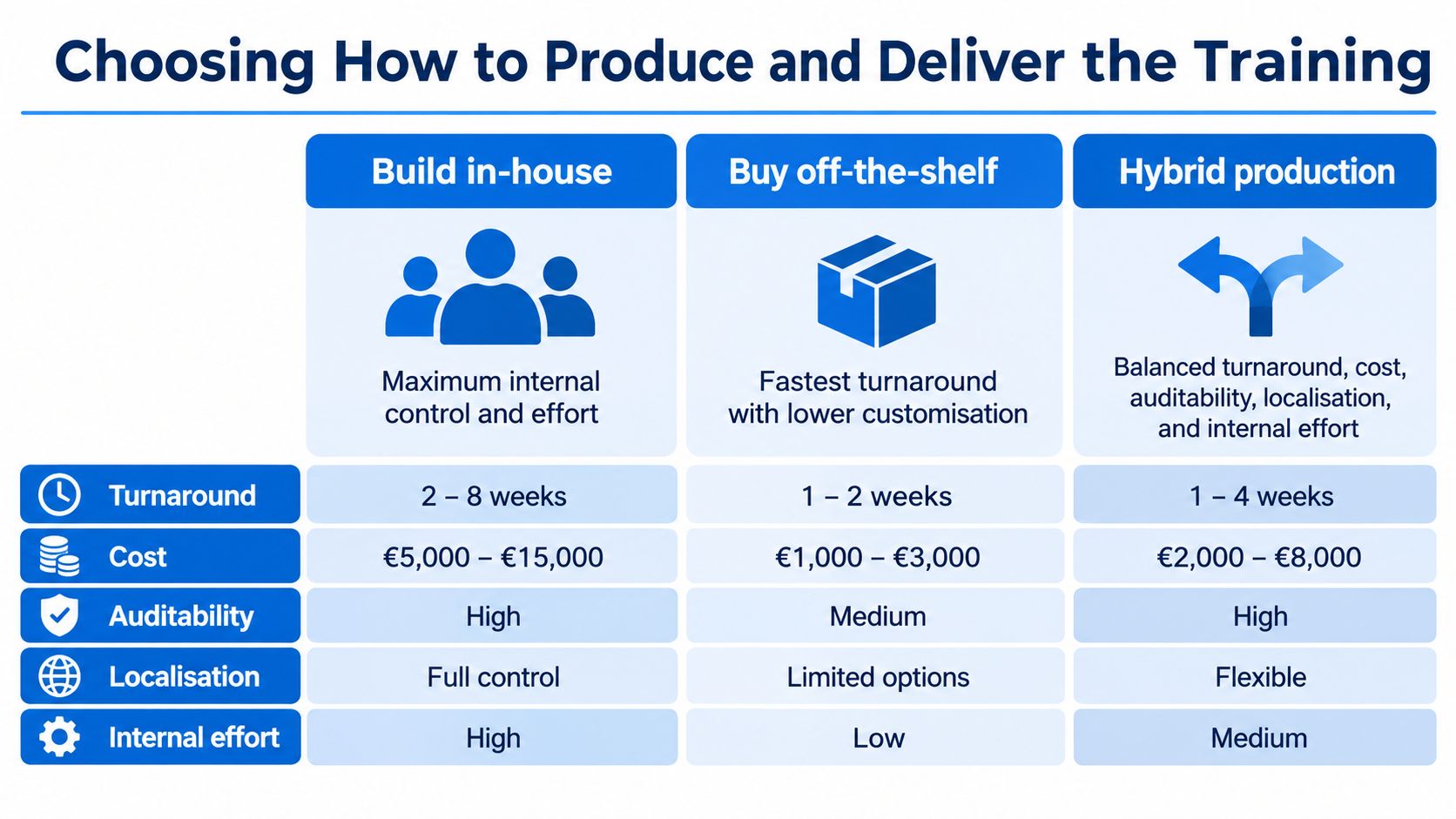
| Route | Turnaround | Cost | Auditability and localisation | Internal effort |
|---|---|---|---|---|
| Build in-house | Depends on available capacity and review cycles | Staff time and production resources | Strong control if source files, approvals and versions are maintained | High when teams must write, produce and update content |
| Commission a bespoke studio | Depends on scheduling, production and revision requirements | Requires a defined production budget | Can support tailored content, but updates need a clear handover and change process | Requires internal review and coordination |
| Use a hybrid production model | Can reduce production bottlenecks while retaining internal review | Varies by scope and service | Can combine tailored assets with documented approvals and updateable source materials | Shared between the provider and the organisation |
Select for the next revision, not just launch day
A training course rarely remains untouched. A procedure changes, a legal reference is updated, or an audit identifies a gap. Before choosing a production route, ask who can edit the script, how approvals are recorded, whether source assets are handed over, and how a revised version will be distinguished from the old one. If the supplier delivers only a finished video, updates may require more production effort than a course built with editable materials.
Also check what “bespoke” means in practice. Does the content use the organisation's procedure and terminology? Can the provider tailor examples by role? Who reviews compliance and HSEQ content, and how is sign-off documented? A fast turnaround has little value if the team can't verify the accuracy of the finished learning.
The corporate training production options available to an organisation should be judged against those questions, not only by presentation quality. The most suitable method is the one that can produce accurate, reviewable training and keep its evidence intact through later updates. Ask for a sample handoff pack and a clear account of how the course will be revised before signing off on the production approach.
Localising Compliance Content Across Jurisdictions
One course can serve multiple locations, but one legal explanation rarely fits every jurisdiction. The practical design task is to separate the behaviour being taught from the local rules that govern it. Employees might need the same core skill, such as reporting an incident or protecting confidential information, while the legal reference, reporting body, threshold or record-keeping rule differs by country.
Separate the reusable skill from local requirements
Start with a shared learning architecture. Define the behaviour in plain terms and identify which elements can be reused without changing their meaning. Then mark the jurisdiction-bound content clearly: legal references, required contacts, reporting steps and any local policy language. Avoid blending local material into a shared script where a change in one country could accidentally alter the instruction for another.
Maintain a jurisdiction tag and version history for each variant. Record who approved the local content and when, and preserve evidence that the relevant workforce received the version that applied to them. When a regulation or internal control changes, this structure lets the owner identify the affected module and audience without rebuilding unrelated course material.
Localisation test: Could an employee in each jurisdiction identify the correct local action without having to guess which rule applies?
Keep the learning experience coherent
Reuse should be deliberate. A shared visual style, consistent narration and recurring characters can help the course feel like one learning experience, while locally specific scenes, terminology or narration can change where needed. Label media assets and scripts by topic, role and jurisdiction so reviewers can identify what is safe to reuse and what requires new approval.
A localisation workflow should also preserve the source material. Store the master script, local variants, assessment content and approval record together, and connect each published course to its jurisdiction and version. When a new location is added, teams can assess which modules need adaptation, rather than copying the entire library and hoping no local requirement is missed. Structured e-learning localisation services can support that workflow, but the organisation still needs a clear owner for local legal review and approval.
The aim isn't to make every course identical. It's to make common behaviours consistent while keeping jurisdiction-specific instructions accurate, traceable and easy to update. That distinction helps avoid both extremes: maintaining wholly separate libraries that duplicate work, and relying on one generic course that obscures local obligations.
Building an Operating Rhythm for Ongoing Compliance Training
A reliable training programme runs as a cycle, not a once-a-year assignment. Start with the hazard register and role profile, design the module around an observable behaviour, then deliver it and capture the course version, assessment and acknowledgement. Review the evidence and check whether people apply the procedure. Return to the design when a risk assessment, procedure, piece of equipment or legal reference changes.
The cycle needs named owners. Someone must maintain the risk-to-module mapping, someone must approve the legal or policy content, and someone must review assessment and behavioural evidence. Without those responsibilities, version control and retraining triggers become administrative tasks that no one reliably completes.
Add AI literacy to the same control system
The EU AI Act makes sufficient AI literacy among relevant staff an organisational responsibility. In an EY survey of 35 Irish executives conducted in March–April 2025, 66% said their organisations were developing employee training on emerging-AI skills, best practices and risk awareness. Only just over half conducted regulatory compliance assessments, while 31% considered failure to comply with internal AI policies or government regulation a significant concern, according to EY's analysis of responsible AI in Ireland.
The useful question isn't whether every employee has seen a generic responsible-AI presentation. It's what each role needs to do. Frontline users may need to recognise prohibited or high-risk use and protect confidential information. Managers approving AI-assisted decisions may need to document human oversight. Developers, HR teams and compliance owners need training shaped by the data and decisions they handle, including when to escalate questionable outputs and how to preserve an audit trail.
Start with one high-exposure role. Build a procedure-linked module with a behaviour that a manager can verify, record its version and assessment, then review whether the evidence answers the questions an auditor would ask. Once that cycle works, extend it to other roles and jurisdictions. That's how compliance training becomes an operating control rather than an annual content event.
Loresson produces bespoke workplace training with scripting, cinematic media, assessments and optional interactive role-play, prepared as editor-ready or fully finished packages for LMS deployment. If your team needs a procedure-linked course with documented review and a clear path for future updates, visit Loresson to discuss the right production approach.