

Your Monday starts with someone asking for "a quick word, off the record". By lunchtime, two other people have told you their version of the same story, and one of them has used the word bullying. You have a client call in ten minutes and no clear idea whether this is a misunderstanding you can settle yourself, a matter for HR, or something that needs a formal process opened today.
Most managers never rehearse that moment. They learn to listen, they learn to stay calm, and then they meet the only decision that really matters, which is what to do next. Conflict management training earns its keep when it prepares people for that decision, not just for the conversation that follows.
Table of Contents
- What Conflict Management Training Covers and Why It Matters
- Core Skills Every Conflict Training Programme Builds
- Choosing the Right Route for Each Conflict
- Key Components of a Training Programme
- Practice Formats Across Face to Face, Phone and Video
- Realistic Scenarios That Make Practice Stick
- Choose or Build a Programme That Changes Behaviour
What Conflict Management Training Covers and Why It Matters
A fire drill works because the decisions were made in advance. Nobody stands on the stairs debating which exit to use, because the route was rehearsed months earlier, when there was no smoke. Conflict at work rarely arrives at a convenient hour, and the teams that cope best are usually the ones that walked through the first ten minutes before anything was on fire.
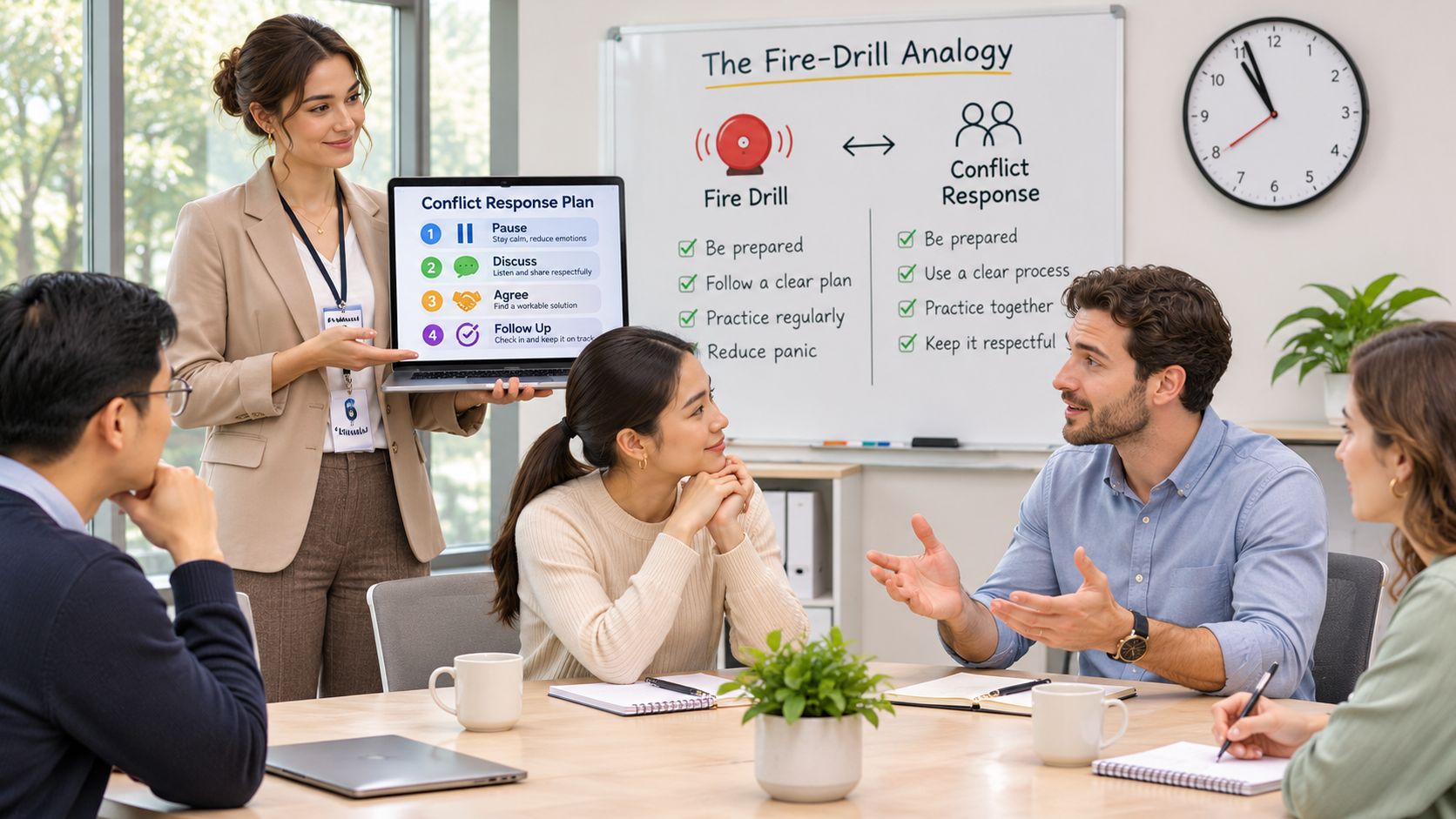
In plain terms, it's structured learning that helps people notice a dispute early, choose a response that fits, hold the conversation, and record what was agreed. It covers the front end (noticing, naming, triaging) and the back end (documenting, following up, closing the loop). The middle part, the conversation itself, is the piece everyone already associates with the subject.
It is not the same as communication training. A communication course builds tone, listening and clear language, and those matter. Conflict management training adds an operational layer on top: what happens next, who else needs to know, and at what point this should leave your hands and become someone else's process.
The people who benefit most are rarely the ones who ask for it:
- Line managers and team leads who field the first complaint and have no formal authority to resolve it.
- HR partners and people advisers who decide whether a matter escalates.
- Shift and site supervisors in manufacturing, logistics and construction, where disputes start on the floor rather than in a meeting room.
- Customer service and sales leads whose teams absorb friction created outside the organisation.
- Staff asked to mediate between colleagues without any title that gives them the standing to do it.
The cost of leaving friction alone shows up as absence, turnover and formal complaints. Ireland's Workplace Relations Commission received 10,559 complaint applications comprising 19,068 individual complaints in 2025, according to the DLA Piper summary of the WRC's 2025 annual report. Not every one of those began as a disagreement nobody handled, but a good share did.
The aim is not a workplace without disagreement. Disagreement produces better decisions when it stays in proportion. What training removes is the drift: the small slight that hardens into a grievance because nobody named it in week one.
Three questions a finished course should leave behind: What is actually happening here? Who needs to be involved? Which route fits this, and who decides if I've got it wrong?
Core Skills Every Conflict Training Programme Builds
Six skills carry the weight of a programme. Each can be practised in a room, and each gives a trainer something observable to mark. That distinction matters, because a course that can't tell competence from confidence isn't a course, it's a morning out.
Early one-to-one conversation. The manager's first move is usually a private word, and the quality of that word sets the tone for everything after. Learners practise naming a specific behaviour, separating what they saw from what they concluded, and agreeing one next step. "You spoke over Anna three times in Monday's meeting" is a behaviour. "You're dismissive" is a verdict, and it closes the conversation before it opens.
Triage. Most programmes skip this and it carries the most risk. Deciding whether a matter suits a private conversation, a mediated process or a formal route is the judgement that keeps a manager inside safe ground. It sits alongside the listening and assertiveness content covered in broader soft skills training, with a decision-making layer added on top.
Interest-based listening. Before anyone argues about positions, somebody has to summarise what each party needs. A learner who can say "you want the rota published earlier, and you want to stop being asked at short notice" has done more for the dispute than an hour of empathy noises.
| Skill | What learners practise | Evidence of competence |
|---|---|---|
| Early one-to-one conversation | Naming a specific behaviour and agreeing a next step | Describes behaviour rather than character |
| Triage | Choosing informal, mediated or formal route for a case | Route justified against safety, power and legal category |
| Interest-based listening | Summarising each party's interests before positions | Both parties accept the summary as fair |
| Documentation | Recording dates, facts and agreed actions | Notes are neutral, dated and complete |
| Repair and follow-up | Checking agreed actions happened and closing the loop | Follow-up note confirms completion or route change |
| Boundary setting | Knowing when to stop acting as informal mediator | Refers allegations to HR or investigation without delay |
Documentation. A note written in the moment reads differently from one reconstructed three weeks later. Learners practise recording dates, facts, who said what and what was agreed, in language that would survive being read aloud by someone who wasn't there.
Repair and follow-up. Most disputes don't end at the meeting, they end when the agreed action happens. Checking back with both parties, separately, and noticing whether the relationship has shifted is a skill, and it's the one that stops a repeat complaint.
Boundary setting. This is the one that saves careers. Recognising the moment to stop being an informal mediator, and hand an allegation to HR or a formal investigation without delay, is a decision rather than a personality trait.
Where the Gaps Usually Are
Most managers arrive with the first skill half-built and the third in reasonable shape, because both are everyday human behaviour. The gains sit in triage, documentation, repair and boundaries, which are the four that vanish when a disagreement hardens into a formal case.
Choosing the Right Route for Each Conflict
Four routes exist, and they are not interchangeable. An informal conversation between the people involved, a facilitated mediation with a neutral third party, an HR-led resolution that documents each step, and a formal investigation or disciplinary process. Most disputes fit one of them cleanly. Trouble starts when a manager picks a favourite and applies it to everything.
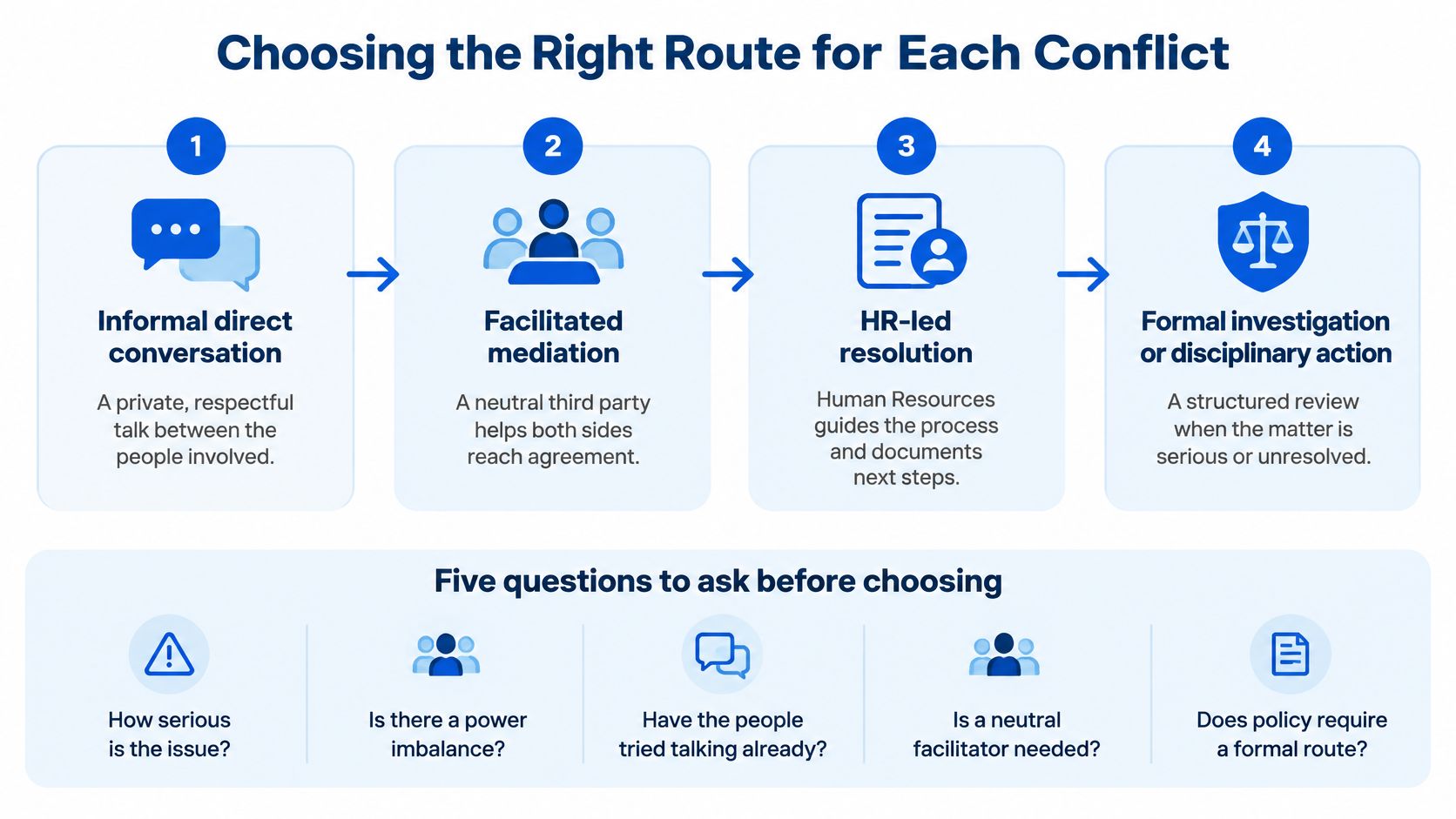
Five questions do most of the triage work:
- Is anyone at risk? Threats, intimidation, safeguarding concerns or serious misconduct stop the informal route immediately.
- Is there a power imbalance? A junior employee complaining about their manager is not the same conversation as two peers who disagree about a rota.
- Does this sit in a legally sensitive category? Discrimination, dismissal, pay, working time and equality complaints need process, not just a chat.
- Are the facts disputed? When two accounts contradict each other on what happened, investigation comes before resolution.
- Are both parties willing to engage? Mediation runs on consent. Persuading someone into a room they fear isn't consent, it's pressure.
| Situation | Route | Why |
|---|---|---|
| Minor disagreement, no power gap | Informal direct conversation | Fast and keeps the working relationship intact |
| Ongoing friction, both parties willing | Facilitated mediation | Structured route to agreed actions |
| Alleged bullying, harassment or discrimination | Formal investigation or HR escalation | Legally sensitive and needs evidence and fairness |
| Threat, intimidation or serious misconduct | Stop, protect and escalate | Mediation is unsafe in this case |
| Dismissal or pay dispute | HR or formal process | Contractual and statutory issues apply |
Irish guidance draws the same line. The Health and Safety Authority's guidance on bullying at work states that employers must take reasonable measures to prevent workplace bullying, including awareness-raising and training, respond quickly to complaints, progress investigations and put control measures in place where needed. Information, training, development and supervision appear among employer responsibilities in the national code of practice. None of that reads as advice to sit everyone down and talk it out.
Route choice also shifts the odds. Ireland's Workplace Relations Commission annual report for 2021 records that more than 40% of cases before its Mediation Services did not require an adjudication hearing after the mediation process. A well-chosen early route isn't a soft option, it's often the shorter one. The procedural side of this overlaps heavily with dignity at work training, where the focus is preventing the behaviour rather than resolving the complaint after it lands.
The common control failure is using mediation where coercion, serious misconduct or an unsafe reporting environment makes facilitated discussion inappropriate. A person who fears the consequences of speaking will agree to almost anything to end the session, and that agreement won't hold a fortnight later.
More confidence is not always better. A manager who has just finished a course can return certain that every dispute needs their intervention. Decisiveness without boundaries raises procedural risk: conversations that should have been paused, notes that should have been kept, allegations handled informally that needed a formal record. The skill being tested isn't nerve. It's proportion.
This short walkthrough shows how quickly a route decision arrives, and why the pause matters:
The rule to take away. If you can't tell which route applies, stop the informal conversation, write down what you have, and get advice before the next step. Pausing costs an hour. Getting it wrong costs a process.
Key Components of a Training Programme
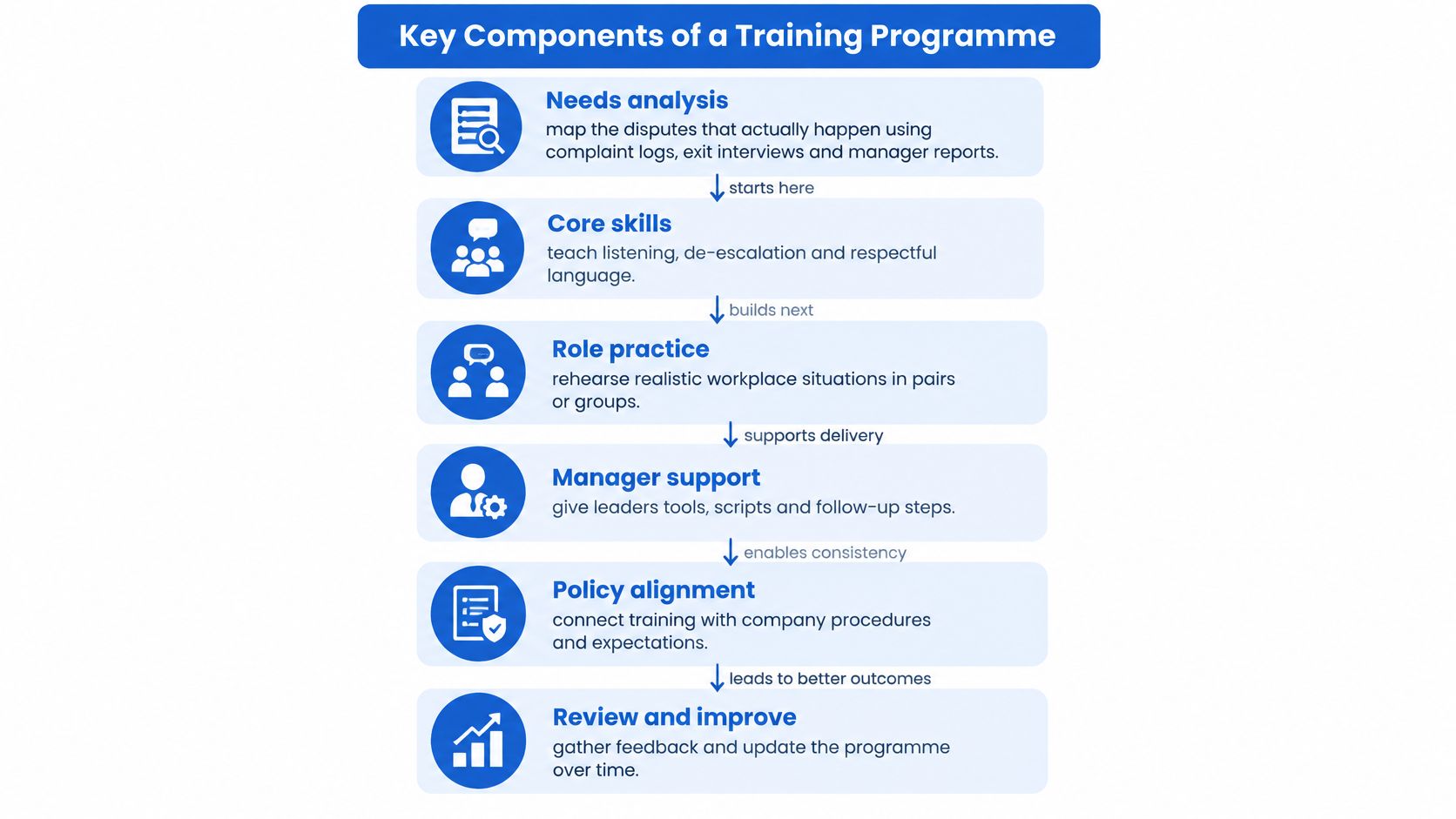
Programmes fail in a predictable order, and the first failure is writing content before anyone has looked at the disputes the organisation has.
Start With the Disputes You Actually Have
Pull twelve months of complaint logs, exit interviews and manager reports, then group them by type. The pattern usually surprises people. The Workplace Relations Commission's review of 1,000 pre-adjudication mediation cases found the most frequent complaint categories were unfair dismissal at 29.9%, employment equality at 18.4% and pay at 15.7%. If your own log looks anything like that, a course built entirely around personality clashes is aimed at the wrong target.
The WRC's 2023 annual report shows the same drift towards team-level work. It recorded 22 outreach workshops covering workplace procedures, communications, dignity at work and mediation processes, a 10% increase on 2022, and 110 requests for workplace mediation, with 34 referrals proceeding. Organisations are asking for help with a team's climate, not only with individual complaints.
Module by Module
Write separate learning objectives for each role, so a shift supervisor and an HR business partner don't sit through identical content. The core modules then follow the work itself: diagnosing the situation, holding the conversation, choosing the route, and recording what happened. Build a scenario library of realistic cases, each tagged to a role and to the workplace procedure it touches.
Set a Practice Budget
Two supervised role-plays per learner and one route-decision assessment before the course ends is a workable minimum. Keep policy e-learning separate from live practice, so the expensive hour in a room goes on decisions and conversation rather than on a slide deck someone could have read at their desk.
Follow-Up and Governance
Book a short check-in around 30 days after the course, and refresh the procedures that change most often, such as how a complaint is logged or who signs off an investigation. Every script and scenario should be reviewed by a suitably qualified person before use, particularly where the content touches legal or safety matters.
A programme with every component but no follow-up fades within weeks. The check-in isn't admin. It's the difference between a course people attended and a habit a team keeps.
Practice Formats Across Face to Face, Phone and Video
Format is a conflict-management decision, not a diary detail. The channel changes what people can see, what they can hide, and how quickly the conversation can be paused.
Ireland's WRC handled 1,034 pre-adjudication mediations in 2025, of which 70.9% were in person, 18% by phone and 11.1% remotely, according to Ibec's summary of the WRC's review of mediation cases. The same review puts the 2025 resolution rate at 50% for face-to-face mediation and 69% for telephone mediation.
| Format | Share of 2025 mediations | 2025 resolution rate | Skills to practise |
|---|---|---|---|
| In person | 70.9% | 50% | Body language, private caucus and room set-up |
| Telephone | 18% | 69% | Tone, turn-taking and handling technology failure |
| Video or remote | 11.1% | Not separately published for 2025 | Camera-off participation, screen etiquette and connection loss |
What the Rates Do and Don't Tell You
The gap challenges the assumption that in-person is automatically superior. It doesn't prove that a phone call causes a settlement. Case type and complexity differ by channel, and a telephone session may be offered precisely where the dispute is smaller or the parties are far apart. Treat the figures as a reason to teach channel selection, not as a ranking.
Run the Same Dispute Three Ways
Parallel practice is where the learning lands. Take one dispute and play it face to face, then by telephone, then on video. Learners notice what changes: the silence on a call feels twice as long, the folded arms disappear on camera, and the side conversation in the corridor has no equivalent at all. Remote mediation is emerging in Irish practice, but it isn't yet the default, which is exactly why the choice needs to be deliberate.
Before anyone joins the call: name the channel, the rules, and the fallback if the connection drops. If you can't state all three, the process isn't ready.
Rules to Agree Before the Session Starts
- Consent. Everyone confirms the format and who will be present, in writing where possible.
- Private caucus. Say plainly whether you'll speak to each party separately, and what stays confidential if you do.
- Turn-taking. Agree how each person gets an uninterrupted stretch, especially on the phone where interruption is invisible.
- Recording. Decide before the session whether anything is recorded, and tell everyone the same answer.
- Interpreters. For multilingual teams, confirm who is interpreting, brief them beforehand, and allow double the time.
- Technology failure. Have a fallback number and a rule for what happens if someone drops out mid-sentence.
Some matters should never be forced into joint dialogue. Intimidation, safeguarding concerns or a serious power imbalance are reasons to stop and reassess, not reasons to try harder. A learner who can spot those three and say so is more valuable than one with a polished script.
Realistic Scenarios That Make Practice Stick
Say a team lead notices that a senior colleague interrupts a junior team member in every Monday meeting, and that the junior has stopped bringing reports. After the third week, the junior asks for a word once the room empties.
That's the opening scene. The learner plays the team lead and has five decisions to make before the conversation ends: name the behaviour without labelling the person, check whether anyone is at risk, choose a route using the triage questions, write an opening line, and decide what goes into the note afterwards.

Depicting difficult conversations is appropriate in training where it serves a genuine learning purpose, and how confronting a scene is can be adjusted for the audience who will see it. The point isn't shock. It's recognition.
How the Scene Branches
Scenarios earn their keep when a decision changes what comes next. Promise confidentiality you can't keep, and the following scene shows the junior discovering you've already spoken to HR. Attempt to mediate a matter that involves intimidation, and the scenario shows the agreement collapsing two weeks later, with the note you never wrote now missing. The same craft applies when the conflict is with a customer rather than a colleague, which is why customer service training built on scripted scenarios holds up better than a slide deck.
Running the Debrief
The debrief carries more weight than the role-play. Learners compare the route they chose with the reasoning behind it, hear the alternative, then name one thing they'd do differently. The question isn't "what would you say". It's "which route did you choose, and what made you choose it".
Before any scenario is used, we arrange verification by a suitably qualified person, particularly where a scene touches safety, technical or compliance matters.
A good scenario contains a few essentials:
- A named role for the learner, and a reason they rather than someone else are handling it.
- A visible decision point with at least two defensible options.
- A procedural consequence for each choice, drawn from the organisation's own policy rather than invented.
- Enough time pressure to feel real, not so much that it becomes a test of speed.
- A debrief prompt that asks for justification rather than performance.
- A review step with someone qualified in the relevant procedure before the scene is used.
Choose or Build a Programme That Changes Behaviour
Any provider can show you a polished video. Ask instead for the material that reveals how the course thinks.
Ask Three Questions Before You Buy
- A sample scenario, unedited. If the example is a generic "colleague is rude" case with no role, procedure or jurisdiction attached, it won't transfer to your building.
- The rubric used to mark a route decision. You're looking for justification against safety, power, legal category, disputed facts and consent.
- One assessment question that requires a justified choice. Questions that ask learners to label conflict styles tell you nothing about whether someone can pick a route at 4pm on a Friday.
Then check the delivery. Who teaches it, what mediation or HR practice they've handled, which sector they know, and whether a named person reviews the legal and safety content. Confirm the scenarios are set in your jurisdiction, use your roles and procedures, and cover the formats your teams use.
Customers tell us the workplace, the audience and the jurisdiction before anything is written, so the scenarios carry the context their teams recognise.
Pilot It on One Team
- Map the disputes handled over the last twelve months and group them by type.
- Choose three priority scenarios that match the most common types.
- Pilot with one team and record four measures before and after: matters escalated, days to resolution, repeat complaints, and confidence ratings from participants.
- Review the evidence and adjust the scenarios before rolling out further.
If you commission an external provider, put the workplace, audience, jurisdiction and the evidence the pilot must produce into the brief. A provider who can't tell you what success will look like before the first workshop is selling attendance, not change. The aim is earlier, fairer handling and better records, not a workshop everyone enjoyed and nobody applied.
Loresson builds bespoke, scenario-led courses for exactly this kind of decision-making, including conflict management training where learners face a branching conversation and have to justify the route they chose. We work from your procedures, your roles and your jurisdiction, and deliver cinematic scenes, narration, graphics, assessments and optional interactive role-play, prepared for your LMS and turned around in hours to a week. If you'd like to see how a route-decision scenario would look with your own workplace inside it, visit Loresson.