

Your team finished the annual customer service training three weeks ago. Completion sits at 96%, the quiz average looks healthy, and the feedback forms say people found it useful. Then the Monday report lands: repeat contacts on billing are up, complaint escalations are up, and the same three issues keep coming back into the queue.
None of that is unusual. Most customer service training is designed to show that people attended, not that their judgement changed on a live call. The manual gets read, the policy gets recited, the assessment gets passed, and the first difficult conversation still catches everyone off guard.
What follows is the version of a programme a learning designer would build if the goal was a measurable change in resolution. It covers what the course must contain, which practice formats earn their place, how to assess competence rather than recall, and which metrics tell you the truth. It's also candid about where these programmes fail, somewhere around week six.
Table of Contents
- What Effective Customer Service Training Really Covers
- Core Competencies Every Programme Should Teach
- Scenario and Roleplay Formats That Build Real Skill
- Sample Course Modules and What Each One Teaches
- Assessment Methods That Prove Competence
- Metrics That Show Training Is Working
- Plan Your First Training Pilot This Quarter
What Effective Customer Service Training Really Covers
A pilot who has read the manual but never flown a simulator with an engine failure is qualified on paper only. Put that pilot in a real emergency and you'll find out exactly what reading builds and what it doesn't. Agents get the same treatment every week: they learn the policy, pass a quiz, and go live without ever having practised a difficult call while somebody watched.
Effective customer service training covers three layers. Most programmes build only the first.
Knowledge is the ground floor. Products, policies, refund rules, escalation routes, the systems behind them, and the standards for phone, email, chat and messaging. It's necessary, and it's the cheapest layer to produce, which is why it tends to fill the timetable.
Skills are what an agent does with that knowledge when the customer is upset or the answer isn't obvious. Needs-based questioning. Explaining a billing error in the customer's own terms. Empathy that doesn't sound rehearsed. De-escalation. Taking ownership rather than transferring the call. Confirming the resolution out loud instead of assuming it.
Judgement is the layer almost nobody teaches deliberately. What can this agent promise on the spot? What must be documented before the call ends? When is a refund the right call, and when does it need a manager, a fraud check or evidence? When should a case go up the line, and what has to travel with it?
Here is how the three layers fit together.
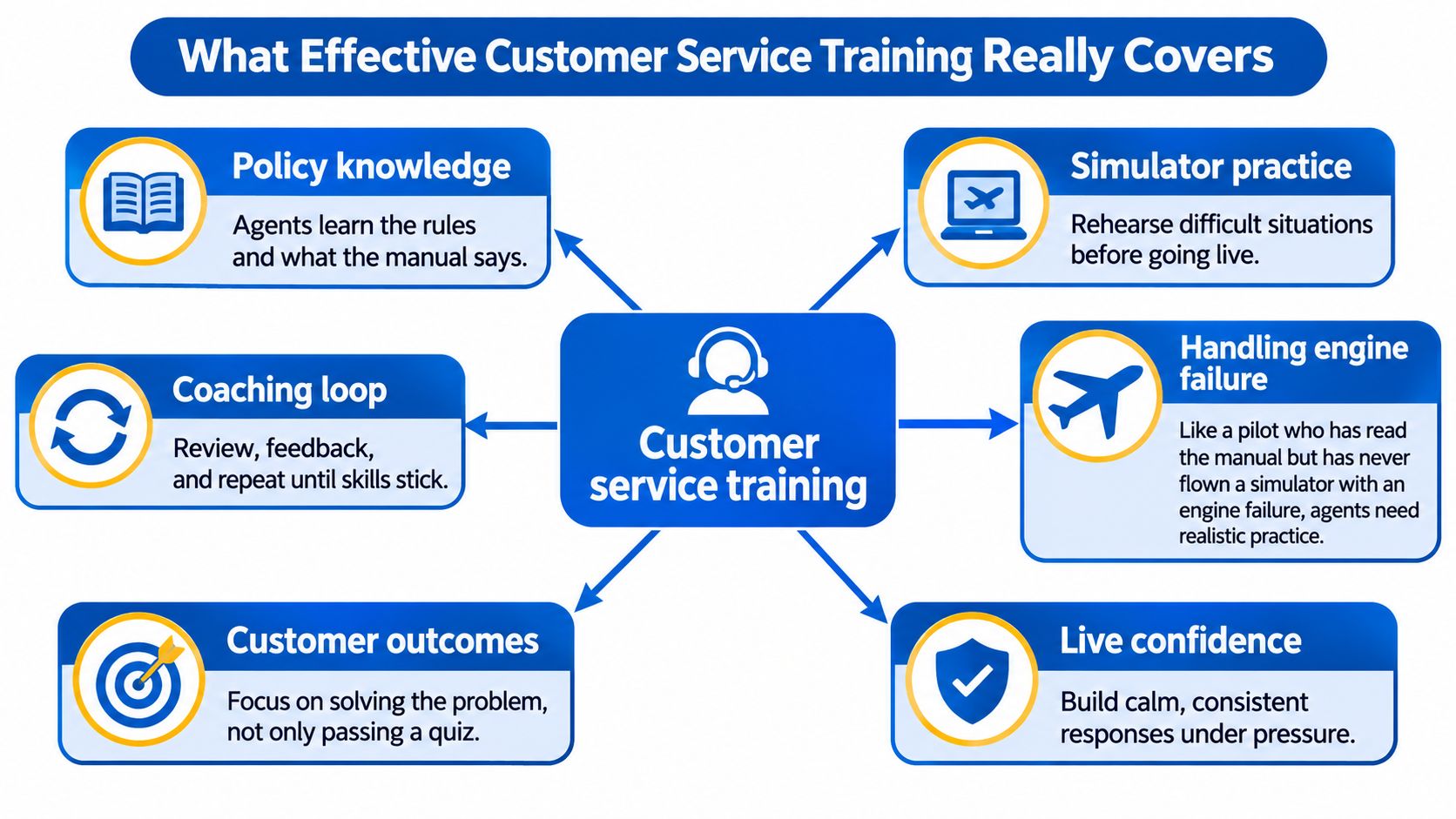
Customers grade the outcome, not the script
They don't care whether the agent followed the process. They care whether their problem was understood and solved, and they work out within seconds whether the person on the line has done this before or is reading from a screen. A programme can score brilliantly on knowledge and still produce calls that fail that test.
The test that matters: if a module has no practice attached to it, it isn't training. It's an announcement.
The loop that changes behaviour
A programme that shifts behaviour runs as a loop rather than an event. Learn the rule, practise it in a scenario, observe it on live work, correct the specific gap you saw. Each turn of the loop should produce something an assessor can record, not just another completed module.
Run a check against your own course this week. List every module in the programme, then write beside each one which layer it develops and whether the assessment is a quiz or an observed decision. Any layer with no module, or with nothing beyond quizzes, is the first gap to fix.
Core Competencies Every Programme Should Teach
Start with what Irish customers report, because it sets the shape of the curriculum. In a 2025 survey of 1,000 Irish consumers, 68% rated their most recent customer-service interaction as good or very good, yet only 29% rated an AI phone-agent experience positively, while live-agent chat reached 54%. The same survey found in-person service preferred by 75% of respondents, email by 61%, messaging apps such as WhatsApp or Messenger by 60% and telephone support by 59%, as reported in the Irish Examiner's coverage of the survey.
Two lessons follow. Humans still win where a problem is complex or emotionally charged, so a curriculum that assumes automation absorbs the hard cases is pointed in the wrong direction. Channel preference is also spread across four routes, which means one agent has to hold a thread across phone, email, chat and messaging without losing context, and the handoff between an automated tool and a human adviser is a competency in its own right.
Eight competencies and how to see them
| Competency | What good looks like on the job | Evidence of mastery |
|---|---|---|
| Needs-based questioning | Asks one clarifying question before offering a fix | The observed call shows the real issue named before the solution |
| Clear explanation | Explains a technical or billing matter in the customer's terms | The customer confirms understanding and doesn't call back on the same point |
| Empathy and emotional regulation | Acknowledges the feeling without taking the bait on tone | Rubric score on tone under pressure in roleplay |
| Issue ownership | Stays with the case or hands it over with full context | Handoff notes are complete and the customer doesn't restate the problem |
| Complaint and consumer-rights handling | Applies remedy options and escalation thresholds correctly | Decision tree applied correctly in a scenario assessment |
| Channel fluency | Adapts length, structure and tone for phone, email, chat or messaging | Written responses meet channel standards in sampled reviews |
| Escalation judgement | Escalates the right cases early, with the right evidence | Escalation accuracy rate tracked against audit findings |
| Accurate record keeping | Records the outcome, the promise made and the next step | An audit sample shows complete, traceable case notes |
Where to start
Don't build all eight at once, and don't build them in the order that reads best on a slide. Pull the last hundred contacts in your queue and count why they arrived. If billing repeats dominate, needs-based questioning and clear explanation come first, because those two competencies remove the repeat contact rather than absorb it. If escalations keep bouncing back, ownership and escalation judgement lead.
The goal of the first build is not a complete curriculum. It's two or three competencies with evidence attached, running well enough that you can show someone the before and after.
Scenario and Roleplay Formats That Build Real Skill
A building with the evacuation plan on paper is still chaotic on the day the alarm sounds. A building that rehearses the route empties in half the time. Practice formats in customer service work the same way, and each one builds a different competency.
The richest version is a room with a trained observer, and it's the one most budgets can't run every month.

The formats below cover the practical range. A sensible build uses two or three of them rather than picking a favourite.
| Format | Best for | Main limitation | Relative time cost |
|---|---|---|---|
| Branching scenario | Policy application and judgement | Cannot test tone or live pressure | Medium |
| Live roleplay with trainer | Empathy, de-escalation and explanation | Needs a skilled observer and scheduling | High |
| Peer roleplay in pairs | Repetition of questioning and closing | Feedback quality varies without a rubric | Low |
| Simulated ticket queue | Multi-task handling and prioritisation | Harder to build and to score consistently | High |
| Recorded call or chat review | Real-world habits and channel standards | Reviews past behaviour, not a controlled scenario | Low |
| Conversational AI roleplay | Repeatable practice with varied customer personas | Realism depends on scenario design and needs human review | Low |
Why one practice format isn't enough
The skill profile Irish employers describe is rarely about brand new abilities. A University of Limerick and Skillnet Ireland study of 32 business leaders and 58 customer-experience employees across large financial-services and ICT organisations in Ireland found that digital transformation had not created entirely new skills. People needed to apply critical thinking, problem-solving, communication and judgement more frequently and across changing contexts, as summarised in the Department of Enterprise release on the study.
That finding changes what a session has to do. The same agent should switch within one sitting between an automated-service escalation, a distressed customer and a compliance constraint. If every scenario is a variation of "angry customer on the phone", the training builds one muscle and leaves the rest untested.

Choosing between formats
The trade-off is honest. Live roleplay gives the richest feedback because a skilled observer hears hesitation, tone and recovery, but it consumes observer time and diary space. Branching scenarios scale to a whole team on a laptop and hold judgement up to scrutiny, yet they cannot hear whether the agent sounded like they cared.
Run them in order. Scenarios first to secure the rules and the decision points, roleplay second to build delivery under pressure, live observation last to confirm the behaviour transferred to real work. Where you commission an external build, note that live role-play is an optional part of a course's scope, while bespoke conversational roleplay scenarios shaped around your workplace and course content sit in the Premium package.
Sample Course Modules and What Each One Teaches
A course for a team handling mixed queries and complaints has to be short enough to survive a rota and specific enough to change what happens on a Tuesday afternoon. Six modules totalling 11 to 13 hours does that without pulling people off the phones for a week.
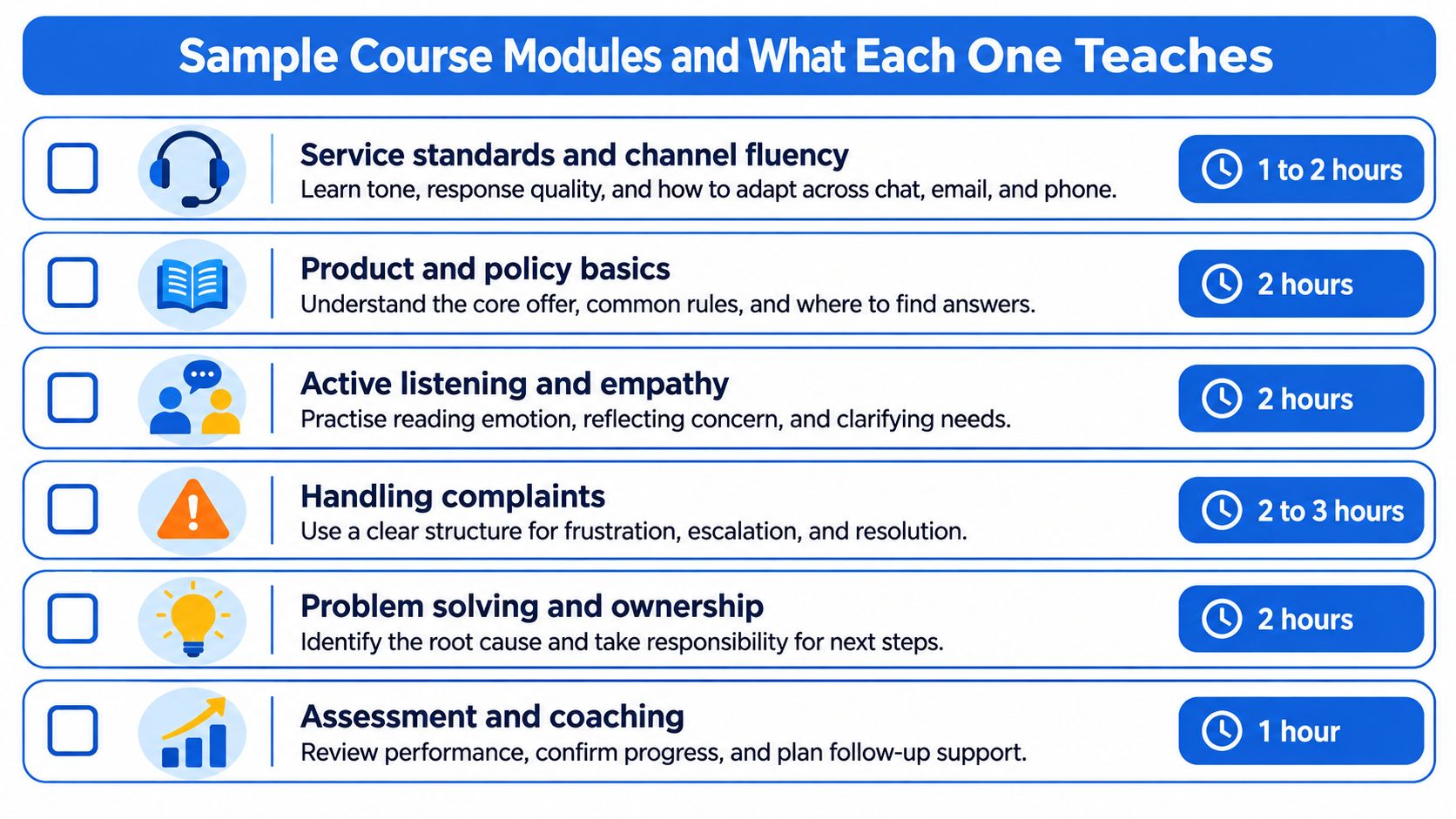
Module 1, service standards and channel fluency, runs one to two hours. The learner answers the same query twice, once by phone and once by email, and both answers have to reach the same resolution in different registers. Module 2, diagnosing the underlying issue, takes about two hours and uses a branching scenario where the first answer is wrong until the agent asks one clarifying question. That module exists because most contacts aren't complaints at all: ComReg's Irish consumer-care statistics record that 88% of issues in Q1 2025 were queries and 12% were complaints, per the ComReg Consumer Care Statistics Report for Q1 2025.
Module 3, empathy and de-escalation, runs two to three hours of live roleplay with an angry customer who repeats the same complaint until the agent stops defending and starts acknowledging.
The module most programmes skip
Module 4, complaints and consumer rights, takes three hours and is the one that separates a real programme from a soft-skills workshop. Irish complaint volumes justify the time: 20,526 consumers contacted the Competition and Consumer Protection Commission in the first half of 2025, with an average disputed purchase value of €6,400, and faulty goods, poor online-shopping experiences and botched home improvements among the leading issues, according to the CCPC consumer contacts report for H1 2025.
That changes what agents need to practise. Faulty goods, non-delivery, cancellation rights and fraud indicators belong in the same module as tone, because the operational question is never "how do I sound sympathetic" but "what can I promise, document, resolve now or escalate".
Module 5, escalation and handoffs, takes two hours and tests what a handover note must contain. Module 6, closing and recording, takes one hour and checks that the resolution was confirmed with the customer and written down.
| Module | Duration | Practice | Pass signal |
|---|---|---|---|
| 1. Service standards and channel fluency | 1 to 2 hours | Same query answered by phone and by email | Both answers meet channel standards and give the same resolution |
| 2. Diagnosing the real issue | About 2 hours | Branching scenario where the first answer is wrong until one clarifying question is asked | Learner asks the clarifying question before offering a fix |
| 3. Empathy and de-escalation | 2 to 3 hours | Live roleplay with an angry customer repeating the same complaint | Tone rubric held under pressure and the customer stops repeating the complaint |
| 4. Complaints and consumer rights | 3 hours | Decision-tree scenarios on faulty goods, non-delivery, cancellation and high-value purchases | Correct remedy, escalation threshold and complaint record at each decision point |
| 5. Escalation and handoffs | 2 hours | Handover note exercise | Note states the issue, evidence, promise made and next step |
| 6. Closing and recording | 1 hour | Closing and case-note review | Resolution confirmed with the customer and documented |
Verify three things before you build: each module stays under three hours, each has one observable pass signal written before delivery, and the complaints module names the remedies your agents can offer. Our training course development service follows the same sequence, starting with the target behaviours and the pass criteria rather than the slide count.
Assessment Methods That Prove Competence
A learner who passes a quiz has demonstrated recall. Recall isn't competence, and the distance between them shows up in month two, when the case is unusual and the policy doesn't answer the question.
Regulators have noticed the gap. The Central Bank of Ireland's cross-sector supervisory review of customer experience found that firms had introduced regulatory training, but some failed to maintain adequate records of training and competency assessments. It recommended ongoing soft-skills and customer-service training for existing customer-facing staff to support positive customer outcomes, as set out in the Central Bank's report on moving the dial on customer experience.
Methods ranked by evidential strength
Scenario assessments with observable decision points sit at the top. Each item names the decision being tested: did the agent ask the clarifying question, apply the right remedy, set the right escalation threshold, handle a vulnerable customer appropriately. Each item carries a minimum pass criterion agreed before the cohort runs, so nobody can move the line afterwards.
Observed live interactions scored on a rubric come next. Score tone, accuracy, ownership and closing on real calls or chats, and record the sample so a second assessor can review the same interaction.
Knowledge checks on thresholds rather than trivia sit below those. Test when a case must escalate, which deadline applies, which remedy is permitted. Never test the year a policy was revised.
Build the audit trail before the first cohort
Link every scenario and every assessment item to a named competency, then keep versioned records of completion, scores, remediation and reassessment. Any dashboard you show a manager should separate completion from demonstrated competence, because the two numbers diverge the moment a course gets popular.
The refresh rule: training should re-trigger automatically when a procedure, product, regulation or error trend changes. If a person has to remember to schedule it, it won't happen.
A failed decision point should send the learner into a targeted scenario, not a repeat of the whole module, followed by reassessment. That chain, from policy requirement to learning objective to learner response to corrective action, is what makes a programme auditable rather than merely complete.
Metrics That Show Training Is Working
A service team closes more cases on first contact, yet customers keep returning with the same problem. That gap can reveal a course that improves speed without improving resolution. Completion shows that people took the course; outcome measures show whether their decisions changed.
In Irish customer-experience research covering 1,491 customer evaluations across banking, telecommunications, automotive, supermarkets, insurance, airlines and utilities, only 33% of issues were reported as fully resolved and 37% of customers said they had to exert more effort than the company itself. A further 46% described their interaction as "nothing notable", and just 16% were particularly pleased, according to Ipsos Banda's research on the future of customer experience.
Use your own team's results as the baseline. A national average provides context, but it cannot show whether a particular course changed the way your staff handle customer issues.
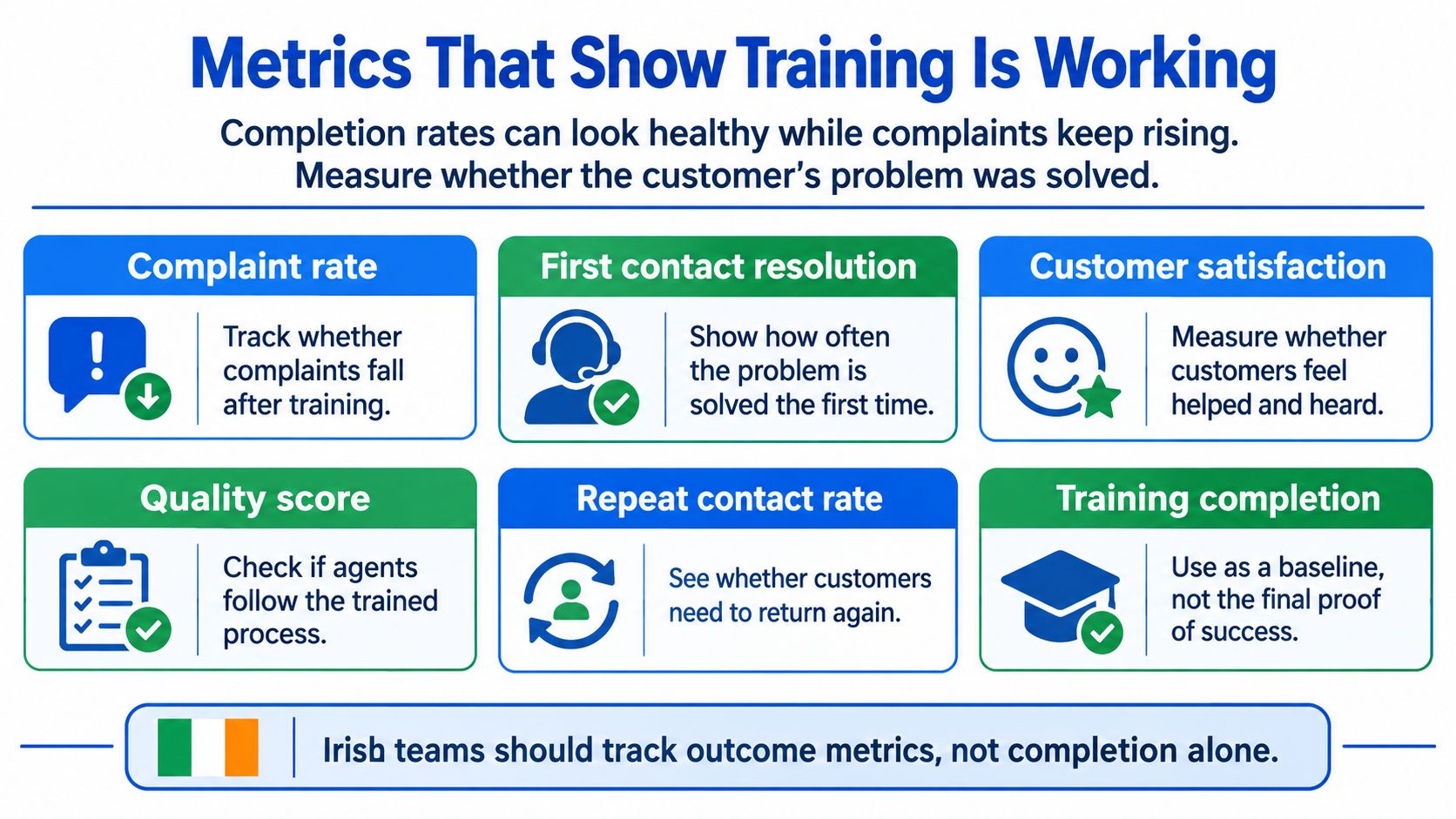
| Metric | Definition | Data source | Improvement signal |
|---|---|---|---|
| First-contact resolution | Share of issues resolved in one interaction | Case management system | Rises while repeat contacts remain stable or fall |
| Customer effort | Customer rating of how hard resolution was | Post-contact survey | Falls over the review period |
| Repeat contact rate | Share of customers returning on the same issue within a set window | Case management system | Falls over the review period |
| Escalation accuracy | Share of escalations that were justified and well documented | QA audit sample | Rises towards the audit standard |
| QA rubric score | Average score on tone, accuracy, ownership and closing | Observed calls or chats | Rises against the team's baseline |
| Time to competence | Days from start to passing all scenario decision points | LMS records | Shortens for each cohort |
| Policy error rate | Share of sampled cases with a policy or procedure error | Compliance audit | Falls after targeted remediation |
Pair the metrics so they can't lie
A single measure can reward the wrong behaviour. First-contact resolution may rise if agents close cases before the customer's issue is settled. Pair it with repeat contact rate: one tracks the initial outcome, the other helps show whether the fix held.
Read the other measures in pairs, too. Escalation accuracy indicates whether staff choose escalation appropriately; QA rubric scores can show whether they communicate clearly and take ownership. If a course should target one of these outcomes, name that metric in the course brief so the learning can be judged by behaviour change rather than attendance.
Set targets against your own baseline, then review at 30, 60 and 90 days. A course should be built around the target metric from the first brief. Loresson's corporate training solutions can be commissioned as bespoke training from a customer brief, with scope and delivery timing confirmed in the quotation.
Plan Your First Training Pilot This Quarter
- Pick one team and one failure mode. Complaint escalations, or repeat billing queries. Not both.
- Record a baseline first. Choose two or three metrics from the table above and measure them for a fortnight before anything changes.
- Map the competencies behind that failure mode, then build two modules: one scenario-based, one roleplay-based.
- Set pass criteria for every decision point before the pilot runs, so the result can't be judged after the fact.
- Run it for four to six weeks with observed live work, then review at 30 and 60 days.
- Decide with the evidence. Extend, adjust or stop, and say which.
Ireland trains at volume. Skillnet Ireland supported 23,142 businesses and 84,515 trainees in 2025, according to its Annual Report 2025. Volume isn't the problem. Evidence is.
Write the brief before you commission anything. Step one of our process is sharing the topic, audience, location and length of the course, and those four details are enough to start. Before any material goes live, arrange verification by a suitably qualified person, particularly where a module covers safety, technical or compliance content. Bespoke production, human review and interactive training then follow the scope and timetable agreed in your quotation. If the gaps you find are closer to induction than to service, our employee onboarding training uses the same scenario-first structure.
Loresson builds bespoke customer service courses around this structure: scenarios with observable decision points, assessments that record competence rather than attendance, and optional interactive roleplay shaped around the calls your team takes. Courses are produced in hours to a week, with scripting, cinematic media, narration, graphics, and assessments prepared for deployment in your LMS. If you have a pilot in mind for this quarter, visit Loresson to see how the process runs from brief to finished course.