

More than 24,000 businesses took part in employee upskilling programmes in 2024, reaching 90,136 workers, according to figures reported alongside SOLAS's National Skills Bulletin. That scale changes how you should think about soft skills training. It's not a remedial extra for a few difficult conversations. It's part of how Irish employers keep work coordinated, safe and adaptable. The useful question isn't whether a course feels engaging, it's whether people make better decisions when instructions change, a handover is tight, or a risk needs escalating.
Table of Contents
- Core Soft Skills and What Training Should Target
- Why Soft Skills Training Matters for Irish Employers
- Learning Formats Compared Side by Side
- How Scenario Video and Roleplay Build Real Practice
- Measuring Whether Soft Skills Training Works
- Roll Out a First Soft Skills Pilot
Core Soft Skills and What Training Should Target
Think of soft skills as observable behaviour, not personality. You can't reliably train someone to be a nicer person in an afternoon. You can train them to give a clear briefing, check understanding, name who owns a task, and flag a risk before it becomes an incident. Those actions can be watched, practised and corrected.
That distinction clears up a common confusion. Knowledge tells a person what the procedure says. Soft skills shape what they do with colleagues under pressure, when priorities clash or information is incomplete.
| Skill | Observable behaviour | Typical failure point |
|---|---|---|
| Communication | Gives a clear briefing and confirms understanding | Ambiguous instructions with no closed-loop check |
| Teamwork and collaboration | Shares task ownership and hands over work cleanly | Poor handovers and duplicated effort |
| Leadership and influence | Explains decisions and handles disagreement openly | Unchallenged assumptions and stalled decisions |
| Problem-solving | Defines the problem before choosing a fix | Solutions chosen before the problem is understood |
| Adaptability | Adjusts priorities when conditions change | Rigid response to changed instructions |
| Judgement and escalation | Flags risk early to the right person | Delayed escalation of safety or service risks |
Skills that carry technical change
Ireland's National Skills Strategy identifies creativity, critical and analytical thinking, teamwork, communication and business acumen as core transversal skills, while Skillnet Ireland's 2025 research reports that 42% of businesses struggle to source essential skills and almost 80% expect employees to need digital upskilling. Put those together and the training target shifts. People don't just need interpersonal polish alongside technical learning. They need to reason and communicate while technical work is changing.
Soft skills aren't an alternative to technical capability. They're the mechanism that decides whether technical change is adopted safely.
Say a planning tool recommends resequencing jobs to recover a delayed order. A team with strong problem-solving habits doesn't accept or reject it on instinct. They check the assumptions, ask what data it's using, and test the recommendation against staffing, materials and safety constraints. The soft skill is visible in the challenge, not in a general attitude to technology.
A technician gives you the second example. The job card says proceed, but a guard is damaged and production is waiting. Working around it keeps the line moving for an hour. Escalating it creates a delay now and prevents a more serious failure later. Training should practise the words, timing and route for that escalation, because good intentions won't carry a difficult conversation on their own.
Don't start by buying all six clusters. Pick two or three skills tied to a failure you already see, such as repeated handover errors, slow escalation, or meetings where decisions are agreed but owners aren't named. That's specific enough to build scenarios around and specific enough to measure afterwards.
Why Soft Skills Training Matters for Irish Employers
In Ireland, adults with more formal education are more likely to take part in learning than those with less formal education, and participation also differs by age. The OECD Skills Strategy Ireland report places Ireland's adult-learning participation target for 2030 above the EU target. These gaps matter when deciding who can access training and whether it reaches the people whose decisions affect day-to-day operations.
Who misses out in a typical rollout
Soft skills training delivered mainly through desk-based modules during office hours may reach graduates and confident self-directed learners first. Shift workers, older staff and employees with less formal education may have fewer opportunities to take part. Yet these employees often handle handovers, customer updates, isolations, deliveries and first-line problem-solving.
Design for the people expected to use the skills. Use plain language, familiar workplace settings and short practice sessions that fit release time. A distribution-centre supervisor, for example, can practise reassigning work when a vehicle arrives late, confirming who owns the revised pick and telling the next shift what changed.
Design test: If the people who handle your riskiest handovers can't access the training easily, the format is wrong, even if the content is sound.
The business case appears in everyday decisions. A clear handover helps prevent duplicated work. Early escalation gets a fault, complaint or safety concern to the right person before it grows. Better problem definition reduces the risk of quickly fixing the wrong issue. Stronger customer conversations can help resolve an issue without repeated contact.
Before commissioning training, answer three questions in writing:
- Costliest failure: Which role or handover creates the most expensive avoidable error?
- Missing audience: Which staff currently get little or no structured development?
- Monday test: What would people do differently on Monday if the skill improved?
If the answer to the third question isn't an observable action, you don't have a training objective yet. You have a theme.
Learning Formats Compared Side by Side
Compare formats by what the learner has to do, not by how modern they look. Four criteria keep the choice honest. Practice depth asks whether the learner only recalls information or has to choose, speak and handle a response. Feedback quality asks whether they learn why a choice worked. Then judge cost per learner and how far the format can scale without losing that feedback.
| Format | Practice depth | Feedback | Cost and scale | Best for |
|---|---|---|---|---|
| Self-paced e-learning | Low, recall and quizzes | Automated and limited | Low cost per learner, high scale | Awareness and policy knowledge |
| Scenario video | Medium, learner predicts the next action | Built-in decision points | Medium cost, medium scale | Showing what good looks like |
| Branching roleplay | High, learner chooses and speaks responses | Immediate and specific to the choice | Medium cost per learner | Conversations, escalation and handovers |
| Live facilitated workshop | High, peer practice in groups | Trainer and peer feedback | High cost per session, limited scale | Team dynamics and leadership |
| One-to-one coaching | Very high, tailored practice over time | Continuous and personal | Highest cost per learner, lowest scale | Senior roles and lasting behaviour change |
Where each format stops working
Self-paced e-learning is efficient for awareness. It can explain a policy, define terms and check recall. It rarely changes what someone says when a colleague pushes back, because the learner never has to produce the words. A quiz answer isn't the same as handling a tense exchange at a goods-in desk.
Scenario video goes further because it models behaviour. The learner watches a team leader give a vague instruction, sees the confusion it causes, and predicts the better next move. That builds recognition. Branching roleplay builds performance, because the learner chooses a response, hears the consequence, and has to recover if the first attempt doesn't land.
The hiring evidence supports that emphasis on interaction. ManpowerGroup Ireland's Q4 2023 Employment Outlook Survey reported that 43% of Irish employers considered communication, collaboration and teamwork the most important non-technical skills when hiring, while reasoning and problem-solving followed at 27%. In one sector, 53% prioritised communication, collaboration and teamwork, compared with 17% prioritising digital-native capability. Broad people skills content doesn't meet that need as well as practice built around real interaction failure points.
Realistic roleplay suits manufacturing, construction, logistics, facilities, hospitality and contact-centre work because the costly errors often begin between people. Someone assumes a load has been checked. A supervisor gives an instruction but doesn't confirm it was understood. A customer service agent spots a pattern but waits too long to escalate it. Practice exposes those moments before they carry operational consequences.
A blended pattern is practical. Use one scenario video to show the model, roleplay so each person practises the conversation, a short live workshop to compare approaches, and coaching only for roles where the behaviour is complex or high risk. If you're comparing delivery routes for a wider programme, our corporate training solutions page sets out how different formats can be combined around a specific workplace need.
How Scenario Video and Roleplay Build Real Practice
A dispatch change arrives with incomplete details and little time to spare. The supervisor passes it on, but nobody checks whether the new schedule is understood. A scenario can pause at that moment and let learners practise the response before a similar decision affects a live shift.
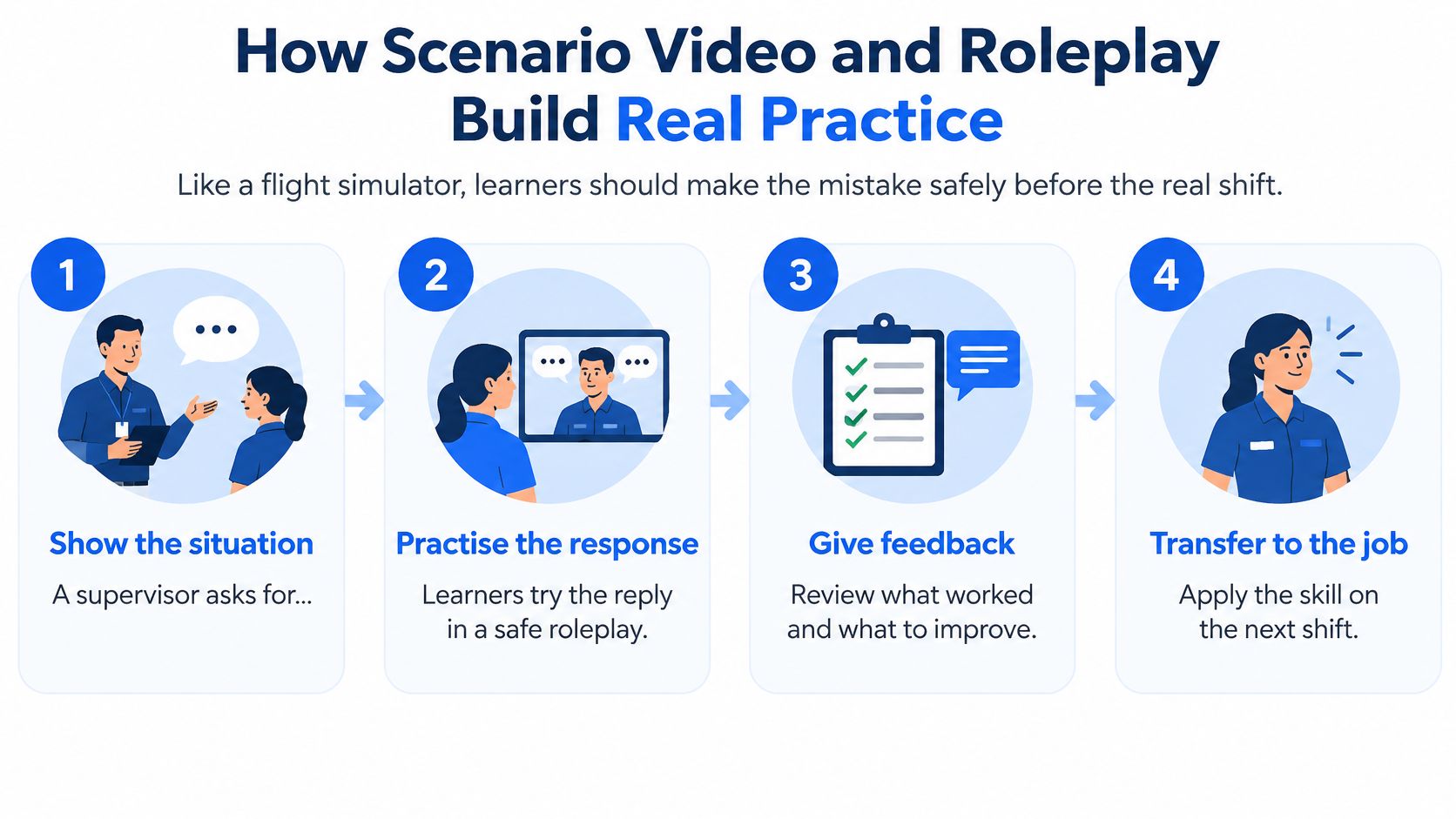
The four stages
- Show the situation: Set out the schedule change, the time pressure and the risk of passing on unclear instructions.
- Stop at the decision point: Ask learners how they would respond. Include realistic options, including the shortcut that might seem quickest.
- Practise the conversation: Let each learner speak with a responsive character and explain their decision in their own words.
- Debrief against criteria: Check whether the learner clarified the request, tested assumptions, named who owns the next step and escalated at the right point.
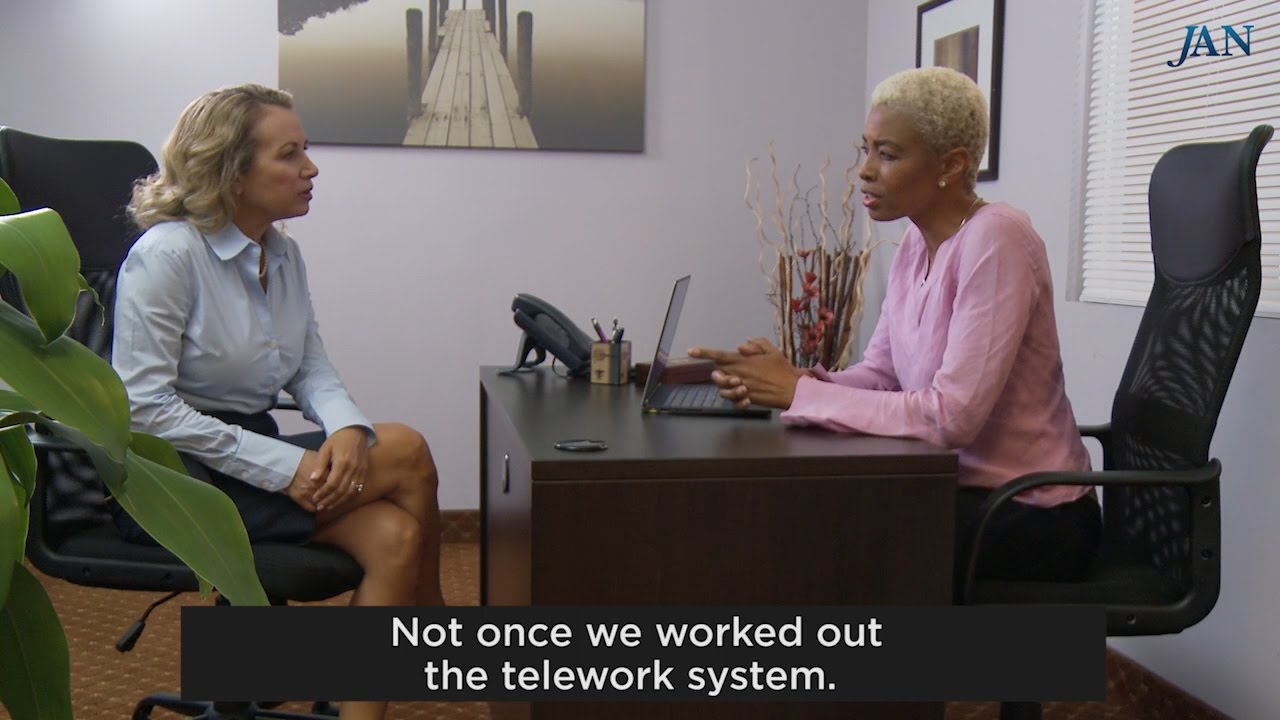
A modelled conversation gives learners a clear example before they make the decision themselves.
Design rules that make practice transfer
Use scenarios based on workplace procedures, customer interactions or common sources of friction. Names and identifying details can change while the operational problem remains recognisable. If every character is calm and every document is ready, the scenario may feel unlike the decisions learners face at work.
Build branches around plausible mistakes. If a learner delays escalation, show what follows, then let them try again. A second attempt can practise how to correct an unclear or incomplete first response.
Include a scenario that requires disclosure, verification or escalation. Workplace use of AI has grown quickly, while the QQI generative AI survey report found that only 20% of staff said their organisation offered training on using generative AI effectively and responsibly. The report also found that only 14% of learners said the same. A learner might need to explain an AI-supported decision to a customer, question an uncertain output, protect confidential information or state that a recommendation needs human verification. These are decisions to practise, not just terms to recognise in a quiz.
Loresson's training video production can turn a procedure, customer journey or escalation route into a sequence where learners watch a situation unfold, learn how to approach it, then practise in a live virtual conversation.
A useful record captures the choices learners made, where they hesitated and whether they recovered. Managers can use those observations to give specific coaching after the session.
Measuring Whether Soft Skills Training Works
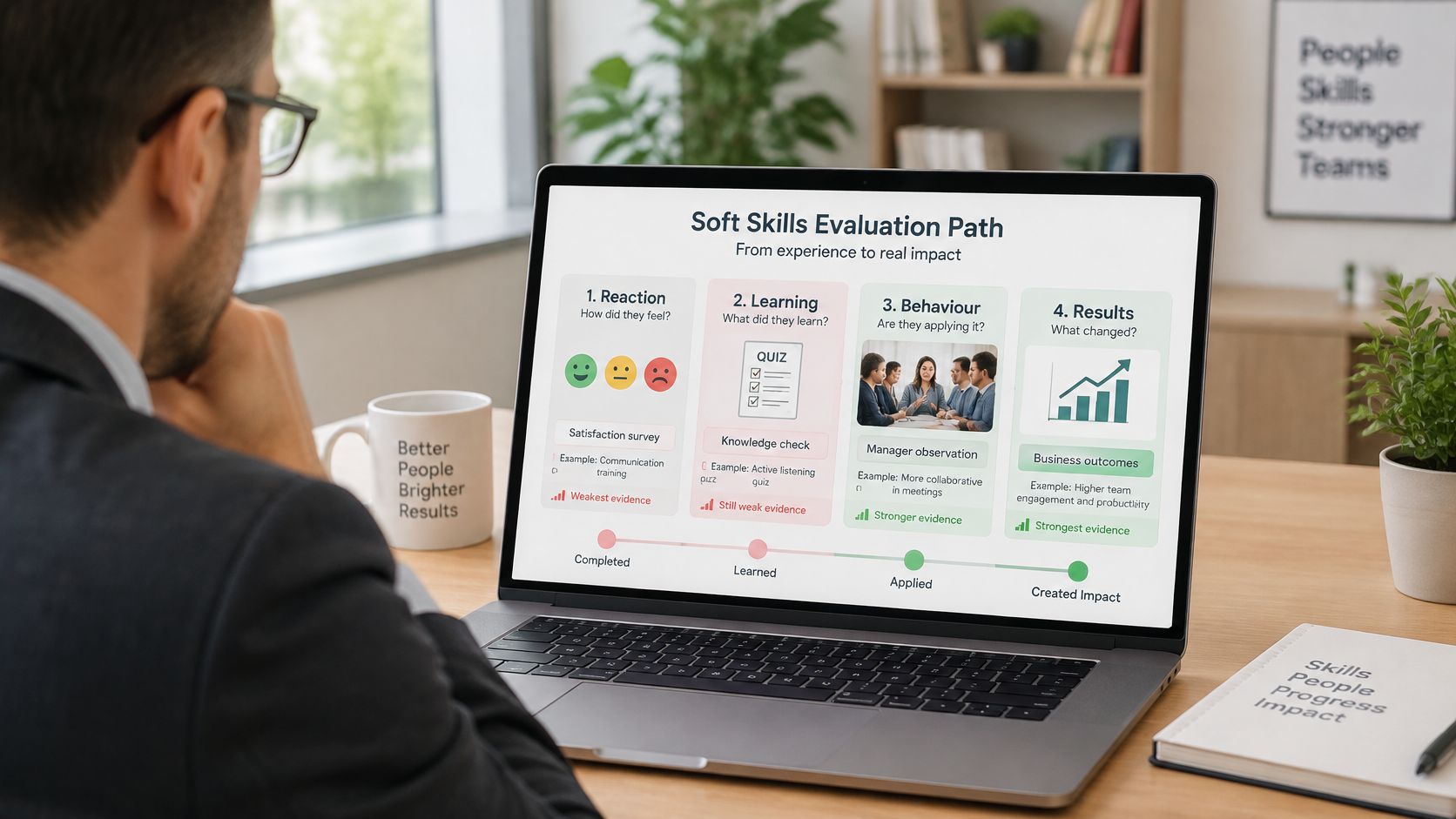
Completion tells you that someone reached the end. Satisfaction tells you whether they liked the session. Neither proves that a handover improved. Treat both as the weakest evidence and build measurement around decisions and workplace behaviour.
| Level | What it measures | Soft-skills example | When to collect |
|---|---|---|---|
| 1. Reaction | Learner view of relevance and realism | Rating of the roleplay as realistic to the job | End of session |
| 2. Learning | Decisions made in scenarios | Pre and post score on escalation choices | Before and after the course |
| 3. Behaviour | Use of the skill on the job | Supervisor rating of handover clarity against a rubric | Several weeks after the course |
| 4. Results | Business outcome linked to the behaviour | Fewer rework incidents or repeat customer complaints | Several months after the course |
The evaluation path matters because each level answers a different question.
What to build into a pilot
Start with the same scenario before and after training. If a learner initially accepts a vague instruction and later asks for the missing detail, confirms the owner and states the deadline, judgement has changed in a way you can score. Keep the scoring criteria visible and use the same rubric both times.
Workplace follow-up is the stronger proof. Several weeks later, ask a supervisor to rate handover clarity, response to changed instructions and reliability of task completion. Use short behavioural descriptions rather than a vague score. For example, a clear handover names the task status, the next owner, unresolved risks and the time of the next update.
Irish employer evidence shows why this specificity matters. The Higher Education Authority National Employer Survey 2024 scored further-education and training graduates at 77% for flexibility, 75% for collaboration and 73% for time management in employer assessments. It also found communication, teamwork and willingness to learn were explicitly identified by 15%, 12% and 11% of employers respectively as sought-after capabilities.
Those scores suggest many learners already have a foundation. Training that stops at introductory awareness will feel too easy and won't shift difficult moments. Aim higher. Practise resolving disagreement without avoiding the issue, escalating risk when the evidence is incomplete, and adapting the message for a contractor, a new starter or an upset customer.
A manager should be able to verify the behaviour after deployment, not just trust that the course covered it.
Small teams don't need a complex evaluation system. Pick one behaviour, one rubric, one baseline and one follow-up date. If the behaviour improves and the linked operational problem falls, you've got a case to extend the training. If scenario scores rise but workplace behaviour doesn't, redesign the practice or the manager follow-up before you scale it.
Roll Out a First Soft Skills Pilot
Start narrow. Decide which failure point gets the pilot, then decide whether you'll build it in-house or work with a production partner. Gather the procedure or behaviour you want to change, the audience and roles, the jurisdiction that applies, and the release time supervisors can protect. Without those basics, even a well-made course can miss the operational problem.
The sequence below keeps the pilot small enough to manage and specific enough to judge.
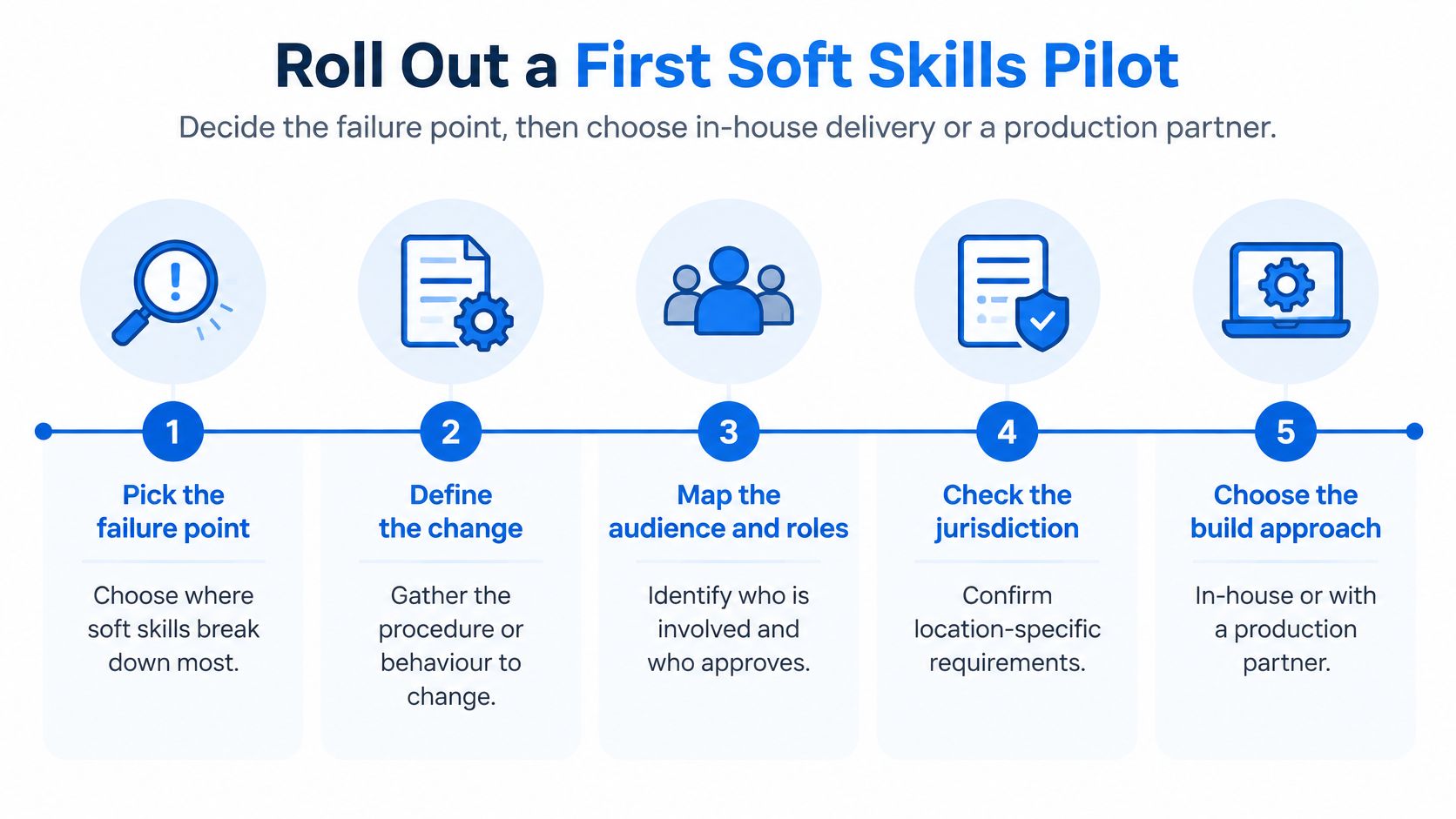
Seven steps for the first pilot
- Choose one visible failure point: Pick something you can already point to, such as late site escalation, incomplete shift handovers, or repeated customer callbacks. The common slip is choosing a broad goal such as improving culture. That gives scenario writers nothing concrete to build and gives managers nothing specific to observe.
- Write three to five observable behaviours: Turn the aim into actions a supervisor can score. For late escalation, behaviours might include stating the risk, naming the impact, contacting the correct role, and confirming what happens next. The slip is settling for vague aims such as be a better communicator.
- Record a baseline: Score current performance using real interactions, recent handover notes, supervisor observation, or a pre-training scenario. The slip is skipping this step because it feels slow. Without a baseline, you can't prove improvement later, however positive the feedback sounds.
- Pick one format combination: For most first pilots, one scenario video plus one roleplay is enough. The video establishes what good looks like, and the roleplay forces each learner to produce the behaviour. Add a workshop only if peer discussion will solve a problem the practice can't solve alone.
- Get the right internal sign-off: Ask safety, HSEQ or compliance colleagues to review safety-critical content before learners use it. Internal approval stays central where a course explains safety-critical actions or local requirements. A polished scenario that contradicts your procedure will damage trust quickly.
- Arrange qualified verification: Before you publish or use the materials for training, have a suitably qualified person verify technical or compliance material. This matters most for safety, technical and compliance content, where a plausible but wrong detail can create risk rather than reduce it.
- Pilot, follow up and decide: Run the course with one group. Collect pre and post scenario scores, then collect supervisor follow-up ratings several weeks later. Extend it only if workplace behaviour changes, adapt it if learners understand but don't apply it, and stop it if neither moves.
Building with a production partner
If you don't have the internal time to script, film and structure the practice, a partner can handle production while your subject specialists keep control of accuracy. Loresson builds scenario courses in four steps. You share the need, we shape the course into structure, script and storyboard, we build the experience, then we review and deliver it with you. You can see how that fits a wider build on our training course development page.
Keep ownership clear from the start. Your team supplies the approved procedure, audience, jurisdiction and examples that make the scenario recognisable. Your reviewers approve safety-critical wording. Qualified verification happens before use. Production speed doesn't remove those responsibilities, it makes them easier to organise because the script and learning flow are visible before delivery.
Say your pilot targets delayed escalation on a facilities contract. The scenario might involve a cleaner finding a damaged electrical fitting, a supervisor asking whether the area can stay open, and a client pressing for a quick answer. Learners practise isolating the conversation from the technical decision. They state what they found, avoid guessing about safety, contact the right role, and tell the client what will happen next. That's a small pilot, but it tests judgement, communication and follow-through in one recognisable situation.
Do the first piece of work this week. Write the three behaviours you'll train and record the baseline for the group you'll pilot with. Once those exist, format choices, scripts and measurement become much easier to defend.
If you've identified a handover, escalation or customer conversation that keeps going wrong, Loresson can turn your procedure and workplace examples into a bespoke scenario course with video, structured practice and interactive roleplay shaped around your roles. Visit Loresson to discuss the failure point you want to fix first and scope a pilot you can measure by behaviour, not just completion.