
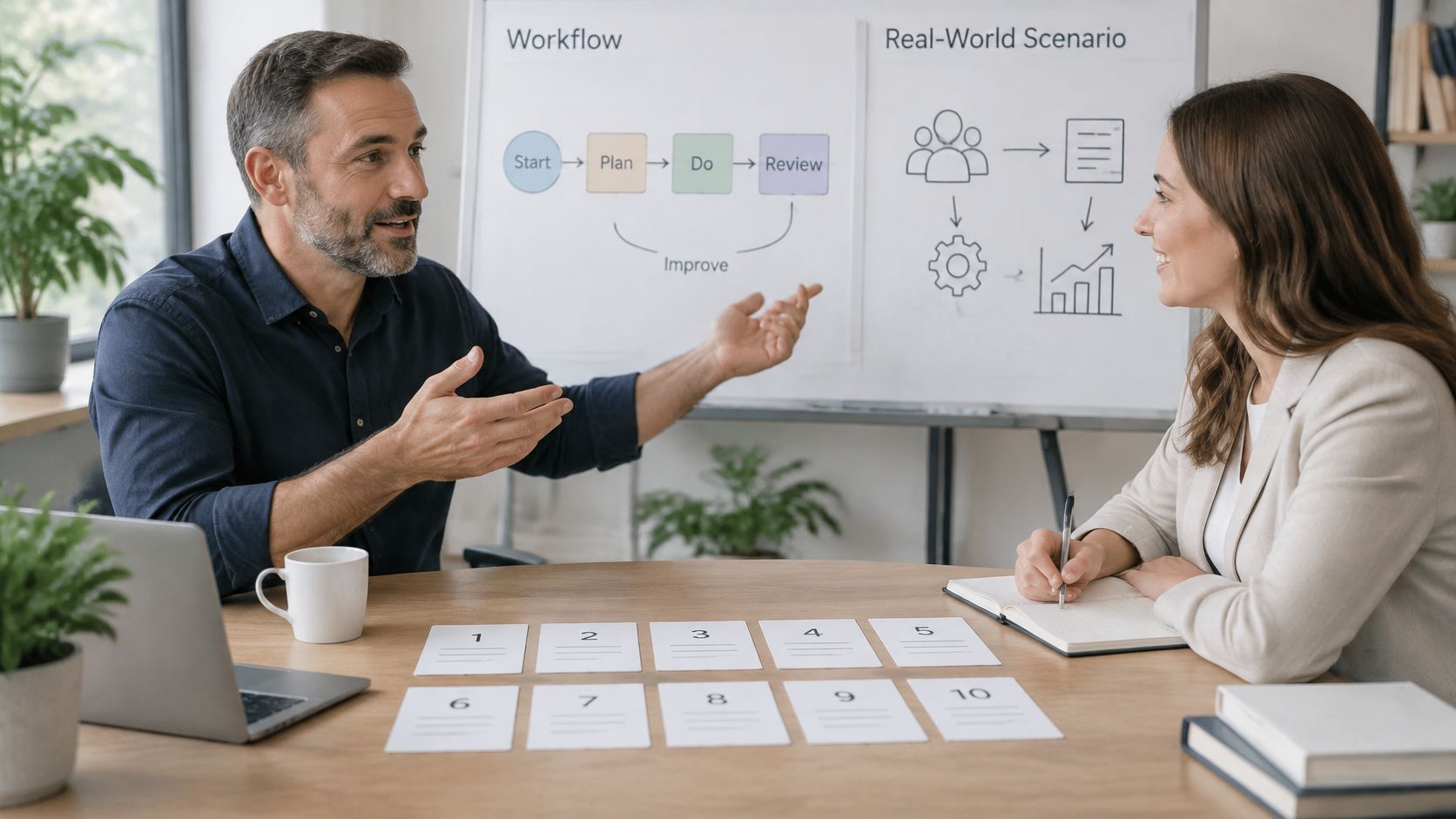
You've got forty minutes with a site safety manager, a recorder running, and a production slot booked for Thursday. She knows the job cold. You leave with three pages of transcript, a policy PDF and a warm feeling, and then you open a blank script and realise you can't build a single scene from any of it. Nothing she said was wrong. It just wasn't shaped like training.
A safety manager, a site lead and a hotel supervisor can all describe the same task and produce three completely different courses. The difference is rarely the expert. It's the questions. Ask "what should staff know?" and you get a topic list. Ask "what's the most serious thing that goes wrong here, and what stops it?" and you get a ranked hazard set you can turn into an opening scenario, a knowledge check and a sign-off note.
These ten subject matter expert interview questions are grouped by the artefact they produce: a scenario, a branching decision, an assessment distractor, a rubric, an audit record. Each one tells you what to ask, what to listen for, and what the answer becomes once it's in the storyboard. You won't need all ten in one session. Two or three, asked properly and recorded verbatim, will carry a thirty-minute course.
Table of Contents
- 1. What are the most serious things that can go wrong in this task, and what do you do to prevent them?
- 2. Walk me through this task step by step, exactly as you would do it on a normal day
- 3. Tell me about a specific time when this went wrong or when someone handled it especially well
- 4. How do you decide what to do when the situation is unclear or the information is incomplete?
- 5. What do new starters usually get wrong that experienced staff never do?
- 6. Which regulations, standards, or internal policies apply here, and how are they applied in day-to-day practice?
- 7. What does a good result look like, and how would you know someone has done this correctly?
- 8. What are the common questions or concerns people raise when they first encounter this topic?
- 9. What evidence would an auditor or inspector look for to confirm that this task was done properly?
- 10. What would be different at another site, in another country, or for another client, and what must stay the same?
- How the 10 Subject Matter Expert Interview Questions Compare
- From Expert Answers to a Course Learners Can Trust
1. What are the most serious things that can go wrong in this task, and what do you do to prevent them?
Ask for severity, not a hazard inventory. The Health and Safety Authority's 2024 fatality figures show why ranking matters: agriculture, forestry and fishing accounted for 12 of the 33 work-related fatalities recorded in Ireland that year. Risk concentrates in a small set of tasks, and the course should weight its scenes the same way.
The answer arrives in four usable pieces:
- Ranked list, most to least serious: the top two hazards become your opening scenes, the rest become shorter segments or job aids.
- The most recent near miss: ask what nearly happened, who noticed and what stopped it. That's your narrative spine.
- The control that works: the second half of the question earns its place here. A logistics manager will tell you pedestrian-zone breaches are the key forklift risk, so the storyboard follows a near-miss sequence in the aisle, not a lecture on truck stability.
- Exact wording: write down the client's own terms for hazards and controls so the narration matches their permits and risk assessments.
Practical rule: never script a control the expert hasn't confirmed is in the current risk assessment. If it isn't there, flag it for the client rather than quietly teaching it.
For working-at-height content, a construction expert's top five scaffold incident causes will usually give you the whole assessment bank: each cause becomes a question, and each wrong answer becomes a plausible distractor drawn from what people do. Our safety training videos are built from that ranked hazard set, because severity order is what decides scene order.
2. Walk me through this task step by step, exactly as you would do it on a normal day
"On a normal day" is the phrase doing the work. It filters out the exceptional case and gets you the sequence people run, which is the backbone of your learning flow and narration script.
A facilities manager describing how she isolates an electrical panel will often mention a verification step that isn't in the written procedure. She tries the switch. That's a script change and a sign-off note, not a footnote. Capture it in a numbered template with four columns: action, reason, equipment, checks. After every step ask "what happens next?", which is where hidden decisions surface.
Where the learning has to fit
The walkthrough also tells you how much time learners realistically have. In the Irish employee training country report, 27% of non-training companies identified workload and limited or unavailable staff time as a barrier to participation. So ask which step is most often skipped under time pressure, and where in the shift someone could watch four minutes of video.
- Ask for a phone video or photo set of the sequence if you can't observe it, then check your numbered list against it.
- Name the trigger for each step, not just the action. "When the permit is signed" is teachable; "then do the checks" isn't.
- Reconcile against the written procedure and send the differences back for approval before scripting.
A hospitality supervisor's opening-shift checks map almost one-to-one onto a branded onboarding module, which is how we structure SOP training: one observable step, one reason, one check.
3. Tell me about a specific time when this went wrong or when someone handled it especially well
This is the critical incident technique applied to course design. You're asking for one event with a beginning and an end, not a rule. Rules give you bullet points. Events give you scenes.
Four follow-ups do most of the work: what was the situation, what did the person notice first, what did they do, what happened next. A hospitality manager describing a guest allergy incident will usually reveal the moment the order was misheard, the phrase the server used to double-check, and the pause before the kitchen was told. That's a branched role-play, complete with dialogue.
Turning the story into options
Ask "what would a less experienced person have done here?" The answer is your best distractor, because it's a mistake real people make rather than one a designer invented. A contact centre lead describing a difficult complaint call will give you three plausible responses in about ninety seconds: appease, escalate, or clarify first.
The best interviewee isn't always the person who explains the policy most clearly. It's the person who handles the exceptions and coaches everyone else through them.
Collect two or three incidents so you cover both the frequent case and the high-severity one. Then anonymise properly: strip names, site details, guest or client identifiers, and get the client's approval on the rewritten version before it goes into a script. Say a hotel group recognises its own front desk in a vignette that hasn't been cleared, and you've created a problem that no edit can fix cheaply.
4. How do you decide what to do when the situation is unclear or the information is incomplete?
Procedures cover the known case. Judgement covers everything else, and judgement is what supervisors, site managers and customer-facing leaders are paid for. This question, the core of the critical decision method, gets at cues, expectations and rejected options.
Anchor it in a real case. A site manager deciding whether to stop work after a weather change will tell you what she looked at (gust direction, the crane's operating limit, the forecast trend), what she expected to happen next, and what she ruled out. Those rejected options are gold: they become the wrong branches in a decision tree, and they're wrong for reasons a learner can understand.
Ask two questions that most interviewers skip:
- "What were you expecting to happen?" This surfaces the mental model, which is what you need to teach.
- "What's required here, and what's just your preferred way of doing it?" Separate mandatory practice from personal habit, and label them differently in the script.
Judgement rarely gets formal teaching time. Research from Technology Ireland Digital Skillnet found that only 27% of organisations planned to invest in AI upskilling over the following year, despite identified capability needs. If nobody's building a course on how to decide, your interview may be the only place that reasoning gets written down.
Test the resulting decision logic with a second expert before you build it. Where two supervisors disagree, you've found either a genuine grey area (teach it as one, with an escalation route) or a procedural gap the client needs to close.
5. What do new starters usually get wrong that experienced staff never do?
Don't assume your audience has had any training on this at all. The Central Statistics Office's Continuing Vocational Training 2020 release reported that 69% of Irish enterprises provided training to staff in 2020, while 37% of staff participated in training courses. Plenty of people arrive at your module having never been taught the task properly, which makes the expert-novice contrast the highest-value question in the session.

Ask for the last three to five errors they've corrected in new starters, and how they corrected each one. A warehouse supervisor will tell you people skip the pre-use check on pallet trucks when the shift is behind. A hotel operations lead will tell you new staff confuse allergen labelling with best-before labelling. Each of those is a focused micro-module with its own knowledge check.
Writing distractors that don't insult the learner
- Use the actual error as the wrong answer, phrased the way a competent-sounding person would phrase it.
- Use the expert's correction as the feedback text, trimmed to two sentences. It's already in the client's language.
- Cross-check against incident reports, audit findings or LMS item analysis where you can get them. Experts remember dramatic errors; the data remembers frequent ones.
The trade-off: experts often name errors that are symptoms of a bad process. If everyone skips the same check, ask whether the check is practical before you build a module blaming learners for it.
6. Which regulations, standards, or internal policies apply here, and how are they applied in day-to-day practice?
Two halves, and the second one matters more. Naming the regulation is easy. Getting the expert to explain how it's interpreted on this site, on this shift, with this equipment, is what stops your compliance course from being a paraphrase of a PDF.
A UK construction client will point you to the construction design and management regulations and the associated guidance, and your script should cite the specific part being taught. An Irish manufacturing client will map internal policy to the Safety, Health and Welfare at Work Act, and you need that mapping written down per learning objective, not asserted in an intro slide.
Capture it as a small table in your handoff pack, one row per requirement:
- Document and version: exact title, version number, effective date, review date.
- Owner: who at the client owns interpretation, usually the HSEQ or compliance lead.
- Learning objective it supports: if a requirement doesn't map to one, it belongs in a reference document, not the narration.
- Prohibited interpretation: the reading the expert says is wrong, recorded in their words. This is the single most useful line for anyone reviewing AI-assisted script drafts later.
Field note: ask what changed in the last revision of the procedure. The delta tells you what existing staff still do out of habit, which is usually the real training need.
Have the client's compliance lead validate every legal reference before production, not after. We treat that internal approval as central wherever a course explains safety-critical actions or local requirements, and generated content always needs checking against the client's actual procedures and applicable requirements.
7. What does a good result look like, and how would you know someone has done this correctly?
Steps without standards produce learners who complete the task and still fail the audit. This question converts expert judgement into observable indicators, which is the only honest basis for a learning objective or a scored assessment.
Push for two levels. A site manager's minimum acceptable permit-to-work has every isolation point listed and signed; her excellent version also has the isolations verified by a second person and the residual risks noted. A customer service lead's minimum complaint resolution ends with the customer confirming the next step out loud. Both of those are rubric lines you can score.
Write the criteria with observable verbs: identifies, checks, records, confirms, escalates. Ban "understands", "is aware of" and "appreciates" from the answer, and if the expert uses them, ask what they'd see or hear that tells them it's happening.
Three checks before you lock the rubric:
- Does it match the organisation's competency framework? If there's an existing sign-off sheet, use its wording rather than inventing a parallel standard.
- Can a supervisor verify it in the moment? If verification needs a lab test, it isn't a training assessment criterion.
- Do the objective and the assessment item use the same verb? "Records the isolation points" as an objective and "lists three hazards" as the quiz question is a misalignment you'll be asked about later.
The trade-off is time. Experts describe excellence fluently and minimum standards reluctantly, because the minimum feels like endorsing mediocrity. Ask for it explicitly anyway. Most compliance training is teaching the floor, not the ceiling.
8. What are the common questions or concerns people raise when they first encounter this topic?
Learners arrive with objections, not blank slates. Ask the expert what they get asked in someone's first month and you'll write narration that answers the question before the learner disengages.
An HR manager will tell you new starters always ask how to request time off, so the onboarding course needs a short, concrete leave segment rather than a policy overview. A safety manager will tell you the recurring question is who pays for replacement PPE and how long it takes, which becomes a dedicated FAQ scene.
New topics generate the most anxiety. The UCD Working in Ireland survey found that 42.8% of employees in the Republic of Ireland reported receiving employer-provided GenAI training, meaning most hadn't. If you're building an AI-use policy module, the questions to ask your expert are the ones staff are too embarrassed to raise: will this be monitored, does using it count as cheating, what happens if I get it wrong.
- Ask for the top three questions, in the words staff use, not the words the policy uses.
- Mine helpdesk tickets, induction feedback forms and previous course evaluations for the questions nobody says out loud.
- Park out-of-scope concerns in a linked resource rather than bloating the module.
- Pilot with a small group and check whether those questions got answered.
9. What evidence would an auditor or inspector look for to confirm that this task was done properly?
This is the question that separates a training video from a compliance asset. Ask it and you get a list of artefacts: signatures, dates, registers, calibration records, completed forms. Each one becomes a demonstrated step, a sample document on screen and an assessment item.
In Ireland, consultation itself is auditable. The Health and Safety Authority's guidance on safety consultation explains that under Section 26 of the Safety, Health and Welfare at Work Act 2005, employers must consult employees on matters affecting safety, health and welfare, and that employees acting as safety representatives or committee members are entitled to paid time off for training. So ask your expert not just "what controls exist?" but "what record shows consultation happened, and who signed it?"
Build an evidence map as you go, one row per artefact: the record name, who completes it, when, the learning objective it supports, and the assessment question that proves the learner can produce it. A signed daily inspection checklist for mobile plant becomes a walkthrough of a sample completed form. Dated calibration records in a lab become a required step, not an appendix.
Ask what findings came up in the last audit and what the inspector asked to see. That's your priority order. Our regulatory compliance courses ship with that map in the documentation, because the client's next auditor will want the trail, not just the completion certificate.
10. What would be different at another site, in another country, or for another client, and what must stay the same?
Ask for two lists, explicitly: what changes, and what never changes. This is the question that decides whether you build one course or a modular family, and it's cheapest to answer before scripting rather than after.
A pan-European logistics operator keeps the core forklift sequence identical everywhere and swaps the national regulation references and reporting routes per country. A training provider building anti-harassment content keeps a common core and inserts a client-specific reporting policy plus a branded introduction. Both patterns work, but only if the expert has told you where the seams are.
Practical prompts:
- "Which step would a colleague at another site do differently, and is that allowed?" Variation that isn't allowed is a compliance issue; variation that is allowed is a localisation slot.
- "What would never change, even under pressure?" Those are your invariant controls, and they anchor the core script.
- "Who signs off the local version?" Name a person per jurisdiction, not a department.
Label the script sections clearly (core, jurisdiction insert, client insert) and keep regulatory references in a separate, updatable part of the handoff pack so a legal change doesn't trigger a full re-record. Confirm localisation scope with the client before production. We treat a request for different subject matter, style or scope after the brief is agreed as additional work requiring agreement on scope and price, so it's worth spending ten interview minutes here to avoid a re-quote later.
How the 10 Subject Matter Expert Interview Questions Compare
| Item | Main purpose | Best used at | Course output |
|---|---|---|---|
| What are the most serious things that can go wrong in this task, and what do you do to prevent them? | Identify and prioritise hazards, failures, and controls | Safety and compliance analysis | Risk scenarios, controls, and assessment priorities |
| Walk me through this task step by step, exactly as you would do it on a normal day. | Capture the routine task sequence and checks | Procedure analysis and course planning | Learning flow, storyboard, and narration |
| Tell me about a specific time when this went wrong or when someone handled it especially well. | Reveal real-world decisions and outcomes through incidents | Scenario and case-study development | Case studies, role-plays, and assessment scenarios |
| How do you decide what to do when the situation is unclear or the information is incomplete? | Make expert judgement and decision cues explicit | Decision-based training design | Branching scenarios and decision assessments |
| What do new starters usually get wrong that experienced staff never do? | Identify common learner errors and misconceptions | Course prioritisation and assessment design | Targeted instruction, quiz distractors, and feedback |
| Which regulations, standards, or internal policies apply here, and how are they applied in day-to-day practice? | Connect requirements to workplace practice | Compliance content analysis | Validated legal and policy references linked to objectives |
| What does a good result look like, and how would you know someone has done this correctly? | Define observable standards for competent performance | Learning objective and assessment design | Success criteria, objectives, and assessment rubrics |
| What are the common questions or concerns people raise when they first encounter this topic? | Surface learner questions, confusion, and concerns | Learner-centred course planning | FAQ content and a learning flow that addresses concerns |
| What evidence would an auditor or inspector look for to confirm that this task was done properly? | Identify records and artefacts that demonstrate compliance | Audit-focused content and documentation planning | Record-keeping guidance and evidence-linked assessments |
| What would be different at another site, in another country, or for another client, and what must stay the same? | Separate core requirements from local variations | Multi-site and multi-jurisdiction course design | Modular content with localisable sections |
From Expert Answers to a Course Learners Can Trust
Pick three questions for your next session, not ten. Start with the risk question and the step-by-step walkthrough, then add whichever one matches your deliverable: the incident question if you need scenarios, the evidence question if you need audit trail, the variation question if you're building for multiple sites. Thirty focused minutes beats a ninety-minute ramble, and experts give better answers when they know what the output is.
Record the exact wording. Not your paraphrase, not the policy's phrasing. The expert's terms for hazards, controls and checks are what make the script match the client's permits and briefings, and they're what a reviewer will look for when they check the draft. Where the expert's account differs from the written procedure, log the difference and send it back for a decision. Don't resolve it yourself in the narration.
Then label every answer so it survives the handoff. Source document and version, jurisdiction, affected role, required behaviour, unacceptable behaviour, a realistic scenario and the person who approves it. That structure is what turns a transcript into a brief a production team can script from without guessing, and it's what makes an AI-assisted draft reviewable rather than merely plausible. Generated content still needs checking against the client's actual procedures and applicable requirements, and verification by a suitably qualified person has to be arranged before anything reaches learners, especially for safety, technical or compliance material.
Two trade-offs worth accepting. First, you'll get less breadth. A ranked hazard list and one detailed incident won't cover the whole policy, and that's fine, because courses that cover everything teach nothing. Second, you'll create work for the client: someone has to confirm the procedure gap you found and sign off the anonymised scenario. Build that review time into the schedule at the start rather than discovering it during production.
To start a brief with us, you share the topic, audience, location and length, plus any procedures, examples or brand guidance you're authorised to share. Those inputs, alongside your interview outputs, are what let us build structured learning that reflects your business and operating reality rather than generic content.
If you've run the interview and got a ranked hazard list, a verified walkthrough and an evidence map, we can turn that brief into a scripted, storyboarded course with cinematic media, narration, assessments and optional interactive role-play, delivered as an editor-ready handoff pack or a finished course ready for your LMS. Specialist HSEQ review and sign-off is included in our Premium package, so the compliance content is checked by a qualified person before it reaches your learners. Visit Loresson to see the packages and send us your topic, audience, jurisdiction and desired course length.