

You've got a new starter on Monday, a forklift that arrived last month and a training folder full of certificates that nobody has looked at since the last audit. Someone asks whether the team is "covered", and the honest answer is that you're not sure. That's the position many workplaces are in when they start searching for workplace safety courses: they need a decision, not a catalogue. The useful question isn't which course is popular. It's which hazard you're controlling, who's exposed to it, and what proof you'll have afterwards that the person can do the job safely.
Table of Contents
- Types of Workplace Safety Courses and Who Needs Them
- Why Employers Must Provide Safety Training Under Irish Law
- Choosing Between E-Learning, Classroom and Practical Formats
- What a Strong Safety Course Must Include
- Testing Whether Workers Can Act Safely Under Pressure
- Match Training to Your Risks and Duties
- Vetting External Providers and Accreditation
- Choose a Route and Confirm Your Training Plan
Types of Workplace Safety Courses and Who Needs Them
Start with the map. Almost every workplace safety course you'll be offered falls into one of seven families, and each family exists because a particular kind of harm keeps happening in a particular kind of work.
| Course type | What it covers | Usual audience |
|---|---|---|
| Site or general induction | Site rules, emergency arrangements, hazard reporting | All new starters and visitors |
| Task-specific safety | Safe methods for a defined task, equipment checks | Operatives using machinery, vehicles or hazardous substances |
| Manual handling | Lifting technique, load assessment, team lifts | Warehouse, healthcare and construction staff |
| Working at height | Access equipment, fall protection, inspection | Construction and maintenance staff |
| Fire safety and emergency response | Evacuation, warden roles, extinguisher use | All staff; wardens trained in depth |
| First aid at work | Casualty care and incident response | Designated first aiders |
| Supervisor safety | Risk assessment oversight, incident investigation, stop-work authority | Line managers and supervisors |
Let the hazard pick the row
The course type follows from the hazard and the role, not from whatever a provider happens to sell. A receptionist and a maintenance fitter work for the same employer, but only one of them needs fall protection training, and only one of them needs to know which assembly point to walk to. Buying the same module for both wastes money and leaves the actual risk untouched.
Two rows get missed most often. Supervisor safety is treated as optional because managers "already know the rules", yet the person who authorises a lift or waves a reversing vehicle through is making the highest-consequence decisions on site. Task-specific safety gets replaced by a generic induction, which tells someone where the fire exit is but nothing about the machine they'll operate for eight hours.
Where people usually get confused
- Induction isn't competence: an induction explains the site, not the task. It doesn't qualify anyone to use equipment.
- Manual handling isn't just lifting boxes: in healthcare it's people, and the load assessment and team lift decisions matter more than technique alone. Our manual handling training treats load assessment as the first decision, not an afterthought.
- Fire training has two depths: everyone needs evacuation behaviour, wardens need role-specific practice and decision-making.
- First aid is a designated role: you train named first aiders properly rather than giving everyone a diluted version.
Before you shortlist anything, write your own hazard list down the left-hand side of a page and tick the rows that match. If a hazard has no row, you've found a gap that no off-the-shelf course will fill for you.
Why Employers Must Provide Safety Training Under Irish Law
In Ireland, safety training is a statutory duty, not optional professional development. Section 10 of the Safety, Health and Welfare at Work Act 2005 requires employers to provide adequate safety, health and welfare training, including task-specific instructions and emergency procedures.
Employers must provide adequate safety, health and welfare training, including task-specific instructions and emergency procedures, adapted when risks change and repeated periodically where appropriate.
That wording does a lot of work. "Adequate" and "task-specific" mean a general awareness video won't discharge the duty for someone operating a bench saw. The Act also sets out the moments when training must happen, and those moments are practical events you can put in a diary.
The triggers that create the duty
Recruitment. A new starter needs instruction before they're exposed to the risk, not in their first quarterly batch.
Transfer or change of duties. Someone moving from stores to production has changed their hazard profile completely, even though their employment contract hasn't changed.
New work equipment or systems. A different machine, a new guarding arrangement or a revised traffic route all change what "safe" looks like on your floor.
New technology. New software, automation or monitoring systems introduce failure modes people haven't met before.
Periodic repetition and changed risk. The legislation requires training to be adapted when risks change and repeated periodically where appropriate, so a one-off session in a person's first week isn't the end of the story.
Fixed-term and temporary workers must receive training appropriate to their work, qualifications and experience. Agency staff aren't a lighter obligation because they're on site for six weeks. Where appropriate, employees attend training during working time without loss of remuneration, which rules out the "do it at home tonight" approach as your default.
What that means for the content you commission
The design consequence is straightforward: you need role-specific, updateable content and records that prove delivery. Assessments, completion records and version-controlled course documentation let you show that instruction was given and kept aligned with operational changes. If your compliance training in Ireland can't be revised when a procedure changes, it will drift out of date.
Keep a training register that links each course to the trigger requiring it: name, role, course, version, date, trigger, next review. Then check which additional requirements apply to your own sector and workplace, because sector rules sit on top of the general duty.
Choosing Between E-Learning, Classroom and Practical Formats
Format is the second decision, and it's where buyers most often choose on price rather than on what the learning has to achieve. Each format does one job well and another job badly.
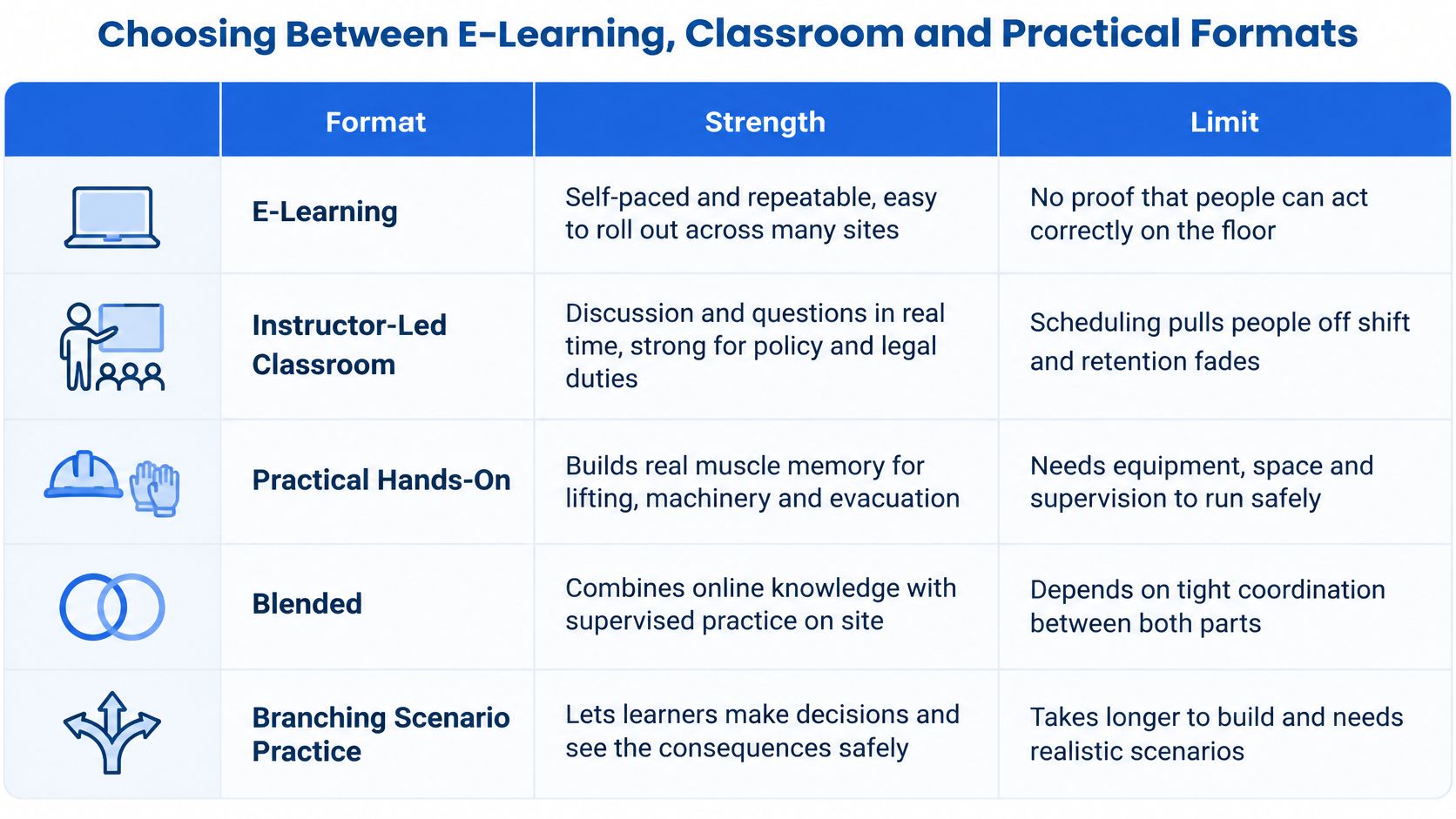
| Format | Best for | Strength | Limit |
|---|---|---|---|
| E-learning | Knowledge, induction, policy, large or distributed groups | Scalable, trackable, repeatable | Weak at practising physical or judgement skills |
| Instructor-led classroom | Mixed groups, questions and discussion | Interaction and live demonstration | Costly to schedule and pulls staff off shift |
| Practical hands-on | Equipment, PPE and manual skills | Real practice and direct competence checks | Needs equipment, a qualified trainer and a suitable space |
| Branching scenario practice | Decisions under time pressure, stop-work choices | Practises judgement and gives feedback on each choice | Needs careful scripting and verification |
| Blended | Most compliance programmes | Theory online, practice on site, one record | Needs coordination and record-keeping across formats |
A decision rule you can apply today
- Knowledge only: policy, site rules and induction content suit health and safety e-learning, because the outcome is knowing something and you can test recall reliably.
- Physical skill with equipment: lifting technique, harness fitting, extinguisher handling and pre-use checks need a practical session with someone watching and signing a competence check.
- Judgement under pressure: stopping an unsafe job needs scenario practice where the learner chooses and gets feedback on the choice.
Classroom sits between the first two. It's good for legal duties and mixed groups, because a fitter and a supervisor arguing about who has authority to stop a job teaches both of them something a slide can't. The trade-off is scheduling: you're pulling people off shift, and retention fades if nothing follows within a few weeks.
Why most programmes end up blended
Blended wins for a boring reason. Theory online is cheap to repeat and easy to track, practice on site is where competence forms, and holding both records in one place is what makes an audit survivable. The cost is coordination. If nobody owns the handoff between the online module and the practical session, learners complete part one and never get observed on part two.
Practical rule: a format is only as good as the assessment attached to it. A fast module with no test proves attendance, nothing more.
For any practical task, the credible evidence set is the same: completion record, assessment result, and a signed competence check naming the assessor and the task observed.
What a Strong Safety Course Must Include
If a course can't name the procedure it teaches or the person who approved it, it's awareness material rather than competence training.
Apply that test before you look at production quality. Cinematic footage and a friendly narrator don't rescue content that teaches the wrong method for your site.
The content checklist
- A link to your risk assessment: the course should teach the controls your assessment specifies, in the order your procedure specifies them.
- Task-specific instructions with reasons: each safe step needs a "because". People follow steps they understand when conditions change slightly.
- Emergency procedures and named contacts: who to call, from where, and what to do while waiting.
- Reporting routes: how to log a near miss or a hazard, and what happens next, so reporting feels worth doing.
- Real workplace examples and images: your racking, your traffic routes, your PPE, not stock photos of a different industry.
- A named owner and a review date: someone accountable for accuracy, with a date that forces a re-read.
- Version control: every change traceable, so you can show which version a given employee completed.
You can supply existing procedures, examples and brand guidance to make the content specific to your organisation, though that's optional rather than a condition of getting a course built.
How generic content fails in practice
Say a logistics site buys an off-the-shelf forklift module. It teaches the manufacturer's manual faithfully: pre-use checks, load capacity, mast tilt. What it can't teach is that the pedestrian crossing at the corner of bay three is blind, that trailers reverse into the yard on a one-way system, or that the banksman must be in position before the second turn. The operator passes the quiz and still meets the actual hazard unprepared.
Generic awareness content has a specific failure mode: it can be completed without changing how anyone works on site. Everyone gets a certificate, the risk stays exactly where it was, and the first sign of a problem is an incident report.
If you're reviewing a course you already own, check three things first. Does it name your procedure and version? Does it show your workplace or something like it? And is there a named approver and a review date on the file? Those three checks take ten minutes and tell you whether you're holding training or decoration.
Testing Whether Workers Can Act Safely Under Pressure
A knowledge quiz can tell you someone remembers the hierarchy of control. It can't tell you whether they'll step in front of a reversing trailer when the yard is behind schedule.
The stakes aren't theoretical. The Health and Safety Authority's report on work-related fatalities in 2025 gives provisional figures of 58 work-related deaths, up from 36 in 2024, with heavy loads and being struck by a vehicle each accounting for 14 deaths and falls from height accounting for nine. Those are practical work activities, not classroom knowledge gaps.

What actually goes wrong at the moment of decision
Fatal-risk decisions rarely fail because nobody knew the rule. They fail under time pressure, against a production target, when authority to stop work is unclear, or when a worker and a supervisor are working from different assumptions about who's where. A learner who scores full marks on legislation can still freeze in that moment.
Can an employee recognise an unsafe situation and confidently intervene before harm occurs?
Rehearse the intervention, not the recall
Branching role-play puts the learner in the decision and shows the consequence. Four scenarios cover most of the ground:
- Stop a lift where the load is unstable and the slinger is out of position.
- Challenge an unsafe reversing manoeuvre when the driver can't see the pedestrian route.
- Escalate a damaged guard to a supervisor who says production can't stop.
- Refuse an unsafe task and hold that position through the conversation that follows.
Each branch ends with feedback on the decision itself: what you noticed, what you said, who you told, and what happened as a result. Realistic depictions of hazards, injuries, emergencies and difficult conversations are permitted in safety and compliance training where they serve a genuine learning purpose, and we can adjust how such scenes are shown to suit your audience.
Then test transfer rather than memory. Use scenario-based assessment inside the course, supervisor sign-off on the task in the workplace, and periodic refreshers that re-run the scenarios rather than the quiz. Ask any provider how their material separates Irish legal duties and HSA guidance from generic international advice, because a course that blurs the two leaves you guessing which parts apply to you.
Match Training to Your Risks and Duties
A training catalogue becomes a plan when you rank it against real exposure. A worker can complete a course, receive a certificate and still be unsure what to do when a load shifts, a pedestrian enters a vehicle route or a guard has been removed. Treat course choice as risk matching: the hazard and the role decide the training, and a certificate alone does not prove someone can act safely. The HSA's annual review of workplace injuries, illnesses and fatalities recorded 10,441 non-fatal workplace incidents in 2024. Central Statistics Office data cited by the HSA indicate Irish workers lost 641,000 days because of work-related injuries during 2024, which makes this an operational-continuity problem as much as a compliance one.
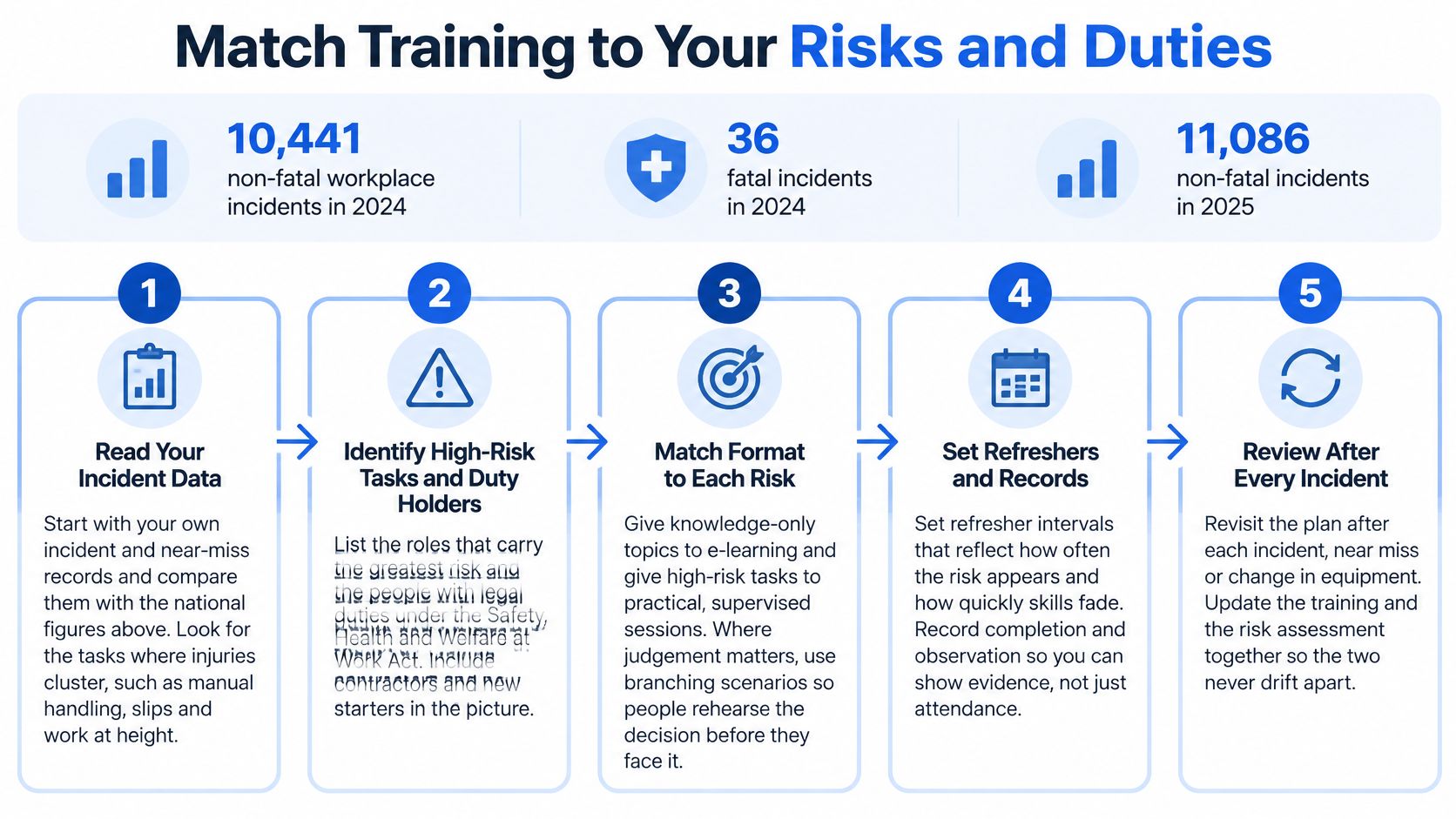
Nine steps from hazard list to signed-off training
- List hazards by task. Use your risk assessment, incident reports and lost-time records. Your own injury pattern is more specific than any national average.
- Rank by consequence and frequency. Start with lifting, vehicles and work at height, where one failure can kill. Frequency matters, but consequence sets the first priority.
- Identify who's exposed. Note which roles, shifts or equipment changed recently. Change is where instruction goes stale fastest.
- Map each priority to a legal trigger. New equipment, a transfer of duties or a periodic refresher tells you when training is due, not just that it is desirable.
- Decide build, buy or blend for each priority. Site induction, onboarding and procedure training often need different routes. Match the route to how specific the procedure is and how much practice the role requires.
- Write the brief. Share your approved procedure, learning need, audience, jurisdiction and desired course length. Existing examples and brand guidance can be supplied too, but they are optional.
- Set the assessment. Use a competence check for practical tasks, plus supervisor sign-off on the daily work. In a bespoke course, Premium includes bespoke interactive conversational learning experiences and roleplay scenarios shaped around the customer's workplace and course content.
- Pilot with a small group and record gaps. Learners will show you where the wording or scenario does not match the floor. A useful pilot checks whether the learner can recognise the hazard, choose the safe action and explain the escalation route.
- Set a review date tied to change. Equipment, procedure or law, whichever moves first. A review triggered by change keeps the course connected to the task rather than the calendar.
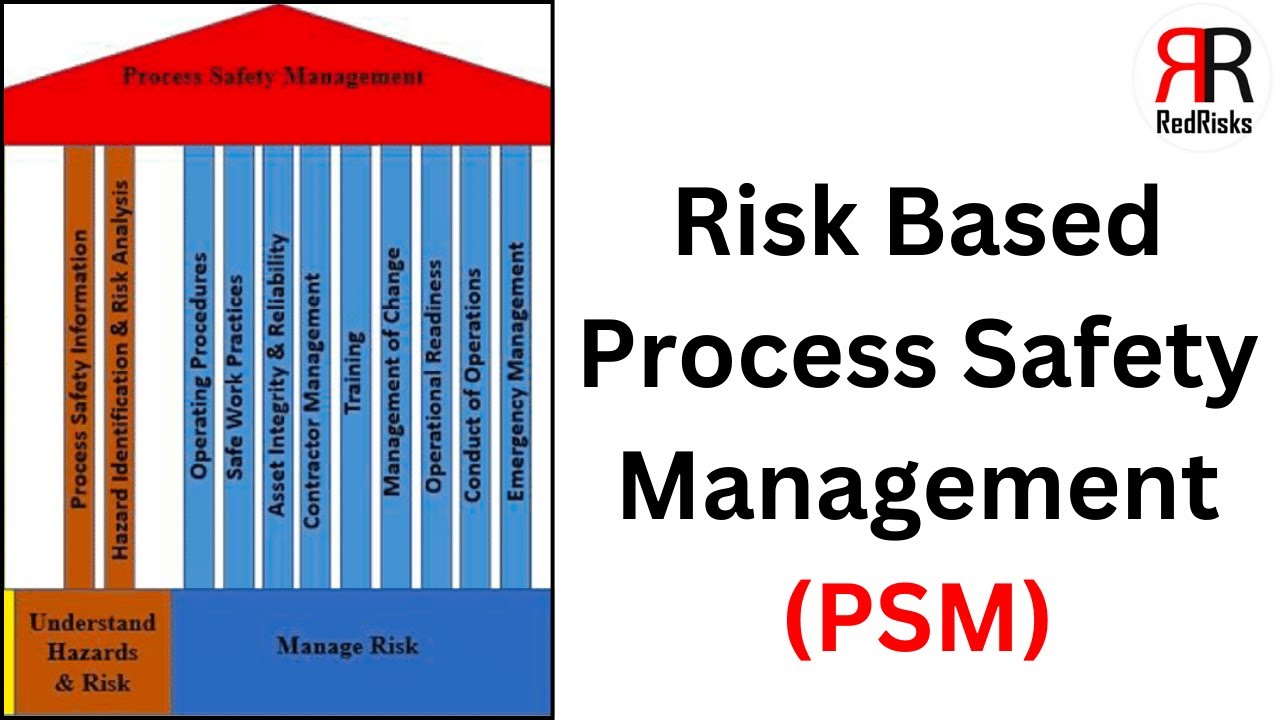
The video below walks through how a risk-led plan gets built in practice.
Who approves what
Three approvals do three different jobs. Your safety lead approves the brief, so the priorities reflect the actual hazards and duties. A suitably qualified person verifies the content before it is published or used for training, which matters most for safety, technical and compliance material. In a Loresson course, a qualified HSQE specialist reviews every claim and signs it off before it leaves Loresson. Premium includes specialist HSEQ review and sign-off, final polish across visuals, narration and learning flow, and preparation for embedding in the customer's LMS or learning platform.
The line manager signs off workplace competence, because they see the task happen. Your internal approval stays central, particularly where a course explains safety-critical actions or local requirements. AI generation does not by itself establish that a course meets a law, standard, accreditation requirement or an employer's training obligations. The signed-off course is one part of the evidence trail. Workplace sign-off confirms that the learner can carry the decision into the job.
Vetting External Providers and Accreditation
Accreditation logos tell you a provider passed someone's process. They don't tell you the course controls your risk. Judge the content and the evidence trail before you commit budget.
- Named trainer qualifications and recent sector experience. Ask who wrote the material and who last stood on a site like yours.
- A sample of content and assessments. Look for scenarios, stop-work decisions and practical checks. If the sample is only multiple-choice questions, that's the whole product.
- Irish duties clearly separated from generic advice. You should be able to point at a screen and say which guidance is Irish and which is international background.
- Version control, a named content owner and a review date. Undated content is unmaintained content.
- Records in one place. Completion, assessment results and signed competence checks, retrievable per person without a spreadsheet hunt.
- A refresher and update policy tied to equipment or law changes. Not a fixed anniversary, a trigger.
On verification, here's how we handle it: a qualified HSQE specialist reviews every claim in a Loresson course and signs it off before it leaves us. That's the standard to hold any supplier to, including your own internal team.
A brochure calling a course "compliant" is a claim to test, not evidence. Ask what the claim rests on: which duty, which guidance, which assessment, whose sign-off. Providers who can answer those four questions quickly are usually the ones whose material survives an audit.
The catalogue still doesn't decide your course. The hazard and the role do. Finish every provider conversation with the same question: how will you prove a worker can intervene safely, not just pass a test?
Choose a Route and Confirm Your Training Plan
Three routes, and your ranked priorities pick between them:
- Keep it in house where you have the competence and the procedure is stable.
- Buy off-the-shelf for general knowledge that doesn't vary between workplaces.
- Commission bespoke content where the procedure, layout or equipment is yours alone.
Then run the three-question check on whatever you've chosen. Does the course reflect our actual procedures? Can we prove competence with records, not just attendance? And who signs it off? If any answer is vague, you've found the work still to do.
One caution on modern production methods: AI generation doesn't by itself establish that a course meets a law, standard, accreditation requirement or an employer's training obligations. Someone competent has to verify it before use, whoever produced it. Bespoke production is one option where the need is specific, provided the brief and the verification are agreed up front. Our first step is that you share the topic, audience, location and length of the course, and we build from there.
Write a one-page training brief this week. Hazards ranked, audience named, jurisdiction stated, course length agreed. Send it to the person who approves safety training and ask for a decision, not a discussion.
We build bespoke workplace safety courses from your own procedures, with scripting, narration, scenario-based assessments and LMS-ready packaging, and a qualified HSQE specialist signs off every claim before delivery. If your forklift routes, manual handling methods or stop-work conversations aren't in any catalogue course, that's exactly the gap we fill. Visit Loresson with your one-page brief and we'll scope the course around your hazards and your roles.