

77% of private-sector enterprises in Ireland provided some form of employee training in 2015, but only half of enterprises assessed the outcomes of their training activities, according to the Central Statistics Office's continuing vocational training release. Delivery was routine. Any systematic check that it worked was not.
That gap is what a training assessment form closes. It's the controlled record that says what one named learner could do at the end of a course, what evidence the assessor saw, who signed the decision, and when that decision needs revisiting.
What follows moves in the order an assessor meets the decisions: the fields worth keeping, the question types that produce usable evidence, the pass rule and the route for a learner who isn't yet competent, the difference between a test score and demonstrated competence, accessibility, the dates that stop a result going stale, and the governance that makes the record auditable. Work through it in that order and the form builds itself.
Table of Contents
- What a Training Assessment Form Records and Why It Matters
- Essential Fields and What Each Field Records
- Question Types and When Each One Fits
- Pass Criteria and the Not-Yet-Competent Route
- Proving Competence Beyond the Test Score
- Making the Form Fair for Every Learner
- Reassessment Triggers and Review Dates
- Governance, Audit Links and Pilot Sign-Off
- Quick-Reference Checklist for Every Training Assessment Form
What a Training Assessment Form Records and Why It Matters
Most organisations can prove a course ran. Far fewer can prove what changed for the person who sat it, or who decided the change was enough.
A training assessment form is a controlled record of whether one named learner met defined learning outcomes. It isn't a quiz score, an attendance sheet or a certificate, though those things can sit alongside it. The form answers a narrower and more useful question: on this date, against this version of the procedure, did this person demonstrate the required competence, and on what evidence?
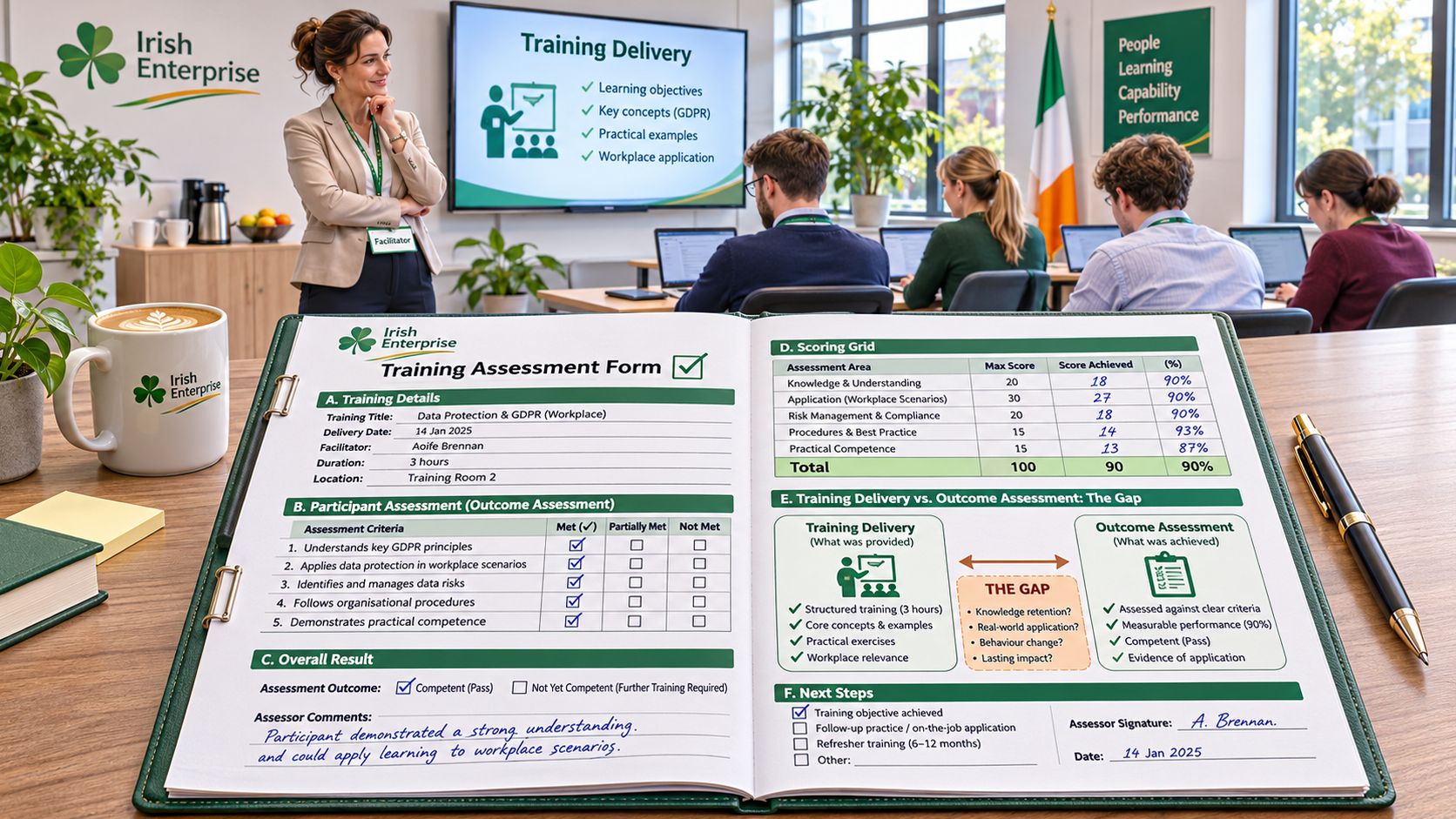
It does three jobs. It records the decision, competent or not yet competent, so a second assessor could reach the same conclusion from the same evidence. It builds the trail that shows how the decision was reached, from the criterion through the method to the signature. It triggers the follow-up, whether that's reassessment inside an agreed window, a corrective action, or a review date when the procedure changes.
Forms do the heaviest work in four places: site induction, procedure training, HSEQ and compliance courses, and onboarding for new starters. Each carries a different risk profile, which is why a single template needs fields for role, department, site and risk-specific outcomes rather than one generic pass mark.
Before you design anything, write three things in a list: the course, its learning outcomes, and the legal or procedural source behind each outcome. Every field, question type and pass rule downstream depends on that list being right.
Essential Fields and What Each Field Records
| Field | What It Records | Example Entry |
|---|---|---|
| Learner ID | Unique reference linking the record to one person | EMP-1047 |
| Role and work location | The job and site the learner is assessed for | Shift supervisor, Site B warehouse |
| Course and procedure version | Exact training material and document revision assessed | Manual handling course v3.2 against SOP-14 rev 4 |
| Learning outcome | The specific competence or knowledge being tested | Lift a load using the two-person method |
| Assessment method | How the evidence was gathered | Written test, observed task, scenario decision |
| Evidence required | What the assessor needed to see or hear | Observed lift and three correct scenario answers |
| Pre-training need | The learner's starting level against the outcome | Has lifted loads but not used the two-person method |
| Result | Competent or not yet competent | Competent |
| Assessor | Name and role of the person making the decision | J. Murphy, HSEQ Advisor |
| Completion date | Date the assessment was made | 14 May 2025 |
| Expiry or refresher date | When reassessment or retraining falls due | 14 May 2026 |
| Corrective action | Follow-up needed after a not-yet-competent result | Repeat observed task within 10 working days |
| Evidence location | Where the supporting evidence is stored | LMS record 88214 and signed observation sheet |
Thirteen rows looks heavy until you group them by purpose. They fall into five:
- Identity: learner ID, role and work location. Who was assessed, and for which job.
- Content: course and procedure version, learning outcome. What they were assessed against.
- Evidence: assessment method, evidence required, pre-training need. What the assessor worked from.
- Decision: result, assessor, completion date. What was concluded, by whom, when.
- Follow-up: expiry or refresher date, corrective action, evidence location. What happens next.
The two fields most templates leave out
Procedure version is the first casualty of simple templates. A competent result against a superseded procedure is weak evidence the moment that procedure changes, and you can't demonstrate the difference without a version stamp. Record the revision number, not just the course name.
Evidence location is the second. A result with no pointer to the stored proof can't be checked during an audit, and an auditor who can't check will ask for the whole set again.
The Health and Safety Authority requires employers to record significant risk-assessment findings and maintain safety-management audit records, with retention periods set in line with legal requirements, and its sector guidance states that employers must keep training records and provide training appropriate to employees' work, qualifications and experience. Since the form holds identifiable employment and competency data, write the access restriction and the retention period into the form itself rather than into a separate policy nobody opens.
The test to apply: if a field wouldn't change a decision or let an auditor trace one, cut it. If it does either, it stays, whatever the template you copied left out.
Question Types and When Each One Fits
| Question Type | Best For | Evidence It Gives | Main Limitation |
|---|---|---|---|
| Multiple choice | Recall of facts, thresholds and definitions | Knowledge of the rule | Guessing; says little about doing the task |
| True or false | Simple, unambiguous facts | Basic recall | Easy to guess; avoid for behaviour |
| Short answer | Explaining a reason or sequence | Understanding in the learner's own words | Marking needs judgement and a model answer |
| Scenario decision | Choosing an action in a realistic situation | Applied judgement and risk awareness | Needs one defensible best action per scenario |
| Observed practical task | Physical or procedural skills | Demonstrated competence | Time-consuming; needs a trained observer |
| Supervisor verification | Performance on the job after training | Transfer to real work | Depends on supervisor availability and consistency |
| Self-assessment | Confidence and reflection | The learner's own view | Not evidence of competence on its own |
Choosing starts with the verb in the learning outcome. If it says state, name or identify, a multiple choice or true or false item can carry it, provided the wrong options are plausible. A distractor nobody would pick tests nothing and flatters the learner. If the outcome says decide, select or respond, you need a scenario. If it says perform, demonstrate or carry out, you need an observed task and, ideally, a supervisor check afterwards.
Writing a scenario that tests a decision
Say a worker finds a damaged harness before a climb. The options are to tag it out and report it, to use it for one short job, or to leave it in the kit for the next person to notice. The learner picks the action, and the assessor records both the choice and the reason given.
That structure is the same one a customer service training module uses when it asks an agent to handle a complaint rather than recite the refund policy. The scenario reveals judgement. The mark scheme records it.
Where yes or no questions fail
An item like "Do you always isolate the power before maintenance?" collects a belief, not a behaviour. Nobody ticks no. Replace it with an observed isolation or a scenario where the shortcuts are visible and the pressure to take one is part of the setup.
Use at least two question types per outcome. One weak method shouldn't be able to decide a result alone, and a learner who freezes on a written test may demonstrate the same competence perfectly well under observation.
Pass Criteria and the Not-Yet-Competent Route
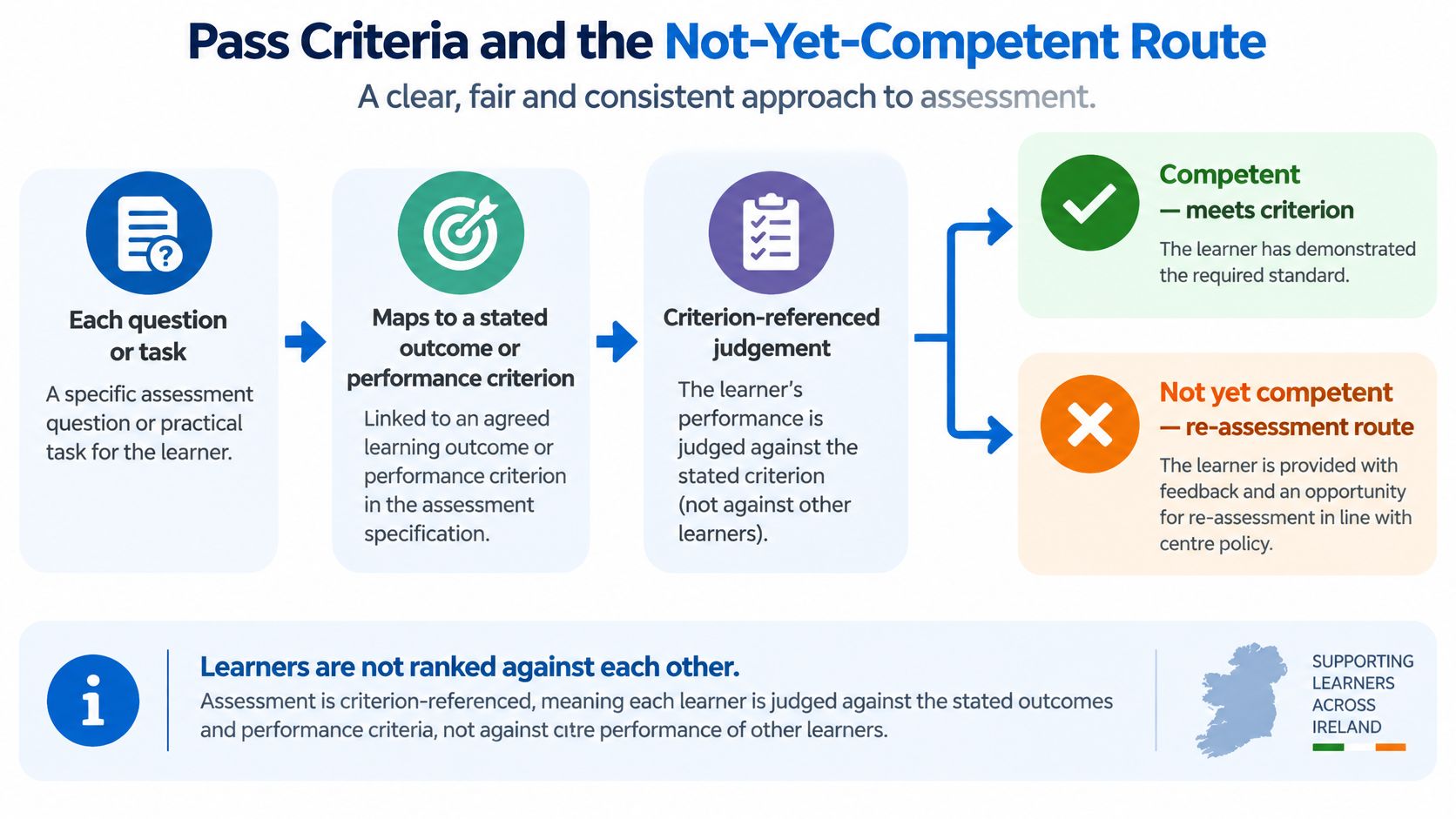
Criterion-referenced judgement is the only structure that survives scrutiny. Each question or practical task maps to a stated learning outcome or performance criterion, and learners are judged against that criterion rather than ranked against each other. QQI's guidelines on quality assuring assessment state that valid and reliable techniques must be selected according to the type of learner evidence required, and that assessment instruments should specify what evidence is acceptable and how it will be measured.
In practice the form needs five things per row: the criterion, the evidence required, the marking standard, the assessor decision and written feedback. Without a stated standard, two assessors on the same course will mark the same performance differently and neither will be able to explain why.
The pass rule
A threshold such as 80% across knowledge items is workable. What isn't workable is letting a high overall score absorb a failed critical criterion. If an item covers a control that prevents serious harm, failing it produces a not-yet-competent result whatever the total, because the total was never the point.
The route an assessor follows
- Mark each criterion as met or not met against the stated evidence.
- Record competent only when every critical criterion is met and the threshold is reached.
- On a not-yet-competent result, write feedback that names the unmet criteria and what the learner did instead.
- Book reassessment inside an agreed window, for example 10 working days.
- Reassess against the same criteria and the same form version, so the two attempts are comparable.
- Escalate a second not-yet-competent result to the line manager for retraining or a role review.
Write this route before you set the pass mark. The route is what makes the mark defensible when someone asks why a learner with 90% wasn't signed off.
Proving Competence Beyond the Test Score
A high score on a knowledge test shows that a learner understands the procedure. It doesn't show that they'll follow it on a scaffold at four in the afternoon when the shortcut is faster.

Record four separate measures so no single percentage can hide a gap. Knowledge is the test result. Skill is the observed task, marked against the same criterion. Judgement is the scenario decision, including what the learner chose when a shortcut was available. Workplace transfer is the supervisor check and the incident indicators after training, at a set point such as 30 days after completion.
The Health and Safety Authority's guidance on workplace safety and health management says training needs should be assessed at three levels, organisational, job-related and individual, and based on how work is performed, including employee questioning, observation, incident records and risk assessments. It also says employers should formally evaluate whether training produced the desired improvement in work performance, not merely whether learners completed a course.
A learner can know the rule, recite the rule and still skip the step that keeps them alive. Only one of those facts belongs on a completion certificate.
Take the lockout-tagout example. A learner scores 95% on the written quiz but, when observed, applies the lock and skips the verification step before starting work. The form records knowledge as met, skill as not yet competent, and the overall result as not yet competent, with the corrective action naming the missed step. Nothing about that outcome is harsh. It's what the observation was for.
Compare the pre-training need entry with the final performance and the gain becomes visible, or the lack of it does. An outcome that is richer material for SOP training is the one where the learner's starting point is documented, because a person who arrived already competent and a person who arrived with nothing are not the same result.

Making the Form Fair for Every Learner
Here's the question a fair form has to answer before it judges anyone: does a failed assessment show a lack of competence, or an inaccessible design?
Ireland's National Skills Council report on an integrated skills infrastructure reports that 21% of adults have a basic literacy need, 25% a basic numeracy need and 17% a basic digital need. A dense, text-heavy form will misread competence for a quarter of a mixed workforce, and the worker carries the consequence.
At the start of the assessment, record four things: language and reading needs, numeracy needs, assistive technology and device requirements, and the response route the learner will use. Then build the routes in:
- Oral answers recorded verbatim by the assessor where the outcome concerns knowledge.
- Visual or diagram responses for learners who can show a sequence but not write it.
- Translated question sets where the safety standard is unchanged and only the language differs.
- Audio read-aloud for candidates who read slowly under time pressure.
- Observed practical tasks in place of written ones where the outcome is performance.
A chemical hazard question can be delivered as an audio prompt and followed by an observed handling task. Same criterion, different route to the evidence.
The distinction that matters: an accommodation changes the route to the evidence, never the standard the evidence must meet.
Record which adaptation was used, keep the result judged against the same performance criteria for everyone, and make sure the audit trail shows both. That record is what protects the decision if a result is ever challenged.
Reassessment Triggers and Review Dates
| Trigger | Action Required | Record to Update |
|---|---|---|
| Learner changes role or task | Reassess the changed duties | Role field and new result |
| New equipment or technology introduced | Retrain and observe use before sign-off | Course version and result |
| Procedure or risk assessment revised | Assess against the new version | Procedure version field |
| Legal or standard requirement changes | Review the form and reassess affected outcomes | Form version and approval status |
| Incident or near miss linked to the task | Investigate, then reassess the learner involved | Corrective action field |
| Return to a critical task after absence | Refresher and observed check | Refresher date |
| Expiry date reached | Schedule renewal assessment | Expiry date field |
A result is a snapshot. The form needs a way to show when that snapshot stops being valid, and that means three kinds of date working together.
Three kinds of date to set
A learner expiry or refresher date. A manual handling course might carry a 12-month refresher, while a permit-to-work procedure needs reassessment whenever the procedure itself is revised. Set it by course and by risk, not by calendar convenience.
A review date on the form. Usually at least every 12 months, so the criteria and question set get looked at rather than inherited.
A trigger-based review. This one runs whenever the procedure, equipment, risk assessment or legal requirement changes, and it creates a dated entry showing the decision, who made it and which learners are affected.
Name one owner for the trigger list. The most common failure isn't a missing trigger, it's a procedure revised in March with nobody checking which learners were assessed against the earlier version.
Run a short routine: check the expiry list monthly, revisit the trigger list after every incident investigation, and bump the form version whenever the criteria change. Three habits, and the record stays honest.
Governance, Audit Links and Pilot Sign-Off
The chain an auditor follows
Four cross-references carry the weight. Each learning outcome links to a risk control or safe-work requirement in the safety statement or risk assessment. The procedure version field links to document control. The evidence location points to the LMS record or file reference. The assessor name matches an entry on the list of authorised assessors.
The form itself carries a version number, approval date, approver and approval status, and is re-approved whenever its criteria change. Then trace the chain with one record: learner 1047, assessed against SOP-14 rev 4, which links to risk control RC-22, signed by a named HSEQ advisor, recorded on form v2.1. If you can follow that line from either end, an auditor can too.
Restrict identifiable employment and competency data to the people who need it, and put the retention period in the form's footer where nobody can miss it.
Pilot before anyone sits the form
- Map each outcome to a criterion and at least two question types.
- Pilot with two learners and two assessors on the same course.
- Compare their results and resolve every criterion they marked differently.
- Have a suitably qualified person verify the content against the approved procedure.
- Set the version, the approval record and the first review date.
- Brief assessors on the not-yet-competent route before the first live use.
The pilot tests a criterion-referenced form, because it shows whether assessors land on the same decision. Before publishing or using materials for training, we arrange verification by a suitably qualified person, particularly for safety, technical or compliance training, and internal client approval stays central where a course explains safety-critical actions or local requirements. AI-assisted drafting speeds production up, but generated material still needs review against your actual procedures, and generation doesn't guarantee regulatory compliance. That final check belongs with your regulatory compliance courses content before anything goes live.
Quick-Reference Checklist for Every Training Assessment Form
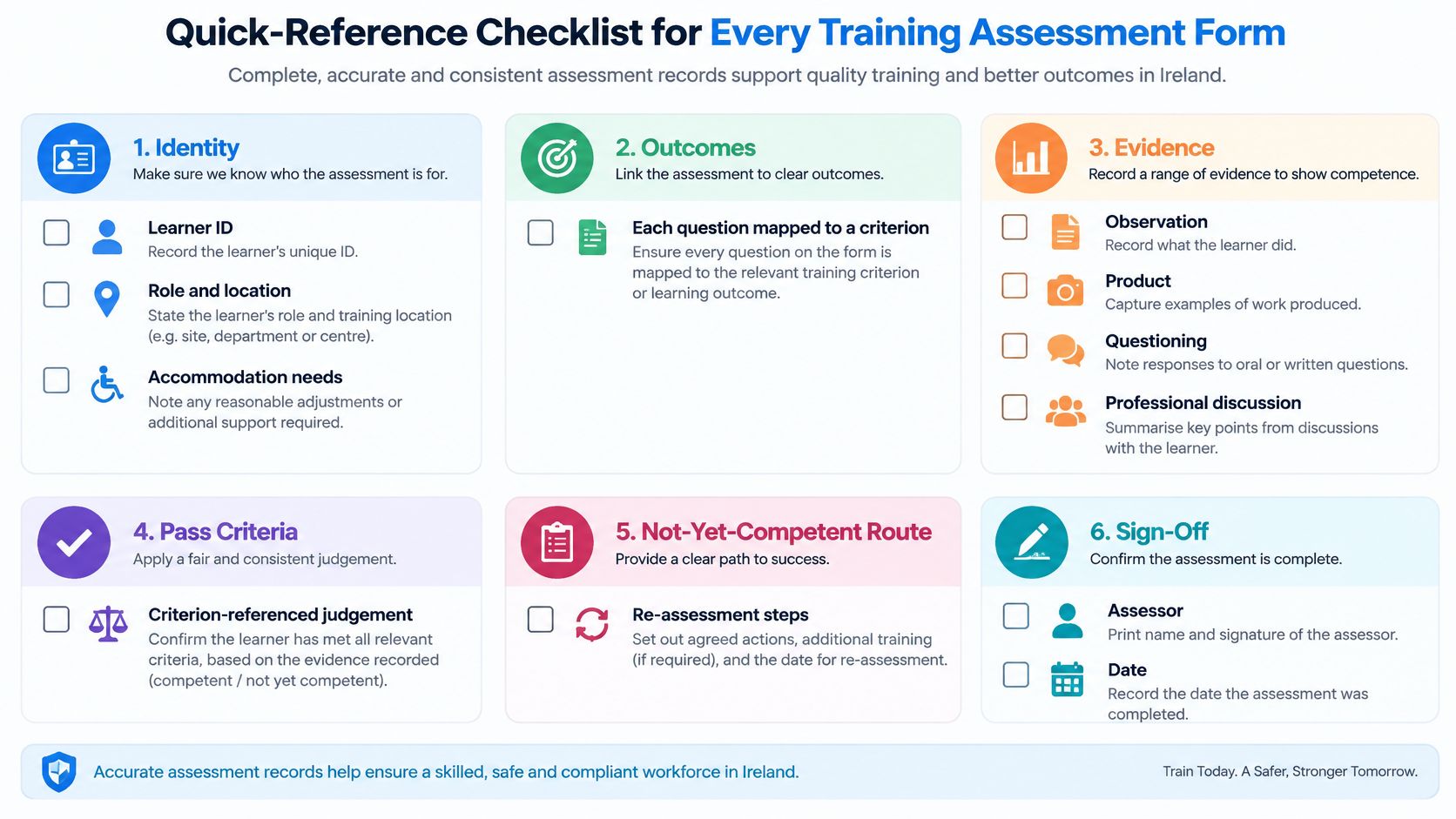
Apply this to a real draft in one pass. Tick what's there, and flag what isn't.
Identity. Learner ID present. Role and work location recorded. Any accommodation used is documented next to the result.
Content. Course and procedure version stamped. One learning outcome per row, written with a verb the question type can measure.
Evidence. At least two question types per outcome. A marking standard that flags which criteria are critical. An evidence location that points to something stored.
Decision. A stated pass threshold. A written rule that a failed critical item means not yet competent regardless of score. Assessor name and date on the record.
Follow-up. A not-yet-competent route with a reassessment window. An expiry or refresher date. A corrective action field that gets used, not just printed.
Governance. A version number, an approval record, a retention period, an access restriction and a review date.
Work through the checklist against a completed form, not a blank template. A blank field on paper is a gap. A blank field on a finished record is the first thing an auditor asks about. For anything you can't tick, go back to the section that sets that field up and fix the design rather than the form-filling habit.
Loresson produces bespoke workplace training courses with the assessment component structured for HR review and sign-off before launch, so the criteria, the evidence trail and the pass rule are settled before anyone sits the course. If you're rebuilding a training assessment form for induction, procedure or HSEQ training, bring us your approved procedure and learning outcomes and visit Loresson to see how the course and the assessment are built around them, with verification by a suitably qualified person written into the process.