
Training People Actually Watch
Training people actually watch is training built with production quality, pacing and jurisdiction-accurate content, not slide decks read aloud. AI-accelerated production now makes broadcast-quality video training achievable at a fraction of studio cost, provided the content is validated by real compliance experts before it reaches a learner.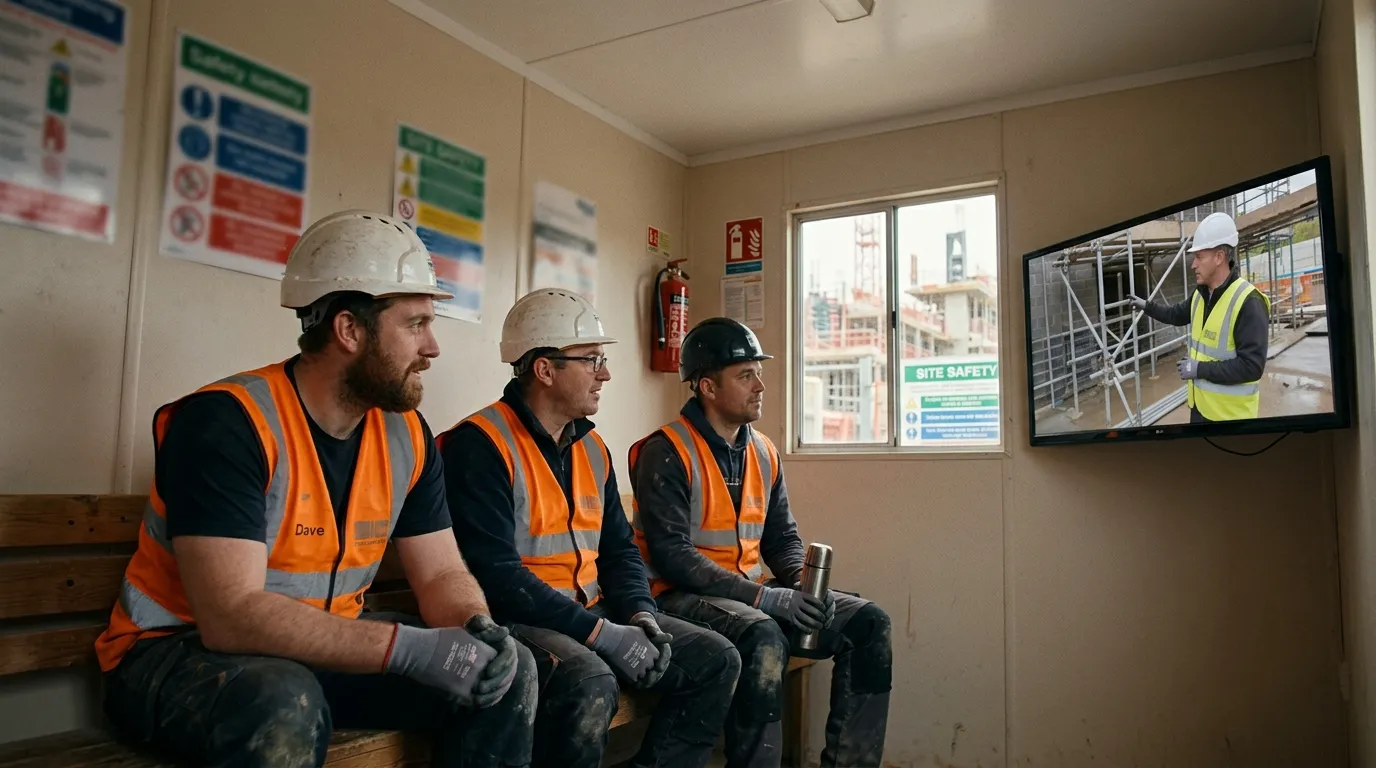
Why Most Compliance Training Fails to Hold Attention
Most retain less are built to satisfy an audit trail, not a learner. Text-heavy slides, monotone narration and generic stock footage tell employees this training is a formality, not something worth their attention.
That disengagement has a cost. Learners who tune out retain less, apply less, and are more likely to repeat the same mistakes the training was meant to prevent.
Training providers know this. It's why so many are now looking at AI course production as a way to lift quality without doubling their budget or timeline.

What Makes Training People Actually Watch
Training people actually watch shares a few consistent traits. It looks and sounds professional. It respects the learner's time. And it gets the regulatory detail right, every time, in every jurisdiction it serves.
Broadcast-quality video training used to mean hiring a studio, a script team, voice talent and an edit suite. That combination made quality expensive, and expense made many providers settle for adequate rather than good.
AI production changes that equation. Course outlines can now become fully voiced, visually polished video training in days rather than months, at a cost traditional studios simply cannot match.
That speed matters for training buyers managing multiple courses, outdated or incorrect regulatory information, or rollouts across several countries at once. It does not mean cutting corners on accuracy.
Speed Without Losing Substance
Faster production only has value if the content underneath is sound. A polished video built on outdated or incorrect regulatory information is worse than no training at all, because it creates false confidence.
This is why the AI production layer and the compliance content layer need to be treated as separate disciplines. One handles delivery. The other handles correctness.

Broadcast Quality Video Training Without the Broadcast Budget
Traditional studio production and AI-accelerated production solve the same problem in very different ways. The table below sets out where each approach genuinely wins.
|
Factor |
Traditional Studio Production |
AI-Accelerated Production |
|---|---|---|
|
Typical timeline |
Weeks to months per course |
Days per course |
|
Cost structure |
High fixed costs (studio, crew, talent) |
Lower cost per course, scalable across a catalogue |
|
Update turnaround |
Full re-shoot often required for regulatory changes |
Rapid re-versioning when content changes |
|
Multi-jurisdiction versions |
Expensive to produce separately |
Can be produced in parallel at lower marginal cost |
|
Visual and voice quality |
High, dependent on crew and budget |
High, when built on well-managed source content |
|
Regulatory accuracy |
Depends entirely on the writing team |
Depends entirely on expert validation of the underlying framework |
The last row matters most. Neither approach is automatically accurate. Accuracy comes from who checks the content, not from which camera or engine produced the video.
Why Generic AI Content Fails in Regulated Industries
Generic AI-generated training content has a specific failure mode. It sounds confident and looks polished, while quietly getting jurisdiction-specific detail wrong.
Health and safety law differs between the UK, Ireland, the US and Australia. Data protection obligations differ again. A course built from a generic AI prompt, with no expert oversight, cannot reliably track those differences.
For an HSEQ consultancy or an L&D manager buying training on behalf of regulated clients, that gap is the entire risk. A visually excellent course built on a legally incorrect framework is a liability, not an asset.
This is the distinction that separates AI production tools from AI-accelerated compliance training. The first generates content. The second starts from an expert-built, jurisdiction-specific framework and uses AI to produce it at speed and scale.

The Trust Problem With Off-the-Shelf AI Tools
Many training buyers have already tested general-purpose AI video tools directly. The results are often impressive on production values and weak on regulatory substance.
That's not a criticism of the technology. It's a reminder that AI is a production method, not a compliance authority. The expertise still has to come from somewhere.
The Human Expert Layer That Makes AI Content Trustworthy
Expert-validated content frameworks are what make AI-produced training defensible in an audit, an incident review, or a tribunal. Every module needs a named line of accountability back to a subject-matter expert, not just a generation log.
This is the layer that should sit above any AI production capability a training buyer considers. Ask who wrote the underlying compliance framework, which jurisdiction it was built for, and how often it's reviewed against regulatory change.
The human review step is not a bottleneck to be automated away. It's the credibility layer that regulated buyers should insist on, whatever production method sits underneath it.
What Good Expert Validation Looks Like
Good validation is specific, not generic. It names the reviewer, states their qualification, and records the date the content was checked against current law.
It also covers each jurisdiction separately. A framework validated for UK health and safety law is not automatically valid for Australian WHS legislation, even where the underlying principles overlap.
What This Means for Training Buyers in 2026
Buyers evaluating AI course production should ask three questions before committing. First, who validates the compliance content, and what are their credentials? Second, how does the provider handle jurisdiction-specific differences? Third, what happens when regulation changes mid-course-life?
Providers that can answer all three, while also delivering broadcast-quality video training at genuine speed and cost advantage, are offering something traditional studios and generic AI tools cannot match individually.
The market is moving quickly toward AI-accelerated production. The providers that will earn long-term trust are the ones combining that speed with visible, named, jurisdiction-specific expertise.
Training people actually watch is not a production trick. It's the result of getting both halves right, the speed and polish of modern AI production, and the accuracy of expert-validated, jurisdiction-specific compliance content.
Frequently Asked Questions
What makes compliance training more engaging for employees?
Engagement comes from production quality, relevant pacing, and content that respects the learner's time. Professional visuals and clear narration hold attention far better than static slides or generic stock video, but only when the underlying compliance content is accurate.
Is AI-generated training video accurate for legal and compliance content?
Only if it's built on an expert-validated framework. AI can produce polished video quickly, but it cannot independently verify jurisdiction-specific law. Accuracy depends on human compliance experts reviewing the content before and after production.
How much faster is AI course production than traditional studio filming?
AI-accelerated production can turn a course outline into finished video in days rather than the weeks or months typical of studio filming, crewing and editing. Timelines vary by course length and complexity.
Can one AI-produced course be adapted for different countries?
Yes, in principle, but each jurisdiction needs its own expert-validated content framework first. The AI production layer can then generate localised versions efficiently, provided the underlying legal detail has been checked for each country separately.